Disclaimer: “As an Amazon Associate I may earn from qualifying purchases.” Adsense and Infolinks were no help at all.

If you have enjoyed this article or it has been helpful to you please feel free to show your appreciation. Thank you.

Read The Third Wave by Alvin Toffler!
Categories
Phillosoph

Hammer-Fist and Single Whip

Sometimes you search for something only to discover it was close by all along.
A case in point:
In my recent book, Crash Combat, I reflect that the hammer-fist is a somewhat underappreciated weapon in martial arts. I may have made this assertion in my previous book too.
Reading Joseph Wayne Smith’s book on Wing Chun, he makes a similar statement.
Hammer-fist can substitute for the chop, back-fist and even some closed-fist punches. It is much less likely to result in self-injury than some of these techniques.
Hammer-fist is easy to perform correctly and can deliver powerful blows to both hard and soft targets. Along with the palm-heel, it is probably one of the best hand strikes that we have.
Naturally enough, I was experimenting with some hammer-fist attacks the other day.
I’d been looking at the rapid 270-360° turn that is possible by using the “closed step” of Pa-kua/Bagua. (See my book for details).
This could be used to power a spinning back-fist to strike a foe in the outside gate. But a true back-fist can be fiddly, requiring a terminal flick of the wrist and impact with the first two knuckles.
A spinning hammer-fist is more logical and for most fighters more powerful.
I notice that if I bend my wrist inward a fraction my hammer-fist seems a little stronger or more stable at the moment of impact.
I also note that this mode favours a sort of “snap”.
I can throw the technique with a relaxed arm and hand and snap into a clenched hand just before impact.
This, of course, lets the arm and hand acquire more initial speed and produces a more powerful attack with less muscular effort.
From a variety of positions, I can just flick my arm and have it land in a hammer-fist. This curve of the wrist seems a technique worth cultivating.
And then it dawns on me!
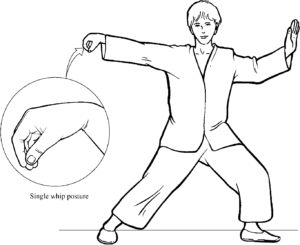
This is the hand form of horse-foot palm from tai chi’s single whip.
I have written about this as a parrying technique and even as a form of punch. I have probably even written about hammer-fist-like strikes with this hand form.
But I had not grasped one of the other important things that posture was trying to teach: that a relaxed, slightly bent wrist gives you a very efficient hammer-fist.
As always, experiment for yourselves.
Can you use hammer-fist instead of your other strikes?
Can you relax more to make it faster and more powerful?
Categories
Phillosoph

Cross Stepping Post: Part Two

It occurs to me this morning that the previous post on “the Post” needs a little more information.
Some of you reading that post will not be familiar with tai chi, bagua or have read the relevant parts of my book.
If you are only familiar with hard, external interpretations of martial arts you may find the seemingly simple movements of the Cross Stepping Post surprisingly difficult.
The essence of the Cross Stepping Post is the cultivation of stability and balance. Your upper body needs to be relaxed and your weight down in your pelvis. Since we are not performing the arm movements at this stage your arms should hang down by your sides, relaxed like hanging vines. If you are used to putting lots of muscular tension into you stances this will probably be one of your first problems in performing the Post.
1. Sinking of shoulders and dropping of elbows.
2. Relaxing of chest and rounding of back.
When you attempt the movements of the Post, your upper body should be as relaxed as possible, having slightly hunched shoulders look that comes from a lack of tension.
The other useful thing to remember is that in martial arts movement generally comes from the waist.
Don’t attempt those kick-like foot movements just by moving your leg.
You will need to rotate your waist/hips to swing them around.
I hope that helps. Persevere and I will post some more information on the exercise soon.
Categories
Phillosoph

Cross Stepping Post: Part One

Recently I have been looking into a concept that Erle Montaigue called “the Post”.
Erle described the Post as being an abstract way to learn very practical things. He as even gone as far as to say that the Post contains two exercises that give every thinkable internal body movement for self-defence without having to think too hard, and are probably one of the most valuable training aids ever.
Certainly, this apparently simple sequence has much greater depth than is first apparent.
I am going to devote a few blogs to this topic and invite the reader to try it with me.
What Erle calls the Post is actually two sequences, one from tai chi and the other from bagua. The tai chi one is called “Stepping over the Gate” and the bagua “Cross Stepping Post”. Initially I am only going to deal with Cross Stepping Post.
If you dislike long complicated katas, you will be pleased to hear that Cross Stepping Post has only four different steps.
These are mirrored on the left and right sides so there are actually eight steps and two linking sets to change sides.
Complexity of the arm movements varies. Performing this exercise without the arm movements is very beneficial since it lets you concentrate on your balance and foot movements.
You can go through the foot movements anytime that you are standing around, waiting for the bus etc.
In his main video, on the post (MTG54) Erle demonstrated a very simple set of arm movements.
In MTG55 he also details the post and there demonstrated a more varied set of arm movements.
On this video Erle points out that what is actually going on internally is actually more important than the actual physical movements. Bear this in mind as you practice.
Both videos are available as downloads or DVDs from http://www.taijiworld.com
I am going to introduce the Cross Stepping Post gradually.
For this first blog, I am going to suggest learning just two of the steps. They are similar, and once you have some grasp of these you will have learnt half the necessary moves.
Just practicing these two steps will also probably reveal to you that your balance and stability is not what they might be.
The first move we will learn is actually the second move in the sequence. I call this the “Forward Foot Kick/Step”, although you must keep in mind that this foot action and the others have many other applications than the one immediately apparent. It is not just a kick!
Your feet are close together and your knees are probably brushing against each other.
As the lead foot heel withdraws past the other heel, the foot straightens up so the toes point forwards. The foot goes back about a foot length and swings in an arc to the forward position. Heel and toe are placed down at the same time and you should be in balance for the entire movement.
Cross Stepping Post actions are performed without obvious shifts in weight such as leaning.
The second move is the fourth, a “Back Foot Kick/Step”.
Position of the feet is similar but a little more natural in that there is some space between the forward and rear foot.
The feet are close enough for the knees to brush. In all these moves the toes always point forward or to the outside. That is, if your right foot is pointing at an angle it is to the right, and to the left for your left foot.
The beginning of this step puts some torsion on your waist and hips. You utilize this by moving the back foot in an arc and placing it down.
The toes of the forward foot point forward or inward. This is a very similar movement to the Forward Foot Kick but uses the rearward foot and has less initial backward movement.
No arm movements yet. Work on your balance and footwork
Experiment with these two movements for a couple of days. See if you can improve your internal balance.
Categories
Phillosoph

Complete Wing Chun

           One surprise about writing this blog is that I have written many less book reviews that I expected.
A few weeks back I did come across an interesting trilogy of books on Wing Chun by Joseph Wayne Smith.
Many martial arts have a degree of secrecy, mystery and mythos. Historically there was sometimes good reason for information control. In the modern world, however, such practices can be counterproductive.
Smith is very interested in the biomechanics of Wing Chun, and why somethings may work better than others.
Those of you that have read my first book will know that I endeavoured to explain the mechanics behind a number of martial arts and self-defence techniques.
There was not room to teach every Judo throw so instead I taught the concepts that are common to the majority of such throws.
Smith’s books concentrate on wing chun and are aimed more at the student who has some familiarity with the basics. It is not a “how to do it” book, more a “why this works” book
The three volumes give a detailed analysis of the various forms including those for the weapons of wing chun.
There are sections on such techniques as pushing hands and sticky leg.
The second volume has an interesting discussion of how the techniques of wing chun might be complimented by those of muay thai and white crane (pak hok pai) kung fu.
I hope to expand a little on some of these concepts in later blogs.
Word to the wise:
The three volumes are collected together as “Wing Chun Kung Fu a Complete Guide”.
Naturally, I did not notice this until I had brought all three volumes separately.
Buying the collected version will save you a few pennies so you can buy one of my books as well.
Categories
Phillosoph

Crash Combat Goes Electronic.

           For anyone who missed my recent announcement in other places. “Crash Combat” printed out looking exactly as I wanted it to. The bad news is that my author spotlight page is playing up recently and only showing “Attack, Avoid, Survive.” If the title(s) you want are not visible if you use the links below please use the search engine  on that website and that should take you directly to the book's own page.
           Crash Combat is also now available in electronic format! Due to some rotten information on the publisher’s site converting the manuscript was considerably more hassle and work than writing the entire thing in the first place! It is probably unlikely that there will be electronic copies of the other titles any time in the near future.
           The ebook of Crash Combat can be brought from here:
Categories
Phillosoph

"Crash Combat" Released!

I mentioned in a recent post that much of my keyboard time had been spent on a new project.
Back before “Attack, Avoid, Survive” was published someone suggested to me that I rewrite it with a more military orientated slant. For a number of reasons I decided against this. My blog on a curriculum for a crash course on close combat caused me to revisit the idea of a military-orientated book. I’ve added the finishing touches just today.
This is not a condensed version of “Attack, Avoid, Survive”. The new book includes some unique content and is written from a different perspective. Attack, Avoid, Survive covers so of the topics in greater depth however. The two are complimentary.

          You can buy your copy here.
Here’s the blurb:
Despite the military technology now available the modern fighting man often encounters potential enemies at close range. When his weapons fail or shoot dry he has only his skills and his comrades to keep him alive.
Crash Combat has been designed to give the serviceman a sound foundation in close combat even if only a few days have been allocated for such training. Included within this book are:
·         Rifle Fencing. Firearms without bayonets can still be effective.
·         Unarmed Hand Techniques. How to avoid breaking your own hand.
·         Realistic Kicking Techniques.
·         Escaping the Grabber.
·         Ginga.
·         Long Har Chuan.
·         Defensive and Offensive Knife Techniques.
·         Effective Use of the Baton.
·         Machetes, Kukris, Goloks and other longer blades.
·         Fighting with the Entrenching Tool.
·         The fast way to understand Throwing Technique.
·         Breakfalls and similar techniques.
·         Sentry Elimination and Capture.
·         Anatomy for Warfighters.
Categories
Phillosoph

Soviet Swamp and Snow Shoes

           I have not made many posts recently since most of my keyboard time has been working on a new project. I should be able to reveal this project within a month, all going well. My research has revealed some interesting webpages in the meantime. One such page is a 1945 training manual for Soviet scout soldiers. The page is in Russian but automatic translation will give a reasonable idea of what the text is about.
           As a taster, some interesting ideas on moving across swamp or snow:
Categories
Phillosoph

On Aggression. Militant Enthusiasm Part Two

This is the second part of the extract of  Konrad Lorenz's On Aggression that was posted yesterday. Once again, I have edited and omitted some paragraphs in the text below. This is done for brevity and to remove passages that might prove confusing outside the context of the book. I strongly urge you to read the original work!
Militant enthusiasm is particularly suited for the paradigmatic illustration of the manner in which a phylogenetically evolved pattern of behaviour interacts with culturally ritualized social norms and rites, and in which, though absolutely indispensable to the function of the compound system, it is prone to miscarry most tragically if not strictly controlled by rational responsibility based on causal insight. The Greek word enthousiasmos implies that a person is possessed by a god, the German word Begeisterung means that he is controlled by a spirit, a Geist, more or less holy. In reality, militant enthusiasm is a specialized form of communal aggression, clearly distinct from and yet functionally related to the more primitive forms of petty individual aggression. Every man of normally strong emotions knows, from his own experience, the subjective phenomena that go hand in hand with the response of militant enthusiasm. A shiver runs down the back, and, as more exact observation shows, along the outside of both arms. One soars elated above all the ties of everyday life, one is ready to abandon all for the call of what, in the moment of this specific emotion, seems to be a sacred duty. All obstacles in its path become unimportant, the instinctive inhibitions against hurting or killing one’s fellows lose, unfortunately, much of their power.

Rational considerations, criticism, and all reasonable arguments against the behaviour dictated by militant enthusiasm are silenced by an amazing reversal of all values, making them appear not only untenable but base and dishonourable. Men may enjoy the feeling of absolute righteousness even while they commit atrocities. Conceptual thought and moral responsibility are at their lowest ebb. As a Ukrainian proverb says: ‘When the banner is unfurled, all reason is in the trumpet.’ The subjective experiences just described are correlated with the following, objectively demonstrable phenomena. The tone of the entire striated musculature is raised, the carriage is stiffened, the arms are raised from the sides and slightly rotated inwards so that the elbows point outwards. The head is proudly raised, the chin stuck out, and the facial muscles mime the ‘hero face’, familiar from the films. Down the back and along the outer surface of the arms the hair stands on end. This is the objectively observed aspect of the shiver! Anybody who has ever seen the corresponding behaviour of the male chimpanzee defending his band or family with self-sacrificing courage, will doubt the purely spiritual character of human enthusiasm. The chimp, too, sticks out his chin, stiffens his body, and raises his elbows; his hair stands on end producing a terrifying magnification of his body contours as seen from the front. The inward rotation of his arms obviously has the purpose of turning the longest-haired side outwards to enhance the effect. The whole combination of body attitude and hair-raising constitutes a bluff. This is also seen when a cat humps its back, and is calculated to make the animal appear bigger and more dangerous than it really is.
Our shiver which, in German poetry, is called a heiliger Schauer, which means a ‘holy shiver’, turns out to be the vestige of a pre-human vegetative response of causing to bristle a fur which we no longer have. To the humble seeker of biological truth there cannot be the slightest doubt that human militant enthusiasm evolved out of a communal defence response of our pre-human ancestors. The unthinking single-mindedness of the response must have been of high survival value even in a tribe of fully evolved human beings. It was necessary for the individual male to forget all his other allegiances in order to be able to dedicate himself, body and soul, to the cause of the communal battle. ‘Was schert mich Weib, was schert mich Kind’ – ‘What do I care for wife or child’ says the Napoleonic soldier in a famous poem by Heinrich Heine, and it is highly characteristic of the reaction that this poet, otherwise a caustic critic of emotional romanticism, was so unreservedly enraptured by his enthusiasm for the ‘great’ conqueror as to find this supremely apt expression. The object which militant enthusiasm tends to defend has changed with cultural development. Originally it was certainly the community of concrete, individually known members of a group, held together by the bond of personal love and friendship. With the growth of the social unit, the social norms and rites held in common by all its members became the main factor holding it together as an entity, and therewith they became automatically the symbol of the unit. By a process of true Pavlovian conditioning plus a certain amount of irreversible imprinting these rather abstract values have in every human culture been substituted for the primal, concrete object of the communal defence reaction. This traditionally conditioned substitution of object has important consequences for the function of militant enthusiasm.
On the one hand, the abstract nature of its object can give it a definitely inhuman aspect and make it positively dangerous – what do I care for wife or child? – on the other hand, it makes it possible to recruit militant enthusiasm into the service of really ethical values. Without the concentrated dedication of militant enthusiasm neither art, nor science, nor indeed any of the great endeavours of humanity would ever have come into being. Whether enthusiasm is made to serve these endeavours, or whether man’s most powerfully motivating instinct makes him go to war in some abjectly silly cause, depends almost entirely on the conditioning and/or imprinting he has undergone during certain susceptible periods of his life. There is reasonable hope that our moral responsibility may gain control over the primeval drive, but our only hope of it ever doing so rests on the humble recognition of the fact that militant enthusiasm is an instinctive response with a phylogenetically determined releasing mechanism, and that the only point at which intelligent and responsible supervision can get control is in the conditioning of the response to an object which proves to be a genuine value under the scrutiny of the categorical question. Like the triumph ceremony of the greylag goose, militant enthusiasm in man is a true autonomous instinct: it has its own appetitive behaviour, its own releasing mechanisms and, like the sexual urge or any other strong instinct, it engenders a specic feeling of intense satisfaction. The strength of its seductive lure explains why intelligent men may behave as irrationally and immorally in their political as in their sexual lives. Like the triumph ceremony it has an essential influence on the social structure of the species.
Humanity is not enthusiastically combative because it is split into political parties, but it is divided into opposing camps because this is the adequate stimulus situation to arouse militant enthusiasm in a satisfying manner. ‘If ever a doctrine of universal salvation should gain ascendancy over the whole earth to the exclusion of all others,’ writes Erich von Holst, ‘it would at once fall into two strongly opposing factions (one’s own true one and the other heretical one) and hostility and war would thrive as before, mankind being – unfortunately – what it is!’
The first prerequisite for rational control of an instinctive behaviour pattern is the knowledge of the stimulus situation which releases it. Militant enthusiasm can be elicited, with the predictability of a reflex, when the following environmental situations arise. First of all, a social unit with which the subject identifies himself must appear to be threatened by some danger from outside. That which is threatened may be a concrete group of people, the family, or a little community of close friends, or else it may be a larger social unit held together and symbolized by its own specific social norms and rites. As the latter assume the character of autonomous values, in the way described in Chapter 5, they can, quite by themselves, represent the object in whose defence militant enthusiasm can be elicited. From all this it follows that this response can be brought into play in the service of extremely different objects, ranging from the sports club to the nation, or from the most obsolete mannerisms or ceremonials to the ideal of scientific truth or of the incorruptibility of justice.
A second key stimulus which contributes enormously to the releasing of intense militant enthusiasm is the presence of a hateful enemy from whom the threat to the above ‘values’ emanates. This enemy, too, can be of a concrete or of an abstract nature. It can be ‘the’ Jews, Huns, Boches, Tyrants, etc., or abstract concepts like world capitalism, bolshevism, fascism and any other kind of -ism; it can be heresy, dogmatism, scientific fallacy or what not. Just as in the case of the object to be defended, the enemy against whom to defend it is extremely variable and demagogues are well versed in the dangerous art of producing supra-normal dummies to release a very dangerous form of militant enthusiasm.
A third factor contributing to the environmental situation eliciting the response is an inspiring leader figure. Even the most emphatically anti-fascistic ideologies apparently cannot do without it, as the giant pictures of leaders displayed by all kinds of political parties prove clearly enough. Again the unselectivity of the phylogenetically programmed response allows for a wide variation in the conditioning to a leader-figure…

…A fourth, and perhaps the most important prerequisite for the full eliciting of militant enthusiasm is the presence of many other individuals all agitated by the same emotion. Their absolute number has a certain influence on the quality of the response. Smaller numbers at issue with a large majority tend to obstinate defence with the emotional value of ‘making a last stand’, while very large numbers inspired by the same enthusiasm feel an urge to conquer the whole world in the name of their sacred cause. Here the laws of mass enthusiasm are strictly analogous to those of flock formation described in Chapter 8; here, too, the excitation grows in proportion, perhaps even in geometrical progression, with the increasing number of individuals.
This is exactly what makes militant mass enthusiasm so dangerous. I have tried to describe, with as little emotional bias as possible, the human response of enthusiasm, its phylogenetic origin, its instinctive as well as its traditionally handed-down components and prerequisites. I hope I have made the reader realize, without actually saying so, what a jumble our philosophy of values is. What is a culture? A system of historically developed social norms and rites which are passed on from generation to generation because emotionally they are felt to be values. What is a value? Obviously, normal and healthy people are able to appreciate something as a high value for which to live and, if necessary, to die, for no other reason than that it was evolved in cultural ritualization and handed down to them by a revered elder. Is, then, a value only defined as the object on which our instinctive urge to preserve and defend traditional social norms has become fixated? Primarily and in the early stages of cultural development this undoubtedly was the case. The obvious advantages of loyal adherence to tradition must have exerted a considerable selection pressure.
However, the greatest loyalty and obedience to culturally ritualized norms of behaviour must not be mistaken for responsible morality. Even at their best they are only functionally analogous to behaviour controlled by rational responsibility. In this respect they are no whit dierent from the instinctive patterns of social behaviour discussed in Chapter 7. Also they are just as prone to miscarry under circumstances for which they have not been ‘programmed’ by the great constructor, natural selection. In other words, the need to control, by wise rational responsibility, all our emotional allegiances to cultural values is as great as, if not greater than, the necessity of keeping our other instincts in check. None of them can ever have such devastating effects as unbridled militant enthusiasm when it infects great masses and overrides all other considerations by its single-mindedness and its specious nobility.
It is not enthusiasm in itself that is in any way noble, but humanity’s great goals which it can be called upon to defend. That indeed is the Janus head of man: the only being capable of dedicating himself to the very highest moral and ethical values requires for this purpose a phylogenetically adapted mechanism of behaviour whose animal properties bring with them the danger that he will kill his brother, convinced that he is doing so in the interests of these very same high values…
…The fourth and perhaps the most important measure to be taken immediately is the intelligent and responsible channelling of militant enthusiasm, in other words helping a younger generation which, on the one hand, is highly critical and even suspicious and on the other emotionally starved, to find genuine causes that are worth serving in the modern world. I shall now proceed to discuss all these precepts one by one….. What is needed is the arousal of enthusiasm for causes which are commonly recognized as values of the highest order by all human beings, irrespective of their national, cultural or political allegiances. I have already called attention to the danger of defining a value by begging the question. A value is emphatically not just the object to which the instinctive response of militant enthusiasm becomes fixated by imprinting and early conditioning, even if, conversely, militant enthusiasm can become fixated on practically any institutionalized social norm or rite and make it appear as a value…However, I think we must face the fact that militant enthusiasm has evolved from the hackle-raising and chin-protruding communal defence instinct of our pre-human ancestors and that the key stimulus situations which release it still bear all the earmarks of this origin. Among them, the existence of an enemy, against whom to defend cultural values, is still one of the most effective. Militant enthusiasm, in one particular respect, is dangerously akin to the triumph ceremony of geese and to analogous instinctive behaviour patterns of other animals. The social bond embracing a group is closely connected with aggression directed against outsiders. In human beings, too, the feeling of togetherness which is so essential to the serving of a common cause is greatly enhanced by the presence of a definite, threatening enemy whom it is possible to hate. Also, it is much easier to make people identify with a simple and concrete common cause than with an abstract idea. For all these reasons, the teachers of militant ideologies have an enviably easy job in converting young people…The actual warmonger, of course, has the best chances of arousing militant enthusiasm because he can always work his dummy or fiction of an enemy for all it is worth….
…If I have just said that considerable erudition is necessary for anyone to grasp the real values of humanity which are worthy of being served and defended, I certainly did not mean that it was a hopeless task to raise the education of average humanity to that level, I only wanted to emphasize that it was necessary to do so. Indeed, in our age of enlightenment, human beings of average intelligence are not so very far from appreciating real cultural and ethical values.
There are at least three great human enterprises, collective in the truest sense of the word, whose ultimate and unconditional value no normal human being can doubt: Art, the pursuit of beauty; Science, the pursuit of truth; and, as an independent third which is neither art not science, though it makes use of both, Medicine, the attempt to mitigate human suffering…
…Of course, education alone, in the sense of the simple transmission of knowledge, is only a prerequisite to the real appreciation of these and other ethical values. Another condition, quite as important, is that this knowledge and its ethical consequences should be handed down to the younger generation in such a way that it is able to identify itself with these values. I have already said what psycho-analysts have known for a long time, that a relation of trust and respect between two generations must exist in order to make a tradition of values possible. I have already said that Western culture, even without the danger of nuclear warfare, is more directly threatened by disintegration because of its failure to transmit its cultural and even its ethical values to the younger generation. To many people, and probably to all of those actively concerned with politics, my hope of improving the chances of permanent peace by arousing, in young people, militant enthusiasm for the ideals of art, science, medicine and the like, will appear unrealistic to the point of being fatuous. Young people today, they will argue, are notoriously materialistic and take an insuperably sceptical view of ideals in general and in particular of those that arouse the enthusiasm of a member of the older generation. My answer is that this is quite true, but that young people today have excellent excuses for taking this attitude. Cultural and political ideas today have a way of becoming obsolete surprisingly fast; indeed there are few of them on either side of any curtain that have not already done so. To the extra-terrestrial observer, in whose place we should be trying to put ourselves, it would seem a very minor issue whether capitalism or communism will rule the world; since the differences between the two are rapidly decreasing anyhow. To such an observer the great questions would be, first, whether mankind can keep its planet from becoming too radio-active to support life, and secondly whether mankind will succeed in preventing its population from ‘exploding’ in a way more annihilating than the explosion of the Bomb.
Apart from the obvious obsolescence of most so-called ideals, we know some of the reasons why the younger generation refuses to accept handed down customs and social norms (pages 254–6). I believe that the ‘angry young men’ of Western civilization have a perfectly good right to be angry with the older generation and I do not regard it as surprising if modern youth is sceptical to the point of nihilism. I believe that its mistrust of all ideals is largely due to the fact that there have been and still are so many artificially contrived pseudo-ideals ‘on the market’, calculated to arouse enthusiasm for demagogic purposes. 
I believe that among the genuine values here discussed science has a particular mission in vanquishing this distrust. Honest research must produce identical results anywhere. The verifiability of science proves the honesty of its work. There is no mystery whatsoever about its results; where they are met with obstinate incredulity they can be proved by incontestable figures. I believe that the most materialistic and the most sceptical are the very people whose enthusiasm could be aroused in the service of scientific truth and all that goes with it.

 Of course, it is not to be suggested that all of the earth’s population should engage in active scientific research, but scientific education might very well become general enough to exert a decisive influence on the social norms approved by public opinion. I am not speaking, at the moment, of the influence which a deeper understanding of the biological laws governing our own behaviour might have, a subject I shall discuss later on, but of the beneficial effect of scientific education in general sense that its content will stand the test of Kant’s categorical question, will act as an antidote to national or political aggression.
Dr J. Hollo, an American physician, has pointed out that the militant enthusiasm by which a man identifies himself with a national or political cause, is so dangerous mainly for the one reason that it excludes all other considerations the moment it is aroused (by the mental processes described on pages 259–60). A man really can feel ‘wholly American’ when thinking of ‘the’ Russians or vice versa. The single-mindedness with which enthusiasm eliminates all other considerations and the fact that the objects of identification happen, in this case, to be fighting units, make national and political enthusiasm actually dangerous, to the point of its being ethically questionable Humanistic ideals of this kind must become real and full-blooded enough to compete, in the esteem of young people, with all the romantic and glamorous stimulus situations which are, primarily, much more effective in releasing the old hackle-raising and chin-protruding response of militant enthusiasm. Much intelligence and insight, on the side of the educator as well as on that of the educated, will be needed before this great goal is reached.  
Categories
Phillosoph

On Aggression. Militant Enthusiasm Part One

Yesterday I completed my reading of Konrad Lorenz's On Aggression. The last couple of chapters are well worth reading, as indeed is the whole book. Below is the first part of another extract from the book. The second part will be posted within a day or two. I have edited and omitted some paragraphs in the text below. This is done for brevity and to remove passages that might prove confusing outside the context of the book. I strongly urge you to read the original work!
As already mentioned, norms of social behaviour developed by cultural ritualization play at least as important a part in the context of human society as instinctive motivation and the control exerted by responsible morality. Even at the earliest dawn of culture, when the invention of tools was just beginning to upset the equilibrium of phylogenetically evolved patterns of social behaviour, man’s newborn responsibility must have found a strong aid in cultural ritualization. Evidence of cultural rites reaches back almost as far as that of the use of tools and of fire. Of course we can expect prehistorical evidence of culturally ritualized behaviour only when ritualization has reached comparatively high levels of differentiation, as in burial ceremonies or in the arts of painting and sculpture. These make their first appearance simultaneously with our own species and the wonderful proficiency of the first-known painters and sculptors suggests that even by their time, art had quite a long history behind it. Considering all this, it is quite possible that a cultural tradition of behavioural norms originated as early as the use of tools or even earlier.
Through the processes described in Chapter 5, customs and taboos may acquire the power to motivate behaviour in a way comparable to that of autonomous instincts. Not only highly developed rites or ceremonies but also simpler and less conspicuous norms of social behaviour may attain, after a number of generations, the character of sacred customs which are loved and considered as values whose infringement is severely frowned upon by public opinion. As also has already been hinted in Chapter 5, sacred custom owes its motivating force to phylogenetically evolved behaviour patterns of which two are of particular importance. One is the response of militant enthusiasm by which any group defends its own social norms and rites against another group not possessing them; the other is the group’s cruel taunting of any of its members who fail to conform with the accepted ‘good form’ of behaviour. Without the phylogenetically programmed love for traditional custom human society would lack the supporting apparatus to which it owes its indispensable structure. Yet, like any phylogenetically programmed behaviour mechanism, the one under discussion can miscarry. School classes or companies of soldiers, which can both be regarded as models of primitive group structure, can be very cruel indeed in their ganging up against an outsider. The purely instinctive response to a physically abnormal individual, for instance the jeering at a fat boy, is absolutely identical, as far as overt behaviour is concerned, with discrimination against a person who differs from the group in culturally developed social norms – for instance a child who speaks a different dialect.
The ganging up against an individual diverging from the social norms characteristic of a group, and the group’s enthusiastic readiness to defend these social norms and rites, are both good illustrations of the way in which culturally determined conditioned stimulus situations release activities which are fundamentally instinctive. They are also excellent examples of typical compound behaviour patterns whose primary survival value is as obvious as the danger of their misfiring under the conditions of the modern social order. I shall have to come back later on to the different ways in which the function of militant enthusiasm can miscarry and to possible means of preventing this eventuality. Before enlarging on this subject, however, I must say a few words about the functions of social norms and rites in general.
First of all I must recall to the reader’s memory the somewhat surprising fact, mentioned in Chapter 5: we have no immediate knowledge of the function and/or survival value of the majority of our own established customs, notwithstanding our emotional conviction that they do indeed constitute high values. This paradoxical state of affairs is explained by the simple fact that customs are not man-made in the same sense as human inventions, are, from the pebble tool up to the jet plane. There may be exceptional cases in which causal insight gained by a great lawgiver determines a social norm. Moses is said to have recognized the pig as a host of the Trichina, but if he did, he preferred to rely on the devout religious observance of his people rather than on their intellect when he asserted that Jehovah himself had declared the porker an unclean animal. In general, however, it is quite certain that it hardly ever was insight into a valuable function that gave rise to traditional norms and rites, but the age-old process of natural selection. Historians will have to face the fact that natural selection determined the evolution of cultures in the same manner as it did that of species.
In both cases the great constructor has produced results which may not be the best of all conceivable solutions but which at least prove their practicability by their very existence. To the biologist who knows the ways in which selection works and who is also aware of its limitations it is in no way surprising to find, in its constructions, some details which are unnecessary or even detrimental to survival. The human mind, endowed with the power of deduction, can quite often find solutions to problems which natural selection fails to resolve. Selection may produce incomplete adaptation even when it uses the material furnished by mutation and when it has huge time periods at its disposal. It is much more likely to do so when it has to determine, in an incomparably shorter time, which of the randomly arising customs of a culture make it best fitted to survival. Small wonder indeed if, among the social norms and rites of any culture, we find a considerable number which are unnecessary or even clearly inexpedient and which selection nevertheless has failed to eliminate. Many superstitions, comparable to my little greylag’s detour towards the window, can become institutionalized and be carried on for generations. Also, intra-specific selection often plays as dangerous a role in the development of cultural ritualization as in phylogenesis. The process of so-called status-seeking, for instance, produces the bizarre excrescences in social norms and rites which are so typical of intra-specific selection.
However, even if some social norms or rites are quite obviously maladaptive, this does not imply that they may be eliminated without further consideration. The social organization of any culture is a complicated system of universal interaction between a great many divergent traditional norms of behaviour, and it can never be predicted without a very thorough analysis what repercussions the cutting out of even one single part may have for the functioning of the whole. For instance, it is easily intelligible to anybody that the custom of head-hunting, widely spread among tropical tribes, has a somewhat unpleasant side to it, and that the peoples still adhering to it would be better off, in many ways, without it. The studies of the ethnologist and psycho-analyst Derek Freeman, however, have shown that head-hunting is so intricately interwoven with the whole social system of some Bornean tribes that its abolition tends to disintegrate their whole culture, even seriously jeopardizing the survival of the people.
The balanced interaction between all the single norms of social behaviour characteristic of a culture accounts for the fact that it usually proves highly dangerous to mix cultures. To kill a culture it is often sufficient to bring it into contact with another, particularly if the latter is higher, or is at least regarded as higher, as the culture of a conquering nation usually is. The people of the subdued side then tend to look down upon everything they previously held sacred and to ape the customs which they regard as superior. As the system of social norms and rites characteristic of a culture is always adapted, in many particular ways, to the special conditions of its environment, this unquestioning acceptance of foreign customs almost invariably leads to maladaptation. Colonial history offers abundant examples of its causing the destruction not only of cultures but also of peoples and races. Even in the less tragic case of rather closely related and roughly equivalent cultures mixing there usually are some undesirable results, because each finds it easier to imitate the most superficial, least valuable customs of the other. The first items of American culture imitated by German youth immediately after the last war were gum-chewing, Coca-cola drinking, the crew cut and the reading of coloured comic strips. More valuable social norms characteristic of American culture were obviously less easy to imitate.
Quite apart from the danger to one culture arising from contact with another, all systems of social norms and rites are vulnerable in the same way as systems of phylogenetically evolved patterns of social behaviour. Not being man-made, but produced by selection, their function is, without special scientific investigation, unknown to man himself, and therefore their balance is as easily upset by the effects of conceptual thought as that of any system of instinctive behaviour. Like the latter, they can be made to miscarry by any environmental change not ‘foreseen’ in their ‘programming’, but while instincts persist for better or worse, traditional systems of social behaviour can disappear altogether within one generation, because, like the continuous state that constitutes the life of an organism, that which constitutes a culture cannot bear any interruption of its continuity.
Several coinciding factors are at present threatening to interrupt the continuity of our Western culture. There is, in our culture, an alarming break of traditional continuity between the generation born in about 1900 and the next. This fact is incontestable; its causes are still doubtful. Diminishing cohesion of the family group and decreasing personal contact between teacher and pupil are probably important factors. Very few of the present younger generation have ever had the opportunity of seeing their fathers at work, few pupils learn from their teachers by collaborating with them. This used to be the rule with peasants, artisans and even scientists, provided they taught at relatively small universities. The industrialization that prevails in all sectors of human life produces a distance between the generations which is not compensated for by the greatest familiarity, by the most democratic tolerance and permissiveness of which we are so proud. Young people seem to be unable to accept the values held in honour by the older generation, unless they are in close contact with at least one of its representatives who commands their unrestricted respect and love. Another probably important factor contributing to the same effect is the real obsolescence of many social norms and rites still on aggression valued by some of the older generation. The extreme speed of ecological and sociological change wrought by the development of technology causes many customs to become maladaptive within one generation. The romantic veneration of national values, so movingly expressed in the works of Rudyard Kipling or C. S. Forrester, is obviously an anachronism that can do nothing but damage today. Such criticism is indubitably over-stressed by the prevalence of scientific thought and the unrelenting demand for causal understanding, both of which are the most characteristic, if not the only, virtues of our century. However, scientific enlightenment tends to engender doubt in the value of traditional beliefs long before it furnishes the causal insight necessary to decide whether some accepted custom is an obsolete superstition or a still indispensable part of a system of social norms. Again, it is the unripe fruit of the tree of knowledge that proves to be dangerous; indeed I suspect that the whole legend of the tree of knowledge is meant to defend sacred traditions against the premature inroads of incomplete rationalization. As it is, we do not know enough about the function of any system of culturally ritualized norms of behaviour to give a rational answer to the perfectly rational question what some particular custom is good for, in other words wherein lies its survival value. When an innovator rebels against established norms of social behaviour and asks why he should conform with them, we are usually at a loss for an answer. It is only in rare cases, as in my example of Moses’ law against eating pigs, that we can give the would-be reformer such a succinct answer as: ‘You will get trichinosis if you don’t obey.’ In most cases the defender of accepted tradition has to resort to seemingly lame replies, saying that certain things are ‘simply not done’, are not cricket, are un-American or sinful, if he does not prefer to appeal to the authority of some venerable father-figure who also regarded the social norm under discussion as inviolable. To anyone for whom the latter is still endowed with the emotional value of a sacred rite, such an answer appears as self-evident and satisfactory; to anybody who has lost this feeling of reverence it sounds hollow and sanctimonious. Understandably, if not quite forgivably, such a person tends to think that the social norm in question is just superstition, if he does not go so far as to consider its defender as insincere. This, incidentally, is very frequently the main point of dissension between people of different generations.
All this applies unrestrictedly to the ‘solidified’, that is to say institutionalized, system of social norms and rites which function very much like a supporting skeleton in human cultures. In the growth of human cultures, as in that of arthropods, there is a built-in mechanism providing for graduated change. During and shortly after puberty human beings have an indubitable tendency to loosen their allegiance to all traditional rites and social norms of their culture, allowing conceptual thought to cast doubt on their value and to look around for new and perhaps more worthy ideals.
There probably is, at that time of life, a definite sensitive period for a new object-fixation, much as in the case of the object-fixation found in animals and called imprinting. If at that critical time of life old ideals prove fallacious under critical scrutiny and new ones fail to appear, the result is that complete aimlessness, the utter boredom which characterizes the young delinquent.
If, on the other hand, the clever demagogue, well versed in the dangerous art of producing supra-normal stimulus situations, gets hold of young people at the susceptible age, he finds it easy to guide their object-fixation in a direction subservient to his political aims. At the post-puberal age some human beings seem to be driven by an overpowering urge to espouse a cause, and, failing to find a worthy one, may become fixated on astonishingly inferior substitutes. The instinctive need to be the member of a closely knit group fighting for common ideals may grow so strong that it becomes inessential what these ideals are and whether they possess any intrinsic value. This, I believe, explains the formation of juvenile gangs whose social structure is very probably a rather close reconstruction of that prevailing in primitive human society.
Apparently this process of object-fixation can take its full effect only once in an individual’s life. Once the valuation of certain social norms or the allegiance to a certain cause is fully established, it cannot be erased again, at least not to the extent of making room for a new, equally strong one. Also it would seem that once the sensitive period has elapsed, a man’s ability to embrace ideals at all is considerably reduced. All this helps to explain the hackneyed truth that human beings have to live through a rather dangerous period at and shortly after puberty. The tragic paradox is that the danger is greatest for those who are by nature best fitted to serve the noble cause of humanity. The process of object-fixation has consequences of an importance that can hardly be overestimated. It determines neither more nor less than that which a man will live for, struggle for and, under certain circumstances, blindly go to war for. It determines the conditioned stimulus situation releasing a powerful phylogenetically evolved behaviour which I propose to call that of militant enthusiasm.
Categories
Phillosoph

Alaskan Packboard Rucksack

A friend of mine was recently asking me about rucsacks. I suggested he take a look at alaskan packboards. Building your own is much easier than you might think. I know, because during my early twenties and of limited means I built one, with nearly all of the stitching done by hand (it shows!) . I’ve used this pack for a number of trips, the longest being a tour around Holland, Germany and Austria. I would have  used it more were it not that externally framed packs are not a good idea if airport baggage handlers and carousels are likely to be involved. My European trip was during a threatened continental air traffic controllers’ strike so I travelled by train and overnight ferry.

The source for my rucksack plans was a British magazine called “SWAT” (Survival Weaponry And Tactics). Apparently identical illustrations are now available in a number of places on the internet.
The heart of the thing is the frame. I think this may have been made from common pinewood, since my knowledge of the properties of woods was rather minimal back then. You might be better off using ash or hickory, but my frame has never given me any problems. It can be built using very simple carpentry skills. The joins are “glued and screwed” for a belt and braces approach. The inside angles have a number of metal brackets added as reinforcement.

The carrying straps are made from 25mm and 50mm polyester or nylon webbing. The wider pieces are used for the shoulder section. The shoulder straps start on the inner side of the upper crosspiece, go under and up the back. These are glued into position and then secured by a metal plate on each side and secured with bolts. Add some extra glue for more strength. The metal plates were constructed from a door “fingerplate”. I suggest you put the bolt heads on the inner side, using countersunk heads if you can get them. Saw the shanks of the bolts down to the nut and upset the ends if you wish. The lower straps are attached to the outside bottom of the verticals and a piece of fingerplate bolted over them.
A piece of 25mm strap is sewn to the bottom of the 50mm pieces. Foam is wrapped around the 50mm pieces and covered with some waterproof nylon, in this instance salvaged from an old umbrella.
The wooden frame is given a number of coats of synthetic waterproof varnish.
The frame is surrounded by a cloth cover. This should be something breathable such as heavy duty cotton. This part is going to make contact with your back but creates an airspace between your back and the pack proper. The cover is laced taunt and screw-eyes inserted through into the verticals of the frame. These are used to attach the pack to the frame. Each screw-eye passes through an eyelet on the edge of the pack and then a rod is passed down through the screw-eyes. The original article suggested using flux-less wielding rods for the rods. I use two aluminium rods that a friend put screw threads and nuts on each end.

The design of the pack can be varied. Potentially you can make a number of different packs to work with the same frame. Mine was made mainly from condura. A double piece was sewn in the bottom and some umbrella nylon used to create a drawcord snowlock. Pockets were made from a combination of left over condura, PU-nylon and the cotton used for the frame cover. The latter was impregnated with wax to prevent water absorption.

The flap was made from a separate piece of waterproof PU-nylon with a camouflage pattern. This is one feature I might redesign. While this flap is very good at keeping rain out it is not loadbearing. A sales assistant in a bookstore attempted to bring me the rucksack by lifting it by the flap and tore the stitching. Last day of the trip and I have a sewing kit so not a major problem. The correct way to lift it is by the crosspiece of the frame. Either add an obvious carrying handle or add the PU-nylon over a condura flap formed as a continuous piece with the back of the sack. There is a large pocket sewn on top of the flap. One side of the pack has two pockets while the other has a long pocket suitable for taking a 2.5 litre plastic bottle of water (conscripted soda bottle!). This pocket can also take my large size platypus bottle.

The pack and frame are actually a lot lighter than you expect them to be. I suspect that some of my smaller, internally framed packs are heavier. I think I once worked out that the pack has a 110 litre capacity, but that was not including the external pockets! A pair of Dutch lads I travelled with were rather put out that my pack could carry tent, supplies, stove and sleeping bag all inside the main compartment, rather than having to strap stuff to the outside like they had to.
The long uprights of the frame take the weight off your back when you sit down.

Misadventures with the pack have been few. The cloth cover comes closer to the crosspiece than you expect. You can see a small hole in the cover where a bolt end rubbed through. I ended up sawing off and filing down the bolt shanks with my Swiss Army Knife while riding a German bus. The slot in the cover that the upper straps pass through was not quite right and I ended up having to reinforce that with the piece of green cloth visible (formerly part of a youth hostel’s curtain, if I recall!). I cannot remember if I added the green nylon strap reinforcing piece before or after this trip.