Disclaimer: “As an Amazon Associate I may earn from qualifying purchases.” Adsense and Infolinks were no help at all.

If you have enjoyed this article or it has been helpful to you please feel free to show your appreciation. Thank you.

Read The Third Wave by Alvin Toffler!
Categories
Phillosoph

Combat Relevant Physical Training

In many armies the basic fitness test is based on the ability of the soldier to run a certain distance within a given time. Pheidippides notwithstanding, endurance running has very little relevance to the operations of most modern soldiers. The ability to march for hours with equipment is more relevant, and has decided the outcome of many conflicts. When a soldier does run it is a fast dash between pieces of cover, a sprint of a few metres and only a couple of seconds.
A few years back an article appeared on the web about how experiences in Iraq and Afghanistan was making some units rethink their approach to fitness training and exercise.
“Plus ça change, plus c'est la même chose!”
Yesterday I mentioned the book Arwrology, published during the Second World War. This is an interesting book in many respects. Notable is that the first section covers combat relevant calisthenics.
“Regarding army calisthenics we should abrogate a lot of the hands up, hands in every direction “P.T” exercises as absonant. Instead of the knee bending with arms up, arms forward, arms sideways and then arms down exercises, teach the Arwrology upward thrusts of the arms, which the soldiers and students should be told, may reach up with trained accuracy and speed into the neck of a Nazi, some night in the jungle or concentration camp…..Silent, crawling exercises in assault positions could do more to stimulate circulation, imagination and fighting ambition that all the “Ceremonial Drill” ever used to fill the time.”
The book includes a number of suggestions for new exercises. Raising the knees is transformed into practice for knee strikes. One of the more novel suggestions is “shortening the neck”. This exercise can be performed while marching and is intended to strengthen the neck against attacks. 
Crawling is an important skill for a modern soldier, his very survival being dependent on the ability to exploit microterrain or move silently or unseen. Rather than restricting practice of this to the assault course it should become an integral part of PT. The Arwrology manual includes a number of crawling techniques, some of which might be familiar from more modern field manuals intended for snipers or scout-snipers. There is also a “Silent Semi-Crawl” intended for sentry stalking.

Being able to fall or go prone without injury is another useful skill for a soldier. It is a quick way to begin crawling and a prudent reaction when suddenly coming under fire or to a nearby explosion. Breakfalls should also become an integral part of PT. The book suggests practicing breakfalls or other Arwrology techniques as a way to “amuse yourself during a Black-Out”. To the more traditional repertoire of breakfalls I would suggest adding the PLF and cartwheel, as detailed in my book. Arwrology includes a number of exercise techniques that begin with the student seated cross-legged and rising up to execute a blow. Rather reminiscent of the Sempok/ Depok sitting moves of some Indonesian martial arts. Other conditioning techniques included practicing throws on a large number of comrades.
More than 70 years ago it was suggested that military physical training should be combat relevant. Once again we hear this suggestion, and if our valuable soldiers are unlucky, there may be a need to make it again in another 70!

Categories
Phillosoph

Crash Course in Close Combat

I spent this weekend reading an interesting book that a friend lent me. “The Battle of Sidney” by John Vader is a hypothetical history of the invasion of Australia by Japan during the Second World War.
In this book an officer called “Brain Murray” proposes a way that the training of soldiers can be streamlined to produce relatively competent fighting men in about a week. Some of this method was about eliminating what the recruit did not really need. There is little point in training a man to salute perfectly and then trying to train him not to salute when in combat. (Saluting identifies leaders as targets!)
I intend to scan the relevant sections of the book and they may be the subject of a future blog or web article.
No mention of unarmed combat is made in the “Murray system” but it seems prudent to give a recruit at least a modicum of instruction. If I was given this task and only had a few hours of instruction scheduled what would I choose to teach?
For a quick course Fairbairn’s “Get Tough” course seems a good place to start. “Arwrology” has some good ideas on combat relevant calisthenics. Initially what I would teach would not be unarmed combat. A soldier is most likely to need close combat techniques if his firearm jams or is out of ammo. Lesson one would be how to use a rifle as a melee weapon. Firstly the swinging and thrusting strikes with the butt. Since modern soldiers seldom fix bayonets I’d next teach thrusts with the naked muzzle. As an impact weapon the rifle muzzle can be very effective on various parts of the body. Defensive moves with the rifle are basically the outward and inward parry, which is a good introduction to later sections.
Mention would be made of the use of entrenching tools and knives for defence but more detail of that might be reserved for a later lesson.
Next would come the instruction on unarmed techniques. Since it is most familiar to most men we would start with the closed fist. Emphasis would be made that punches with the closed fist are best suited to targets below the ribs. Hook, shovel hook and low reverse punches would be taught and practiced.
After this the palm heel strikes would be taught. This would include the palm heel uppercut (Fairbairn’s “Chin Jab”), jabs, crosses and high hooks. This would be followed by knife-hand and elbow techniques. Leg techniques would include the side kick/stomp, knee strikes and “Broncho Kkick”.

The defensive component of the first lesson would include some instruction on Long Har Chuan and Ginga. Finally there would be some basic grab release lessons as in Fairbairn’s book, although I would include the “under and outside” method of wrist escape in addition to those he used. The day would finish with some “Milling” to get the recruits accustomed to engaging an opponent at close range. Possibly the Milling should be at the start of the program? If good progress has been made breakfalls will be introduced on the first day.

The second lesson would be on another day and would start with a quick recap of some of the techniques and introduce the finger jab and other distraction techniques. This would be followed by instruction on the knife, entrenching tool, machete, helmet and riot baton The second lesson would include using the entrenching tool as a shield to make openings for the use of the faster knife. There might be some instruction on breakfalls and quickly regaining your feet. Once breakfall techniques have been taught they are incorporated into other activities such as PT or route marches. The second session will include instruction on sentry stalking and introduction to techniques such as the garrote, Naked Strangle and “the Moshe Neck Roller”.

For more in depth descriptions of all of these techniques and more, buy my books!
Categories
Phillosoph

The Kiyoga.

Continuing my tradition of making Friday posts a little more “out of the box”…
I have been researching a number of things recently but I am unsure exactly why I had an urge to take Anthony B. Herbert’sMilitary Manual of Self Defense” down off the shelf.
The book is mainly simple line illustrations. Some sections are obviously pulled from John Styer’s “Cold Steel”. A short passage at the start of the book admits that some content was taken from “Cold Steel”, “The Complete Book of Knife Fighting” and “Black Medicine Vol. 1 & 2”. Some sections  of “Get Tough” are also reproduced. Although uncredited the razor fighting section is obviously taken from Bradley Steiner’s “Close Shaves” and includes Steiner’s ludicrous comment that the sharpened corner of a cut-throat razor can penetrate an eye deep enough to reach the brain.
A lot of the text is of better quality, however. Note that Herbert describes the result of many techniques as “kills”. I believe he is using the more specialized military definition of the term which means “out of the fight” rather than an actual lethality.
What caught my eye today is that on the back cover the listing of sections mentions “The Kiyoga ™”. Telescopic batons are rather familiar now. When Herbert wrote his book this was evidently a new idea, although similar Japanese weapons date back at least a century or two. The section on use of the Kiyoga is relatively short but comprehensive and logical, covering applications of both the closed and open weapon. The reason I am featuring the Kiyoga today is this wonderfully over the top contemporary magazine advert for the weapon. I can remember the great comedian Kenny Everett reading this out in one of his early television shows.
Categories
Phillosoph

Fire from Sunlight.

           Many dozens of years ago I read an extract from a survival manual. Much of the content was actually FM 21-76 repackaged with snippets of allegedly Native American bushcraft. One of the few ideas that seemed novel was to use ice or snow to make a lens to create fire by focusing sunlight. Sunlight tends to be rather diffuse when snow is on the ground, so I have no idea as to how practical this actually is.
           The reason I bring this up is that I have just come across some rather nice videos of ways to use focussed sunlight to create fires.
           In one he uses a quantity of water in kitchen wrap as a lens. Many clear plastic bags could be used instead.

           Similar is the use of a glass pot lid. Could a clear bottle of water be uses in a similar fashion? Possibly! Sadly I don’t have time to experiment today.

           An ingenious method is using the remains of a noodle pot and silver bag to create a concave mirror.
Categories
Phillosoph

Yugoslavian Mess Kit in More Detail

Recently on this blog I made a brief mention of the Yugoslavian Mess Kit. Since then I have the opportunity to examine a couple of examples so I can now provide some additional details.

The first thing you notice about this mess kit is the pouch that it comes in.
There is an old joke that an elephant is a horse designed to military specifications and there is an element of truth in such witticisms.
I have a British ’58 pattern water bottle pouch that I suspect weighs more than many rucksacs I own!
The pouch for the Yugoslav mess kit is therefore a pleasant surprise, being simple and made of a reasonable weight of robust canvas.
It is provided with two closed loop attachment points on the back. These appear to be approximately 2" so will accommodate many types of belt you may want to use with it.

I got to examine two examples, both of dull green but differing in shade.

The mess kit slid easily out of the first one I examined but the second stubbornly refused to yield its contents at first!

Mystified by this, I discovered the slot moulding on the bowl was catching under the fastening for the pouch top. This just seems to be a variation in cut and once freed the problem has not reoccurred.

The lower, metal part of the mess kit I will call “the pot”. Construction is quite sturdy and the metal used is of a good thickness. Capacity is about 800 mls. The pot lid fold upwards and holds the bowl in place when the kit is in the pouch.

The “bowl” is rectangular in section and appears of similar size and shape to the pot.

Capacity is actually about 700 mls and wall thickness seems to be at least 3-4 mm.

The bowl fits over a lip on the top of the pan and is a good friction fit but is also secured by the pan handle. The bowl has no handle but a slot moulded on one side is designed to be hooked over the upturned end of the pot handle. In this manner both pot and bowl can be held in one hand, for example while queuing in a mess line.

Like all other plastic parts of the kit it is marked “NE DRŽATI NA VATRI” (“Do not place in fire”).

Inside the bowl and pot is a water bottle. This is slightly unusual for a military water bottle in that it is rectangular in section to fit efficiently within the pot. Capacity is a splash over one litre.
The plastic of the bottle is a little softer than for the other items and has a degree of spring to it. It appears to be intelligently designed and constructed for its intended role.
Fitting over the spout of the bottle is a rectangular section “beaker”. This fits over a raised lip on the top of the bottle and forms a secure friction fit. Capacity of the beaker is approximately 150 mls.

The Yugoslavian mess kit is often marketed as an “eight-piece kit”. The final three components are a knife, fork and spoon set (KFS).

The KFS fits in the side of the pouch in what appears to be an internal pocket but is in fact just two flat loops of cloth. It is easier to fit the kit back in the pouch if the KFS is replaced after the eating and drinking vessels.

The KFS is somewhat different to the camping KFS I grew up with. The grip of the knife is formed into a sleeve into which the handles of the spoon and fork are inserted.

An inscription inside the knife handle includes the word “ROSTFREI” which I know is German for “rust-free” aka “stainless steel”. Odd that, since two tiny specks that appear to be rust are near the inscription. A quick check with a magnet reveals the fork and spoon are not magnetic, but the knife is!

The knife blade has both a serrated section and a straight, apparently chisel-edged, part. As I reported in a previous blog, the knife has a bottle opener cut-out. I now discover it is provided with a can-opener beak as well.
The spoon is quite generously sized. Fork and spoon are both “full-sized” implements which might disappoint the “ultra-light” travellers, but be welcome to those with larger hands.
Warning: The serrated part of the blade is surprisingly sharp!
One of the kit’s virtues is also the chief objection. Everything fits neatly together in one package.
It is, however, very difficult to access the water bottle without first removing the bowl and pot from the pouch, removing the bottle from within them and removing the beaker.
Admittedly it may be possible with some pouches to push the pot handle back far enough to remove the bowl while keeping the pot in the pouch, but this is fiddly and not something I would like to try when it is on a belt and I am on the move.
I happen to regard canteen cups and mess tins as a pack item rather than a belt item.
Don’t use this as your primary water bottle. Use it to complement a system such as one with a drinking tube you can drink from while walking.
The Yugoslavian mess kit on its own would not be my first choice for camping/ bushcraft needs.
It does, however provide you with some very nice components to build a kit around at a very reasonable price.
Many military water bottles or camping KFS kits on sale cost more than the entire Yugoslavian kit. In fact, many belt pouches on their own cost more!
Categories
Phillosoph

Emergency Kit for Action Heroes

As is the custom on Friday, today’s blog will be a little more diverse and light-hearted than usual.

Regular readers will be familiar with my tendency to conduct “thought experiments”, often inspired by books or television that I am viewing. (Well, I like to think they are “thought experiments”. My girlfriend just considers them another of my eccentricities.) 

The following occurred to me while watching an episode of “Supernatural”, but it applies to many other examples of the action or horror genre.

The scenario is the protagonists end up having to explore somewhere at short notice. Would it not be useful if they had beforehand assembled a small kit that contained useful items they might need?  In effect, a modern day “possibles bag”?

We will assume that this kit is intended to fit is a small bag such as a messenger bag, but it could just as readily be distributed in an equipment vest or in a daysac. It would be the sort of thing you can quickly grab from the car before you go to rescue this week’s female guest star. What might the contents be?

    • Flashlight. Nearly everywhere in these movies seems to be dark and often underground, so a flashlight would certainly be useful. Larger, more robust models can be used as clubs. Your flashlight will flicker and lose power when danger is near.
    • Pistol. Danger is usually implied so better to have one and not use it that be without one and need it. A compact high-capacity .45 with several loaded spare magazines would be desirable. If we are in an episode of Supernatural silver or other specialist ammunition will be needed!
    • Knife. A good, robust fixed-blade knife. My choice would be a kukri for its versatility and considerable chopping ability. A MOD survival knife is also a good choice. The shorter bladed varieties of machete or the British Army Golok are other possibilities, although might be a bit long to fit in some of the suggested bags.

    • Prybar. A small crowbar has various uses and can perform many of the jobs that a knife is not recommended for. Of suitable length to fit in the bag. As well as opening doors and breaking locks it can also be used as a digging implement, a piton or a weapon. Cold iron is of course potent against certain supernatural creatures and a good lump of it works well on most natural creatures!
    • Cordage. People always seem to be falling into holes or quicksand, so a rope to throw to them will be handy. A hank of paracord bundled hojo-jitsu style. A hank of string or braided fishing is useful for more mundane uses, as communication cord or setting a tripwire to topple a sentry. A roll of duct tape serves to silence and bind captives. A handful of cable ties have a number of potential uses too.
    • Shell dressings, plasters. If there are guns about, it is only prudent to pack a few battle dressings. A handful of smaller plasters for the inevitable cuts and scrapes. Major characters always seem to get these on their foreheads!
    • Fire. One or two disposable butane lighters to light fuses and torches. Of course, in action movies Zippo lighters are disposable! Characters light them and throw them away, particularly if there is a big volume of gasoline. MacGyver favours books of matches, but has been seen to use other people's lighters when they are available.
    • Compass. Having a spare compass is never a bad thing, and they are rather useful for orientating your treasure map.
    • Water bottle. Heroes are often immune to many physical needs, sometimes setting off on arduous journeys with neither a packhorse nor pack. A small bottle of water is useful, however. You can use it to wash wounds or pour it on the floor to find the hidden trapdoor!

This is just a bit of whimsy, of course, but the resulting list is not a bad nucleus to base an emergency kit around.

I would certainly add foil emergency blanket to such a kit.

Use a planning system such as Uncle-Phil’s List to judge what other components could be added depending on available capacity and situation.

Categories
Phillosoph

A Kephart Inspired Cooking Kit

As has become the tradition this week, today’s blog will start with a quote from Kephart:

Cooking Kit.—It is easy to make up a good lightweight set of utensils for two or more men (see Vol. I. pp. 1 18-123), but a satisfactory one-man kit is another matter. The Boy Scout sets do fairly well for a short outing when baked bread is carried, but are inadequate for baking on the journey. A reflector is too cumbersome for a lone woods-cruiser. Let him bake his bread and cakes in a frying-pan (see Vol. I, pp. 344-345). This, calls for an 8 or 9-inch pan. Get one with folding handle (detachable ones are easily lost), or take a common one, cut off all of the handle but about 1½  inches, and rivet on this stub a semi-circular socket into which you fit your stick for a handle when you go to cooking. For general use I do not like aluminum frying pans, but when traveling afoot they are satisfactory. A deep aluminum plate fits inside the pan in my kit, along with an aluminum fork, whitemetal dessert spoon, and a dish towel. When tied up tightly in a light bag they do not rattle around.
You want two little kettles for cereals, dried fruit, tea or coffee, to mix dough in, and the like. A pot that is broad and shallow boils water much sooner than one that is deep and narrow, and it is easier to clean. The kettles must not be too big to stow in the knapsack. Anyway, when one is going afoot he does not want to bother with food that takes long boiling, and so has no use for a large kettle, 1 choose two 1-quart aluminum buckets, which can be bought through any dealer in kitchen ware, fill them with part of my foodstuffs, set them bottom to bottom, and tie them tightly in a bag so that the covers will not come off. So there is no waste space, for the food must go somewhere, anyway. The kettles are good protection for perishables. Thus no sooty vessel goes inside another, and you have a package of small diameter.
A seamless tin cup is carried wherever convenient, generally outside the pack, where it can be got at when one is thirsty. Aluminum is much too hot for cup and spoon. The complete kit weighs just 2 lbs, 2 oz. including bags. No table knife is carried, as I wear a sheath knife.”

Camping and Woodcraft. Horace Kephart 1921 (Vol.2 p102)

Elsewhere Kephart shows a frying pan with a folding handle with rings through which a stick extension can be inserted. The same feature was seen on the Swedish mess kit described a few days ago.
specifications are very logical, and based on decades of experience and experimentation. Producing a similar kit for my own use proved to be more problematic than one might expected!
Billies are the main problem. Most items now sold by suppliers as “Billies” are nothing of the sort. They are saucepans with side handles. A true billy has a pail or bail handle like a bucket. This lets it be hung above a fire and then raised higher when you want the contents to simmer. You can use it as a bucket to carry water from a water source. It carries much more easily than a saucepan. You can even swing a billy back and forth by its handle, build up speed and then take it around in a full circle. This is the traditional Australian outback way to settle coffee grounds or tea leaves. You centrifuge them down!
You can buy true billies as cooking vessels but the majority on offer are far too big. They are for feeding hungry scout troops, not solitary travellers. 
Suitable frying pans often have the opposite problem. They are often too small. Some are designed to serve as lids for pots, but obviously they can only do one job at a time. Many have detachable handles, or to be more realistic, “losable” handles.
So, twenty or more years ago the younger me put down his treasured and much read copy of “Camping and Woodcraft” and attempted to solve the conundrum of the camping cooking kit. 
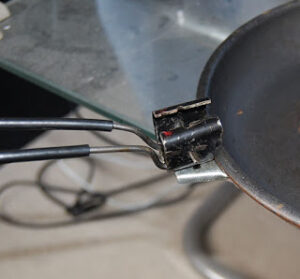
The frying pan was the easier problem to solve. I brought a lightweight frying pan from a local budget store. I cut off the handle, leaving a short stub. To this I attached a piece of aluminium bent into a not quite complete square section piece of tube. Attachment was by cold riveting with aluminium rivets (the only time since school I have used a technique learnt in metalwork class!) Holes were drilled in the sides of the fitting for the attachment of a wire handle. The handle folds by squeezing it slightly to pass through the channel in the top of the handle fitting. It can also be removed if desired. The square section tube also acts as a socket for the insertion of a suitable stick to act as a longer handle if needed. 
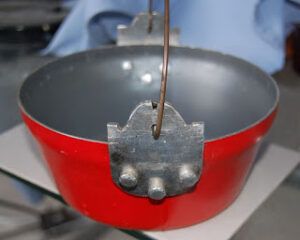
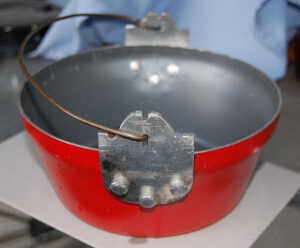
To create the billies I brought two “milk pans” from a budget store. The handles were sawn off and the rivets where they had been attached were drilled out. Using these holes I attached a piece of aluminium plate, cut and filed to shape. Opposite this plate more holes were drilled and a similar plate fitted. These are the “bail ears”. I think these look rather crude but an engineer friend of mine was quite impressed by them. I used my cold riveting skills to attach these but pop-rivets would probably work just as well. Pop-rivets are sometimes hollow but this will allow a little bit of steam to escape when the lid is on, so this should not be a problem. 

Word of warning here. Aluminium is a very reactive metal so don’t, for example, use copper rivets with aluminium plate. They will react together and corrode. Read up on this topic and when in doubt ensure you use “like with like”.
Using aluminium rod a bail handle was made and fitted to the bail ears. Note how the handle and bail ears are shaped so that the handle locks in an upright position when desired. This was the suggestion of the friend I was scrounging the plate and rod from and is rather neat!

A good camping billy needs a lid. The lids for mine were made from the bottoms of catering-size food tins. Yes, I had mates in the kitchens as well as the workshops! You will come across articles where cooking vessels are entirely made from tin cans. This is not actually recommended since modern tins tend to have a plastic coating inside. This is not designed for prolonged use as a cooking vessel. The tins I used are only used as lids, so don’t get the heat a cooking vessel does. As you can see, each lid has a tab with a folding ring riveted in its centre. I can use this to lift the lid with a stick or similar implement.

Since they have tapered sides the two billies can be nested even though they have the same capacity. In practice, I do as Kephart suggests: I fill them with foods, put the lids on and place them in a bag, base to base. 

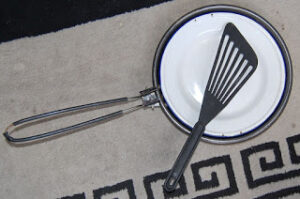
The final part of the kit is the plate. I wanted the plate to also serve as a cover for the frying pan when needed, which eliminated plastics. The plate is an enamelled tin plate. Using a ceramic cutting bit and a fine drill bit I drilled small paired holes in the rim of the plate and used paperclips to create two loops that could be used to lift the plate when it is used as a cover. When travelling the plate fits inside the frying pan and both are carried in a stuff sac I had that was just the right size. This may be accompanied by a spatula, nylon, pan scourer, plastic spork and plastic tubes of washing up liquid and cooking oil. I had planned to add a lightweight plastic cutting board to fit over the plate but never got around to it.

I used this simple but versatile cooking kit when I hiked in Iceland. Some of my travelling companions regarded it as unusual, but unarguably effective. I was obviously eating better meals than them while carrying less weight.
Having cooked with a few alternate cooking kits over the years I find my homemade kit still holds its own. While it is quite light for a kitchen item the frying pan is a much heavier duty item than is found in many camping kits. It has the advantage of a cheap non-stick coating too. The milk pans also had a non-stick coating which is still in a very nice state, even though I scratched some measuring marks into it.

It has been a while since I have had a chance to use these, so they do look a little dusty in the photos. My modifications were never going to win any beauty contests but they have certainly proved themselves up to the tasks asked of them!

Categories
Phillosoph

US Mess Kit (Updated)

In yesterday’s post I quoted Horace Kephart’s comments on the suitability of the Boy Scout cook kit for short duration trips.
The more observant of you will have noted that I stressed that this quote was taken from the 1921 edition of this book.
The reason for this is that in some of the earlier editions of this book Kephart gives a different recommendation.
On page 27 of both the 1910 and 1912 editions :
Individual Cooking kits…This is not formidable. A frying-pan and a large tin cup, with the sheath-knife, are sufficient; though a quart pail is a useful addition. Instead of a frying-pan, for such trips, I like a U. S. Army mess kit, procured from a dealer in second-hand military equipments for twenty cents. It consists of two oval dishes of tinned steel which fit together and form a meat can 8 inches long, 6½ inches wide, and 1½ inches deep, weighing ¾ of a pound. In this a ration of meat is carried on the march. When the dishes are separated the lower one serves as a plate, and is deep enough for soup. The upper dish has a folding handle which locks the two together, and it makes a fair frying-pan.”

The US Army mess tin is another designs that has changed little since Kephart’s day, the same basic design being widely used for the better part of a century.

While most nations issued their soldiers pails, American outdoorsmen were more used to frypans, skillets or spiders.

Those of us of a certain age and background will recognise it as the design of mess kit provided in Action Man’s kitbag!

The above passage does a pretty good job of describing the basic kit.

The frying pan is quite deep, allowing it to be used for cooking duties other than frying. It will probably take at least a pint of liquid (actually 600 mls!). The oval shape makes it long enough to take a reasonable volume of food without becoming excessively bulky. This is not really a kit for a pocket or belt pouch but it will fit easily in the majority of rucksack pouches.

The dish part, as already noted, has two compartments, each about 20mm deep. The one on my kit seems to be of slightly thicker material than the pan. It is possible that the two parts are from different issue kits. Some people dislike metal eating plates for being hot to hold and for allowing food to cool more quickly. On the other hand, this dish can also serve as a lid for the pan, conserving fuel, keeping dirt and insects out or just preventing moisture and heat loss when boiling, baking or poaching. The ring on the end of the dish allows you to raise or remove the dish when used as a cooking lid, although this is not the best arrangement and sometimes dips the other end in the pan. 
The ring on the dish has other functions. Slipped over the handle it allows both parts to be dunked in hot water as a single unit. The accompanying issue knife, fork and spoon set also had cut outs that could be slipped over the frying pan handle so all five parts could be dunked with one action. Cleaning of the mess kits in this fashion is described on this webpage and in this video
In the above site you will also see that the ring and the division down the centre of the dish allowed it to be placed on the handle so that the whole kit can be held as a single item when queuing in a chow line. We have seen this feature used in other mess kit designs.

Assembled properly the two components of the kit fit together snuggly and do not rattle. As Kephart notes, the interior of the kit can be used to pack foodstuffs. Placing the knife, fork and spoon inside was an obvious temptation but these had a tendency to rattle if not packed sufficiently. The two photos below also show what I believe to be the Army Arctic Canteen Cup. This appears to be a potentially useful cooking vessel.

There were several different models of these mess kits, the main difference being in their material of construction. Kephart’s was tinned steel while others were galvanized steel. Models of a later vintage and modern reproductions/copies are claimed to be of stainless steel. The example I brought was supposed to have been stainless steel but seems to be of aluminium. Certainly it is much lighter than I expected, which was a pleasant surprise! The dish seems to be of a thicker material and it is possible that this is stainless steel. Both parts are non-magnetic, which eliminates tinned or galvanized steel. The handle is marked “US. WYOTT” which suggests this part is Vietnam Era. (Correction: An engineer friend of mine tells me mine is indeed thin stainless steel!)
The metal of the pan is rather thin, which can catch you out if you are used to cooking with heavier pans. Make sure the bottom is completely covered with oil and do not give the pan too long to warm up. If you like your pans to remain nice and blemish free you probably are going to be disappointed.

In conclusion, if you want a camping frying pan that has a good capacity but it easy to pack this is a design worth looking at.

Categories
Phillosoph

Scout Mess Kit and Aluminium

Continuing the discussion of cookware. In the 1921 edition of Horace Kephart’s book he makes the following statement in the second volume:
“It is easy to make up a good lightweight set of utensils for two or more men (see Vol. I. pp. 118-123), but a satisfactory one-man kit is another matter. The Boy Scout sets do fairly well for a short outing when baked bread is carried, but are inadequate for baking on the journey. A reflector is too cumbersome for a lone woods-cruiser. Let him bake his bread and cakes in a frying-pan (see Vol. I, pp. 344-345). This calls for an 8 or 9-inch pan.”
 Camping and Woodcraft Vol.2, p.102
I do not know for sure the exact form of the Boy Scout set to which Kephart was referring. I suspect it was not that different to the kits in use in the 1950s. Over two million of these were produced so they were in production for a long time. Quite a few of these kits are offered from sources such as ebay. A tip is to try searching for “BSA” (Boy Scouts of America). Also try GSA or “Guide cook/mess kit”. I’ve also come across “non-official” mess kits that are clearly based on or inspired by these kits.

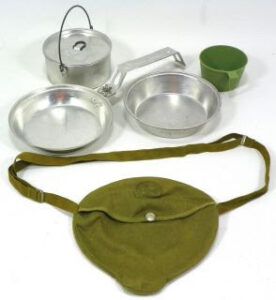
The kit includes a frying pan and a metal plate which fit together to form a unit that looks rather like the water bottles you see in Westerns. The folding frying pan handle secures the two together and this fits in a canvas bag. More modern versions often have a mesh bag. Inside the package fits a billy, and inside the billy is a drinking cup. In older versions the cup is metal, in more modern renditions it may be plastic. 

The best feature of this kit is that it has a real billy. It has a handle by which it can be suspended above a fire and a lid to keep the dirt and insects out. On the original versions the lid has a folding ring, allowing the lid to be lifted with a stick while the billy is over a blazing fire. More modern examples have a more conventional (and less desirable) plastic knob. Fitting a ring or loop is recommended. The capacity of the pot is apparently 1¾ quarts, which is a fairly good size for a pot if you only have one. Shape is low and broad, suggesting a more efficient use of heat sources and easy cleaning.
The billy fits between the plate and frying pan, which means you can potentially contaminate the insides of these vessels with the pot bottom. Keeping the billy in its own bag would be prudent although one would have to ensure the bulk of this does not prevent the parts fitting together. Having the billy in contact with the inside of the pan may also explain why no non-stick version of the frying pan has been offered.
The plate is metal and I have heard criticisms that this allows the food to cool too quickly. Personally I have found that an outdoors appetite seldom allows food time to get cold! I can see that the metal plate might be uncomfortable to hold if hot, however. Some clever bunny should offer a plastic replacement for these kits! The frying pan is a little on the small side, hence Kephart’s comment that this is a good kit if you do not have to bake. There are criticisms that the bolt that holds the handle on works loose. Adopt the habit of routinely checking and tightening it whenever you handle it. 

The scout cook kit is made of aluminium so this might be an opportune moment to discuss this material for cooking purposes. This Canadian Health site gives a nice account of the pros and cons of different materials. The key to cooking safely with aluminium vessels lies in understanding the acidity of the foods you cook. “Naked” aluminium is actually coated with a layer of aluminium oxide. As long as this is intact you should have no worries. Acidic foods or sauces will dissolve this protective coating. So too will rough scrubbing if the vessel is not left long enough for a new protective layer to form. Aluminium will react to form oxide with the oxygen in the air or water. I suspect boiling some water in a vessel will speed this reaction up. Acid foodstuffs to be cautious of include tomatoes, fruit juices and vinegar. Reserve these until your food is cooked or in an non-aluminium vessel. The above refers to “naked aluminium”. Anodised or non-stick coated vessels are not a problem unless the coating is damaged.
Many more modern versions of camping cookware or mess kits have moved towards the use of stainless steel. This is heavier but more “soldier proof” and needs less care to use safely.
Categories
Phillosoph

Buck Pigsticker Model 651

I plan to make a few more posts on cooking and messware, but today we will have a change of subject as an interlude.
As those of you who have invested in my second book will know, one of my favourite knives is the Buck Special model 119. This is just a really nice knife, and very reasonably priced too!
My appreciation of this got me interested in another of Buck’s products, the model 650 Nighthawk.
Finding an example at a price that I could live with proved more problematic. Examples in the UK had an exorbitant mark-up.
Reasonably priced knives in the US came with exorbitantly hiked up shipping costs.
Eventually I found a retailer on ebay that was offering the knife at a reasonable price and postage.
When the knife arrived, I unpacked it and was quite surprised.
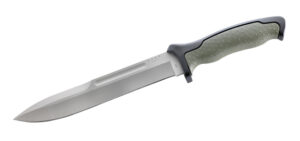
It was much bigger than I had expected! The blade was grey rather than the black it appeared in photos. Photos on the internet had given the impression that it was a Bowie-shaped blade when in fact it was more symmetrical, a spearpoint design rather like an M3 trench knife.
It was actually several minutes before the penny dropped and I noticed that the little label on the sheath said “Model 651”.
I searched the web but there was no mention of a Buck Model 651!
I contacted the vendor, a lady in Liverpool. I told her she had sent me the wrong model knife, but I rather liked it so was going to keep it.
Could I buy the 650 I had ordered originally? More money changed hands and a few days later another package arrives. It contains another 651! All of the knives she had acquired were 651s and not being particularly familiar with the field, she had identified them as Nighthawk 650s.

I contacted a friend of mine in the US who put me in touch with his step-father. We came to an arrangement whereby he would buy a 650 locally and ship it to me and I would trade him one of my 651s.

By this time I had done some further research. Intrigued by the lack of web footprint for the 651 I contacted Buck directly and the mystery of the 651 was revealed.

The 651 “Pigsticker” was a very limited run of knives intended for the Australian and New Zealand hunting markets. Nearly all of the run went south of the equator, much to the ire of many American collectors.
As this post on Bladeforums puts it:
“The info we have is that this is Buck Knives largest ever-regular production military knife! Period. With a full 13 inches over all length this is one massive to quote Crocodile Dundee “Now that’s a knife” Tactical knife by Buck!Very fitting as this knife was made and Named the Intruder “Pig Sticker”, these were contracted from Buck by an Australian company. The amount ordered I think 300 or so was sent to them and a few over run were left for replacements. Also it was stated that a New Zealand company has since then bought every last one that was left and they are now ALL down under! ..During the few months between the two delivers it seems that some members of the Buck (knife) Collectors Club {BCCI} got wind of a Huge Military Tactical Knife made for a foreign market and NOT for retail sale in the USA Some few of these Buck Knife Collectors and Buck employees were able to order one or two of these rare ‘extra’ knives for themselves during the short time between the two deliveries! As word spread many of the Buck and military knife collectors are upset at not hearing of this knife sooner as they are now all gone! Rare? Well HECK Yes!!! These huge Pig Stickers are known to be in the hands of less then 40 or so lucky USA collectors! YES – it is estimated there are LESS then three dozen of these knives, snatched by collectors, remaining in the Country at this time. And here are ONE of them for sale. You now have a chance to own one of these rare knives. We do say that YOU will most likely not have another chance for a long time to own one. Most of the collectors we know are hording the extra ones they now have. This knife has one of the the thickest blades we have ever seen on a Buck Knife. It fits our hands very well and has a fantastic tactical grip non slip OD green and black grip. The large Buck 120 black handle knife, Buckmaster 184 all metal knives are not part of this sale, they are for comparison only. The sheath has a built in upper leg tie down adjustable strap for worry free movement during carry … yet it releases and draws from the sheath with ease for use. It is hair popping razor edge sharp.”
Obviously, on their journey south some of these knives passed through Liverpool docks.
As is rather commonplace, some of them happened to fall out of their shipping container and were sold, ending up on ebay.
I am probably one of the few people in this country who owns a 651 and knows how rare it is.
Likewise, my friend’s step-father is one of the few Americans to possess one!
I have seen offers of more than $300 for these.
The 651 is actually a very nice knife.
It was designed as a working knife that would be used against dangerous game and it seems to be well up to the job.
The blade is thick and sturdy and has a good edge. My only criticism of the design would be the Nighthawk-style handle, which would be improved by a full guard, given its intended use.
That is my general criticism of all Nighthawk models, incidentally.

Buck should consider offering a similar knife for general sale. It would find many happy users.