Disclaimer: “As an Amazon Associate I may earn from qualifying purchases.” Adsense and Infolinks were no help at all.

If you have enjoyed this article or it has been helpful to you please feel free to show your appreciation. Thank you.

Read The Third Wave by Alvin Toffler!
Categories
Phillosoph

211-21-1111-1211

As it is Friday I will continue the tradition of covering a more eccentric topic.
Regular blog readers will know that I am fond of Kephart's book "Camping and Woodcraft". At the same time I acquired my copy I also acquired another great book: “Jack-Knife Cookery” by James Austin Wilder. The first part is about cooking while later sections divert into tips on camping, scouting, self-reliance and survival. The book is a little gem so if you encounter a copy buy it!
On page 167 the author describes an alternative to Morse code which he claims is easier to remember. Once you understand the principle you can sit down and write it out in a few minutes. The author makes no claims that this is his own invention so its origin is unknown.
The alphabet is written down in four columns of seven letters. As an aide memoire the first row is AHOV -which looks like "ahoy". Last line is GNU, like the animal. DKRY looks a bit like “Dictionary” spelt wrong.
Once you have this matrix you then number the letters from 11 to 2222 using only 1's and 2's.
A
11
 
H
12
O
21
V
22
B
111
I
112
P
121
W
122
 
C
211
J
212
Q
221
X
222
 
D
1111
K
1112
R
1121
Y
1122
 
E
1211
L
1212
S
1221
Z
1222
 
F
2111
M
2112
T
2121
&
2122
 
G
2211
N
2212
U
2221
the
2222
 
Skinny 1's represent dots, fatter 2's represent dashes. If signalling with a flag then “Dot is Right!” (She is that sort of woman). Wilder does not say if this is the signaller’s or the observer’s right, however. (People need to use Port and Starboard more in everyday speech!).
S.O.S would therefore be : “.–. -.
Obviously this code has its drawbacks, the most obvious being that virtually no one will be familiar with it! Many of the most commonly used letters use four characters while less used ones use less, so an alternate arrangement could be constructed.

A friend of mine has a love of alternate writing systems and the like, so this blog is for him. This signaling code is an interesting idea and deserves being recorded somewhere on the internet.

Categories
Phillosoph

Hit Girl vs Kick Ass

I watched “Kick Ass 2” last night. It was OK but I thought the first movie was better.
There is a scene in the early part of the movie when Hit Girl (Chloë Grace Moretz) unleashes a fury of kicks and blows against Kick Ass (Aaron Taylor-Johnson). What struck me about this sequence was not that the attacks were particularly strong, fast or technically skilled. The reason she dominated the exchange was her character’s determination and commitment to the attacks. This is something to think about.
 
Here is the clip. Action starts at the 50 second mark.:
 

Categories
Phillosoph

Uncle Phil's List : Far Cry 2 Example

For today’s blog I thought it might be useful to give an example of how the “Uncle Phil List” can work. We need a scenario so as an abstract example, let us consider the protagonist in the video game “Far Cry 2”. He is a mercenary operating in “Unnamed African Country” (UAC).

First broad category is “Shelter”, subdividing into shelter, sleeping and clothing. The climate is fairly warm and sunny, but subject to heavy rainstorms. Terrain varies between jungle, savannah and arid/desert regions. Hostile forces are widely encountered so shelter needs to be low key. The temperature means a tent is probably unnecessary, although a basha sheet or rain poncho may need to be rigged to keep the rain off. In the jungle a hammock will be the safest way to sleep. On the grasslands and desert using a hammock may not be possible so he will need a ground sheet or kipmat of some form. Mosquitoes and other insects will be a problem, so a mosquito net that can be used with both the hammock and ground mat will be needed. Outside the forest a way to support the rainsheet and mosquito net will be needed so a couple of tent poles may be carried. A blanket or two may be more practical than a sleeping bag.
Clothing needs to be comfortable and suited to the hot and often humid conditions. Rhodesian and South African troops often wore singlets and shorts for operations, only wearing long trousers and sleeves at night or when in heavy bush. Hiding is the main strategy against enemy patrols so colours/ shades that blend with the environment are preferred. Dried grass and sand are quite light so clothing or a camouflage pattern that includes light tan would be recommended. An interesting idea would be soling boots with sections of truck tyre so foot prints look like those of locals wearing homemade sandals. A hat that can protect against the sun will be necessary: so much so that a spare might be carried. Sunglasses will be needed due to the bright reflections from sand and bleached grass. Goggles might be useful in the desert or for when driving vehicles. A neck scarf/sweat rag fulfils a number of roles. A head net and gloves for protection against insects will be needed. Fingerless gloves and useful against thorns and other hazards when moving in brush. Gaiters will provide some protection from snakes, even when wearing shorts. If the weather is cold, or if moving at night one of the blankets can be worn as a cloak, so a couple of blanket pins are included. A poncho is carried for those tropical downpours and also provides shelter while sleeping.
Fire: A couple of lighters and possibly a container for tinder and other firelighting aids should be carried. In the forests available wood may be damp. A candle is useful for applying sustained heat to moist tinder and kindling.
Water: At least one water bottle will be needed. Water encountered will need to be sterilized. Purification tablets will be carried and so might a means for filtration. A vessel for boiling water to conserve the tablets should also be carried. Crocodiles may be a hazard when filling water bottles. A pail on a string might be a useful device
Food. Food and cooking equipment will be needed. Game is fairly present, although means to acquire it without gunshots that might alert patrols need to be considered. A small fishing kit takes up little room and can be used to set night-lines when resting up.
First Aid and Other Medical: Given the character’s profession some shell dressings for gunshot wounds need to be carried. Various parasites are an obvious concern –in the game the character contracts malaria and has to source medication. Insect repellent, sunscreen, medication and basic hygiene items will be needed, and in generous quantities. A snake bite kit will be prudent given travel will often be across country and in heavy undergrowth
Tools: A machete (panga) will prove to be a very useful item. There may be a case for carrying a spare in the pack as well as on the belt. Other blades such as a swiss army knife will also be needed. A few yards of rope would prove useful when crossing streams and navigating steep terrain. Lesser cordage will prove useful for various applications. The weapons you encounter in the game are often in a poor state. The environment of UAC is hard on such things so you will need a gun-cleaning kit. A collection of spares for your weapons and other items will be needed, as well as more generic repair items such as tape and a sewing kit. A notebook will be needed for recording intelligence. Keep it in a waterproof bag and ensure all vulnerable gear is protected from moisture and insects. Specialist items may include field glasses and a satellite phone. (Amusingly the character gets phone calls in the middle of gun battles and infiltrations!) A pack will be needed to carry the gear and some webbing to carry the items he may need when not near his pack: ammunition, machete, first aid, water etc. One of the simplest ways to get around in the game is to take the bus, illustrating that some money will be useful. A hiking pole or even spear may help movement across difficult terrain and deter large animals. In Africa a man walking with a spear may be less remarkable than one obviously carrying a rifle. The spear can also bring down animals for food silently. Camouflage paint may be considered a specialist item and necessary since shorts and singlets leave lots of skin exposed. Caucasian South African troops use face-paint to conceal that they are Caucasian when viewed at a distance. Pale skin can draw attention and make the owner a priority target! (My character in the game is oriental, but the same applies!)
Navigation needs are fairly obvious. The character will have some maps and at least one compass. It is easy to get disorientated in the forest or long grass so a wrist compass may be a useful item. Given that the enemies in this scenario are relatively unsophisticated and will not be using electronic warfare a GPS system may be practical. Possibly it will be built into the satellite phone? In the game the character has a GPS that also locates uncut diamonds, which would be nice! The frequency of sunny days suggest revising the methods for direction finding by the sun for that hemisphere. Likewise, the clean night skies suggest a refresher on constellations. Record this in your notebook so you do not have to rely on memory during stress.
In the game, the character is pretty much on his own so means of signalling are a low priority. The conditions favour heliographs (but he has no one to signal). Likewise a whistle on his compass lanyard would take little room, but not be of much use when the whole country is against him. I guess the satellite phone is a signalling device. There is a flare gun in the game but this is mainly used for arson! A source of light such as a flashlight would be useful. Some of the terrain is very dark at night and a low-power red bulb flashlight would be useful for brief checks of terrain or the map. There are also caves and deserted dwellings that need to be searched.
By no means a comprehensive list, but this does illustrate how the Uncle Phil List can be used as a tool to plan what gear you may need.
Categories
Phillosoph

Uncle Phil's List : New Format.

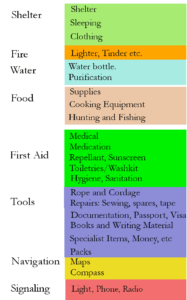
Since it is a Monday I will keep today’s post brief. Some time ago I introduced the useful planning tool of “Uncle Phil’s List”. Chances are you will not need an item for each category and some categories will have multiple items. The power of the list is that it makes you consider each individual category for a few seconds which really helps you clarify what you do and don’t need. Today I am going to present in in a slightly different format with eight larger, broader categories.

Categories
Phillosoph

Common Sense Does Not Exist!

Recently I challenged a friend : “I do not think that word means what you think it means!”
Recognising the reference, he responded “Inconceivable!”
This provoked an interesting discussion on redundant terms. To call something inconceivable you need to be able to conceive its existence or possibility, so it cannot therefore be “inconceivable”. “Impossible” is related term. A true scientist knows that very little is actually impossible, just that some things are very, very, very (to the nth power) unlikely. “Unbelievable” is of a similar vein. When someone says something is unbelievable or more accurately hard to believe they are actually telling you more about themselves than the subject of discussion. “I find that hard to believe” has an interesting aspect of arrogance, implying something is less likely because the observer lacks sufficient imagination or education to grasp the concept.
A phrase that particularly makes my teeth grind is “common sense”. “Common sense” does not exist. It will be a very happy day when this irritating and pointless phrase drops from the language.
Generally when someone uses this phrase they are implying some idea or piece of knowledge is self-evident or universally known. But if you think about it, if that were the case we would not need a term to describe it, nor would we so often complain that common sense was not used. The most accurate definition for common sense might be “What is blindingly obvious to one person but is not to another”.
A recent panel show had the question “Do you think you have common sense? Did most of the audience answer yes? True or False?” One of the panellists, a woman admired for her intelligence began talking about how she broke her nose walking down the stairs in high heels and a rucksac. She then said she likes to use a rucksac because she “Likes to walk with her hands in her pockets”. Walking with your hands in your pockets so you cannot defend yourself or save yourself if you trip on the stairs is obviously pretty dumb. If “common sense” existed, no one would do this. Most of the audience, predictably answered “yes”, they did think they had common sense. They are mistaken, of course, because they cannot have what does not exist. Like most of the population, the majority of the members of the audience probably walk around staring at their phones not looking where they are going, so would not be considered to have common sense if such a thing did exist (which it does not!)
Common sense is most often used in phrases like “Why didn’t you do that bit first, it is just common sense?” Logically such a statement could never be made if common sense was self-evident or universally-known knowledge. “Common sense” is often used as a weapon when the speaker thinks someone has been a bit of a dick and often that extends to the speaker’s manners too. You probably begin to appreciate that use of the term “common sense” is often inherently insulting in some way. Common sense does not exist. Using “common sense” to justify your argument is about as relevant as a character reference from the Easter Bunny! Claiming something is common sense is often just being rude and actually just branding yourself as a fool.
Scratch the surface of a claim of common sense and arrogance is usually just below.
Advertisers like to use the term common sense in another way. If they call something “common sense” they can create an impression that not agreeing with the idea they are offering makes you foolish. No one wants to be considered foolish, therefore you should agree with the “common sense” idea or buy the product with “common sense features”. By now you should have accepted the concept that common sense does not exist so you will recognise that anything offered to you as being common sense is probably a con of some kind
Categories
Phillosoph

Trench Club

Last night I was watching a cheesy movie. A military unit had gone into a city full of zombiods. The enemy were aggressive and cannibalistic but they were not undead and did not require a shot to the head. In an early scene the soldiers have run out of ammo and are fighting off the waves of attacks with hand-held M9 bayonets. What struck me was this. If you are going up against a whole city filled with potential enemies it is inevitable that you cannot carry enough ammunition. Knowing this, would you not attempt to carry better close combat weapons than bayonets you cannot fit on your SMGs? If you are in a city then at least one crowbar is a useful thing for a unit to have. Later the character acquires a tomahawk.
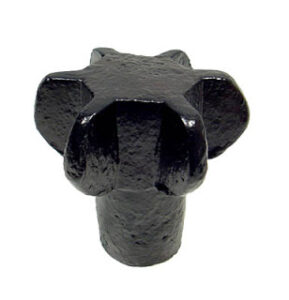
Thinking on this brought me around to the topic of trench clubs. I had meant to post this image a while back but it seems I never got around to it. It is tempting to think of soldiers sitting in the trenches whiling away the time making their own clubs. Doubtless some weapons were made in exactly this fashion. However, some weapons were actually produced more systematically by regimental carpenters. The example shown in this image is sometimes referred to as a “Knobkerrie” and was designed and produced by the Royal Engineers of the Second Army. The head is described as being iron and it seems likely that it was actually cast iron. The Victorians favoured cast iron for many uses and I doubt that the Edwardians were any different. Cast iron was certainly used for other models of trench club and it would be a very logical choice in quickly and simply creating club heads. This head resembles a cogwheel and it may be a part of some machine was used for the original mould. What is particularly interesting about this particular head was that it was designed to attach to a standard issue entrenching tool handle (aka "helve"), making a weapon about 16" long.

The head of this trench club reminds me of these geometric maceheads from Southern Russia, in use from the eleventh century onwards. A websearch also turned up these Byzantine mace heads and a number of similar designs. Some are made from bronze so would have been cast. One example even looks like the WW1 Royal Engineers “c” head.

Categories
Phillosoph

In Praise of Gaiters

Yesterday’s post on Bombay bloomers and Plus-Sixes leads me to a related topic. The blousing of trousers is a common military practice but the use of practical gaiters is somewhat neglected by both military and civilian outdoorsmen. Those of us that do use them are sometimes looked at as somewhat eccentric. Most of us don’t care, since gaiters are one of those things that once you have properly tried them you are not going back. Kephart, in “Camping and Woodcraft” sums up the merits of gaiters and related items better than I could:
“Never buy leggings that strap under the instep. The strap collects mud, and it is soon cut to pieces on the rocks. Any legging that laces over hooks will catch in brush or high grass and soon the hooks bend outward or flatten. The present U. S. A. canvas legging (Fig. 91) has only one hook, in front; it is quickly adjusted. The strap puttee (Fig. 92) is better for a woodsman or mountaineer. Leather puttees are suitable only for horsemen ; in walking and climbing they cut one in front and rear of the ankle joint. Genuine pigskin is the only leather that will stand hard service and frequent.
For still-hunting I like spiral puttees (Fig. 93), not spat but plain, as here illustrated. They are strips of woolen cloth with selvage edges, specially woven and *' formed," which wind round the leg like a surgeon's bandage and tie at the top. Do not wind too tightly. They are pliable, noiseless against brush, help to keep ticks and chiggers from crawling up one's legs, and, with the clothing underneath, are a sufficient defense against any snakes except the great diamond-back rattlers. '* In experiments, only in rare instances has snake virus stained blotting- paper placed behind two thicknesses of heavy flannel." German socks, instead of leggings, are good for still-hunting in severe cold weather. Many dispense with leggings by wearing their trousers tucked inside boots or high-topped shoes. This will do when the woods are dry, but when all the bushes are wet from rain, or from heavy dew, the water runs down inside your shoes until they slush-slush as if you had been wading a creek.”
Shortly after I first read this I was reading a James Bond novel where Bond and his companion were at risk from an area infested with water moccasin snakes. It occurred to me that Bond and his companion could have used the bedding in their luxury prison to improvise gaiters or puttees to protect themselves from the snakes.

In contrast to Kephart, I favour gaiters over puttees. Zippers were relatively rare in Kephart’s era so gaiters had to buckle, lace or be hooked closed. Mine have heavy duty zips with individual teeth up the back part of the leg. Lengths of cord tied in decorative knots have been added to the zipper pulls so they are easier to operate if fingers are wet or numb with cold. Mine were designed to use a strap under the sole but I removed this. The elasticated areas and the hook that engages the lowest section of boot lace keeps them adequately in position. Don't confuse gaiters with the short anklets issued by some armies. Gaiters or puttees should come at least halfway up the calves.
I cannot discuss gaiters without mentioning my time hiking in Iceland, where the gaiters proved themselves useful in ways unexpected.
When it came to crossing a glacial meltwater stream one of the first things I would do is remove my gaiters. One gaiter would be placed on the ground, outer-side down. I would then step out of my boots and on to the dry clean inner surface of the gaiter. Standing there I could remove my socks and trousers and stow those in the top of my pack. I wear quick drying swimming shorts as underwear so once I had put my boots back over my bare feet I was nearly ready to cross. Gaiters were stowed in the top of the pack together with my socks, trousers and a towel.

On the other side of the river I would take out a gaiter and place it outer-side down on the ground. I would remove one boot, dry my foot with my towel and step onto the clean gaiter. I would then do the same with the other foot and replace my socks and trousers while standing on the clean dry gaiter. Shake the water out of my boots, replace them and then put my gaiters back on.
As you can see, gaiters make a task like crossing a ford much more manageable. Gaiters protect your trousers from damage and dirt. They can keep sand out of your footwear. Gaiters can protect you legs from thorns, even when wearing shorts.
Modern gaiters can be found constructed from stuff such as gore-tex. Mine are just simple condura and I don’t see any need for anything like gore-tex. Condura is tough, non-absorbent, breathable and sheds water, and that is all that you need. When buying gaiters make sure they will fit your boots without need for a strap or cord across the sole. Manufactures make them with the cords because people think they need them. A decently designed gaiter does not! Zips should be of the type with individual teeth rather than the spiral type.
Categories
Phillosoph

On Bombay Bloomers and Plus-Sixes

A couple of weeks back we had a suddenly hint of summer. My girlfriend phoned me and asked if I wanted to meet her at a nearly riding centre to look at the horses and then walk in the large park nearby. Since it was the first day of weather this year that did not need a jacket to be worn, I dug out a pair of shorts. “Shorts” is a fairly loose description for these, since they are about knee length on my long legs. Not quite shorts, not trousers and not quite long enough to be breeches. My Brazilian girlfriend asked what such trousers were called in English and I was at a loss to give her a satisfactory answer. Whatever they should be called, they are however incredibly comfortable to wear. My lady was of the opinion that they actually looked quite good worn with my boots. I ended up telling my girlfriend about “Bombay Bloomers”. While this can be a generic term for the substantial shorts worn by soldiers of the British Empire, the most notable sort were these shown worn by this Gurkha:

As you can see, the shorts have substantial turn ups and in these examples they are secured in place with buttons. The idea was quite ingenious. When the temperature dropped at night and the mosquitos became a nuisance the wearer could roll down the cuffs for more protection. Likewise, if the soldier had to operate where thorns or leaches were a hazard, he rolled the cuffs down. I have seen such shorts/ trousers tucked into the tops of socks or gaiters. Some examples were evidently long enough to reach the ankle.
The famous outdoorsman, Horace Kephart, in “Camping and Woodcraft” (1917) notes that: 
To wear with leggings the ‘foot breeches ‘ of our infantry, which lace or button in front below the knee, fit better than trousers that must be lapped over; but for wilderness wear I prefer common trousers cut off about six inches below the knee: they are easier to put on and they dry out quicker.
“Plus-sixes” have much to recommend them for outdoor use, particularly if they also incorporated the idea behind the Bombay Bloomers. This would require the breeches to be quite roomy in the thigh, but there is nothing wrong with that. It lets the air circulate and reduces the tendency of trousers to drag to the knees on a hot day when walking uphill. Many soldiers now use kneepads but the cut of their trousers necessitates them being worn outside, compromising both camouflage and air circulation. Loose Plus-sixes that can be turned up to act as shorts would be far more practical and comfortable.

>

Categories
Phillosoph

Post Apocalyptic Heroric Fantasy Armaments

Friday, so I get to post something a little more off the wall.
Recently I was enjoying the cartoon Korgoth of Barbaria. A great pity they only ever made the pilot. One interesting point of this Conan parody is that it is set in the future. It is a genre that might be termed Post-apocalyptic Heroic Fantasy. There have been a number of movies and books along these lines. One movie that immediately springs to mind is “Steel Dawn”, where we learn shoulder pads and 80’s hairstyles can survive just about anything. Novels along these lines include Sterling E. Lanier’s “Hiero Desteen” novels, Robert Adams’ Horseclans series and Fred Saberhagen’s “Empire of the East” and “Book of Swords” series. I have not read all of these, but plan to read some of these soon.
What strikes me about some of the stories in this genre that I have seen or read is that if anything they are too Medieval and fail to meet some of the potential of a post-apocalyptic society regressed to the Dark Ages. Would people in such a situation be using swords and bows? Very probably. The survivors of such an event would also have the benefit of knowledge, however. If you look through history it is obvious that some inventions could not be created until certain technological achievements had occurred. It is also obvious that some inventions could have appeared centuries earlier than they did, but the idea just never occurred to anyone. This is why some inventions were in use hundreds of years in one part of the world before they were introduced or discovered in others.
A society that exists centuries after a post-apocalyptic event may indeed rely heavily on animal transport and fight mainly with bows and swords. They may not be able to build Jumbo Jets or M16s, but they would know that such things were once possible. Likewise, they would know that lower technology devices such as steam engines, chemical matches and rockets are possible. Given a few decades they may be able to produce their own versions.
Let us consider some weapons. Gunpowder was being produced in China as early as the tenth century and there isn’t really any reason why it might not have been created earlier. Source the three components, mix them together and confine them in a tube and you have a rocket. It is very likely a future barbarian world would have rockets where the raw materials for gunpowder could be found. The Chinese made some interesting weapons by just adding simple rockets to arrows. Packed into a basket and given a common fuse, and a single soldier could fire scores of them into a formation within a couple of seconds. What is more, every soldier in a company or battalion could carry and fire such a device, then take up his bow or spear to fight in a more conventional fashion. Larger rockets, capable of starting fires or exploding were also relatively simple devices and could be fired from wagons or ships. While the ancient Chinese developed a number of rocket systems they were a weapon very much ignored in the West. This may be because in Europe the destruction of fortifications was more of a priority and cannon were better suited to such roles. China, in contrast, enjoyed a long period of peace so the development of gunpowder weapons languished somewhat during this time.
What of more conventional guns? Once you have the gunpowder, a muzzle-loading cannon is a relatively simple device that can be surprisingly potent. Casting a barrel takes some knowledge but could be established by research and experimentation. As late as the 19th century mortars and some other light guns were constructed from reinforced timber. In “Space Viking” by H. Beam Piper, a character opinions that gunpowder seems to be one of the last items of knowledge a decivilizing world loses.

Personal firearms pose a more interesting question. Many guns are mechanically very simple. Something like an M16 would be difficult to produce, relying on precision parts, polymers and aluminum castings. A Sten Gun, however, is just a few tubes and springs and such guns have been made in underground workshops and village forges as we know. The real challenge for our post-apocalyptic warriors will be in the production of ammunition. Producing something like self-contained modern pistol and rifle ammunition may prove too difficult. Ammunition may be more likely to resemble 19th century paper cartridges or shotgun ammunition. These are simpler to make and reload, but probably will not be suited to automatic or other complicated feed mechanisms. Where personal firearms may exist they may be more likely to be single-shot or double-barrelled weapons. Such guns may not have that many advantages over weapons such as the bow or crossbow. Making an arrow or quarrel requires more skilled labour than primitive firearm ammunition but can be reused. Compare a simple gun and a bow and you will find that the bow often outperforms the gun. Guns did not replace bows because of performance advantages but because they and their ammunition were easier to mass produce. If guns are to persist in the armoury of future barbarians it will most likely be if they offer a unique capability. Pistols and shotguns can supplement a sword in close combat, even if they are only single or double-shot. Rifles will have to compete with the bow so we are likely to see them designed more towards precision longer range shooting where their flatter trajectory offers some advantages.
Categories
Phillosoph

Learning from Honey Badgers. Using Your Environment.


I once saw a film clip of a baby elephant that had become trapped in the mud. It was impossible for the elephants to lift its weight. Instead, several elephants worked together to construct a ramp out of mud and the baby was able to escape.
 
I came across this video today about a honey badger. Some useful ideas about using what is in your local surroundings to your advantage.