Disclaimer: “As an Amazon Associate I may earn from qualifying purchases.” Adsense and Infolinks were no help at all.

If you have enjoyed this article or it has been helpful to you please feel free to show your appreciation. Thank you.

Read The Third Wave by Alvin Toffler!
Categories
Phillosoph

Soldier's Load : The Soviet Approach

As is now an established tradition, the Friday post will be a little more diverse than usual (Although yesterday we had a bomb thrower that used biscuits to work!).
I have been reading a little about the Battle of Berlin (the 1945 one). This lead me to look at Soviet infantry equipment.
In military circles “simple and effective” is often synonymous with “Russian”. The Soviet solder did not seem to carry very much, but what he did carry was surprisingly well thought out. Reducing the soldier’s load is a long running topic of debate so it is worth having a look at how the Soviets approached this. This is going to be just a quick thumbnail sketch of Soviet equipment so for brevity I will not go into great depth. There are many fine websites that can give you details such as introduction dates, model numbers, variations and so forth. 
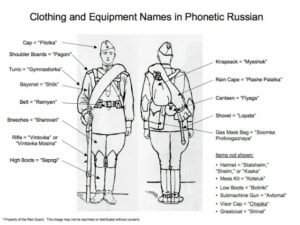
The first thing that becomes apparent is that some of the infantry equipment was very similar to that of the German soldier. Of course, during the war a lot of German equipment was used by the Soviets and the similarities often do not make this obvious in photos. Many readers will be familiar with German belt order items so for convenience I will refer to these for purposes of comparison.
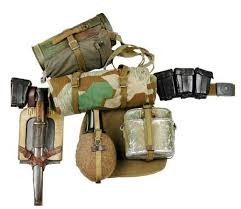
The first thing you notice when comparing the German and the Soviet is what is not there. The German routinely carried his mess tin and breadbag on his belt. Sometimes the mess tin was attached to the yoke or a backpack but carry on the belt was very common. The Soviet seems to have preferred to carry his mess tin in his backpack or tied to the outside. The Soviet mess tin was a kidney section pail of similar design to the German. An older pattern of circular pail was also in use. There was a Soviet version of the breadbag but it does not seem to have been so widely used. Again the Soviet seems to have preferred to carry his rations and personal items in his pack. The breadbag may be placed inside the pack rather than being worn on the belt.
Another “missing” item is the bayonet scabbard. The German usually placed his bayonet over his entrenching tool. The Soviet rifle used a socket bayonet that was kept permanently attached to the rifle. The standard bayonet had a screwdriver tip for adjustment of certain parts of the rifle. It was also a handy implement for clearing a jammed cartridge. Some other Soviet weapons had folding bayonets. No bayonet scabbard was issued in wartime since they were not needed. Bayonet scabbards tend to be all metal and on the heavy side in my experience, so this policy may have saved the Soviet soldier a few ounces of unnecessary weight. While the bayonet was a useful fire poker, screwdriver, pot lifter and candlestick it was not much use as a utility knife. Scouts and some other troops might carry the NR-40 knife. Other blades such as German trench knives or Finnish puukkot might also have been carried.
An iconic equipment item of the German soldier is the metal canister used to carry his gas mask. The Soviet equivalent was a canvas bag carried near the left hip. Once it was accepted that gas warfare was unlikely Soviet soldiers often did not bother to wear this bag. Some removed the gas protection equipment and used the bags for more useful items.
So what did the Soviet soldier carry? There would be an ammunition pouch. At the start of the war a pouch was worn each side in the same fashion as a German soldier. Reenactor websites I have viewed are insistent that it became routine to wear just one ammunition pouch, which was positioned on the right of the belt. A grenade pouch was usually worn on the left side. The belt would also carry a water bottle.
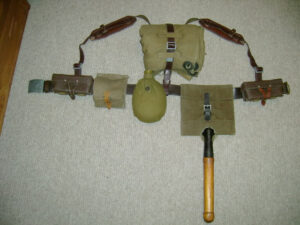
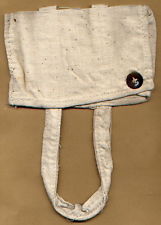
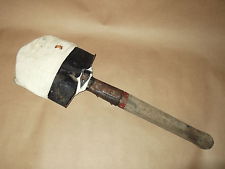
The final belt item was an entrenching tool. The German soldier seems to have favoured carrying this on his left side, sometimes towards the rear. In contrast the Soviet carried his on the right side. A dense item such as an entrenching tool might injure the wearer if it was fallen upon, so the Soviet e-tool was on the flank, with the ammunition pouch preventing it creeping forward. Alternately the tool was tied to the pack. If the tool was expected to be urgently needed for close combat it might be tucked through the front of the belt. Several designs of carrier were used for the e-tool. The simplest and most interesting is the one shown below. The shaft is passed through a loop and a flap used to secure the top. The flap is fastened by a button, toggle or popper. It is both a quick draw and minimum weight solution!
The Soviet’s kit was not limited to what was on his belt. We have mentioned his backpack several times and have discussed the design of this item in >another blog. The classic image of the Soviet soldier has him with a blanket roll across his chest. In actual fact this item is a rolled greatcoat. Russian soldiers were not issued blankets and were expected to use their greatcoat to sleep under. Note that the rolled greatcoat was always worn from the left shoulder to the right hip so that the rifle or SMG could be properly fired from the right shoulder. Alternately the greatcoat horseshoe was tied around the outside of the pack.
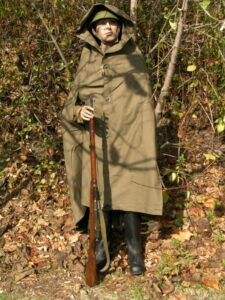
Another important item was the shelter cape or “Plash-palatka”. This was rather ingenious square of cloth that served as basha-sheet, tent component and rain cape. As can be seen, this is a 180cm square of canvas with button holes in each edge and grommets at the corners. One side has toggles next to the button holes (top edge in diagram). There is a single arm slit near this side. One corner (top left) has two drawcords in channels. Not shown in the diagram is that there is a toggle sewn some distance toward the centre from the bottom right corner. When worn as a rain cape the toggle is passed through the bottom right grommet to prevent this corner trailing on the ground.
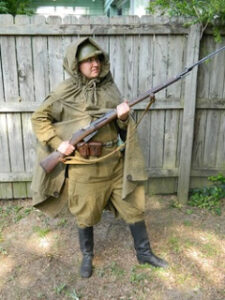
 
When used as a rain cape the drawcords are pulled in to form that corner into a hood. The opposite corner is folded up and secured as described in the previous paragraph. The right arm is passed through the arm slit to operate the weapon. The left arm comes through the front opening of the cape but maintains a good drape of cloth over the left side to keep off the rain and provide concealment. This really is a well thought out design!

The Plash-palatka on its own could be used as a shelter or combined with others to form a variety of structures. Some of these are illustrated in the Russian manual. The preferred method of joining them appears to be lacing them together through the button holes. This may be because only one side had toggles and this side would have to be placed lowest to prevent rain entering through the fly of the arm slit.
For turning the Plash-palatka into a shelter the soldier also carried two sections of tent pole, a wooden peg, a metal peg and four foot of guy rope. This could be compactly stowed in a small back and the resulting package was the right length to fit widthwise in the backpack! It could also be tied to the outside of the pack if interior space was limited.
The Plash-palatka might be carried folded up inside the backpack. If the rolled greatcoat was carried it might be rolled around the greatcoat to keep it dry. When the greatcoat was not carried the Plash-palatka might be rolled up and carried from the left shoulder to the right hip in the same fashion that the greatcoat was. The folded item might also be carried attached directly to the yoke straps as is shown in an earlier photo.

My researches also brought me to the combat load of a cold-war era Soviet Motor Rifleman. Very little has changed! The design of ammunition pouch is different to suit the AKM and a bayonet in a scabbard is now worn. The gas mask case is back and a rolled NBC suit is attached to the yoke, just above a shelter cape.
Categories
Phillosoph

IRA Anti-Armour Launcher

A recent blog post was an illustration of how easily firearms such as sub-machine guns can be manufactured. Where local laws have created a sufficient market criminal organizations may readily act to meet the demand. One of the weapons I showed had been designed and constructed in Northern Ireland in what was then one of the most heavily policed areas of the United Kingdom. Where there is a will and a need a way will always be found.
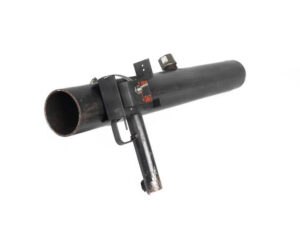
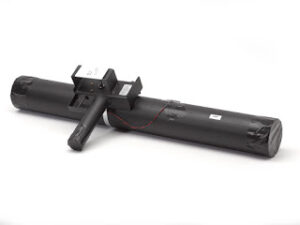
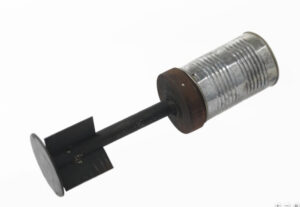
What I did not state in my earlier post was that the Irish SMG shown had been built by a Loyalist Irish faction. As far as I know the republican terrorists did not produce a significant number of homemade SMGs. The PIRA/IRA etc were well supplied with small arms from both Libyan and American sources. Where the IRA were very creative was in the field of heavier weapons. Yesterday I came across this interesting home-made weapon. It is a recoilless bomb thrower designed to attack unarmoured and lightly armoured vehicles. The projectile is made from a tin can containing a shaped mass of explosive. The weapon works on the Davis principle and uses two packets of biscuits as counter-shot. The local pigeons must look forward to a firing!

The firearmblog webpage does a fine job at describing the device, so I will direct you there.

Categories
Phillosoph

Simple Camouflage Clothing

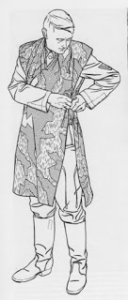
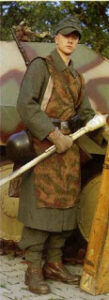
One of the books I own has this interesting illustration and entry. I would be inclined to describe this as a “tabard” but the book calls it a body-apron, or more properly “Die Heeres Tarnungs Köper-Schürze”. One side was white while the other side had a camouflage pattern. It was secured by two sets of camouflaged tapes which could be tied at chest level and waist level. It was probably intended to be worn over the webbing equipment, access to the ammunition pouches being via the side openings. The camouflaged smock issued at around the same time was also intended to be worn over the webbing and was provided with two pocket-like openings. In practice it was more common to wear the webbing outside the smock and the same may have been done with the body-apron.

  Today I found a couple of additional illustrations of this item in differing camouflage patterns.

The version below was a post-war design used by the German border guard (Bundesgrenzschutz or “BGS”). This version was made of waterproofed material and intended to also serve as rainwear. It fastens with poppers rather than tape.

While I was trying to locate an on-line picture of the German body apron I came across the following interesting photographs.

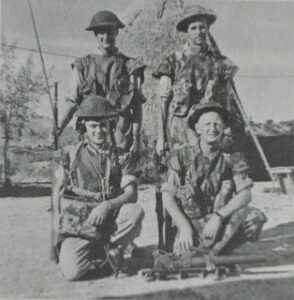
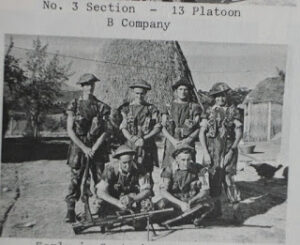
These soldiers are from the New Zealand 24th Auckland Battalion. These photos were apparently taken in Italy in 1944. These are obviously not the German body-apron, which had a V-neck. The Kiwis most likely made these themselves from captured German or Italian camouflage material. Notice that the webbing and pouches have been marked with paint/ dye/ blanco to add additional camouflage effect and that at least one soldier also wears camouflaged trousers. I have seen it suggested these troops have been through “sniper school” but the variety of armament displayed makes me sceptical of this. We see Bren guns, Thompsons and a 2" Mortar but no scoped rifles are evident. The Imperial War Museum collect includes photos of other Commonwealth troops using tabards including one of the 1st Guards Brigade.
Modern camouflaged clothing can be very expensive. These photographs illustrate that reasonably effective camouflage gear can be produced no matter how basic your tailoring skills. In another illustration I have is of German troops in Normandy wearing sleeveless “string vests” designed to hold foliage. There is no reason why a camouflaged tabard cannot be improved further with some bits of frayed cloth, scrim and netting.
Watch news footage from the Middle East and you will note that American soldiers are very easy to identify. Their black or woodland camouflaged body armour appears as a dark blob. This must make a very nice aiming point. Fifteen years of conflict and still this has not been addressed. For several decades I have been advocating that modern soldiers should use camouflaged smocks large enough to fit over their body armour. (And place the knee pads under the trousers while you are at it!). Constructing tabards from any suitable shade of available cloth would quickly fix this problem. 

Categories
Phillosoph

The Shape of Guns to Come?

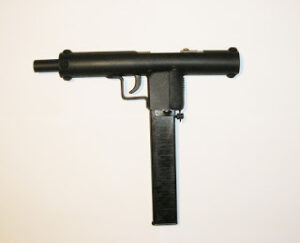
In several of my blogs and in my second book I have suggested that restrictions on gun ownership could create greater opportunities for the supply of legal weapons by organized crime. Tons of narcotics are smuggled across our borders every month and the same routes can be used to import illegal weapons. This is only one option, since firearms can easily be produced in any reasonably furbished workshop.
To illustrate :
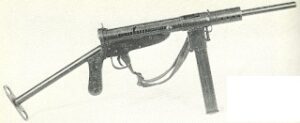
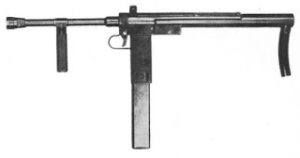
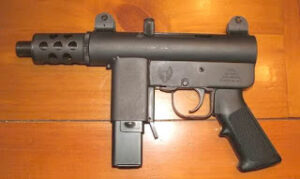
This is the Polish Blyskawica, an SMG designed and produced by the Polish resistance while occupied by the Nazis. The Sten and MP40 inspiration is plain here, but this is an original design. It includes a floating firing pin, something of a refinement over many of the SMGs then in common use. The Poles also produced their own copies of the Sten gun, as did many other peoples under Nazi domination. The Danes even built a "baby sten" (below).

Another Sten inspired weapon, the German MP3008 (above). This was designed to be cheaper and easier to produce than the MP40. 10,000 were made, the Volksstrum receiving many of them.
The EMP 44 (above) was an even simpler German weapon designed to be fabricated from piping. The chunk of metal that mounts the rear sight also reinforces a potential weak spot where the barrel joins the receiver. Only produced as a single prototype.
The Cook SMG (above) from the 50s is another prototype. Essentially it is a Sten Gun that placed the trigger before the magazine well.
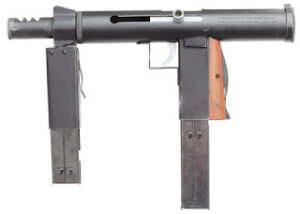
The International Ordinance MP2 was another simple weapon that used Ingram M10 magazines. The foregrip has storage for a reload. The Cellini Dunn SM-9 was a very similar looking weapon.
The MP2 has inspired other simple designs too…
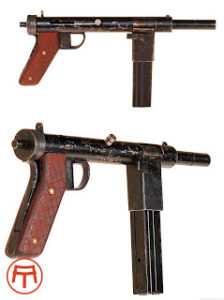
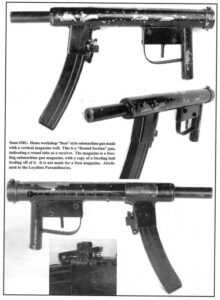
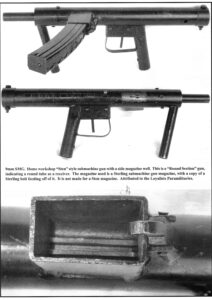
The following guns were manufactured in Ireland during the troubles. Despite the presence of the British army and other security forces weapons still got made or smuggled into the country.

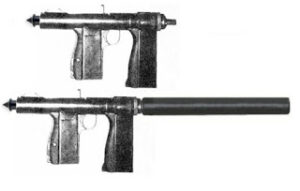
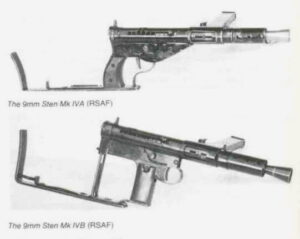
When it comes to easily produced designs the Sten Gun is usually mentioned. It is worth remembering that the Sten  and many of the designs shown above were intended as a battlefield weapons. More compact  and more easily concealed weapons can easily be created. The prototypes below are Mk IV Sten Guns intended for airborne troops. Similar weapons would be attractive to criminals and could very easily be produced.
Illegally-produced weapons similar to the Encom MP (below) or the Danish Baby Sten could easily become commonplace if we create a market for them. Already large numbers of criminally manufactured weapons are in circulation. Many of these are novel designs that are not based on commercial nor historical models.

Categories
Phillosoph

On Aggression. The Three Obstacles of Man.

Regular readers may recall that some time ago I started reading Konrad Lorenz's On Aggression. Reading further yesterday I came across the chapter on Humility in Science. In this section Lorenz describes three factors that he believes inhibits mankind's understanding of his own behaviour. This chapter, and indeed the entire book is worth reading. Below are some selected paragraphs.
 Lorenz: I may claim that the contents of the preceding chapters are natural science: the recorded facts are verified, as far as it is possible to say of the results of a science as young as comparative ethnology. Now, however, we leave the record of facts elicited by observations and experiments on the aggressive behaviour of animals and turn to the question of whether they can teach us something applicable to man and useful in circumventing the dangers arising from his aggressive drives. There are people who see in this question an insult to human dignity. All too willingly man sees himself as the centre of the universe, as something not belonging to the rest of nature but standing apart as a different and higher being. Many people cling to this error and remain deaf to the wisest command ever given by a sage, the famous “Know thyself” inscribed in the temple of Delphi. What keeps people from listening to it? There are three obstacles, all of them motivated by strong emotions.
The first is easily overcome by the man of insight; the second is at least honourable, in spite of its harmful effects; the third is understandable from the standpoint of cultural history and is therefore forgivable, but it is the most difficult to remove.
All three are inseparably bound up and shot through with a most dangerous human quality, of which the proverb says that it goes before a fall: pride. I will now discuss these obstacles and try to show in what manner they are harmful, and then I will do my best to contribute towards their elimination.
The first obstacle is the most primitive. It hinders self-knowledge in inhibiting man’s awareness of his own evolutionary origin. Its irrational quality and its stubborn tenacity are paradoxically derived from the great likeness which our nearest animal relations bear to us. If people did not know the chimpanzee they would be more easily convinced of their own origin…(snip)…he is irresistibly funny and at the same time as common, as vulgar, as no other animal but a debased human being can ever be.
(snip)  The second obstacle to self-knowledge is our reluctance to accept the fact that our own behaviour obeys the laws of natural causation. Bernhard Hassenstein has called this attitude the “anticausal value judgement”. The reluctance of many people to recognize the causal determination of all natural phenomena, human behaviour included, undoubtedly comes from the justifiable wish to possess a free will and to feel that our actions are determined not by fortuitous causes but by higher aims.
A third great obstacle to human self-knowledge is – at least in our Western cultures – a heritage of idealistic philosophy. It stems from the dichotomy of the world into the external world of things, which to idealistic thought is devoid of values, and the inner world of human thought and reason to which alone values are attributed. This division appeals to man’s spiritual pride. It supports him in his reluctance to accept the determination of his own behaviour by natural laws. How deeply it has penetrated into accepted ways of thinking can be seen from the alteration in meaning of the words ‘idealist’ and ‘realist’, which originally signified philosophic attitudes but today imply moral value judgements. We must realize how common it has become in Western, particularly German, thought to consider that whatever can be explained by the laws of nature is automatically devoid of higher values. To anybody thinking in this way explanation means devaluation. …(snip)… Science is often accused of having brought terrible dangers upon man by giving him too much power over nature. This accusation would be justified only if scientists were guilty of having neglected man himself as a subject for research. The danger to modern man arises not so much from his power of mastering natural phenomena as from his powerlessness to control sensibly what is happening today in his own society. I maintain that this powerlessness is entirely the consequence of the lack of human insight into the causation of human behaviour. What I intend to show is that the insight necessary to control our own social behaviour is blocked by the three pride-inspired obstacles to self-knowledge. These obstacles prevent the causal analysis of all those processes in the life of man which he regards as being of particular value, in other words those processes of which he is proud. It cannot be stressed enough: the fact that the functions of our digestive system are well known and that, as a result of this knowledge, medicine, particularly intestinal surgery, saves many thousands of human lives annually, is entirely due to the fortunate circumstance that the functions of these organs do not evoke particular awe or reverence. If, on the other hand, we are powerless against the pathological disintegration of our social structure, and if, armed with atomic weapons, we cannot control our aggressive behaviour any more sensibly than any animal species, this deplorable situation is largely due to our arrogant refusal to regard our own behaviour as equally subject to the laws of nature and accessible to causal analysis. Science is not to blame for men’s lack of self-knowledge. Giordano Bruno went to the stake because he told his fellow men that they and their planet were only a speck of dust in a cloud of countless other specks. When Charles Darwin discovered that men are descended from animals they would have been glad to kill him, and there was certainly no lack of attempts to silence him. When Sigmund Freud attempted to analyse the motives of human social behaviour and to explain its causes from the subjective-psychological side, but with the method of approach of true natural science, he was accused of irreverence, blind materialism and even pornographic tendencies. Humanity defends its own self-esteem with all its might, and it is certainly time to preach humility and try seriously to break down all obstructions to self-knowledge…(snip)
…..The first great obstacle to human self-knowledge, the reluctance to believe in our evolution from animals, is based, as I have tried to show, on ignorance or misunderstanding of the essence of organic creation. Fundamentally at least, it should be possible to remove this obstacle by teaching and learning. Similar means should help to remove the second obstacle, now to be discussed, the antipathy towards causal determination; but in this case the misunderstanding is far more difficult to clear up. Its root is the basically erroneous belief that a process which is causally determined cannot at the same time be goal-directed. Admittedly there are countless processes in the universe which are not goal-directed, and in these cases the question “What for?” must remain unanswered, unless we are determined to find an answer at any price, in measureless over-estimation of the importance of man, as for instance, if we explain the rising of the moon as a switching on of night illumination for our especial benefit. There is, however, no process to which the question of causes cannot be applied. As already stated in Chapter 3, the question “What is it for?” only makes sense where the great constructors – or a living constructor constructed by them – have been at work. Only where parts of a systemic whole have become specialized, by division of labour, for different functions, each completing the other, does the question “What is it for?” make any sense. This holds good for life processes, as also for those lifeless structures and functions which the living being makes use of for its own purposes, for instance, man-made machines. In these cases the question “What is it for?” is not only relevant but absolutely necessary. We could not understand the cause of the cat’s sharp claws if we had not first found out that their special function was catching mice. At the beginning of Chapter 6, on the great parliament of instincts, we have already said that the answering of the question “What is it for?” does not rule out the question of the cause. How little the two questions preclude each other can be shown by a simple analogy. I am driving through the countryside in my old car, to give a lecture in a distant town, and I ponder on the usefulness of my car, the goals or aims which are so well served by its construction, and it pleases me to think how all this contributes to achieve the purpose of my journey. Suddenly the motor coughs once or twice and peters out. At this stage I am painfully aware that the reason for my journey does not make my car go; I am learning the hard way that aims or goals are not causes. It will now be well for me to concentrate exclusively on the natural causes of the car’s workings, and to find out at what stage the chain of their causation was so unpleasantly interrupted. Medicine, “queen of applied sciences”, furnishes us even better examples of the erroneousness of the view that purposiveness and causality preclude each other. No “life purpose”, no “wholemaking factor” and no sense of imperative obligation can help the unfortunate patient with acute appendicitis, but even the youngest hospital surgeon can help him if he has rightly diagnosed the cause of the trouble. The appreciation of the fact that life processes are directed at aims or goals, and the realization of the other fact that they are, at the same time, determined by causality, not only do not preclude each other but they only make sense in combination. If man did not strive towards goals, his questions as to causes would have no sense; if he has no insight into cause and effect, he is powerless to guide effects towards determined goals, however rightly he may have understood the meaning of these goals. This relation between the purposive and the causal aspects of life processes seems to me quite obvious, but evidently many people are under the illusion of their incompatibility…(snip)… Probably the reason why people are so afraid of causal considerations is that they are terrified lest insight into the causes of earthly phenomena could expose man’s free will as an illusion. In reality the fact that I have a will is as undeniable as the fact of my existence. Deeper insight into the physiological concatenation of causes of my own behaviour cannot in the least alter the fact that I will but it can alter what I will. Only on very superficial consideration does free will seem to imply that “we can want what we will” in complete lawlessness, though this thought may appeal to those who flee as in claustrophobia from causality. We must remember how the theory of indeterminism of microphysical phenomena, the “acausal” quantum physics, was avidly seized and on its foundations hypotheses built up to mediate between physical determinism and belief in free will, though the only freedom thereby left to the will was the lamentable liberty of the fortuitously cast die. Nobody can seriously believe that free will means that it is left entirely to the will of the individual, as to an irresponsible tyrant, to do or not do whatever he pleases. Our freest will underlies strict moral laws, and one of the reasons for our longing for freedom is to prevent our obeying other laws than these. It is significant that the anguished feeling of not being free is never evoked by the realization that our behaviour is just as firmly bound to moral laws as physiological processes are to physical ones. We are all agreed that the greatest and most precious freedom of man is identical with the moral laws within him. Increasing knowledge of the natural causes of his own behaviour can certainly increase a man’s faculties and enable him to put his free will into action, but it can never diminish his will. If, in the impossible case of an utopian complete and ultimate success of causal analysis, man should ever achieve complete insight into the causality of earthly phenomena, including the workings of his own organism, he would not cease to have a will but it would be in perfect harmony with the incontrovertible lawfulness of the universe, the Weltvernunft of the Logos. This idea is foreign only to our present day western thought; it was quite familiar to ancient Indian philosophy and to the mystics of the middle ages.
I now come to the third great obstacle to human self-knowledge, to the belief – deeply rooted in our western culture – that what can be explained in terms of natural science has no values. This belief springs from an exaggeration of Kant’s values-philosophy, the consequence of the idealistic dichotomy of the world into the external world of things and the internal laws of human reason. As already intimated, fear of causality is one of the emotional reasons for the high values set on the unfathomable, but other unconscious factors are also involved. The behaviour of the ruler, the father-figure, whose essential features include an element of arbitrariness and injustice, is unaccountable. God’s decree is inscrutable. Whatever can be explained by natural causes can be controlled, and with its obscurity it loses most of its terror. Benjamin Franklin made of the thunderbolt, the instrument of Zeus’s unaccountable whim, an electric spark against which the lightning conductors of our houses can protect us. The unfounded fear that nature might be desecrated by causal insight forms the second chief motive of people’s fear of causality. Hence there arises a further obstacle to science, and this is all the stronger the greater a man’s sense of the aesthetic beauty and awe-inspiring greatness of the universe and the more beautiful and venerable any particular natural phenomenon seems to him. The obstacle to research arising from these unfortunate associations is the more dangerous since it never crosses the threshold of consciousness. If questioned, such people would profess in all sincerity to be supporters of scientific research, and within the limits of a circumscribed special field they may even be great scientists. But subconsciously they are firmly resolved not to carry their natural explanations beyond the limits of the awe-inspiring. Their error does not lie in the false assumption that some things are inexplorable: nobody knows so well as the scientist that there are limits to human understanding, but he is always aware that we do not know where these limits lie. Kant says, “Our observation and analysis of its phenomena penetrate to the depth of nature. We do not know how far this will lead us in time.” The obstacle to scientific research produced by the attitude here discussed consists in setting a dogmatic border between the explorable and what is considered beyond exploration. Many excellent observers have so great a respect for life and its characteristics that they draw the line at its origin. They accept a special life force, force vitale, a direction-giving wholemaking factor which, they consider, neither requires nor permits an explanation. Others draw the line where they feel that human dignity demands a halt before any further attempts at natural explanation. The attitude of the true scientist towards the real limits of human understanding was unforgettably impressed on me in early youth by the obviously unpremeditated words of a great biologist; Alfred Kühn finished a lecture to the Austrian Academy of Sciences with Goethe’s words, “It is the greatest joy of the man of thought to have explored the explorable and then calmly to revere the inexplorable.” After the last word he hesitated, raised his hand in repudiation and cried, above the applause, “No, not calmly, gentlemen; not calmly!” One could even define a true scientist by his ability to feel undiminished awe for the explorable that he has explored; from this arises his ability to want to explore the apparently inexplorable: he is not afraid of desecrating nature by causal insight. Never has natural explanation of one of its marvellous processes exposed nature as a charlatan who has lost the reputation of his sorcery; natural causal associations have always turned out to be grander and more awe-inspiring than even the most imaginative mythical interpretation.
For more from Lorenz


Categories
Phillosoph

When Sneakers Matter More Than Schoolkids

        Those of you who have purchased my second book will have heard this story before.          Many years ago I was watching a documentary about the then newly non-communist Russia and the problems it was having. The section I most remember is when the BBC journalist did his obligatory wet blanket bit and declares in shock:

        “You have armed guards outside the children’s school!”

         An equally shocked Russian grandmother asked him :

        “You would send your children to school that did not have guards?!”

         Once more there has been a shooting at a school and once more the tragedy is being exploited to push anti-gun agendas.
Gun laws do not make people safer. Laws are not a magic incantation that will make a thing no longer exist. We have anti-drug laws yet still have widespread drug abuse. Prohibition made alcohol illegal yet did nothing to reduce alcohol consumption. Organised crime will doubtless be eager to supply and manufacture illegal firearms once there is a market among criminals.

         Banning guns is not what we should be talking about. Even if all the guns vanished overnight, there are still axes, butcher knives, chainsaws and a host of other things a malcontent can use for harming the defenceless. 

         Go to the shopping mall and you will see armed security guards. Go to a school or university and you will see…? What does it say about us that we defend shops full of training shoes and flatscreens with armed guards while we are willing to leave our children undefended?

Categories
Phillosoph

Fairbairn's Thumb Hold

 
Fairbairn's Thumb Hold
For today's blog I am going to reproduce an article I wrote on the Thumb Hhold shown in Fairbairn's book “Get Tough”. The key to grasping this technique (pun intended) is to study Fig 44 below. Note how your hand comes up from the knife edge part of the hand, passes across the back of the hand and secures the thumb with the fingers while your thumb slips between his.
The technique that W.E. Fairbairn called the “Thumb Hold” was one that for a long time puzzled me. I could see that it was an effective prisoner control technique. Fairbairn would not have recommended it unless this was so. The principle of final lock was easy enough to understand. The problem was how did you get to this final destination?
Although Chinese martial arts were seldom taught to non-Chinese in the early 20th century there does seem to be some evidence that Fairbairn had some instruction in some Chinese techniques. The Thumb Hold may be the Chin-na technique called “Yu Wo Tong Xing” or, in English, “Walk With Me”.
Below is a reproduction of the relevant illustration from Fairbairn's book. I have coloured the figures in the hope that it makes the technique a little clearer. I have also taken the liberty of flipping the illustrations to show them applied against the victim's right arm rather than his left. If you are a Police officer you probably carry your firearm on your right side so it is better to apply this technique so your weapon is furthest from your prisoner. The prisoner will probably be right handed so immobilizing his right arm may hinder him using any concealed weapons you may not have been aware of. Appling the technique using your left keeps your right hand free to use your firearm should there be trouble from a third party. There are therefore sound reasons for preferring to apply this technique against the suspect's right arm whenever possible and the rest of the page will be written assuming this is your intention.
Thumb hold is a “mirror move”, by which I mean you apply it right hand against his left, or in this case your left against his right.
Hook or thrust your left thumb up into the web of his hand between his fingers and thumb. The “tip” to remember how this goes is to turn your left hand palm up as though asking for a tip. Fig 42 is not that clear but I believe is supposed to show the action viewed from the German's right side.
What you are going to do now is make two circular movements. With your right foot step back and make a reverse 180 degree turn so you face the same direction as your prisoner. At the same time you move your linked hands in a vertical circle across the prisoner's front. Your hands start off low, circle up over to the prisoner's left then come down back on his right side to finish as shown in Fig. 44. As you made your backward turn and vertical circle you let your left arm slip behind his right so it ends up between his arm and body as shown.
Your right arm helps get his right arm circling by patting his elbow and acting as a fulcrum. This is shown in Fig 43, which is possibly the most confusing illustration in this sequence. I believe it is supposed to show a view of the German's arm viewed from the thumb side. The German's thumb is pointing downwards concealed by the Tommy's hand. The Tommy is in the process of making his rearward turn, bringing back his right foot and pivoting on this left and is about to use this motion to rotate the German's elbow. Fig 44 is viewed from the same angle but the Tommy has turned to face in the same direction. Note that his thumb will be positioned on the same as you.
Fig. 45 is notable in that it shows the Tommy stabilizing the German using his other hand while using the thumb hold to bring the prisoner up onto his toes and keep the German slightly out of balance. Using the German's thumb as a lever he can both bend and twist the wrist joint by just moving his hand towards himself and can also control the elbow.
The Thumb Hold in Fairbairn's own words, directions adjusted for application against the right arm:
    • Stand facing your opponent and slightly to his right.
    • 1. Insert your left thumb between the thumb and forefinger of his right hand, your fingers under the palm of his hand, your thumb to the left (Fig. 42).
    • 2. Seize his right elbow with your right hand, knuckles to the left, and thumb outside and close to your own forefingers (Fig. 43).
    • 3. Step in towards your opponent; at the same time, turn your body so that you are facing in the same direction, simultaneously forcing his right forearm up across his chest and towards his right shoulder by pulling his elbow with your right hand over your left forearm and forcing upwards with your left hand (Fig. 44).
    • 4. Release the hold with your right hand just as soon as you have pulled his elbow over your left forearm, and hold your opponent's right elbow very close to your body.
    • 5. Keeping a firm grip on the upper part of his right arm with your left arm, immediately seize the fingers of his right hand with your right. This will prevent him from trying to seize one of the fingers of your left hand and also give you an extra leverage for applying pressure as follows:
    • 6. Press down on the back of his hand towards your right-hand side with your left hand. Should your opponent be a very-powerful man and try to resist, a little extra pressure applied by pulling his fingers downwards towards your right-hand side with your right hand will be sufficient to bring him up on his toes and convince him that he has met his master (Fig. 45).


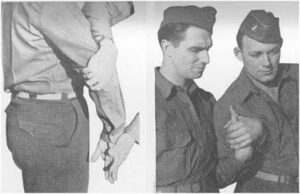
Rex Applegate's book “Kill or Get Killed” contained many of the techniques Fairbairn taught and the following photos are reproduced from that source. Again, I have flipped the images to show application against the right arm.
The left image gives us a much better view of the process Fig.43 was supposed to show. We can see the arm is about to be rotated about the elbow vertically and that the lower arm will be slipped between the arm and body as the Soldier applying the technique moves closer to the camera and turns to face towards our right. This picture actually shows the application of a wrist hold. The wrist hold is a related technique to the thumb hold and is applied with the same action. The difference is for the initial grip the palm of your left hand is placed on the back of his right hand, your thumb over the little finger side of his right hand. Note that in this example the thumb points in the same direction as the fingertips. Stepping back and circling the arm places the prisoner in the bent wrist and elbow position and pressure can be applied by moving his hand towards oneself. In some versions of his book Applegate observes that under certain conditions taking hold of the whole hand to apply the wrist hold may be more easily achieved than trying to initially slip your thumb between his thumb and finger. His suggestion is to apply the wrist hold then use your free hand to secure the prisoner's wrist while you shift your other hand to hold the thumb.
Crude and Rude.
This is an alternate method for applying the technique that will not win you any points for elegance, but may be simpler to achieve in the heat of action.
Grab the prisoner's right wrist with your left hand. Execute the backstep and hand circling action. As you circle the hand you will probably have trouble maintaining the wrist grip, so as soon as possible also take hold of the wrist with your right hand. Slide your left hand across the back of his right hand and hook the thumb to apply the Thumb Hold.OR

Apply a basic wristlock with either hand. Grasp the side of the hand and push into the back of the hand with your thumb to bend the wrist forward. Apply your other hand to the wrist lock for more control.
Maintain pressure on the opponent's wrist with your right hand, step forward, and pivot around to stand next to the opponent. Release your left hand, quickly reach under the opponent's right arm from behind, and grab his hand. Use the left hand and apply downward pressure on the opponent's wrist. Or secure his thumb to press down and rotate the wrist joint.
Thumb Hold Applied from the Rear Quarter.
Slip your left hand between his upper arm and body to grip the biceps. At the same time take his right wrist in your right hand. Turn your right hip in to bend the elbow joint and then turn to your right to slip behind, converting the force into a pull. Slide your left hand from his biceps across the back of his right hand and hook his thumb.

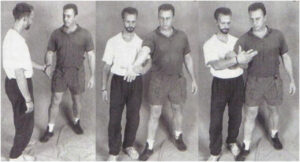
Another variation of the basic technique taken from this page. In this case White applies a wrist hold, clamps the right arm with his left and employs pressure with his right. Pull the hand toward you to exercise control. This could easily be converted into a thumb hold with the left. He does not attempt to bend the elbow until he is beside the prisoner. The position of Black's hand would have made it difficult to have applied the thumb grip from the start. Also note that White has made his initial grip to the little finger side of the hand but with his thumb pointing in the opposite direction to Black's fingertips. This sequence might also suggest what could be done if you initially made a same hand grip, using your right hand against his right.


Tactical Analysis.
Fairbairn sums up the pros and cons of the Thumb Hold very nicely:
    This is the most effective hold known, and very little exertion on your part (three to four pounds' pressure) is required to make even the most powerful prisoner obey you. It is possible also for you to conduct him, even if resisting, as far as he is able to walk. You have such complete control of him that you can, if necessary, use him as cover against attack from others. The movements you have to make to secure this hold are very complicated, which is mainly the reason why it is almost unknown outside of the Far East. But the advantage one gains in knowing that he can effectively apply this hold more than repays for the time that must be spent in mastering it. First concentrate on making every move slowly, gradually speeding up until all movements become one continuous motion. When you have thoroughly mastered the hold, then learn to secure it from any position in which you have secured your opponent. It should be understood that this hold is not a method of attack, but simply a "mastering hold," which is applied only after you have partially disabled or brought your opponent to a submissive frame of mind by one of the “follow up” methods.
I would not bother to teach the Thumb Hold in a general self-defence course. It is too intricate and serves little immediate defensive purpose. For police and prison officers it is a useful technique to be proficient in, however. At least a day should be spent practising the Thumb Hold and its related variations. Suggested topics would be:
    • Application of the Thumb Hold to either the left or right arm.
    • Application of the wrist hold to either the left or right arm.
    • Alternate ways to apply the hold.
    • Application of hold against suspects in varying positions such as seated, sitting on the floor and so forth.
    • Converting a same hand hold into a Thumb Hold.
    • Applying the hold from differing angles and directions.
    • Converting other holding techniques into a Thumb Hold.
    • Dealing with counter attacks and resistance from held suspects.
 
Categories
Phillosoph

Something for the Ladies? Arwrology Ankle Clamp Throw

Long ago, in my nights in the Capoeira roda my “jogo” was noted for a number of characteristics. One was a very well-timed front thrust kick that many of my companions never saw coming until they were staring at the sole of my foot. My other characteristic was how rarely I would use techniques that took me close to the ground. I had been a small child who had grown to above average height as an adult. Deliberately making myself shorter in front of an opponents was something that did not come naturally to me. Also, given my height such moves were somewhat slower for me than when performed by some of the shorter Capoeirista. My height and the related traits may have been the reason that I did not pay particular attention to the Ankle Clamp throws when I was rereading “Arwrology” the other week. Why would I use an Ankle Clamp throw when a shoulder jerk or head twist is a very more natural and quicker technique for me?
The other night I was relaxing at home watching TV when there was a sequence where a female character was ordered to her knees by the bad guy. That might be a good situation to turn the tables with an ankle clamp throw! The love of my life is about a foot shorter than me and half the weight (or less!). Obviously some of the techniques that I favour are not so useful for her. Fools who want to give themselves an illusion of power often make their intended victims beg or grovel. I’m sure many of my readers can think of various ruses where they might get into position for a counter attack such as the ankle clamp.
 Arwrology describes the Ankle Clamp as having four variations depending on which side of the foe you are on and whether your head is “face forward” or “back”. I am going to describe the technique in my own words in the hope that an alternate description may make it easier for some students to understand.

Readers who have read my book will know that I prefer to teach the underlying physical and anatomical principles of a technique. Ankle Clamp is fundamentally the same as many throws: you disrupt the foe’s balance and prevent him changing his footing to compensate.
I will describe two variations of Ankle Clamp since the significant parameter is whether you place your bent knee before or behind the enemy’s foot.
Approach the foe from the side and position your bent knee so that it is in front of his nearer foot (pic. above). Your other foot is placed behind the foe, sole down and thigh parallel to the ground. This is important since the upward thrust from this leg powers the technique. You can rest your same side arm on your knee, which acts as an aide memoire. Since your bent knee was placed in front of the foe your torso goes behind his legs. Once your feet are in position do not hesitate in continuing the technique. You need to be smooth and fast to prevent the enemy realizing what you are up to and countering you. In the photo above the officer is drawing attention to the foe's dagger and that the throw needs to me completed before this can be employed on the thrower.
The arm that is nearest to the enemy we will call the “lead arm” (right arm in the photo above). The other arm, the one you can rest on your thigh we will call the trailing arm. Coil your leading arm around the outside of the foe’s far leg. At the same time slip your trailing arm between his legs and grip the wrist of your lead arm to join them together. You now use your arms to raise that leg up, thrusting down on the foot that is sole down to provide power. If you imagine you placed your bent knee to “the north” you are throwing the leg you hold to the south or south west. Effectively you are throwing the enemy’s balance north or north east and the position of your bent knee and the calf and thigh around it prevents him moving his other foot forward to compensate. These directions are approximate. How you break the foe’s balance will depend on an individual’s stance and reaction.

 
The other variation is when you place your bent knee on the ground behind the foe’s foot. This is the variation the book calls “Head Back”. Your other leg with the sole on the ground will be to the front or out to the side. Once again, you reach your lead arm around the outside of the foe’s leg. Your other hand slips between his legs and joins with the lead arm to lift his leg. The main difference is that in this variation you lead arm will reach across the front of his legs rather than coming from behind. Since in this variant the foe can look down and see what you are doing there is a greater chance of them kicking out or striking the thrower. The solution to this is to make the technique smooth, fast and without hesitation. As the Arwrology book says elsewhere “if anyone can see what you are doing, you are doing it too slowly!”
That is the essence of the Ankle Clamp throw. To make the technique more fluid the original book proposed a simple drill involving two lines of soldiers. One line was to be thrown, the second was tasked with catching the thrown man. A student would then precede down one line, throwing each man in turn. Once the entire line had been toppled the next student would do the same, and so on until each man had thrown dozens of different opponents using the Ankle Clamp.

Categories
Phillosoph

Arwrology Drill

Kata or forms can be a divisive subject in martial arts. Some folks love them so much there are actual kata competitions. Bruce Lee was not a big fan. If I recall correctly this was the subject of his comment about worshiping boats. “A boat is just something to get you to the next place. Once you have crossed the river you leave it and move on, you do not stay to worship it”. That was not his exact words, and he may have made this comment about another topic but I think the sentiment he describes is still worth reflection.
Readers of my book or this blog will know of my admiration for Tai Chi. To many people Tai Chi is nothing but a form or kata. This is not actually the case but this is a common perception. The Tai Chi forms have many layers of meaning and application. Just beneath the health and meditative layers the movements train you in a broad range of defensive and counter offensive movements. Many has been a time I have been working a solution to a problem in self-defence and suddenly realised that a particular action is the same as taught in one part of a Tai Chi movement. A “clothesline” across the throat is the hooked palm of single whip, a jerk on the shoulders the elbow dropping of the beginning moves and so on.
Regular readers will know that I have been looking at the wartime Arwrology book recently. In one section, around page 55 a sequence of strikes is shown as a drill and I did think at the time of reading that this was a rather nice basic kata.
This weekend I got to look at a copy of “American Arwrology” by Fred C Bauer. This is one of those books that seem mainly intended to whet a student’s appetite and cause them to want to learn more on a course. Many of the topics and techniques of the original Arwrlogy book are not included, which is a shame since certain techniques I would have been grateful to see described from a different perspective. The book does have some interesting content and insights however, so do not take this to be a negative review.

 
Bauer devotes a large section to a sequence he calls “D-55”. This is the drill shown on page 55 of the original book. If you have ever undergone parachute training or certain other types of military training you will know that they will often involve long periods of repetition. These movements become so ingrained that when the jump master shouts “in the door” you are there in launch position without really thinking about it. By the time you realise he has said “Go!” you have gone!
Drills like D-55 and other useful katas have the same effect. When you realise an attack is coming your elbow strike, knife hand or palm heel explodes out and hits a target.
D-55 is a very nice drill of honing your basic counter-offensive techniques. It can be performed on empty air but it is also recommended to put some time in using it against a punch bag. The original moves are:
    •  Right elbow strike, outward
    •  Right knife hand. The previous elbow strike sets the knife hand up.
    •  Left hand, punch.
    •  Left knee strike.
    •  Left elbow strike, inward. Follow through of this sets up an outward elbow strike with the same arm.
    •  Left elbow strike, outward
    •  Left knife hand. The previous elbow strike sets the knife hand up.
    •  Right hand, punch.
    •  Right knee strike.
    •  Right elbow strike, inward.
    •  Back to start and repeat. 

 
Bauer does a nice job of illustrating that some of these movements can be changed. In the original book the punch is described as straight from boxing. Bauer’s book shows a low, vertical fist impacting with the first two knuckles. Those of you who have read Jack Dempsey or the section on bone alignment when punching in my book may be puzzled by the latter. I believe this strike is intended for the softer lower area of the body and may use the upper knuckles because of an upward curving action, rather like stabbing a knife up into the diaphragm. I’m a bit above average height so this punch following the knife hand feels more natural as a higher blow and since heads are bony it becomes a palm-heel strike. Following a hand strike with a knee strike from the same side can seem a little awkward for some people so potentially you could swap that over to a strike with the other side knee, incorporating more changes of sides during the drill. My Karate background makes some of these moves with a hikate of the other arm. Knee strikes are often made when hanging on to someone so I make them with a simulated grab and pull back of the “opponent” as the knee strikes.
Drills such as this are not some magic ritual that needs to be performed exactly. Moves can be varied to suit the individual or just for variety.
Categories
Phillosoph

"Ed's Breads" and Other Flour Recipes

In one of my recent posts about mess kits I mentioned that my cooking techniques inspired in my fellow travellers a degree of curiosity and even envy. This was because I travelled with basic ingredients such as flour and porridge rather than (often heavier) pre-packaged meals.
Most hikers live off packets of rice and pasta until they are sick of it. A mountain hut warden I once met in Iceland claimed he had to resort to cooking his own food in a separate building since the smell of real meat could cause riots.
My friend Ed is a man of similar traits so I will start today’s blog with some recipes of his in his own words. This is a selection of recipes for flour that he uses when hiking in Wyoming.
Some of my own comments and variations in Section Two. (I once forwarded these recipes to another friend who was a gamekeeper and ex-soldier. Much to his wife's amusement, he could not stop making and eating flatbreads!)

Ed's Breads

FLATBREAD
Ingredients:  Water, flour
Procedure:  Fill coffee-can approximately half full with water. Shake flour into water approximately one spoonful at a time.
Stir each addition of flour into water before adding more. When mixture is a thick batter, stir busily for two or three minutes before adding more flour.
Continue to add flour and stir until mixture is a wet dough. Turn out onto floured cloth and knead with small additions of flour until dough is shiny and stiff.
Tear off egg-sized pieces of dough and pat flat and thin (1/8" or a bit thicker).
Bake flattened pieces of dough in greased lid of largest cookpot, uncovered, for roughly thirty seconds per side; turn promptly at the first hint of burning.
This is the ancient Egyptian pta, older by far than the pyramids, older than agriculture, the first bread. In India, it's a chuppatti, in Mexico a tortilla. Eat it rolled around butter and honey for breakfast (be careful, it drips), or cold sliced turkey ham for lunch, or curried lentils for dinner. Remember to pat out as many cakes as you plan to eat before starting to bake them: the skillet-time is very short, and you'll quickly run through all your prepared cakes. Don't hesitate to bake more flatbread than you'll eat at one sitting, because they can be carried for days and eaten cold at any time. Or you can re-heat and soften a chuppatti by laying it over the open top of a steaming teakettle for a few seconds. Uncooked flatbread dough can be wrapped in plastic and kept for several days.

SODA FLATBREAD
Procedure:  Fill coffee-can approximately half full with water. Stir in baking powder.  Shake flour into water approximately one spoonful at a time. Stir, knead, form cakes, and bake as for plain flatbread.
This will make a somewhat lighter flatbread.  If the dough is allowed to sit for a few minutes before rolling out, the cakes may expand as they bake, sometimes developing into regular balloons of bread. If so, good.

RICH FLATBREAD
Ingredients: Water, flour, one tablespoon baking powder, one-third to one-half cup vegetable oil.
Procedure:  Fill coffee-can approximately half full with water. Stir in baking powder. Add oil. Add flour, stir, knead, form cakes, and bake as for plain flatbread. These will be crisper than ordinary flatbread cakes.

SORTA BANNOCKS
Ingredients: Self-rising flour, water, small amount of cooking oil.
Procedure: Fill coffee-can approximately half full with water. Add oil. Stir flour into water approximately one spoonful at a time.  Stir, knead, and bake as for campbread, but reduce baking time to 45 minutes maximum.
This is becoming my campbread of choice, just because it's so easy. You can fancy it up with chopped dried fruit, nuts, and so on. Conversely, you can mix in cooked peas or lentils, cooked carrots, cooked chopped onions, etc., and make a serious ration bread for times when you need nourishment but can't build a fire.
CAMP BREAD
Ingredients:  Flour, warm water, two or three packages dry yeast, vegetable oil, honey, one handful raisins, one handful whole or chopped walnut meats
Procedure:  Fill coffee can half full with warm water. Dissolve honey in water. Add yeast to mixture and stir.
Wait 15-20 minutes or until a layer of brown foam has formed on the surface of the water. Add vegetable oil (about one cup for a large batch of bread), raisins, walnuts, and about two cups of flour. Stir well. Continue to add flour while stirring until dough becomes too thick to handle with spoon. Turn dough onto floured cloth and knead until shiny. Return to coffee can, cover with damp cloth, and allow to raise for about 1 1/2 hours or until dough has doubled in mass. Turn dough onto floured cloth, knead briefly, and form into a loaf by hand.
Put seven or eight clean one-inch granite pebbles and a half-inch of water in the bottom of the pot. Wrap the bottom of the dough in heavily oiled aluminium foil and rest it on top of the pebbles. Cover the pot tightly.
Suspend the pot about an inch above a bed of coals and leave it there for two or three hours, or overnight if you mean to let the campfire die down. Depending on altitude, it may be necessary to turn the loaf over about halfway through the baking process.
An hour and a quarter over hot coals would normally be enough. But once sleet was falling through a black night and I had had enough of standing in my poncho watching the campfire. I gave up and crawled into the tent; fire danger registered zero that night.
In the AM (bright and sunny, as it usually is in the Big Horns — and colder'n hell too), after shattering the 1/2" of ice on the tent fly, we crawled out and found that a) the fire was still alive and b) the bread was done to perfection. Luck, I suppose, but I think this approach could work under other conditions too.

This bread is one of the great staples of the trail. It's best when eaten in chunks torn roaring hot off a fresh-baked loaf.  It's next best when sliced and toasted over a new morning fire.  It's still mighty welcome even when all you're doing is building a cheese sandwich, somewhere on the trail to Nameless Lake.

Section Two

Note that lichens can also be used as yeast and in some environments a batter mix will naturally become contaminated with wild yeast, particularly if left in a warm place (such as beside a campfire) and originally made with warm water.

Take a portion of this mix and thicken with flour etc as described above to make your bread or pancakes. Keep the rest of the culture going by regularly adding warm water, a little sugar and flour or uneaten breadstuff. If you have it an occasional teaspoon of vinegar will be appreciated by the yeast. You can transport this culture in a closed top container (the yeast is anaerobic so needs no air) but allow room for expansion.

Other Doughs

The basic dough of just flour and water (with maybe a hint of salt) is much improved by giving it a good kneading. I've seen it suggested that you should add boiling water to the flour, but cold works too and smells a lot better.
Kneaded for ten minutes or so, this is the stuff used to make the pancakes served with Peking Duck and the pastry for Potsticker Dumplings.
Call them tortillas and fry them to make crisp tacos, or use more oil to make soft tacos.
You can also cut this dough into strips and then drop it into boiling water to make fresh noodles. You can add an egg to the noodle mix, but it's not essential. Not the world's best pasta, but I've been served a lot worse. You can also fry your noodles: unlike dried ones you needn't boil them first.
The other basic mix I use is known as Twister Mix:
Flour: about half a cup.
Baking powder: around a teaspoon, maybe less.
Teaspoon of sugar (or honey or syrup)
Pinch of salt
Blob of fat, butter, meat drippings etc.

Water: couple of tablespoons, often less.

The sugar and salt are optional and quantities are varied depending on what you are making. You can also do without the fat, or use oil as Ed does, which saves the job of rubbing the fat into the flour (melting the fat beforehand is a good trick too).
Once all the dry ingredients are mixed, gradually add the water till you have a dough. Ed's method of adding the dry stuff to the water is a good idea since I usually add too much water and have to pile in more flour.
I've seen it written that once the water is added, doughs with baking powder should be handled as little as possible to avoid driving the evolved gases out. My personal experiments with this indicate that my bread is improved by kneading it till smooth: maybe I've just got cold hands!
This dough can be improved by adding nuts and fruit, adding spices, eggs or using milk in place of some or all of the water.
Rolled oats (porridge flakes), pinole or cornmeal may be mixed into the flour.
I've read that fresh snow can substitute for eggs in pancake batter: I've yet to try it. The white ash left after a fire is supposed to be a substitute for baking powder.
Made as a dough the above mix can be wrapped around a stick to make twister bread, or as a flattened round (bannock) to bake either in a vessel or directly on the coals. Dropped in a stew or steamed a ball makes a fair dumpling.
If you have a vessel to cook in you can add more water to make it as a thick batter and avoid the kneading. Just drop a blob onto your frying pan. Made as a thinner batter it makes a pretty good pancake even without any egg added. Knock up some syrup from sugar, water and any fruit juice you may have.
Several ways of cooking dough have been mentioned already.
You'll notice that Ed bakes his bread in a billy, and this can be a good way if you can pile coals around and on top of the vessel, or better still place it in an "Imu" (cooking hole).
You'll also notice that the dough is not in direct contact with the sides of the vessel : you'll have a merry time trying to get the bread out if you let this happen!
Personally, I like to cook my bannocks in a frying pan since I usually have to use a stove rather than a campfire.
Lightly grease the base, or if you have no fat, dust with flour. Place the dough or thick batter into the pan and cook over a gentle heat, turning as necessary.
If cooking on a fire, once a crust is formed the pan is propped up beside the fire to brown the top of the loaf. If firm enough the bread is propped up to stand on its own. Placing a metal plate or pan lid over the frying pan and placing coals on top is another method.

Dough mixes can be therefore baked, fried or boiled and can be used as either sweet or savoury fare. They can also be used for sauces and gravies.

Ed makes his doughs up in a coffee can while mine ends up being mixed in one of my billies, but what if you just have a source of water and a bag of flour as proposed above? Well, you could possibly peel a sheet of bark or use the foil in your emergency kit, but there is an even simpler way

Sit your bag of flour down and make a well in the centre of the flour. Add a pinch of salt if you have it. In one hand you have a stick, in the other a handful of water, or a bottle. Gradually pour in the water while keeping the stick moving. You'll see a blob of dough begins to form on the stick. Flour your hands and remove the blob for kneading. You can also do this for the full twister mix, though rubbing in the fat can be a chore.