Due to legal or personal restrictions, many people do not carry weapons with them as a matter of course.
Those that do often lack sufficient tactical understanding in their use.
Many victims have been killed or injured because they were attempting to draw or ready a weapon rather than deal with the incoming attack first. Many police officers have been killed by dying attackers they had successfully shot and fatally wounded. The attacker still lived long enough to take the cop with them.
This is why a familiarity of empty‑hand skills, particularly parrying and evasion, is needed.
Improvised Weapons
Knowing empty‑hand techniques does not mean you should not arm yourself if you have time and opportunity.
Many such weapons will be objects from your immediate environment. Things that you can throw, parry or hit with. Objects that can be placed between the enemy’s weapon and your own tender flesh.
The best training weapons are those that closely match what is likely to be available as an improvised weapon when an attack occurs.
Mastering a broadsword, sai, nunchakus or quarterstaff has only limited utility, since most objects available as improvised weapons will be blunter and smaller.

Hanbo
One of the first training weapons you should acquire is a hanbo.
In his book “Stick Fighting”, Masaaki Hatsumi tells us a jo is 4 feet 23/16 inches and 7/8 inches in diameter, and that a hanbo is 2 feet 113/4 inches or “walking stick” length.
Based on this, I ordered a 7/8 inch diameter oak dowel, one metre long.
It can be considered as either a short jo or long hanbo. I am taller than most feudal Japanese, so a metre is about the right “walking stick” length for me.
Later, it occurred to me than since a hanbo is “half a roshakubo” it perhaps should have been the same diameter as a bo, which Hatsumi gives as 11/16th inches.
Hanbos available on-line are offered in 24 mm and 27 mm diameters and jos as 15/16.
I am quite happy with 7/8 inch diameter as a training tool, however, since the light weight makes it a little swifter and more agile.
Making a Hanbo
The oak dowel needed very little work.
Using a penknife reamer I made a small depression in the centre of each end. This was mainly to help get the ends symmetrical. It gives the ends a “hollow‑point” look which I quite like.
I rounded the ends of the dowel. I started this with a sander bit on a Dremel, but most of the work was done manually with sandpaper.
Once this was done, the entire length was manually sanded. Run the shaft through your hands a few times, further sanding any spots that need it.
Lastly, boiled linseed oil was applied with a piece of kitchen towel. After about an hour, I applied some more oil. The oil will take 24 to 48 hours to fully dry and cure.
Training
Training with a hanbo can be educational.
As I have previously mentioned, many self‑defence techniques that are taught do not work if the enemy has a knife or other weapon.
The tip of a hanbo is faster than many empty‑hand attacks, so it is a good tool to test your defensive moves against.
Try countering a hanbo strike with an actually block. Blocks match strength against strength. The hanbo is harder than flesh and has no pain receptors.
Use the cross‑block to counter a thrust from the hanbo. Even if it is successful, the hanbo user may easily move the tip up and strike down on the bones of the blocking arms.
Parrying against hanbo attacks may be more practical.
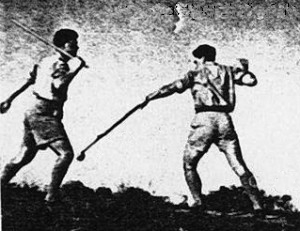
You should, however, have some practices where the hanbo plays a sword. This means the defender may not touch the hanbo “blade” or they are “cut”. This is very good training for honing your evasion skills such as inquartata, V-stepping, ginga, body‑rolling and bow and slip.
Parrying is always preferable to blocking. Evading an attack is always preferable to parrying.
Practising against a “sword” helps improve one’s counter-offensive footwork. You will need to get past the weapon without the blade touching and “injuring” you. Following the principle of “Meet the Meat”, you need to reach a body part of the “swordsman” that you can attack.
Try your baton or nightstick moves with a hanbo. The added length provides more inertia, testing your control and improving your strength and dexterity. Performing abanicos with the hanbo will build wrist strength.
The hanbo may be used to practise staff-fighting moves too. Practising indoors with a full-size staff can be hazardous to the fixtures and fittings. A hanbo is less so, but one should still be mindful of one’s surroundings. Awareness in itself is a defensive skill.
One interesting thing I have found is that manipulating the hanbo one‑handed seems to move the end faster and more forcefully than trying to wield it two‑handed like a katana. Is this because when using one hand I tend to use Filipino wrist roll and circling techniques that need a relaxed hand?
Once the oil has cured, I will have to experiment further.
Recommended Reading
I have already mentioned “Stick Fighting” by Masaaki Hatsumi. The majority of the book is lock and throwing techniques. The reader should pay attention to the statement on p.31: “Do not be in too much of a hurry to apply a throwing or arm-entanglement action but defend yourself with one of the Basic Movements until a suitable opportunity presents itself”
This is a good approach to defence in general. Neutralise the guard or offensive, hit the core, and takedown when possible.
The “Basic Movements” in Hatsumi’s book are strikes at the hand or jabs at targets on the centreline: chin [throat], ribs and solar plexus.
Since evasive footwork will should take you to the side of an attacker, centreline targets may not be readily accessible. Familiarise yourself with other target areas more accessible from the side.
“The Filipino Martial Arts as taught by Dan Inosanto” is another recommended book, useful for learning the basic stick manipulations.
“Attack, Avoid, Survive” and “Crash Combat” both include detailed information on stick techniques.
“Lessons in Sabre, Singlestick, Sabre & Bayonet and Sword Feats” by J. M. Waite is the best book on sword use that I have encountered. “Cold Steel” by Alfred Hutton is also worth reading, although I have reservations about some of the parrying techniques he shows.