Disclaimer: “As an Amazon Associate I may earn from qualifying purchases.” Adsense and Infolinks were no help at all.

If you have enjoyed this article or it has been helpful to you please feel free to show your appreciation. Thank you.

Read The Third Wave by Alvin Toffler!
Categories
Phillosoph

Escape Introduction

In a certain adventure series I watch one or both of certain events are likely to happen every few episodes.
The first is that the protagonists are likely to find themselves deep in dark woods with no phone reception.
The second is that one or both of them will be knocked out and wake up tied up somewhere, usually with a gloating adversary.
You’d think that they might consider investing in a pair of satphones, or some other alternate communication options. Investing in some counter custody equipment would also be logical.
Escape and Evasion (E&E) is not just something for action heroes and spies. Many of us are more at risk than we realize. I can think of at least two people that I know who have been victims of illegal abduction. Neither were wealthy. In one case the motive was rape. Fortunately both incidences ended happily, except for the would be rapist, and I have no problem with that result.
Today’s blog is an introduction to a series of forthcoming posts on the topic of escape.
An abductee may face confinement and/or restraint. I have already addressed confinement to some degree with the articles on lock picking. Lock picking is a non-destructive technique and if you are illegally confined you should have no qualms about damaging property if it allows you to escape.
This blog has also looked at some methods against physical restraint, most recently with an article on escaping zip-ties. For convenience let us divide physical restraint into four broad categories.
The first of these is restraint using cordage. This may be rope, leather thongs, string, wire or a variety of similar items. Here your main options are cutting the cord or undoing the knots. The practicality of each very much depends on the materials used and how you have been tied. Your teeth can be used to chew cord or manipulate the knots. If you cannot reach your own bindings you may be able reach those of a companion. Hands may be restrained before or behind you so any escape gear you carry should be accessible from either posture. Look for edges that you can abrade the cordage against. Look for objects in the locality you can break to create cutting edges. Items such as lighters can be used to burn through bindings.
Once you are free do not neglect the potential of the remaining cordage as a tool or weapon to further aid your escape.
The second class of restrain is that using chains and manacles. In the modern world the most commonly encountered of this category are handcuffs. Such restraints are much harder to break or cut. There are ways to bypass or damage the mechanisms, however. Ways to deal with handcuff restraint will be detailed in forthcoming posts. I’ll be assessing the merits of some of the commercial products offered.
A more recent category of restraint is the use of adhesive tape such as duct tape. I have looked at ways to break such restraints in a previous post. Many of the techniques suggested for use against cordage can also be applied to tape, with the obvious exception that there are no knots to attack. Your location may include organic solvents that can be used to weaken the adhesive. Possible sources include petrol, brush cleaner, paint thinner, stove fuel, nail polish remover, alcohols and similar.
The last category is that of zip-ties and similar devices. A variety of techniques against these have been covered in previous posts. Future blogs will look at some of the tools you may use to apply such techniques.


Categories
Phillosoph

POW Manual Alphabet

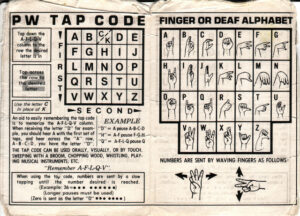
I found this while I was researching the tap code. In addition to the tap code the advice to potential prisoners had another form of manual alphabet.

Categories
Phillosoph

Good Advice from Kephart.

Let us start the week with more wise words from Horace Kephart. Advice as good today as it was nearly a century ago.
“Carry a change of underwear. When on a hike, take your bath or rub-down at close of day, instead of in the morning; then change to fresh underwear and socks, and put on your sweater and trousers to sleep in. Fresh dry underclothes are as warm as an extra blanket would be if one slept in the sweaty garments he wore during the day—to say nothing of cleanliness.”
Camping and Woodcraft 1927 Vol.2 p.100.
Categories
Phillosoph

Underwear for Survival

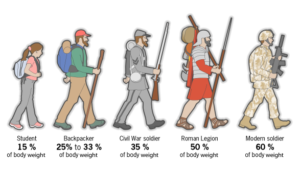
Recently I came across another reference to American Civil War (ACW) “Foot Cavalry”. As has been noted in other posts, many infantry in this conflict became adept at moving fast and light.

John Worsham’s account of the war as part of Jackson’s brigade is worth a read. So too is John D. Billings' memoir, Hardtack and Coffee, I'm told. 

Many of the lessons that they learned and techniques that they practiced have been generally ignored in more recent times.

In previous posts we saw how such soldiers reduced their sleeping gear to a blanket, gum-blanket or oilcloth and perhaps a shelter half. Their food and eating equipment occupied a foot square haversack.

Knapsacks were often discarded and what little they did not wear was rolled up inside a blanket. Such a blanket might contain little more than a spare shirt, socks, a nightcap and perhaps spare underwear.

Some cordage, a sewing kit, tobacco and a bible might complete the load.

One advantage these soldiers had was that their jacket and trousers were of wool, which stays warm if wet and dries more readily than cotton. Some garments were “jean cloth” –a mixture of wool and cotton.
Wikipedia has some silly comments about woollen uniforms, failing to appreciate that woollen cloth need not be the thick, heavy stuff used for modern winter clothing.
Woollen uniforms were used by most armies until after the Second World War, when the printing of camouflage patterns favoured switching to cotton.
Long frock coats were the current military fashion at the time of the ACW, but the majority of soldiers opted for either sack coats or shell jackets.
The sack coat was originally issued as fatigue wear. It was longer than a shell jacket but generally not as long as the civilian garments called sack coats.
The shell jacket was a waist-length garment and was favoured by troops that rode.
Union infantry seem to have favoured the sack coat, while the Confederacy mainly issued shell jackets, probably as an economy measure. Pragmatically the Confederacy allowed trousers to be blue, brown or grey.
Greatcoats were also used, and this article has instructions on how to fold one to fit in the knapsack.
If the knapsack was not being worn, the coat was presumably rolled in the blanket roll or carried in the company baggage until weather was cold enough for them to be needed. Presumably, many soldiers simply wore their blanket as a cloak if it was chilly.
Billings tells us some soldiers discarded their blanket in favour of the coat.
It is what these soldiers wore under their uniforms that is of interest to the modern outdoorsman.
At this period, shirts were regarded as an inner or underwear garment more than they are now. You might have seen soldiers in shirtsleeves, but wearing a shirt as the outermost layer was much less common.
Shirts might be woollen, cotton or linen. They might be issue items or civilian in origin. Many shirts were sent from home and homemade.
Typically, a shirt would be of the pull-over type with a buttoned opening reaching part way down. Such shirts were also thigh-length.
One reason for this length is that a shirt would also serve a soldier as a nightshirt. Nearly a century later, Rommel’s Afrika Korps were also issued long shirts so they could sleep in them.
Another reason for the long shirttails was that many men in the ACW period did not wear underpants. Instead they would tuck their shirt tails between their legs, a practice that dates back to at least the middle ages.
More than one shirt might be worn. A letter from a soldier asks his family to send him four woollen shirts, two of thin wool that can be used as undershirts.
While researching this article, I came across this facebook group detailed the contents of a British soldier’s blanket roll in 1776.
Three shirts were carried, one worn, two packed, and men ordered to “change their linnen [sic] three times a week”.
A recent military innovation of the ACW period was the issue of drawers.
Many soldiers had never encountered such things in civilian life and it was considered good sport to try to convince a newbie that these were parade trousers that he should wear.
The drawers issued were ankle-length and made of a cotton flannel, hardwearing on the outside and soft on the inner face. The use of cotton is perhaps a little surprising, given that cotton is cold when wet and slow to dry.
In a previous post, we saw that the WW2 Soviet soldier wore long cotton underwear, but this was presumably for easy processing through the field laundry.
One presumes laundry for a civil war soldier was more personal or ad hoc.
Perhaps there is something about the combination of cotton drawers under wool trousers that I am missing.
One advantage of cotton is that it could be boiled to kill lice, ticks and fleas.
Wearing two pairs of drawers might be done in cold weather or when riding.
When drawers were worn, the long shirt tails probably provided an additional protection against chaffing.
Worsham mentions Many wore around their waists, next to their skin, a flannel belt or worsted string, to prevent bowel complaint”. This may be a reference to the “kidney warmers” favoured by Germans (and Japanese!) and presumably those men were of German descent, as many Americans were.
Incidentally, “kidney warmers” were another component of Afrika Korps uniform. A future blog will discuss kidney warmers. They seem a useful addition to your cold weather gear.
Laundering seems to have been an issue for civil war soldiers.
New or clean underwear seems to have been a cherished spoil of war. There are even accounts of soldiers redressing during battles.
On the subject of cotton underwear vs woollen, we can look to James Austin Wilder and Horace Kephart, several decades later.
In “Jack-Knife Cookery” Wilder advises scouts to wear “light woolen athletics”, even in summer.
Kephart (Camping and Woodcraft 1927) informs us:
 However, the broad statement that one should wear nothing but wool at all seasons requires modification. It depends upon quality and weave.
Some (wool) flannels are less absorptive and less permeable (especially after a few washings by the scrub-and wring-out process) than open-texture cottons and linens.”
“If woolen garments are washed like cotton ones-soap rubbed in, scrubbed on a washboard or the like, and wrung out — they will invariably shrink. The only way to prevent shrinkage is to soak them in lukewarm suds (preferably of fels-naphtha or a similar soap), then merely squeeze out the water by pulling through the hand, rinse, squeeze out again, stretch, and hang up to dry. This is easy, but it requires a large vessel, and such a vessel few campers have.”
“Drawers must not be oversize, or they will chafe. But one’s legs perspire much less than his body, and need less protection; so, up to the time of frost, let the drawers be of ribbed cotton, which is permeable and dries out quickly. Cotton drawers have the further advantage that they do not shrink from the frequent wettings and constant rubbings that one’s legs get in wilderness travel. Wool, however, is best for wading trout streams. For riding, the best drawers are of silk.
I conclude that for cold weather, for work in high altitudes where changes of temperature are sudden and severe, and for deep forests where the night air is chilly, woolen underclothes should be worn. In hot climates, and for summer wear in open country, a mixture of silk and wool is best, but open-texture linen or cotton does very well. Pajamas should be of flannel, at all seasons, if one sleeps in a tent or out-of-doors.”
“Drawers must fit snugly in the crotch, and be not too thick, or they will chafe the wearer. They should be loose in the leg, to permit free knee action. Full-length drawers are best because they protect the knees against dirt and bruises, and safety-pins can be used to hold up the socks (garters impede circulation).”
In his 1906 edition, “The Book of Camping and Woodcraft” he comments:
 “It is unwise to carry more changes of underwear, handkerchiefs, etc., than one can comfortably get along with. They will all have to be washed, anyway, and so long as spare clean ones remain no man is going to bother about washing the others. This means an accumulation of soiled clothes, which is a nuisance of the first magnitude.”

What does all this mean to the modern outdoorsman or serviceman?

There are obvious advantages to having your field gear of wool but this can be a little hard to achieve in modern times.

Woollen garments tend to be expensive and may be too heavy or too warm for all-season wear.

Wool items can be found on Army surplus sites, often of Swedish or Finnish origin. 

Reenactor suppliers can also yield suitable garments, be they medieval, ACW or 20th century. Prices are often high but some companies do offer budget items.

I have come across ACW sack coats for about $60, which is not bad if you are happy with either grey or blue. Viking/ LARP/ medieval tunics can be found for similar prices and these may actually be more practical items for field wear.


Below is a wool/ polyamid tunic that incorporates printed camouflage components. This suggests how a monocolour woolen garment might be customized.

It is worth noting here that Kephart favoured a cotton flannel or chambray shirt as his outer garment over gauze woollen underclothing.
Trousers were either cotton moleskin or wool kersey.
Kephart notes that:
The material and quality of one’s underwear are of more consequence than the shell he puts over it, for his comfort and health depend more on them.”
Obviously long undergarments can improve our comfort when away from our centrally-heated and air-conditioned buildings.
A common theme we have seen is that woollen undergarments should be light and of open weave.
Kephart and Wilder both advocated that in winter wearing two sets of summer-weight woollen undergarments was preferable over one heavier layer.
Most of the woollen undergarments that can be found nowadays are designed for winter use and too warm for all-season use.
Long underwear of synthetic materials are also mainly designed as “thermals” for when the mercury drops.
For the upper body, we can get by with one or more layers of thin shirts, tee-shirts or long-sleeved tee-shirts.
The Spetsnaz use of string vests is worth recalling here.
Coolmax is a synthetic that is soft, fast drying but not overly warm. I have used a coolmax tee-shirt on several of my travels, including a visit to humid Hong Kong. I didn’t care about getting drenched in the heavy rain since the garment would dry off so quickly when the temperature rose afterwards.
For the legs, most of the long underwear commonly available is likely to prove too warm for all-season wear.
String long johns seem to cost ten times the price of a string vest!
One solution may be to repurpose some pyjama bottoms as long field drawers. Brushed cotton, cotton flannel and soft polycottons should all prove suitable. Just make sure the fit around the loins is sufficient to prevent chaffing.
The pyjama top can serve as a shirt, if pattern and colour allow.
My female readers may have guessed the second suggestion, which is to use pantyhose/ tights as an inner layer. Many horse riders know the benefit of these against chaffing. You can even get tights specifically designed for men, some more so than others!
Tights/ leggings in coolmax can be found and I am considering acquiring some.
Categories
Phillosoph

Morse Code

I touched on the topic of Morse Code in the last post.
I learnt AMA in under a day and Cykey coding in less than an hour. Could I memorize Morse? Here is how I approached the task.
 
Firstly, learn the letters as sounds. Use your phonetic alphabet and say the Morse after the letter. “Whiskey: dot, dash, dash” or “Quebec: dah, dah, dit, dah”.
 
Most of you will probably already know one bit of Morse: SOS is three dots, three dashes and three dots.
 
Learn the vowels first. The most frequently used letters in English are the shorter sequences in Morse.
Alpha is a simple dot-dash.
Echo is the most used letter in English so is a single dot.
India is two dots, like a pair of eyes. (“eye-eye!”)
Oscar you already know from SOS. It is three dashes.
Uniform is two dots and a dash (un-i-FORM).
Each of these vowels have a Morse character that is either their reverse or their inverse.
Alpha written backward is November, dash-dot. A and N form the word “An”. Alpha and November are both reverses and inverses of each other.
You cannot write Echo backwards but you can swap the dot for a dash. A single dash is Tango. E and T go together as in “ET phone home”.
The inverse of India is Mike, two dashes. I and M form the abbreviations “I’m” or “’im”.
The inverse of Oscar is three dots, which is Sierra which you already know from SOS.
Uniform backwards gives us Delta dash-dot-dot. D and U form “du”, a phonetic rendering of “do”. Or you could think of “depleted uranium”.
To the above we will slip in another letter you may already know. “v-for-VICTORY”, three dots and a dash you may have seen in old war films. I always remember a scene when a Lancaster bomber flies past and flashes this signal to the ground troops, one of the soldiers explaining it to the others. 
The reverse of Victor is the Morse code for Bravo. B and V sound similar. “Bravo for the Victor!”
 
You have just learnt twelve letters in Morse code! That is nearly half the alphabet, and includes some of the most commonly used letters. You can create many messages with just these.
 
There are four “loner” or “orphan” letters that do not have an inverse or reverse in the standard code. They are Charlie, Hotel, Juliet and Zulu. You will have to memorize these individually, but there are only four. All of these are four elements long.
You now have sixteen letters. Only five more pairs to go.
 
Next, learn some simple words that use other characters.
I learnt my name which gave me the codes for Papa, Hotel and Lima.
Papa is actually the letters A and N together. The inverse of this is N and A and is the code for X-Ray. P and X go together as PX (Post Exchange) or XP (eXperience Points).
Hotel is four dots, or two Indias. There is no four dashes in the standard international Morse alphabet.
The code for Lima reversed gives me that for Foxtrot. I associate this pairing by thinking Lima sounds like an animal and Foxtrot that it sounds like something to do with animals. Lima is one I remember by the visual mnemonic: A line with a dot on top and two to the side.
 
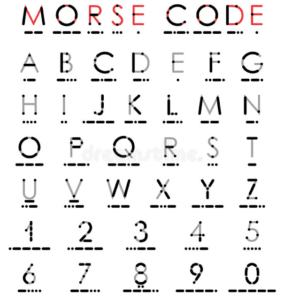
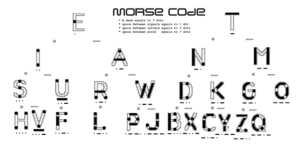
The chart below is a visual representation of Morse code. You will see a number of different versions of this. I like this one since it reproduces the codes in a linear fashion beneath each character, avoiding misreading the graphic. This chart will help you remember some characters. 
There are various ways to learn the other characters.
Charlie (CATCH-it-CAN-it) is memorable because it seems odd it is so long. Dash-dot-dash-dot. There is no reverse of this in the standard alphabet.
Juliet is another loner. It is one dash more than Whiskey.
Quebec, dash-dash-dot-dash also sticks in my mind, and may be remembered by the rhythm of “GOD SAVE the QUEEN”. The reverse of Quebec is the code for Yankee. Associate this pairing by thinking both “Q” and “Why” can be questions.
Kilo (KICK-the-CAN) is dash-dot-dash. “K” and “R” look similar and Romeo is the inverse of Kilo, dot-dash-dot.
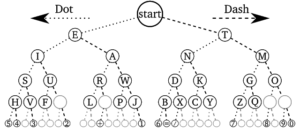
Another chart, sometimes called a Morse Tree or dichotonic key.
You will encounter different versions of these and some put “dash/dah” on the other side, so look carefully.
This key is mainly of use in translating from Morse. It helps me remember that Juliet is one dash more than Whiskey (the-WORLD-WAR).
The reverse of Whiskey is Golf. Golf and Whiskey are associated, or you can think of G and W paired as in “Gross Weight” or “Games Workshop”/“Greedy Wizard”.
 
Golf and Whiskey, Bravo and Victor, and Delta and Uniform all have the “earlier” letter of the alphabet of their pair begin with a dash, the later letter with a dot.
Some letters I remember by breaking them up into smaller letters. X-Ray is dash-dot-dot-dash so I remember it as “NA”. Like the letter X, the code is symmetrical.
Zulu is dash-dash-dot-dot, so “MI”.
The question mark is dot-dot-dash-dash-dot-dot. This is also the Morse prosign for “I will repeat” or “please repeat”. It is often taught as “IMI”.
 
Do not forget to take a look at Morse Without Electricity.
 
Memorizing the Morse code is not the same as being proficient or fluent in it, of course.
An emergency situation is not a time for tests of memory if you can help it. Therefore I suggest you include backups.
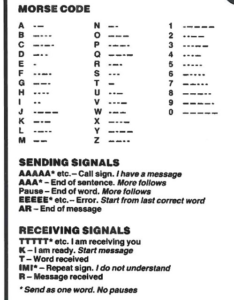
I have a small wallet that holds credit cards, membership cards and the like. For years it has carried a laminated card I made with Morse code on. Many of you will recognize the book I photocopied the original from (Note misprints of numbers! All numbers have five elements).
My card is folded just above “Sending Signals” so that the alphabet is on one side of the card and the signals on the other.
For larger kits I suggest you consider a suitably sized rendition of the chart below. I have modified this so that the linear form of the codes is below each character.
An alternate card may be found here.

Numbers

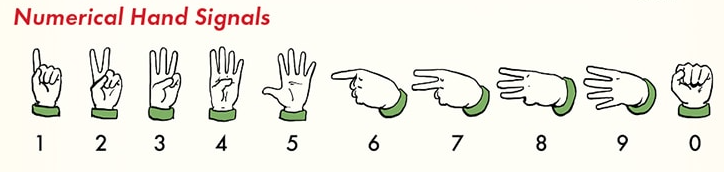
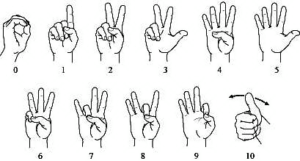
Relate the numbers in Morse to the hand signals for numbers. The image in colour, borrowed from the Art of Manliness page, is the system used in TC 3-21.60.
Note that since these are a tactical communication, the left (non-weapon) hand is usually used to make these signals. AMA, in contrast, is made with the dominant hand.
Tactical Hand Signals for Numbers
An alternate system, using a folded finger for 6 to 9 may also be encountered.
Number 10 with the fist clenched and the thumb raised or wagged may also be seen.
Alternate System of Number Hand Signals
All numbers in Morse have five elements.
For 1 to 5, number of fingers raised is number of dots in the coding, working from left to right.
For 6 to 9, number of fingers extended to the side is number of dashes, from left to right.
For 6 to 9 in the folded finger system, the number of dashes is the number of the folded finger, remembering to start with the little finger and move towards the thumb.
Categories
Phillosoph

Binary Tap Code

In the movie “Ship Ahoy”, Eleanor Powell’s character tap dances as message in Morse code.
In real life, Vietnam POW Jeremiah Denton informed the world that prisoners were being tortured by blinking out the word “TORTURE” in Morse code.
I cannot be denied that Morse code is useful.
It is not the easiest system to master, however.
You have doubtless seen movies where someone knocks on the plumbing and a character identifies it as Morse code, which one of them can understand.
Morse code actually requires two signals, distinct in sound or duration, so it is impossible to tap out certain characters in Morse by banging on pipes.
SOS is one of the few signals you can tap out with a single sound. In this instance you may vary the interval between taps, rather than their duration. Three fast taps, three slow taps, three fast.
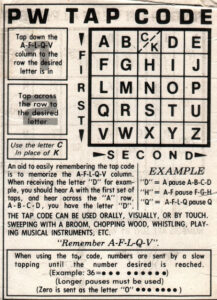
Another code system used by POWs was the tap code, sometimes known as the 5 by 5 tap code.
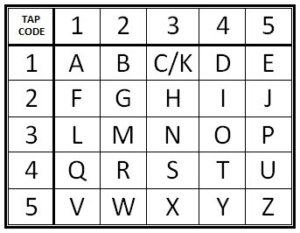
This code relies on creating or visualizing a 5 x 5 table of letters.
C and K are treated as the same letter.
The position of the desired letter in the matrix is identified by two sequences of between one and five knocks.
For the first set of knocks you count down the rows of the matrix.
For the second set you count across the columns.
Three knocks in the first sequence would have you count down to “L”.
Four following knocks would have you count across and end on “O”.
3-4 is therefore “O”.
A disadvantage of this code is that more than half the alphabet requires six or more knocks. Common letters such as U and Y need nine!

An idea that occurs to me is to combine some elements of Morse and the Tap code.
To do this, the references for the letters are converted into binary, using “dits” for zeros and “dahs” for ones.
A number value up to seven can be represented by a three-figure binary number.
The location of any letter on the Tap code matrix can therefor be represented by six figures or six taps.
That all letters are the same length may be useful for some applications such as binary one-use pads.
Since “O” is 3-4 it can be represented as 011-100 or dit-dash-dash-dash-dit-dit.
A dash means to move down a row or across a column, a dit to stay.
The binary system also allows us to distinguish “K”. Logically this is to the right of “J” so 010-110.
The binary referenced table potentially has 49 character positions, 64 if the zero rows and columns are included.
Numerals zero to five would be 000-000 to 000-101. Six to nine would be 001-000, 010-000, 011-000 to 100-000.
This is similar to the hand signals for numerals six to nine. 

SOS would be 100-011, 011-100, 100-011, so the Morse code …—… is easier to retain.

In binary tap code this effectively 3-7-3.

None of the standard letters use 7 so seven on its own could be used as a distress or “!”. 

Categories
Phillosoph

Universal Lever Lock Pick

Most of my lock picking has been geared towards cylinder pin locks. The same skills can also be applied to wafer locks. There are, of course, many other types of lock mechanism. Warded locks were discussed in a previous post.
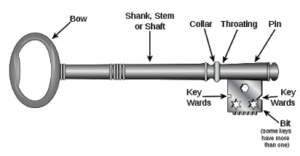
A lock mechanism I often see on the television is that of lever lock or some other design that uses this form of key:

Sometimes this is because the program is set in the past, or set in an old location. Often the lock is for a jail cell in some “developing” nation. My beloved Bogotas are of very little use against such a lock! Naturally I am curious as to how such locks can be dealt with.
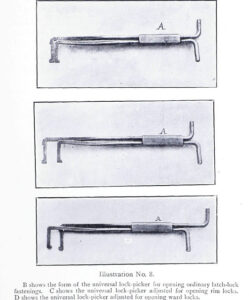
The other day I encountered Houdini’s book “Handcuff Secrets”. Despite the title, he covers many other topics and it is an interesting read. One particular item he shows (p.71) is the ingenious device shown below, constructed from two pieces of steel and some brass tube.

Categories
Phillosoph

More on Finger Spelling

The recent posts on American Manual Alphabet made me recall something many decades past. A summer long past at primary school when I had become interested in codes and cyphers. One of the books in my possession back then was “The KnowHow Book of Spycraft”. Recently I have been reading the “The Official CIA manual on Trickery and Deception” and realize many of the ideas in the children’s book are more practical than you might expect. Supposedly Soviet spy Oleg Gordievsky, testified that the KnowHow book gave away the KGB’s tradecraft.
When I look at the tracks of a bicycle in the snow and estimate its speed, it is something I learnt from the KnowHow Book of Spycraft. Even today this book and the related “Usborne Spy’s Guidebook” are well worth a flick through, especially if you want to inspire a youngster to noticing more than their phone.
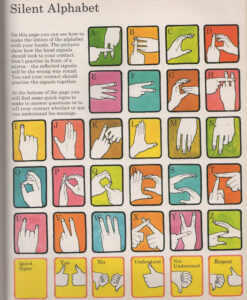
The reason I recalled this book is that it contained the following page:
The system is less like British Finger Spelling than I had thought. Some of the single-handed signals have potential as useful supplements to the AMA symbols we have already learnt. For example, “Echo”, “Foxtrot”, “Mike”, “November” and possibly “Uniform” will all be clearer over a greater distance than standard AMA signs. “Juliet” can be made with less hand movement, although I would suggest this is always made with the four fingers raised to distinguish it from the standard “Lema” gesture.
Categories
Phillosoph

Tension Tools

Version 1.3
Some time ago there was a knock on my door.
A female student accompanied by a member of staff.
The young lady had locked her keys in her locker.
Could I do something?
Ironically, I had been having a sneaky read of some lock picking ebooks when I was disturbed.
I have access to three sets of bolt cutters in that building, but the issue was not could I do something, but should I?
I pointed out that I could not open a locker unless I had proof it was her locker.
Who had allocated her the locker?
The answer was the person who would have been my first port of call for the bolt-cutters.
I pointed out that he may not be in his room, selfishly enjoying his well-earned lunch break.
Dully, the student muttered something about could I give her a clip to open the lock with.
“Do you mean a paper clip?”
Bovine grunt to the affirmative.
Ironically I have just about everything in that room except decent springy paperclips!
“You can’t pick a lock with a clip. You need a tension tool too” I told her.
One might think, given that this is supposedly a future scientist, that “What is a tension tool?” might have been a likely response, with possibly, “Do you have a tension tool?” or “How do I get a tension tool?”
A further grunt about clips and she wandered off with the member of staff to find a paperclip.
I have no idea how much time she wasted trying to pick the lock without a tensioner.
Picking is all about the correct application of tension.
It doesn’t matter if you are single-pin picking, raking, using a pick gun or an electric pick; you still need a tension tool.
One of the most common mistakes about picking that you see in the movies is a character using a pick or pick gun and no tension tool. This is like a horse-riding scene without the horse.
Admittedly, tension tools are the less glamorous half of the double act.
In many kits you get dozens of varied pick designs but just a couple of tension tools, almost like they are thrown in as an afterthought.
Picks show considerable variety, while tension tools often seem to be bent bits of metal, often home-made.
As you become more experienced, you begin to appreciate that the tensioner and how you apply it is critical in whether a lock opens easily or not at all.
The proportion of tensioners to picks in your kit may begin to shift, particularly when you realise you only use a small proportion of your available picks for most tasks.
Tension tools are commonly called “tension wrenches”, although some pickers object to the term “wrench”.
It can also be argued that what pickers call “tension” is more strictly “torque”, so the term “turning tool” is used as well. That said, web-searching “tension wrench” will give you more hits relevant to lock picking than “torque wrench”.
Trying to acquire more tension tools can be frustrating!
Some companies will only sell you turning tools as part of a larger set or with a pick kit.
When you can buy individual items, many companies do not bother to list the width and thickness of the tools.
Also. crossing the Atlantic tends to at least double the price!
Not surprisingly, many pickers tend to “roll their own”.
Turning tools are easy to make or modify. Tolerances are broad and tools are not subjected to strong forces.
If you do make your own, the dimensions given for the Southern Specialities 2500 set (below) may prove useful.
BosnianBill’s article on tension tools provides some useful photos of tools alongside steel rules. Another useful page for dimensions and design features may be found on this page.
Red: .030" thick .50" leg, .125" wide and 3" long; .25" leg, .094" wide and 3" long.
White: .040" thick .50" leg, .125" wide and 3" long; .25" leg, .094" wide and 3" long.
Blue: .050" thick .50" leg, .125" wide and 3" long; .25" leg, .094" wide and 3" long.
Finding materials to make your own tools can be problematic.
The “steel wiper blade inserts” usually recommended are not as easy to find in some areas as others.
You take pot luck at what you can find, and as was seen in my account here, thicknesses of material can be significant.
It would be nice if more retailers sold raw materials for making tools.
There are other options. Some pickers make tension tools by bending the tips of screwdrivers.

TOK and BOK

You will encounter the terminology TOK and BOK.
American locks are usually mounted pins upwards, so turning tools that are applied to the pin side of a keyway have become known as “top of keyway” (TOK) tools and the alternative “bottom of keyway” (BOK).
In Europe, it is common for locks to be mounted either way up, so these terms can be a little confusing.
TOK is often used as a term for prybar-type turning tools and BOK for other tools.
In reality, some prybars may be applied to the bottom/outside of a keyway and a narrow headed BOK tool might be used on the top/inner side of a keyway.
TOK tools tend to be used at the 12 and 6 o’clock positions, BOK at more oblique angles.
Alternate terminology is “centre of plug” and “edge of plug”.
Typical “L-shaped” “BOK” turning tools (above).
The two on the left are both 3mm/0.12" wide, which could be considered to be the standard width.
The longer one has a twist handle and is from a set of five tools that is widely available on ebay. They take ages to come but cost very little and were surprisingly nicely finished.
Their price makes them a good source of materials for customization or creating your own tools.
The shorter tool is from my Serenity kit and is probably the tensioner that I use the most. I plan to bend the end into another, narrower head.
Generally, turning tools are used with very light pressure, so do not need to be very long.
A tool such as the longer one above could easily be cut and made into an additional tool.
I will keep this tool as it is just in case I ever need a long tool. It could easily be bent into a shape that can be used on a tulip lock, for example.
Keyways are very useful for bending and improvising tools.
Second from the right is one of the tools supplied with my larger Chinese pick set. It is narrower and noticeably thinner than the two to the left but still useful.
It could also be cut to make a second tool or bent to make a Z-tool.
Rightmost tool (above and next below) is made from a pen clip. Unusual in that it required some unbending rather than bending. The shoulders and head could be filed down if desired, and the other end could also be made into a head for a Z-tool. This nicely illustrates that a turning tool need not be that long.
Update: I have since seen it suggested that longer turning tools provide greater feedback, which is logical.

Tulip turning tools are used for locks recessed into doorknobs. This is obviously an application where length has advantages.
This article notes that the same effect can be more simply be achieved by creating a tool with a sixty-degree bend.
The handles of many Bogota picks are already at sixty degrees.
Two home-made Z-tools (above).
The one on the left is made from a laboratory spatula. This was intended as a wide turning tool so was left at its original 4 mm width. It could easily be filed down to standard or narrow width.
The keyway of a padlock was used to bend the ends.
The next tool from the left was made from a windscreen wiper insert and was seen in my article here.
The short end has been filed down to about 2 mm and the shank and shoulders suitably filed and tapered (shown below).
The shorter end is used in small locks but can also be used TOK. The end of the shorter nose will be filed square for more effective use TOK.
The result is a versatile tool that can be constructed in just a few minutes.
Ideally I would have a set of these in different thicknesses, complimented by the larger tool. 
The middle tool is the standard-width tool from my larger Chinese kit.
Next to it is another tool made from a pen clip, but not yet filed to final dimensions.
The rightmost tool is the same design as that which comes in the Goso hook kit, and one of the most useful parts of that kit.
This tool also comes with the five-part tension tool kit I mentioned earlier.

Flat Z-tools (above).
These three on the left came with the five-part tension tool kit.
Unlike many Chinese-made picks, the turning tools are competently finished and seem serviceable. One is thicker than the other two.
I don’t use these a lot but they work well enough and I have even had some TOK successes with them!
It is a shape worth bearing in mind if you are improvising turning tools. Such turning tools are often associated with picking dimple locks.
On the far right is the prybar tool from my Serenity kit.
Prybar and TOK tensioners are favoured by many pickers who are far more experienced than myself.
TOK gives more room for hooks and probes to move when single pin picking (SPP). BOK allows a rake to make better contact with the pins.
I find I have trouble with them popping out of locks.
Prybars are often used for picking with TOK, which I often cannot get to work, perhaps because I usually rake locks.
Part of the problem may be the Serenity prybar appears to be under 1 mm thick, probably 0.8 mm, so not suited to some of the wider keyways I have on some locks. This prybar works with my narrow SKS lock.
Ideally you also want prybars made from 1mm/0.04" or 1.2mm/0.05" thick material.
Many retailers do not bother to list the thickness of prybars, so you may encounter thinner examples.
Y-shaped turning tools are used for certain styles of car lockway. Many of these locks have shutters and wafers on either side.
This type of turner are sometimes called “wishbone” tools. 
Lock picking is generally about “less force, more finesse”.
If it is not working the solution is usually a gentler touch on the pick, rake or tensioner.
Spring tensioners reduce the tendency to apply too much torque.
By the time I tried using a spring tool I had already developed the habit of a light touch and had to use more pressure on it than I was accustomed to!
Springs seem to work but you should learn to use more conventional tensioners if you are to be proficient with improvised devices.
My experience with turning tools made from hairpins has been mixed.
The best results have been with tools constructed to be at a vertical angle to the lock, like a prybar. Bend the end over so it acts as a wider, flatter beak that cannot turn.
Wider keyways will need additional modification.
You will probably find hairpins too wide to be used as picks on some locks.
The challenge is bending them in the right direction.
 
Categories
Phillosoph

Luggage Locks and Skeleton Keys

Warded locks are very simple devices.
At the far end of the lock is a catch or spring. Rotation of the end of the key releases this. Between this mechanism and the keyhole is a space with a number of cross-walls or “wards”. The key cannot turn unless its cut-out sections coincide with the position of the wards.
With a little forethought, keys can be designed that will only open certain locks in a house, but not others. The downside is that warded locks only really prevent the use of other keys. If most of the excess metal of a key is removed the result is a key that can open a warded lock irrespective of the pattern of wards. This is the original meaning of “skeleton key”.
Items such as screwdrivers might be modified to open some locks.

Warded mechanisms are still used and a set of skeleton keys can be purchased or fabricated with modest effort or expenditure. Such keys are, however, too large for the small warded locks commonly encountered on luggage.
While still common, such locks have dubious value. Many small padlocks can easily be snapped open, sometimes without the need for tools. These, and many other luggage locks, can be bypassed by items such as pens applied to the zipper.
The keys for such small warded locks do not exhibit much variation. Some locks don’t even have any warding inside! I have a key on my bunch from a lock I have not seen for decades.
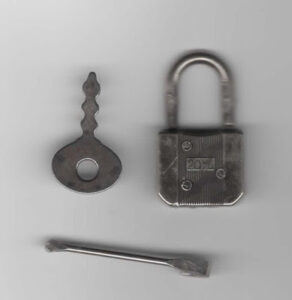
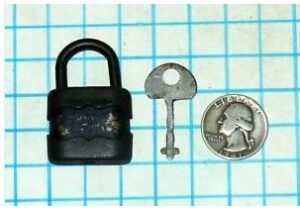
When I encountered a small warded lock recently, I tried the key and it opened the lock like they had been made for each other. Below is the lock, the key that opened it and a skeleton key for small warded locks that I made.
Below: A lock with a skeleton key made by filing down a similar key.

Some of your lock picking tools might open a small warded lock.
I have opened such a lock using hooks, half-diamonds, single-hump Bogotas, half-snowmen and snowmen. A ball or half-ball would probably work too.
Just insert the pick and rotate until you trip the latch or spring. Small jiggler keys also may work.
Conventional lock picks are not really designed to take lateral pressure, so such use should be occasional or for when you do not have a better alternative.
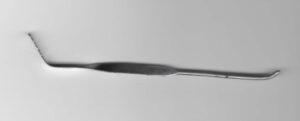
If you are a customs officer or someone else who often has a legitimate need to regularly open such locks you can make yourself an opener from some stout wire, tube or rod. Below is a photo of one of my turning tools. The rod section of the handle has been given a slight hook for opening small warded locks.
Alternately, the creation of a small skeleton key should be relatively simple, particularly if you already have a similar key.
Skeleton keys can also be formed from scrap metal.
The skeleton key that I made was created from a section of laboratory spatula. It was produced in under three minutes using just pliers and a needle file. This now rides the same keyring as my other skeleton keys.