Disclaimer: “As an Amazon Associate I may earn from qualifying purchases.” Adsense and Infolinks were no help at all.

If you have enjoyed this article or it has been helpful to you please feel free to show your appreciation. Thank you.

Read The Third Wave by Alvin Toffler!
Categories
Phillosoph

Umbrella Fighting : Part 4

Latest version of this article is available here.
In the final part of our discussion of the umbrella as a defensive weapon it is time to consider the counter offensive capabilities of the device.
The use of the umbrella in the two-handed “swagger stick” grip has already been covered in an earlier blog, as have the defensive moves, so today we will concentrate on the one-handed “rapier style” offensive techniques. Some of the techniques we will discuss will appear familiar from sport fencing but in certain details there will be differences, as will become apparent.
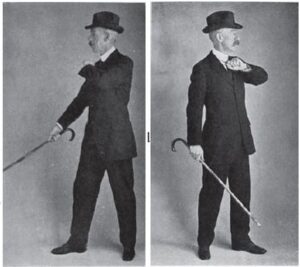
To make learning the basic principles easier we’ll start off with a ready stance. If used for self-defence you will probably need to go straight into an attack when threatened. The sword stance below is a training aid. Against an actual enemy you are better advised to use the rear overhead stance shown immediately below or the low guard positions shown in the pair of photos after. Note position of the free arm. All of these positions reduce the chances of the umbrella being grabbed. From this you can step back into a two-handed or sword-style stance as the enemy advances.
 
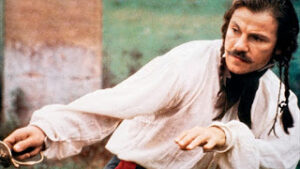
To learn the thrust adopt a posture with your strong side advanced. Your feet will be between 18" and 24" apart. In his book on Broadsword Sir Richard Burton defines the width of the stance as “two foot-lengths”, which gives us a convenient measure by which to proportion this to smaller or larger individuals. Your knees should be slightly bent and your weight evenly distributed. You will be higher and more erect in posture than a sporting fencer. Your strong hand, holding the brolly, should adopt the position of Tierce. The point will be about level with your weak-side eye and your strong hand level with the chest on the strong-side. Your elbow should be down and in-line with your hip rather than sticking out. It should be comfortably bent and about a fist width from your torso. Your weak-hand will be positioned over your chest ready to defend as Harvey Keitel is kind enough to demonstrate for us.
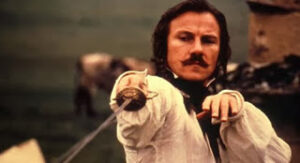
Next we learn the lunge. Step your lead/strong-side foot forward so there is four foot-lengths distance between your feet and your rear leg is straightened. At the same time extend and straighten your lead arm to thrust. This action may raise your hand a fraction higher than the point and rotate your palm outward if made from Tierce. (For a thrust from Quarte the palm may become turned outward.)
In sport fencing combat stops when one player lands a lunge. In self-defence this will not happen so regardless of if you hit your target or not a lunge must be followed by an immediate withdrawal. This is why the lunge we are learning is shorter ranged than that of the sporting fencer. If you are adept at fencing moves such as the lunge or flèche use them, but be wary of overreaching yourself or compromising your ability to withdraw quickly. The withdrawal is made by bending your rear knee and springing back off your lead foot. Your weapon should move back into a guard position. It is recommended that you gain proficiency by practicing the lunge and other footwork without the arm actions.
As well as lunging you also need to be able to move about. The basic movement is the sliding step. Move the foot closest to the direction you want to go, place it down and then adjust the other foot. Longer ranged movements are made with the passing step. Step forward or outward with the rear leg then bring the other leg forward to resume the lead. These actions are detailed in my book so I will not cover them further here. Sporting fencing is linear and performed on a narrow strip of floor. Self-defence will involve more lateral movement so utilize the Pa Kua and Ginga footwork detailed in my book to circle a foe or avoid attacks. The Inquartata, Volte, Demi-Volte or Passata Sotto moves described in my book in the knife-fighting section are also applicable to umbrella fencing.
The tip of a typical umbrella is not sharp. Usually it is a narrow but blunt-ended tip and this is quite interesting from a martial point of view. In modern sporting foil the torso is the only legitimate target area. When rapiers and smallswords were used as weapons the chest area was actually a target area to be avoided if possible. There was too great a possibility of a penetrating blade becoming stuck. This is not a problem with the tip of an umbrella, however. It can apply considerable force with little danger of deep penetration, making it highly effective against the ribs, sternum or the intercostal muscles. The tip also has a considerable effect against softer areas, but is best applied at the more sensitive areas.
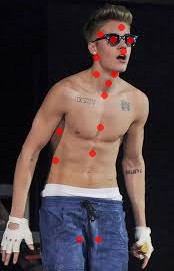
Our illustration above shows just some of the potential target areas. The points marked on the legs are the femoral nerves and arteries. Psychologically a hit to this area has a similar effect to one directed at the genitals but it is easier to inflict a solid hit here. If you can get behind the attacker the kidney region is a good target but a similar effect can be achieved by hitting the side of the torso as marked. The targets on the neck and head are more dangerous and should be attacked only if your life is in danger.
So far in this article we have considered the point of the umbrella. The handle in your hand can be used to strike should your attacker get within the range of your point. Switching to the two handed moves detailed in a previous blog is another option if range decreases.
A number of other techniques can be used with an umbrella.
The umbrella can be used as a single handed club, striking with the handle. This may be done if the umbrella is being gripped near its middle and there is insufficient time to adopt the fencing or two-handed holds. How effective this will be will depend on the weight, shape and construction of the handle.
Many umbrellas have a hooked or crook handle and this can possibly be used to hook a neck or ankle and pull an attacker off balance. A one-handed grip provides reach but a two handed grip gives more power and permits a quicker follow-up move.
Another move that can get a foe off-balance is to thrust the length of the brolly between their legs and move it to trip them.
Umbrellas can also be opened, providing a screen or shield. In 1838, the Baron Charles de Berenger advocated opening an umbrella to distract and hinder an attacker while a handgun was brought into play. We also find references to umbrellas being carried by the bodyguards of the presidents of France and the Philippines. A company even offers examples made with Kevlar fabric. While these will not stop bullets they can defend against lesser missiles such as bricks, acid and eggs. An opened umbrella may also deter an aggressive animal such as a dog.
Part One Fencing Parries with an Umbrella.
Part One and a Bit An Interlude.
Part Two Swagger Stick Techniques.
Part Three Commanding the Blade or Brolly.
Categories
Phillosoph

Chariots: Celts Ride Smoother!

If you are looking for something to read, L. Sprague de Camp’s “The Ancient Engineers” is worth considering. One of the things I learnt from this book was that four-wheeled transport was relatively rare for a considerable period of man’s early history. This was because it was some time before the king pin was invented. The king pin is the pivot point for the front wheels of a cart. Before this invention four-wheeled vehicles were difficult and slow to turn. This is the reason why many ancient peoples favoured two-wheeled transport such as chariots.

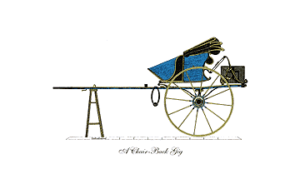
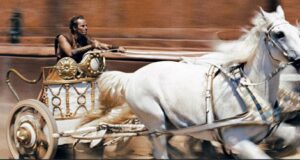
The book has some interesting information on Roman chariots. Apparently a young man’s chariot was boarded from the rear and driven while standing. This is the sort of chariot familiar to us from movies such as Ben Hur. Older men, however, favoured chariots they could board from the front and drive seated. This seems a metaphor for “youth and energy” versus “age and wisdom”. The young man would travel between towns standing and probably tired and aching when he reached his destination. The older man rode seated and probably in comfort with a blanket across his legs. If we look at horse-drawn transport in later centuries it becomes apparent that the older man’s chariot remained in use under a number of other names. Look at the horse-drawn gig, cabriolet and racing buggy and we see chariots for seated drivers.

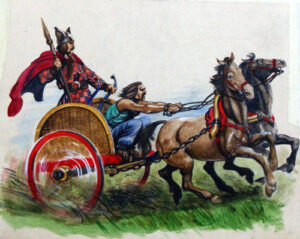
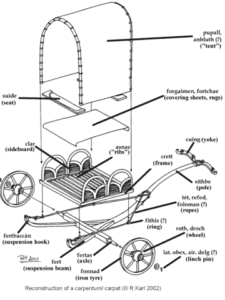
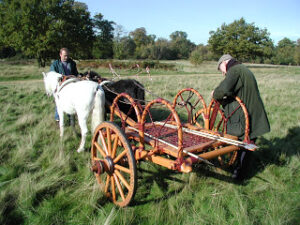
Chariots are something that interests me for a variety of reasons. Chariots were used by a variety of ancient peoples but if we want to find the most developed designs we do not have to look far from home. Below are some illustrations of Celtic chariots.

The open back would allow the chariot to be rapidly boarded or dismounted on the battlefield. As you can see, these can be boarded from behind but are also open at the front so the driver can be seated if he desires. Ancient accounts describe how Celtic heroes would run along the pole between the horses to slash at enemies before the chariot. This athletic accomplishment gives us another hint about the capabilities of chariots on the battlefield. This feat suggests that the chariot had slowed or stopped before the infantry. If the chariot was moving at speed there would be little point in slashing at foes before it, they would simply be run down. Many modern historians and re-enactors have discovered that they cannot get horses to charge through an unbroken line of infantry. Horses may not be the brightest of creatures but they will not run into an apparently solid wall! Accounts of chariots smashing through shield walls need to be taken with reservation. The integrity of the formation would have had to have been disrupted first.

One illustration shows a detachable canopy could be fitted to a chariot to keep off the rain or provide shade. Possibly this could be used as a shelter when the chariot driver was camped. A plank for the driver to sit on is also shown. Other seating arrangements might have included a storage trunk. A hammock style camp stool would also be a possibility to provide some cushioning against the bumps in the road

The most interesting feature, in my opinion, and that which marks the Celtic chariots as most advanced technically is that they incorporated a suspension system. Many illustrations show two arched structures on each side of the chariot. Sometimes these are concealed by a side wall that provided protection on the battlefield. Illustrations show a Y-shaped structure within each arch and this has been assumed to be wooden. Excavations of Celtic chariots reveal these Y-shaped structures were not wood. The photos here and on this site show that these were Y-shaped straps from which the floor of the chariot was suspended. The floor here is made from a lattice of straps but it is possible that in actual use this was covered by a rug, fur or wicker. Experiments with reproductions of Celtic chariots show this floating/suspended floor structure gives the chariot riders a much smoother ride, even when moving at speed.

Categories
Phillosoph

Gender Neutral Pronouns.

For a long time I have had a fascination with the English language. My girlfriend is Brazilian and taught herself English in just a couple of years, yet her mastery is better than that of many native English speakers I regularly encounter. I know university lecturers that have no concept of how to use an apostrophe, which is just embarrassing. My girlfriend will often come up with a well chosen phrase that is not “correct” English but has me scratching my head as to why we do not use that particular phrase.
If anything, my interest in language has deepened and diversified during the last year. I came across the SaypYu project for a more easily learnt phonetic system which has made me appreciate just how many English words are not spelt as they are pronounced. I also came across Ogden’s Basic English system which has many interesting ideas.
Some languages, such as French, assign a gender to nouns, to the frustration and bafflement of the English-speaking student. English is thankfully devoid of most noun genders so it is perhaps surprising that the English language lacks a gender-neutral pronoun for singular individuals. To some people this is a big political issue representative of all sorts of things. There is, however a real need for a workable pronoun that can refer to an individual when the gender is unknown, indeterminate or not relevant. US Field Manuals, for example,  find it necessary to begin with a statement that “Unless this publication states otherwise, masculine nouns and pronouns do not refer exclusively to men.”
As one might expect, many invented pronouns have been proposed over the years. This article gives a good account of the practicability of some of these.
Ze/ Hir and derivatives apparently see some use in the homosexual and transgender communities. That will probably mean it is highly unlikely to find much favour with institutions such as the military who are also in need of a useful gender-neutral term. On a practical note “hir” would seem to be pronounced “hɘr”, which is the same pronounciation as “her” so the distinction is graphic rather than also being phonetic.
The best candidate seems to be Ne/ Nir. The variations are listed as Ne/ Nem/ Nir/ Nirs/ Nemself. This seems an unnecessary number of variations and I always favour simplification over unnecessary complication. The Feminine Singular pronoun makes do with She/ Her/ Hers/ Herself so I propose a similar format be followed for Ne.
“Ne” would actually be pronounced “ni” in the same way that “he” and “she” are in fact pronounced “hi” and “shi”. The last thing that English needs is more non-phonetic words. Use of the spelling “Ni” will help distinguish it from other pronouns. Implementing these ideas we have the gender-neutral singular pronoun of :
Ni/ Nir/ Nirs/ Nirself
This is used grammatically in exactly the same way that one would use She/ Her/ Hers/ Herself.
Another potentially useful but seldom used innovation is “Mx.” as a gender-neutral honorific for when you do not know if someone is a Mr, Mrs, Miss or Ms. I suspect that this is more useful for correspondence than everyday speech.
If in future blogs you come across “ni” or “nir” do not be frightened. It is just an example of language evolving in a practical direction. Feel free to use it yourself and spread the word(s)!

Categories
Phillosoph

Cardloss Hotline Numbers and IMEIs

The other week I wrote about keeping a record of some important numbers. Chances are many of you have not yet got around to doing this yet. Some of you will have overlooked my post since it was apparently about Handbag theft and you don’t carry one.
While you are sat at the computer I want you to look up the hotline numbers for cardloss for your bank(s). Enter these numbers into the contacts of your phone and do not forget the international hotlines. If your partner uses a different bank, note the numbers for them too. If you are using your own computer save these numbers in a document file.
While you still have those numbers handy, write them down on a piece of paper. Write down your account number(s) and sort code as well. Also copy that information into your computer file
Now I want you to take your phone and enter *#06# into the keypad. The number that comes up will be you IMEI. Copy that down on your piece of paper and also into your computer file. If no number comes up then check on-line on how to get the IMEI number for your particular model of phone.
Take your piece of paper and fold it up so the writing is protected. This gives me the excuse to post a way to fold an envelope from your piece of paper. Tuck the note into your wallet or another safe place on your person. Make a duplicate(s) and place in your bag or car as you wish.
If your phone is lost or stolen you have the information you need with you. If your cards get lost but you still have your wallet, bag or phone you have the numbers you need ready to use as soon as possible.
This is a simple but very useful precaution.
Categories
Phillosoph

Travel Journals and NuScript

Today I will try something a little different.
The past few days I have been working on some ideas about handwriting in the modern world. Since this blog is about survival and martial arts that may not seem really that relevant.
Travelling is a relevant topic on this blog, and one of the major times that I use handwriting is when I am travelling. so I thought it might be entertaining to post some of my thoughts on this handwritten.

If you are interested in the article on handwriting, it can be found here.
NuScript : Clearer Handwriting for the 21st Century
Categories
Phillosoph

Friday 13th December

Friday 13th December : Last Chopping day before Christmas!

Categories
Phillosoph

Never Buy Envelopes Again?

Some time back I found myself in need of an envelope. I looked all over the house and there were none in the whole place. I’d have to wait until I went into work and find one there. Then it occurred to me I had a printer filled with paper! I made an envelope out of printer paper and posted the items I needed to deliver. There is probably some moral there about thinking in terms of labels rather than seeing actual form and function. An envelope is just folded and fastened paper.
This incident got me interested in if there were better ways to construct envelopes. Given that Christmas is coming, this seems a good topic to place on the blog today.
Below is a pair of videos on making envelopes. There are many alternate ways of doing this, as you will discover on youtube. These  two are origami methods that are useful if you need something more decorative. This page on the Art of Manliness site shows a simple variation that produces an envelope that stays closed.

Categories
Phillosoph

Theft Resistant Bags

Those of you that have read my blog post on handbag theft may recall this photo, illustrating how a strap can be fitted around a fixture for added security. If you have not read the blog on handbag theft, I suggest you do so since it contains some useful security advice even if you do not carry a handbag. My time at universities has often involved conversations that go:
“My bag! It has gone!”
“Where was it?”
“I just left it there for a moment while I went off to…”
{Fast Forward}
“It has all my notes in it! Why would someone want those?”
“They probably didn’t, but they are gone, and you are really screwed now!”
OK, I’m not generally so callous as to say the last bit, but that is pretty much the consequence. My point is, male or female, you at some time will have a bag that contains things important to you. Even if you think those things are of no value to someone else that will not stop it getting stolen. Read the blog on bag security.

Back to the topic of today’s blog. I began to investigate the bag used in the photo that I had used. Backtracking on the search engine I discovered this was no ordinary bag, but had a number of interesting anti-theft features:

  • The strap of the bag contained two stainless steel cables to hinder it being cut.
  • The clip on the strap has a locking device so it cannot be easily detached once the strap is a passed around a fixture.
  • The zipper pulls can engage spring clips so the zips cannot be easily opened without the owner’s knowledge.
  • The body of the bag has concealed metal mesh so that the bottom cannot be easily cut through.
  • The bag also contains a shielded compartment so that information on credit cards or passports cannot be read remotely.
An impressive range of features on a not-unattractive bag. What was also impressive was that this bag was being offered for $49.95! Could I find a similar bag in the UK at a reasonable price
A brief websearch turned up the Pacsafe Metrosafe 200 GII. At first glance this seemed to be the same bag but the actual shape of the main part is slightly different, the other design being from the same manufacturer and termed a “Bucket bag”. Both have the same security features and have two useful side pockets for a water bottle and a collapsible umbrella, for example. After I had ordered the Metrosafe 200 I realized this was not quite the same bag and did a little more research. Pacsafe make an impressively large range of bags, all incorporating these security features. There is also a Metrosafe 100, which is a smaller bag of the size that I think is easier to defend and remain aware of. The price of the Metrosafe 100 was reasonable so I ordered one of these for my lady too.
So, what are these bags like? The two I have got to examine (the Metrosafe 100 and 200) are both made from a tight-weave black nylon and are very attractive. Given the mesh and steel cable used in their construction you might expect a weight penalty but I cannot say it feels heavier than any other bag of similar size. While I have brought these bags to serve as handbags for my girlfriend the styling is attractive and neutral and I’d have no problem in carrying or using these myself.
The strap is good quality and provided with a sturdy looking buckle and slider for adjustment. The two steel cables concealed within give the strap a nice springiness. One end is securely sewn to the bag, the other attached to a sturdy ring by a clip. This clip has a sort of bolt-action lock so it can only be released if you are familiar with its mechanism. The clip allows the strap to be passed around a fixture like a chair arm or table leg. Trying to release the clip will take a couple of seconds and make anyone tampering with it conspicuous. Obviously this and all the other features of the bags are of little use if you leave them totally unattended!
Below the sturdy ring and within one of the snap pockets is a spring clip. When it is closed the specially shaped pull tab on the main zip is secured by this clip. This spring clip is my only criticism of this bag. It is set quite deep in the pocket and while it is mounted on elastic it takes a bit of effort to bring zip tab and clip together. If you are undisciplined it will be tempting to leave the zip pull unsecured.
On each end of the 200 bag there is a side pocket intended to take such items as a folding brolly or bottle of water. These are provided with press-studs on the rear side to make them fold flush when used for less bulky items. A small handle is provided at the top of the bag. On the back side of the bag is a zipped compartment. While the zip uses the same pull tab as the other zippers this one will not reach to any spring clips. Since this pocket would normally be against the body this is not a major problem. A short chain could be added to the tab, allowing it to secure to the spring clip in the side pocket.
The front of the bag has a padded flap secured by Velcro. Beneath this is a large separate compartment secured by a two-way zip, both tabs of the zip attached to a spring clip. In one corner is an opening for a headphone cable. The front compartment is divided into a number of usefully sized lightly padded pockets. One of these contains the leaflet for a five year warranty. One of these pockets is RFID safe. A plastic spring-clip is provided for hanging useful items from. The interior of this pocket is a rather nice yellow-green which will probably make the contents easier to find.
The main compartment and rear pocket are also lined with yellow green. The main compartment has a large additional pocket in it and has a split-ring suited to hanging keys on a snap link.
The 100 is similar to the 200 in shape but smaller and simpler. There is no flap and no side pockets. There are just two compartments and the zippers of each are secured by a spring clip to one side. This spring clip is easier to use than that of the bigger example. The carrying strap is the same as that of the bigger bag but has a locking clip at each end so that it can be fully detached from the bag. Pacsafe sell similar straps separately for this wishing to add them to an existing bag. The mounting rings appear to be sturdy and well anchored. A tunnel on the back of the bag allows it to be threaded onto a narrow belt for wear as a waist pack. Both compartments have the attractive green yellow lining that the larger bag has. The main compartment has a number of usefully sized sub-divisions including an RFID pocket. The main compartment is provided both with a plastic spring clip and a split ring, located on opposite sides of the compartment. A port for a headphone cable is also provided.
Both bags show an impressive care and attention to detail. All of the spring clips are swivel mounted, for example, making them less fiddly.An illustrated booklet explains the features of the bag in pictures and a number of languages and it is recommended that this booklet be kept in the bag for the eventuality that the metal elements concealed in the bag set off any security scanners.

I presented the two bags to my lady this weekend. She is very impressed with them and very pleased.

Categories
Phillosoph

Saving Money in the Winter

I hear people complaining about fuel bills this year from as far away as Malaysia. Today’s blog will have a couple of suggestions on saving money. If you wish, think of it as economic survival tips
You probably use more hot water than you need. When I was in Brazil one of the things I noticed was that most household sinks only had a cold tap. Hot water was often only found on baths or showers. When I got back to the UK I found I had got out of the habit of automatically running the hot tap when washing my hands etc. It turns out you don’t really need hot water as much as you think. I still like a hot bath or shower, but for general hand washing cold water is just fine. Supposedly razors shave sharper if you use cold water (although that may be just straight razors since I saw that on a gangster film!). My girlfriend claims washing with cold water is better for the skin. Don’t know if this is true, but I have noticed using more cold water has been very good for my heating bill.
While in the general area of the bathroom, have you ever thought about how much time you spend in the bathroom and how much time you spend heating it? Unless I am in the bath or shower I am seldom in this room for more than a couple of minutes, so why heat it for hours at a time? If I am in the shower or bath, I am warm anyway! Turn off the radiator in your bathroom. The heat from the rest of the house will keep it at a temperature comfortable enough for the time you spend in there. If you have a particularly cold bathroom or spend a long time in one consider a heater that you can turn on only when you need it. If you are the forgetful type who would leave such a heater on consider fitting it with a time switch, similar to the light switches beloved by many landlords.
Many days it is just me in the flat, so unless it is really cold there is little point in heating the entire place. Before you crank up the heat try putting on a jumper or throwing a blanket over your legs as you lounge around watching the TV.
One thing I would have thought is self-evident, but apparently is not is that if no one is in a room you do not need the lights on. Perhaps this is a product of all those movies and TV shows where every lamp in the house is always on, even if it is mid-day and a character is telling us “the place evidently hasn’t been occupied for months..” My insistence that unnecessary lights be turned off got me accused of being obsessive when my girlfriend and myself were first together. Then she had to live in a place where she had to feed the meter and turning lights off suddenly changed to being called “Being clever like Philip”. In Rio de Janeiro we stayed at a place where the corridor lighting was linked to motion sensors, which was quite a smart idea and one I’d like to see more widely used.
When I first moved into my current flat the local 99p store was selling hot water bottles and knitted covers. Quite possibly the best £1.98 I ever spent. When the night is cold I simply boil a kettle, tuck the bottle under the duvet and sleep snug and warm. The trick to keeping a hot water bottle serviceable is to not fill it with boiling water. Click the kettle off before full boil, or add a cut of cold water to the bottle before you pour the boiled water in. Only fill the bottle two thirds full and squeeze out some of the air before plugging. Don’t leave water standing in the bottle for any length of time. Empty the bottle and place it to drain first thing in the morning. I used to use the still warm water for my morning shave, but I grew a beard so don’t need this anymore. The beard is a different sort of energy conservation. I get an extra five minutes in bed because I don’t have to shave.
Categories
Phillosoph

Weapons All Around You!

Some time ago I offered my services to a video game developer. Nothing came of that but during the process I did create the following list of commonly found everyday objects that could have been used as weapons within the game. Some of them are household items while others are more likely to be encountered in certain environments such as hospitals, marinas and so on.
You are never far away from things that can harm you or that you may use to defend yourself. For more about defending yourself and your loved ones please buy my books.
hand axe/ hatchet
hammer
screwdriver
spanner/ wrench
chisel
awl/ gimlet
bricklayer’s trowel
crowbar
lead pipe
prybar
chainsaw
hedge trimmer
drill
nail gun
wood axe
fire axe
pickaxe
garden fork
axe handle
shovel
pitchfork
flashlight
scythe
sickle
billhook
long billhook
garden shears
gas can
machete
sledge hammer
rake
hoe
meat hook
cleaver
butcher knife
kitchen knife
bread knife
carving knife
ice pick
saucepan
frying pan
rolling pin
kettle
meat tenderiser hammer
skewer
cutlery
guitar
broom
mop
fire extinguisher
golf club(s)
hockey stick
baseball bat
oar/ paddle
boat hook
gaff
pool cue and balls
bowling ball
bowling pins/ Indian clubs
crochet mallet
dumbbells
ski-poles
ice axe
chairs
small tables
pencils/ pens
household chemicals: caustic, inflammable, poisonous
household sprays and hairspray
bottles -broken or clubbing
soda can
cables, scarves, clothesline for garrotting
ornaments/ ashtrays/ paperweight
vase
flowerpots
lamp
fireplace poker
chair/ table leg
rocks/ bricks
crockery, plates, cups, saucers
heavy books
typewriter/ printer/ portable TV
walking cane
burning brand
garbage can and lid
tire iron/ jack handle
lug wrench
knitting needle
scissors
umbrella
chains/ bike chain
flare gun
speargun
defibrillator
scalpels
burning toilet paper
candles (fire source)
candlestick
bucket/ wastebin