Disclaimer: “As an Amazon Associate I may earn from qualifying purchases.” Adsense and Infolinks were no help at all.

If you have enjoyed this article or it has been helpful to you please feel free to show your appreciation. Thank you.

Read The Third Wave by Alvin Toffler!
Categories
Phillosoph

Narcissism and Aggression

Surfing channels last night, looking for something different and I came across a program about cult leaders. In addition to the history of several examples there was also some content on the psychology behind some famous incidents.

One interesting piece of information was that many people who believe they are having a religious experience and hearing the voice of god are in fact undergoing a temporal epileptic seizure. Inducing such seizures under laboratory conditions will produce the same experiences. This was interesting since there is considerable evidence of links between epilepsy and certain criminal acts. That may be the subject of a future blog, but for the moment I will point out that that statement should not be taken to imply that all epileptics are criminals or dangerous.
Another trait of cult leaders discussed was narcissism. The program described an experiment where subjects were given a questionnaire to determine if they were strongly narcissistic or not. The subjects were then asked to write an essay, and the essay was taken away for marking by an unseen party. In reality the essays were not read but were instead randomly assigned either an “A” grade or marked “F. Worst Essay I Have Ever Read!” The graded essays are then returned to the subjects and the subjects given the opportunity to subject the unseen (and non-existent) grader with a blast of sound. Not surprisingly, many F-graded subjects did not like being criticised. What was significant was the narcissistic students tended to inflict more intense and longer duration punishments on the “grader”.
Quite interesting, I think. Obviously many of the cult leaders in the program were narcissistic and in the majority of examples their violent crimes seem to have been triggered by their perception that they were losing control or things were not going to go their way. An extreme example of this was Jim Jones and the deaths at Jonestown.
In your day to day life you will doubtless have to deal with some narcissistic and potentially more volatile individuals. It is a good policy to avoid humiliating enemies unless it is necessary. In my book I mention using “Mental Judo” to let aggressors back out of a fight while saving face, or make it appear that such actions are their idea. This has applications in other fields too. Over the years I have influenced many colleagues to adopt practices that I think are better. Many of them are quite convinced that these were originally their good idea and defend them accordingly. Only a few close colleagues know that I was the origin of these ideas or know about the various hints and nudges it took.
Categories
Phillosoph

"Foxy Shovels Love Fights!"

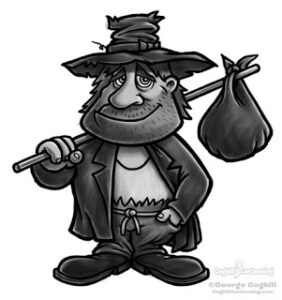
I came across this illustration the other day which I found sort of charming (if that is a correct term for the subject matter!).
I have talked about entrenching tools in both my books and will doubtless cover them further in other blog posts, but since it is a Monday and getting late I will leave you to enjoy the picture for today's blog post.
Categories
Phillosoph

On Desires, Acceptance and Meditation…

It is coming up to that time of year when I have increased contact with another generation of younger people. One thing that has struck me over the past few years is how many individuals (and not just those younger than myself!) cannot distinguish between what they want and what they can have. Stop for a moment and think about that and you will realize this is the root of so many conflicts between individuals and within yourself.
Often trying to have what you desire hurts others. If you cannot have what you want then another option is to be happy with what you can get. Well, perhaps “accept” is a more practical goal than “happy”. What cannot be cured, must be endured. There are some things in my life I accepted long ago and they do not bother me while the same things are a source of worry to others. My girlfriend was laughing at a friend of hers whose hair was thinning. I glanced upwards at my own long bare pate and raised an eyebrow. “You being bald does not matter” she explained “you are cool with it and don’t let it bother you so it is nothing on you”. There are, of course, other aspects of my life I apparently cannot change and I have not yet been able to accept, so I am making more of an effort to work on that.
Recently I saw a program that included a section on meditation, in particular mindfulness meditation. It seems that scientific studies have indicated changes in brain mechanism resulting from practice of meditation and it has proved to be have a positive effect in a number of situations and institutions. Many of you, like me, may have assumed that meditation involves letting your mind go blank, which is a very difficult if not impossible for most of use. What in particular struck me in this program was a comment that made it clear that “clear your mind” was a constant and dynamic process during meditation. It is inevitable that thoughts will pop-up in your head. The trick was to not dwell on them and dismiss them until an appropriate time. This reminded me of a friend of mine who used to seem to go out of his way to think about his problems and used to torture himself something rotten as a result. We all know that is can be a good policy to distract yourself when you have something on your mind, and for major problems such as grief from the lost of a loved one I know that sleeping as much as possible is often the best medicine. One of the things Mindfulness Mediation seems to teach is the ability to discipline your thoughts and dismiss those that are not at that time relevant.
Possibly the most accessible form of mindfulness mediation is sitting meditation. Just sit, concentrating on a single thing, such as your breathing and practice dismissing any other thoughts and ignoring any external distractions. No need for a special outfit, scented candles, CD of whale noises or anything else. One thing I have noticed recently is that I have found my exercising (mentally) quite relaxing. My mind has just been concentrating on each movement and dismissing anything else that pops into my head at that moment. Tai Chi, of course, is often described as “mediation in movement” and we can see a similar process here. I was quite interested to learn there was also such a thing as mindfulness meditation while walking. Rather than concentrate on each breath you concentrate on each step, and the sensations it brings. You can, of course, advance to concentrating on both your steps and breathing. From a self-defence point of view walking anywhere without paying attention to your surroundings is a bad move so walking meditation has the potential to become even more advanced while you concentrate on a number of things while eliminating unnecessary thoughts.
Something to research further and experiment with.
Categories
Phillosoph

Nettles

When she was a little girl my favourite aunt fell into a patch of nettles. At the hospital, through her tears she demanded “Dock Leaves!”. Interestingly, no one at the hospital understood why she was demanding them.
I can very distinctly remember when I learnt about dock leaves. I was a small child in the beer garden of a pub. At one end of the garden was a very tall nettle. My father patiently explained to me the danger that this posed and also how rubbing a sting with a dock leaf would negate its effects, and that dock leaves would always be found where nettles grew.

Recently I went for a walk in a park with my girlfriend. She was overjoyed to encounter some brambles with a good growth of blackberries and was soon wading among then picking as many as she could. All of a sudden she announced “My arm is burning”. Turns out that while she recognizes blackberries, they do not have nettles in Brazil, so she was quite unaware of the risk of brushing against these innocuous-looking plants. I began hunting for dock, but contrary to common wisdom there were none nearby and I had to search a good twenty yards away. Not entirely sure what I found was dock, but rubbing them on the sting did seem to reduce the effects.
Back at work, I told her to use some soap to neutralize the effects of the sting. A colleague had some Olbas Oil and this proved effective. Olbas Oil is part of my travelling first aid kit so it was interesting to find yet another use for it.

In addition to dock I now learn that greater plantain and dandelion leaves could have been used instead. There were quite a few of these growing closer to the nettle. Alkalis such as baking soda or soap work, as does hot water. Other remedies include horsetail, jewelweed, the underside of a fern leaf (the spores), mud, saliva, oil and onions, lemon juice, and topical use of milk of magnesia. Worth knowing.
Categories
Phillosoph

Uncle Phil’s List

Today’s blog leads on loosely from the previous ones and introduces a very useful tool.
Decades ago I created what was to become known as “Uncle Phil’s List”. The list can be used to create a bug-out bag, survival kit or pack for a long holiday or just a weekend away. The list gives you a number of categories, each of which you consider in turn. Chances are you will not need an item for each category and some categories will have multiple items. The power of the list is that it makes you consider each individual category for a few seconds which really helps you clarify what you do and don’t need.
The list has nineteen categories but memorising them all is unnecessary. Part of real knowledge is knowing something exists and where to find it when you need it rather holding it in memory. Cut and paste the list, print it out and laminate it to use when you are planning and packing. Copy it into the front of your notebook if you wish.
Uncle Phil’s List.
  1. Shelter.
  2. Sleeping
  3. Clothing
  4. Fire
  5. Water
  6. Food
  7. Hunting and Fishing
  8. Cooking Equipment
  9. Medical. First Aid items. Necessary Medication. Sun-cream and Insect Repellent.
  10. Tools
  11. Navigation
  12. Signalling
  13. Light
  14. Toiletries/Wash kit
  15. Documentation. Passport, Visa, Books, Tickets, Money and writing material
  16. Rope and Cordage.
  17. Repairs -sewing kit, tape, glue, spares
  18. Specialist items: Defensive weapons, climbing gear, cameras, gift for hosts etc.
  19. Packs -i.e. how the items are carried and bags that can be used for carrying found food etc.
For example, the first category, “Shelter” can cover everything from having a plastic rubbish bag or poncho in your bag to protect from the rain to making sure your tent is not missing any parts or confirming the hotel reservations. “Sleeping” might also make you think about your accommodations but should also make you consider if you need bedding and related items. On many trips, particularly to more civilized areas, your answer to many of the categories will be “no, don’t need anything for that” or “I can use the credit card for that”. The important thing is that you have actually spent a few seconds thinking about this and coming to that conclusion rather than assuming, and assumption is the mother of all muck-ups!
Future blogs will cover how this list can be used to assemble various useful kits for a number of purposes.
Categories
Phillosoph

All Weather Blanket Rainwear Trick.

A friend of mine asked me the other night about alternatives to ponchos. That leads on nicely from yesterday’s blog post since I mentioned my All Weather Blanket.
An All Weather Blanket is a more robust version of the Space Blanket. Appropriately enough I brought mine at the Kennedy Space Centre in 1991-2. Since then it has been a permanent addition to my daysac and has travelled with me from Hong-Kong to L.A and from Iceland to Brazil. One of the reasons that it has lasted so long is I loosely roll and scrunch it up rather than folding it up neatly. Folding it tightly causes wear on the corners and folds I have been told and my experience seems to verify this.

An All Weather Blanket can perform a number of useful functions but today’s post is about how to effectively use it as rainwear.
Firstly, preparation. When you are cold, wet and the light is failing is no time to fiddle around with knots. While you are snug at home tie a length of cordage to each of the grommets on your All Weather Blanket. I have used old nylon shoelace from some trainers for this. Your All Weather Blanket is now ready. Scrunch it up and place it in your daysac.
This method of making an All Weather Blanket into a rain cape is relatively unknown. I discovered it when researching Scottish plaids and even in Scotland this trick seemed to have been only used by women in the Inverness region if I recall correctly.
Take your All Weather Blanket and drape the centre of the top edge over your head like a shawl. Hold the top corners, one in each hand. Bring the two corners together and tie the shoelaces that you fitted earlier together. Use a simple reef knot, nothing complicated.
Holding the corners once again, cross your right forearm over your left. You have created a big loop which you now pass over your head so that the knot is behind your neck. The section of blanket that was draped over your head has now become a hood. Let your arms fall to your side and the cloak you have created will fall closed. Adjust the hood a little and you are now protected from the rain from head to knee. The reflective interior of the cape will warm you while the open front allows you to easily vent humid air or pick things up.
That is it really. Very simple if you know the trick, but it is a trick that is virtually unknown.
Categories
Phillosoph

Six Items for Travelling

The publication of my book on Survival Weapons gives me the excuse to diversify a bit more on this blog, as some readers have requested.
Today's post nicely covers the aspects of both survival and marital arts and I hope will be of interest.
It seems odd these days, but once information about ninja was hard to come by. One of the best sources was (and still is) Donn F. Draeger's Comprehensive Asian Fighting Arts.
In the discussion of the ninja Draeger mentions the “Six tools of Travelling” or Shinobi-rokugu (p.127). Six items that a ninja would never leave on a mission without.

Draeger’s descriptions of the items were not as clear as one might wish, however. Last night, while researching a quite different topic I was able to clarify a few things. Items 4 to 9 in the illustration below represent Shinobi-rokugu.

Amigasa. Amigash was a broad brimmed straw hat, the Japanese version of what is commonly called a coolie hat.
A hat is obviously good protection from the sun and the rain but for the ninja has the useful property that it can also conceal the face without the attempt being obvious.
A hat such as this can also be used as an improvised buckler to fend off an attack with a knife.
In the movies, such hats are sometimes thrown like frisbees. While this would not do the damage shown in such movies, it would be a useful distraction.
Below is a photo that is reproduced in a couple of my Japanese language books. I originally thought that the arrows shown here were either hand-thrown weapons or darts for a blowgun.
Hand missiles this size made predominately from wood and feather would be rather light, while such large fletchings on a blowpipe dart would be unnecessary and less than efficient. Possibly these arrows were a hybrid for both than throwing and blowgun.
I now see these are actually arrows intended for a bow and what was visible in my books was just the tail section of the arrow. Each extends across the width of the hat, the rest of the shaft in a pocket of some kind so it resembles a supporting rib.
Doubtless other weapons were concealed in the hats. Bo-shuriken could be placed radially like the arrows and this would be a good hiding place of a garrotte/spare bowstring.
The floppy hats favoured by 17th century cavalry such as the English Cavaliers often concealed a metal structure called a “Secret” to protect from blows and it is possible that some amigasa also had a metal cap or framework within.

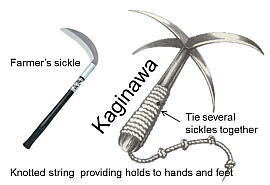
Kaginawa. A rope with a hook. ninja were known for climbing so it is hardly surprising that this would be an essential item. A length of cordage is always useful anyway.
Tenugui. Draeger calls this a towel, which conjures the “Hitchhiker’s Guide to the Galaxy” to mind.
The tenugui is actually made from thin cloth and is better understood as resembling a bandanna of about three foot by one foot size.
Kendo fighters will know the tenugui as a headscarf to be worn under the helmet, but it was originally a multi-purpose item, used as a bandanna in the fields and a handcloth in the home.
It could also be used as a bandage or sling, or as a mask to protect from smoke or conceal the identity. 
Sekihitsu. Draeger just calls this a “stone pencil”, which does not tell us much. In fact this was a portable writing kit ("Yatate"), which was not an uncommon item for feudal Japanese to carry on their person.
Ninja were spies as well as assassins and some means to record information and leave messages was essential to their task.
One of my Japanese language books shows this as something resembling Popeye’s pipe. The “bowl” is in fact an inkwell and the stem contains a brush. There is even a vent cut in the stem to allow the bristles to dry and air. Such kits could be used to conceal various weapons, and even the ink might be poisoned
Even standard yatate were sturdy enough to be passable clubbing weapons. Underneath this item in the photo is what looks like pieces of pointed chalk. This may be either chalk or a slate pencil. Both would be useful and this may explain Draeger’s use of the term “stone pencil”.
Kusuri. Medicines. Ninja are known to have produced special pills intended to staving off the effects of thirst or hunger. Various salves, ointments and insect repellents might also have been carried.
Doubtless the ninja also carried a few poisons and hid them in plain sight within their medicine kit.
Carrying a few medicines on your person was by no means unusual in feudal Japan.
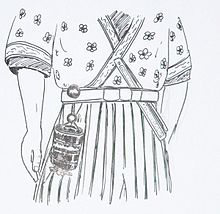
Shown in the photo is a typical Japanese medical kit (“inro”) which is rather neat. It has a number of small trays which act as compartments moving up and down the cords. The whole thing can be pulled together and hung from a belt. Quite practical and worth copying.

Uchitake. Draeger describes this as a short bamboo pole.
In Eric Van Lustbader’s novel “The Miko”, the uchitake isdescribed as a long bamboo pole that can be used as a walking staff. The other five Shinobi-rokugu items are packed into the pole, which can doubtless also be used as a fighting staff.
The sixth item of the rokugu is in fact a short tube of bamboo filled with gunpowder and is mainly intended for firelighting. Since the Shinobi-rokugu is intended as a basic survival kit some means of making fire would be needed and this makes much more sense.
Below is an illustration found in several of my books, but since I do not read Japanese I am little the wiser. The C-shaped item is obviously a striking steel but how the other items are used exactly I am unsure. The tube it is attached to resembles a flute, but has holes evenly spaced around it. Obviously this cannot be a container for gunpowder.
The lower item is apparently a charcoal/ char-cloth body warmer or donohi which could provide a ready source of ignition for lighting fuses, arson etc. Possibly the flute-like tube is the central part of the donohi around which the char-cloth is wrapped. This could be blown down to produce more heat when needed. A perforated tube could alternately be used to transport a lit slow-match.
How to make a Donohi

Some of you may note something is conspicuous by its absence. There is no mention of a knife. It may have been considered redundant to tell a ninja to bring a knife. In feudal societies, most people carried a knife as a matter of routine, using it for all manner of everyday tasks.

Shinobi-rokugu in the Modern Day

A few months back I brought a new daysac. Once I had it I began to add a few useful things to it, and now that I think about it my choices did parallel the Shinobi-rokugu.

  • One of the first things I added was a hat. In fact I added two. One is my much traveled broad-brimmed boonie hat. The second is a lightweight synthetic headover that can serve as a cold weather hat, neck warmer and so forth.
  • I’ve not added a rope and grappling hook, but I did add a ball of string to provide useful cordage. Perhaps I should add a hank of paracord too.
  • I put a bandanna in the bag too, and usually carry one in my pocket, so that is my Tenugui equivalent.
  • Not yet added, but when travelling my daysac usually carries a notepad and spare pen in a plastic bag. Perhaps I should consider some chalk.
  • Medicines. I will be adding a few aspirin, plasters and dicholorfenic. When I travel with this bag a bottle of insect repellent and sunscreen will doubtless be added.
  • My fire kit is a spare disposable lighter and a couple of nightlight candles. The latter can be used to get a fire going and can also be used for illumination.
For completeness, other items added to the daysac included an All-Weather Blanket, “pak-a-mac”, lever-powered torch, pair of woollen gloves and my Platypus Water Bottle.
Categories
Phillosoph

Desert Eagles

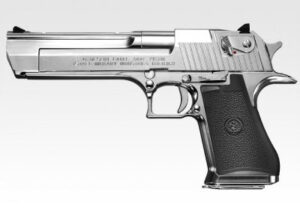
Recently I have been viewing some footage from a certain video game I have become interested in. One of the many things that amused me about this game was how nearly everyone you encounter seems to be packing a Desert Eagle! No wimpy 9mm Glocks and Berettas in this town! If you do not have a Desert Eagle it is because you have a shotgun, M16 or rocket launcher.
Desert Eagles are common in action movies and possibly the game is satirizing this. The Desert Eagle (aka “Deagle”) is an interesting weapon in many respects. It is commonly assumed that it was created as a hunting handgun. To quote an old Jewish saying with a considerable element of truth “Jews don’t hunt” so it would be unusual for an Israeli company to develop a hunting handgun. The real origin of the Desert Eagle is more martial. In military operations such as house searches for terrorist caches, pistols are often an important weapon, since a free hand may be needed to open doors and cupboards and for other duties. For some reason it seems to have been decided that a weapon with more power and penetration than a 9mm was needed for such situations and the Desert Eagle was developed. Its application as a hunting weapon for the American market seems to have come later.
Many years back I got to shoot a Desert Eagle belonging to a friend. This was “just” a .357 model and I doubt the .50 AE was available way back then. I recall it had a very nice and smooth trigger. I also seem to recollect I needed to shift my grip to engage and disengage the safety. If a pistol must have a safety I prefer a design such as the frame-mounted safety of a M1911A1, where it is disengaged by a quick downward sweep of the thumb. The Desert Eagle has the safety high up on the slide and needs to be moved up to fire. I have not handled the newer models of Desert Eagle but I suspect that the safety is still on the slow side to operate. Carry the Deagle hammer down, safety off? When the Desert Eagle first came out this was apparently not recommended. Current models are described as “drop-safe” so this may have changed. Being capable of being brought into action quickly does not seem to have been a requirement of the original Desert Eagle, it doubtless being envisioned that the weapon would be drawn, cocked and readied before commencing on a search operation. It does however amuse me that in the movies you so commonly see the Desert Eagle used as a carry gun when in reality it would take several seconds to get it ready for firing, not to mention the weight and bulk of the thing tucked under your armpit all day.
Here is a link to a rather nice article on the Desert Eagle. If you wish to know about more practical options for a self-defence carry weapon please buy my book.

Categories
Phillosoph

The Harry Solomon Scenario

The other night my girlfriend was talking to me and I was being a good boyfriend and mainly listening attentively. At one point I commented “So what are you going to do?”
As I listened to the answer another part of my brain processed why those words sounded so familiar and significant. Scroll back about 15 years or more when “Third Rock from the Sun” was the newest show on TV. In one episode Harry Solomon (French Stewart) becomes a barman. People attempt to tell Harry their problems and Harry just continues to polish a glass and sigh philosophically “So what are you going to do?” The joke was people would consider this question, causing them to consider all their options and play out the possible consequences and reach a conclusion. Typically an exchange would go something like:
“So, what are you going to do?”
“I should tell my boss to kiss it! But if I do that I might lose my job and then we would have to cancel our vacation. I’m going to have to put in the overtime. Perhaps it won’t be so bad and I could use the money. Thanks Harry, you have been a real help!”
Harry, a usual, would be essentially oblivious to the real world and what was happening around him but establishes a reputation as being an excellent barman and a great guy to tell your problems to.
Once I had identified the origin and significance of the phrase the temptation became too much. A couple more times during the conversation I ask my girlfriend “So what are you going to do?” and watch with interest as this kick-starts her keen mind into problem solving and planning her course of action.
Sometimes, take time to ask yourself or others this important question. The answers may surprise you.
Categories
Phillosoph

Survival Weapons: Contents

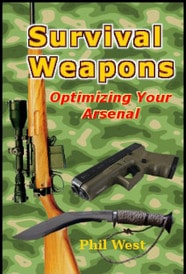
For those of you who are considering buying my latest book, a quick rundown of what you will find within its attractive green cover should you be wise enough to make the modest investment.

Introduction
This should need no introduction!
What is survivalism?
A brief account of what survivalism (with a small s) is and what is often mistaken for it.
The Amorality of Gun Control
An updated and improved version of my blog post with a similar title. This has been described as “the facts without the political posturing” and should be required reading for anyone who thinks they have an opinion on gun control.
Gun 101
A very practical and comprehensive chapter on exterior ballistics and other related technical issues a shooter should know about.
Deer Hunting Rifles
A guide to choosing a large game hunting rifle and calibre and load choices. With some information on using a bolt-action weapon for self-protection thrown in too.
Shotguns
A chapter on shotguns, explaining the sometimes complex seeming topics of shot size, choke, barrel length, pellet numbers and conversion from lead to steel shot. Information on shotguns both for hunting and defence. Includes numerous very useful tables of information.
Handguns for Defence
A chapter on selection and use of handguns for defence against both two legged and four legged aggressors. Includes information on snap, point and other sightless methods of fast shooting.
Defensive Rifles
Rifles for self-defence purposes, included fast target acquisition methods. Includes a discussion of common types and selecting the accessories that are most useful. This chapter includes a detailed history of the intermediate round.
Rimfires
A chapter on the essential .22 discussing takedowns, full size rifles and handguns. Includes a discussion of the .22 as an unconventional weapon.
Rifle and Shotgun Slings
A short but useful chapter on how to make the carrying sling of your weapon lighter and quieter. Also includes a discussion on ways to use a sling to improve the accuracy of your shooting.
Accuracy and Sighting
How to sight in your weapon and zeroing range for various weapons. How to adjust fixed or adjustable sights. Types of iron sights and why they are sometimes preferable to scopes. Selecting a scope. Occluded sights, laser sights and removing scope flash.
Survival Knives
The blades you should really be spending your hard earned money on. A handful of knives that will do nearly any job and won’t break the bank. Other useful implements.
Using Knives
How to use bladed tools more effectively and safely.
Sharpening
A detailed chapter on how to sharpen you tools and keep them sharp.
Tactics and Strategy
Because a weapon is of no use if you do not know how to employ it. Some notes and tips on concealment, moving quietly, communicating without words and avoiding the bad guys.
Improvised and Miscellaneous Weapons
Hunting weapons that can be built from found materials and that can keep you alive when your store-brought items are out of reach.
As you can see, terrific value! Buy your copy now at:
http://www.lulu.com/shop/phil-west/survival-weapons-optimizing-your-arsenal/paperback/product-21076317.html