Disclaimer: “As an Amazon Associate I may earn from qualifying purchases.” Adsense and Infolinks were no help at all.

If you have enjoyed this article or it has been helpful to you please feel free to show your appreciation. Thank you.

Read The Third Wave by Alvin Toffler!
Categories
Phillosoph

Survival Weapons: Contents

For those of you who are considering buying my latest book, a quick rundown of what you will find within its attractive green cover should you be wise enough to make the modest investment.

Introduction
This should need no introduction!
What is survivalism?
A brief account of what survivalism (with a small s) is and what is often mistaken for it.
The Amorality of Gun Control
An updated and improved version of my blog post with a similar title. This has been described as “the facts without the political posturing” and should be required reading for anyone who thinks they have an opinion on gun control.
Gun 101
A very practical and comprehensive chapter on exterior ballistics and other related technical issues a shooter should know about.
Deer Hunting Rifles
A guide to choosing a large game hunting rifle and calibre and load choices. With some information on using a bolt-action weapon for self-protection thrown in too.
Shotguns
A chapter on shotguns, explaining the sometimes complex seeming topics of shot size, choke, barrel length, pellet numbers and conversion from lead to steel shot. Information on shotguns both for hunting and defence. Includes numerous very useful tables of information.
Handguns for Defence
A chapter on selection and use of handguns for defence against both two legged and four legged aggressors. Includes information on snap, point and other sightless methods of fast shooting.
Defensive Rifles
Rifles for self-defence purposes, included fast target acquisition methods. Includes a discussion of common types and selecting the accessories that are most useful. This chapter includes a detailed history of the intermediate round.
Rimfires
A chapter on the essential .22 discussing takedowns, full size rifles and handguns. Includes a discussion of the .22 as an unconventional weapon.
Rifle and Shotgun Slings
A short but useful chapter on how to make the carrying sling of your weapon lighter and quieter. Also includes a discussion on ways to use a sling to improve the accuracy of your shooting.
Accuracy and Sighting
How to sight in your weapon and zeroing range for various weapons. How to adjust fixed or adjustable sights. Types of iron sights and why they are sometimes preferable to scopes. Selecting a scope. Occluded sights, laser sights and removing scope flash.
Survival Knives
The blades you should really be spending your hard earned money on. A handful of knives that will do nearly any job and won’t break the bank. Other useful implements.
Using Knives
How to use bladed tools more effectively and safely.
Sharpening
A detailed chapter on how to sharpen you tools and keep them sharp.
Tactics and Strategy
Because a weapon is of no use if you do not know how to employ it. Some notes and tips on concealment, moving quietly, communicating without words and avoiding the bad guys.
Improvised and Miscellaneous Weapons
Hunting weapons that can be built from found materials and that can keep you alive when your store-brought items are out of reach.
As you can see, terrific value! Buy your copy now at:
http://www.lulu.com/shop/phil-west/survival-weapons-optimizing-your-arsenal/paperback/product-21076317.html
Categories
Phillosoph

Protein Supplements: Save Your Money

Our society programs us to be consumers.
If we take up a new hobby or interest often our first reaction is to search for what things we need to buy to partake in that activity.
The problem for business is that certain activities such as exercising with weights or running do not need that many material things, so the solution is to create things that seem they may help.
Specialist foods seem to be a very successful niche.
I came across this article the other day, which pretty much confirms what I had suspected about protein supplements.
Since I originally wrote this, having added protein in nearly every possible food has become a trend. Was no one else awake in school?
Your normal everyday diet contains ample protein for your needs.
If your diet did not contain protein, which is highly unlikely, your body can make proteins from amino acids which it can synthesise from the citric acid cycle using glucose and body fats which you probably wanted to reduce anyway.
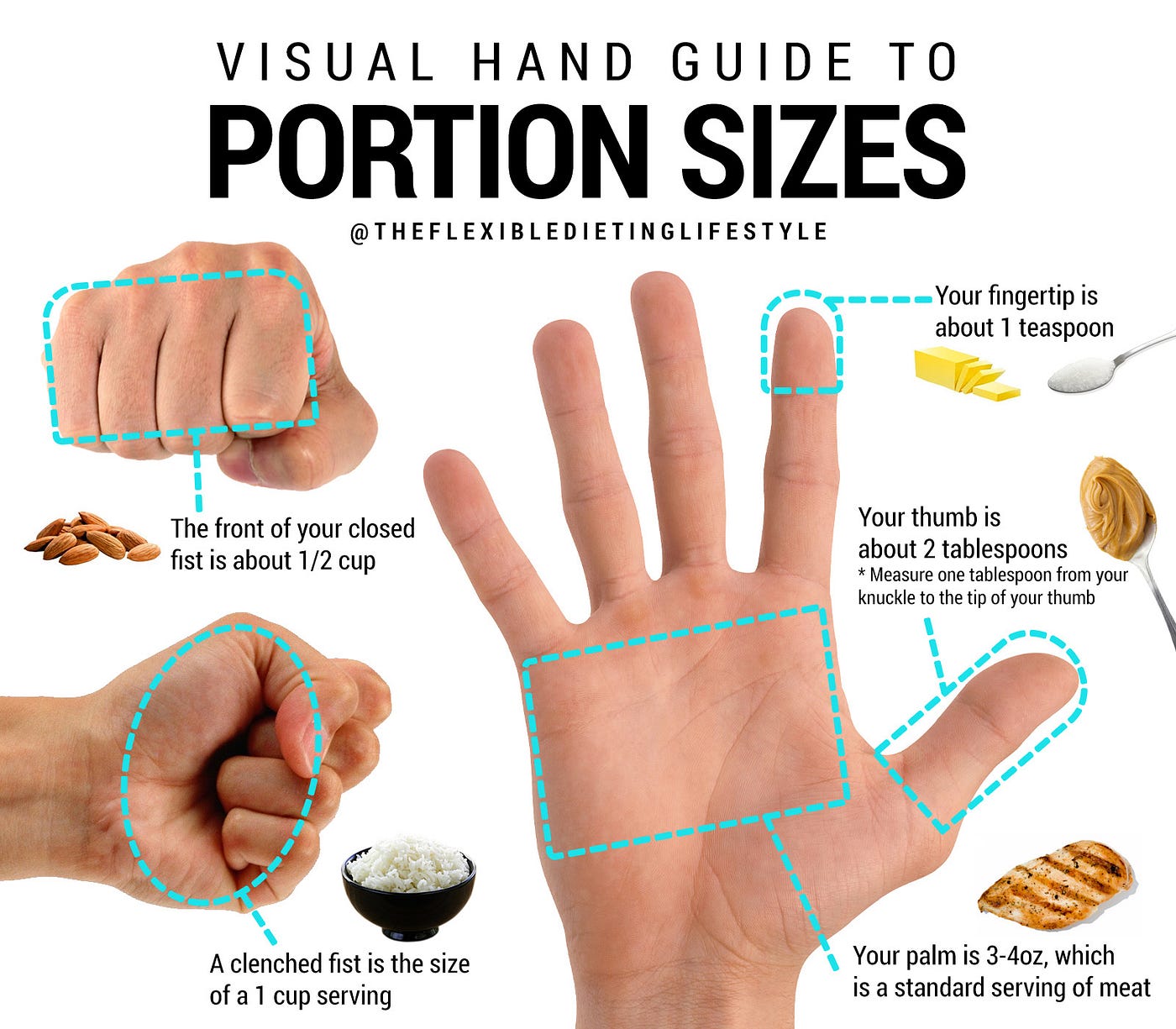
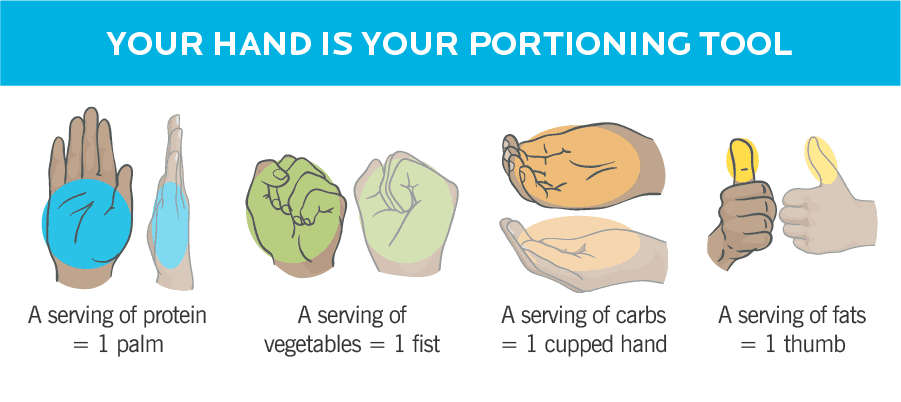
You only need a few ounces/75-100g of protein a day, much more than you probably eat. A portion of meat or other protein-rich food should be about the size of your palm. If eating white (non-oily) fish the portion may be as big as your palm and fingers.
The recommended daily intake of protein is 0.8 grams per kilo/0.36 per lb of body mass. If you exercise intensively (be honest!) or are over 65, this should be increased, but should not exceed 2 grams per kilo.
Measure food portion with hand Hand measures of food
Save your money and buy my books instead.
Categories
Phillosoph

Machetes for Gardeners

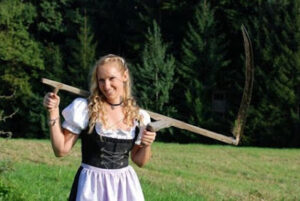
Many years ago someone who was interested in some of my writings invited me to visit him in Austria. This was my second visit to Austria but my first in the area of Kitzbühel. Famous for its winter sports, it is also a very pleasant place to visit in other seasons. Ultimately that association led to me writing my first book. One memory that sticks with me is how often you would see a scythe hanging on the outside of a house. These were more than rustic decorations, however. On several occasions I saw homeowners using these scythes to trim the edges of their lawns. A much more elegant choice of tool than the noisy strimmers so often used in other countries. 

Jumping forward a few years and I was holidaying on a certain Caribbean island. There on several occasions I witnessed gardeners or municipal workers at work and often the only tool they would have was a battered machete, the handle invariably replaced with electrical tape. They only had a machete since this was all they needed. If planting flowers in a flowerbed the end of the machete would serve to dig the necessary a hole a few inches deep. The flat of the blade would then pat the earth flat again. The edges of lawns were trimmed by deft swipes of the machete. Moss and grass was cleared from between paving stones by grubbing it out with the blunt back edge of the point.
If you are a gardener you may have a whole shed full of tools and my observations above make me wonder how many you really need? The machetes I saw in use were the fairly typical “GI-pattern” but being of a certain ilk I began to wonder if about a specific design of gardening machete.

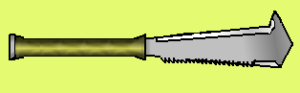
Here is one possible design. The blade is about a foot long and the long handle allows a variety of grips for fine control or long slashing actions. The end is designed to serve as a trowel and a blunt hook like extension serves several uses including grubbing. Perhaps I should make the butt serve as a digging stick?
Categories
Phillosoph

Underground Weapon Production

In my recently published book I discussed how increasing gun control legislation is likely to create a market for firearms produced by organized crime.
Today I came across this interesting blog on improvised and home-made firearms across the world.
Notable is that while some examples are quite crude, some are very sophisticated and seem effective for their purpose.
Many of these guns are produced in countries with very restrictive gun laws such as Australia, China and Northern Ireland.
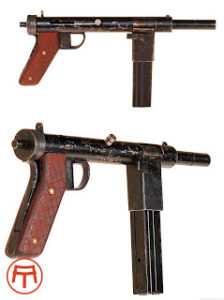
This photo shows an SMG factory that was in business for 20 years in Northern Ireland.

The weapon below was produced in Denmark right under the noses of the Nazis:

Categories
Phillosoph

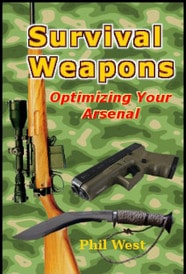
Survival Weapons: Optimizing Your Arsenal

Things have been a little quiet recently on this blog and one of the reasons for this is that I have been working on a new project. It is now ready, so I will present.
With chapters on Hunting rifles, Shotguns, Defensive Handguns and Rifles. Rimfires, Sighting systems, lighter and quieter rifle slings and Survival Knives- choosing, using and keeping them sharp, Tactics and Strategy and Improvised weapons. Sections on making a rimfire quieter, the 22 as an unconventional weapon of war and the history of the intermediate round.
Categories
Phillosoph

Czech Your Geography

For those of you that missed the story, the Czech Ambassador has been forced to make a statement explaining that the Czech republic is not the same as Chechnya
I am certain people interested in my books are not so ignorant, but to help anyone you know understand the difference…

Categories
Phillosoph

Sweet Dangers

Today’s blog subject is at the request of my girlfriend, following a recent conversation we had.
About a year ago, when I decided to exercise more and eat a bit more wisely, the BBC screens a program called “The Men Who Made Us Fat”. One statement that struck me was that sodas were the single biggest contributor of calories in the American diet. This is quite staggering given the average American takes in quite a few calories.

Doing a little research I discovered that a can of coke or similar has the equivalent of eleven cubes of sugar in it. A friend of mine was drinking a bottle of iced tea so I looked at the ingredients. Seventeen grams of carbohydrate in 500mls, and nearly all of that would be sugar. These are not the only culprits, of course. Most of us consider fruit juices to be a healthy option, but they too include considerable quantities of sugars. What is a considerable concern with sweet drinks is that you are taking in calories without any bulk to make you feel sated.
Knowing the above has not made me swear off sodas etc for the rest of my life, and I don’t expect you to either. What it has done is that I have greatly reduced my intake, and if truth is told I don’t really miss them as much as you might expect.
On one blog I viewed the author pointed out that if he drank six cans of soda a day he was consuming his entire weight in sugar every year. What I find interesting about this statement is that it never occurs to him that six cans of drink a day might be in anyway excessive. In the BBC program mentioned earlier the presenter buys a “Double Gulp”, which is a 64 fl oz cup of soda. Let us conduct a short thought experiment:
You come across a friend or colleague drinking from an entire jug of water. The chances are this would concern you and you might suggest they need to see a doctor. Suppose your friend is drinking a bucket of coffee with 50 cubes of sugar in it. That would certainly concern you. Yet if you come across someone drinking a Double Gulp, your only observation might be that they must be thirsty. Interesting?
I have to admit to a certain dark admiration to the recent adverts for a certain soft drink that claims their product has 140 “Happy” calories that can be used to do fun things. A piece of population perception manipulation at its finest!

By no means am I saying give up drinking soda. I don’t intend to. Make them an occasional treat, as I do. If you cannot, at least be aware how many calories you are taking in through this medium and adjust your intake of other calories accordingly. Try cutting down, and you might find you need them less than you thought.
Categories
Phillosoph

Friday Funny: Under Undress…

For those of you that have missed the Friday Funny…

I think this is actually from the "Springbreakers" movie that is about to come out. The odd thing is that since I share my life with a Brazilian lady, these bikinis look rather conservative and modest to me.
Categories
Phillosoph

Acupressure for Self Help

I dislike the term “Alternative Medicine”. It suggests an “either/or” or “Us and Them” mentality that is not productive. Both “sides” of the medical profession are guilty of this. Like any important issue medical care should be determined by empirical rather than emotional or historical factors. If something works, use it. That you cannot explain how something works, or that the explanations offered for how it works don’t make sense is not a reason to ignore it, but an indication that we need to learn more. Primitive man knew nothing about aerodynamics but this did not stop the birds flying.
Acupressure is a good example of what I am talking about. Many of the traditional explanations of how it works quite frankly do not make a lot of sense. One meridian is assigned to an organ that doesn’t physically exist in the body. If we dissect the body there are no apparent meridians. Some practitioners will talk about the blood flow being different in different times of the day, but we know blood flow is not tidal but circulates. On the other hand acupressure/ acupuncture could be demonstrated to be having an effect that was more than psychosomatic.
Erle Montaigue used to tell a story of a student of his who was a surgeon. While operating on a patient one day the patient went into cardiac arrest. The surgeon stabbed his scalpel into a “energy point” on the sole of the foot and the patient’s heart started again. That the patient was unconscious and also pumped full of pain killers eliminates that this was a psychological effect. That we cannot see the meridians may simply mean that we do not know what to look for, and that they may be a number of structures that conventional anatomy regards as discrete. Many people who have experienced heart attacks have reported shooting pains along the inside of their left arm –a location that acupuncture designates as the heart meridian. Blood flow may not be tidal, but we do know the body is subject to biorhythms and that we feel more energetic at certain times of the day. Acupressure and Acupuncture gained greater acceptance in the west when it was discovered that it stimulated the body to produce endorphins: natural painkillers.

Many decades ago when I had started my first ever full time job I brought a copy of “Acupressure Techniques Book. A Self-Help Guide” by Dr Julian Kenyon. My first job was at a research centre located in a large country estate. Many of the rolling fields around us were bright yellow with the flowers of rape (Brassica napus) and I was soon to make the unwelcome discovery that I was allergic to rapeseed pollen. I had never had any indication that I suffered from hayfever before, but all of a sudden I was clawing at my eyes. More out of curiosity than anything else I took a look at my new book. I knew Acupressure could produce endorphins, but that did not seem much help for what was a disproportionate immune response. None the less, I consulted the book and found a page on hayfever and allergies. Not expecting much I tried stimulating the points suggested. I actually did not expect this to work at all!
The next day I had no symptoms at all. In fact I have not been subject to hayfever again in more than 25 years. Much to my surprise that one treatment was enough.

As you may expect, I have a healthy respect for the capabilities of acupressure (pun intended). There are obviously possible effects other than endorphin production. I still have the book and still consult it on occasion.
Many years ago my mother was experiencing considerable back pain. On certain evenings she would ask that I “do her back” and slowly and painfully lower herself to the floor to lay face down. I’d probe the relevant points between her vertebrae for a minute or so and she would then spring back to her feet like she was 20 years younger. The relief this could produce was quite dramatic.
I don’t know if the book is still in print, but if you can find a copy by bookfinder.com consider buying one. In my own book I mention that Liver 4 is also a useful healing point. This is a point worth learning since it can be used on a number of ailments including toothache and headaches. I have nothing against using painkillers, and oil of cloves is miraculous for tooth pain but there will be times when you do not have such things handy so acupressure can be a very useful alternative.

If you have hayfever or allergies then it will cost you nothing (other than the price of the book) to try some acupressure on yourself. Hopefully you will experience similar success to my self.
On particular page in the book sticks in mind. In the section on haemorrhoids the author recounts on how he has witnessed haemorrhoids visibly reducing before his eyes while a point on the patient’s head was stimulated. Perhaps this section struck me since it was another example of acupressure having an effect that seemed to be more than just than of endorphins. Haemorrhoids affects millions of people, including a significant proportion of pregnant women so if there is a way that their effects can be reduced by an acupressure point on the head such information needs to be more widely circulated.

The relevant point is GV-20. This is on the centreline on the top of the head, intersecting a line drawn up from the angle of the jaw and through the apex of the ear. Press down on this point and rock your fingers forwards to stimulate. Usefully this point can be stimulated in any social situation. Kenyon’s book also includes a number of other points that might have an effect. While researching this post I also came across this video on a point for relief of haemorrhoid pain. Not tried this myself but worth experimenting with.
Categories
Phillosoph

African Throwing Knives

I wrote this article a couple of decades ago for the Thrower list. Back then there was very little on the internet about African Throwing Knives.
 

African Throwing Knives

Miss Summers kindly models for us with a hammer and a Southern form of African Throwing Knife.
“African throwing knife” is a confusing term since most of these are not anything we'd call a knife, and "throwing iron" is sometimes used. The weapons are mainly used in Northern and Central Africa.
Problem is that many of them are never used as missiles or even weapons, but have symbolic/ ritual/ magical functions.
Using the African words is of little use since every tribe has a different name for them. The terms “Hunga Munga”, “Thrombash” and “K'pinga” are possibly the best known.
Throwing forms usually have an uncovered grip section or just a cord or lizard hide wrap. At least some of these knives have an aerodynamic "D" shaped section.
A typical northern form of knife is about 30" long and shaped like an "f" or sometimes an "?". The "knife" is carried sloped over the shoulder, sometimes in a sheath that holds three. These weapons have been used by both cavalry and infantry, and seem to have been the main reason leg armour was adopted for African war horses.
I've seen it claimed that many of these knives are used as general purpose tools for jobs such as clearing brush or butchering game. You can see these things as being awkward for some jobs and good for others and it is usually noted that many of these knives obtained for collections show no signs of the wear or resharpening you'd expect. On the other hand, man will often use the tool to hand rather than the tool for the job (I remember a nice photo in the Pitt-Rivers Museum of a guy making a pair of sandals with his spear edge).
Southern forms of knives are shorter (c 18" or less) and proportionally broader. Shape is more varied, resembling "Y", "r", "K" or branching antler-like shapes.
The elite warriors of certain tribes would carry four of these hanging on the inside of their shields.
When thrown vertically at the top of a shield they are said to somersault over and drop down onto the foe's head.
When thrown horizontally they can be bounced off the ground to take out the foe's ankles beneath his shield.
Being able to jump suddenly was a required skill of a warrior!
 
FEEDBACK
I think Phil was referring himself to an African throwing knife called "'Mbum", a middleway between the axe and the knife. Otherwise to particular "Taliks" used by Tahuas to kill the mices of the desert; or the throwing knives used by Ballegs and Vahims' tribes….
Grisonio
There's a name for these in every dialect of the North and Central Africa -not heard those ones though. Thrombash, Hunga Munga and K'pinga are some of the better known terms. If the desert tribes are using what I'm thinking of they'll be about 30" long -lot of knife for a mouse.
Phil
(Lee Fugatt) writes:
….kill mouses?? Prego Grisonio but I would love to see some one pick off a mouse with a throwing knife!!! I miss grey squirrels about half the time and kinda good at throwing stuff. Ain't saying it can't be done but I'd sure to see it!! Lee
Tahuas'tribes are nomads who live hunting preys like mice, locusts, lizards, scorpions, snakes and coleoptera, perhaps the only animals of the desert, if we exclude the more and more rare "fennec" (little-fox). Their life depend on their throwing-skill and during hunting period they cannot miss the target. When that happens, — (and IMO it happens very seldom) — they can only say: "#@$+§*%!! bye bye dinner…" @=^)
Lee, they are "professional throwers" and don't waste their time playing with squirrels and bambi…. @=^D

Grisonio

P.S. = Hey Phil, one of the throwing-weapons used by mouse-hunters of Central Africa is like this…

'MBUM" (Maybe you know it by a different term) is bound by a short rope utilized to set it in rotary motion.
How big is this thing and is it made of metal? It looks a lot like a southern throwing iron, though I'd expect a northern form to be in use in desert regions. When you say the rope sets it in a rotary motion -do you mean a rope is wound around to spin it like a top, or just a cord wrap handle?
Phil
Yeah, it is a sort of "ascia-falcetto" or double-scythe, but only one of the blades is sharpened. It is supplied with another short blade, a cutting tooth, near the bone handle. Length: approximately 16 cm. (blade) + 9 cm. (handle)
The cord is very short and bound near the tip of the handle. About its utilization, IMO, the African Mbum can be considered a middleway between the medieval Kusari-Gama of Okinawa and the prehistoric Bola Perdida of Peru. A similar throwing-weapon, without cord, is utilized in Central Africa by Kotos. Hope this helps.
Grisonio

Indeed it does. What part of Africa did you say these mouse hunters were from again? This thing is smaller than a Central African (southern) thrower and way smaller than the northern forms -plus you have the additional action of the cord to whirl it by -there seems to be a real shortage on decent information on African throwing blades.