Disclaimer: “As an Amazon Associate I may earn from qualifying purchases.” Adsense and Infolinks were no help at all.

If you have enjoyed this article or it has been helpful to you please feel free to show your appreciation. Thank you.

Read The Third Wave by Alvin Toffler!
Categories
Barata

Computers and Related Hassles

Today's blog subject is a little removed from the usual themes of self‑defence or self‑reliance.
I would like to pass on some tips that make life a smidgen easier.
Think of them as a defence against some elements of modern life attacking your sanity, if you wish.
Burning computer

Reset Folder

A common theme on this blog is to urge the reader to have back‑ups, both for you computer, and for your life in general.
On my backup and external drives I have a folder I call “Reset”.
In Reset are copies of the themes, backgrounds, profile photos, keyboard shortcuts, bookmarks, macros, browser extensions, fonts and plugins that I favour.
All the things that make my computer programs look and work just like I want them to.
Also in this folder are some installation .exes of some of my favourite programs.
When I have a new machine, or have to update my operating system, or something similar, I can quickly get things back to the way I like them.
A small but useful component of this folder is a text file checklist.
* The text file lists the programs I favour.
* The file lists which files need to be changed, and with what,
* The file also records where on the computer these files need to be put.

ISO to Go

Also on my external drives is a folder containing the ISOs of the operating systems I use on my home computer and laptop.
 I plan to have an ISO of my personal operating system if I can find a utility that works with my system.
Should I need a “live disc”, an ISO may easily be transferred to a flash drive with “Ventoy” on it.

Router Password Card

A previous broadband provider included with the router a plastic card with the network passkey printed on it.
That company was brought out by a less competent company that hiked the prices up, so I changed broadband providers.
The new provider did not provide a card, so I made my own.
On a blank plastic card I wrote the necessary information. I keep this card by the router.
Whenever my girlfriend or step-son visit, they will usually reach for that card to reset their devices.
This idea relies on the card being placed back with the router once it has been used. This has not been a problem in practice.
A very simple idea that has proved very useful.

Box of Computer Bits

Behind my computer is a box. It is a two-litre ice cream tub spray-painted black to match the computer. It is a useful height to rest my external hard drives on.
In the box is a multiple slot card reader for reading micro-SD, SD and other card-shaped formats.
Also in that box are various USB drives, SD cards, dongles, adaptors and computer leads.
Handy stuff to have near your computer.

Code Leads

I have a lot of computer leads, both in that box and elsewhere.
Most of them are black, so it can be time consuming finding the lead with the connectors that I need.
My solution was half an hour of time spent colour coding.
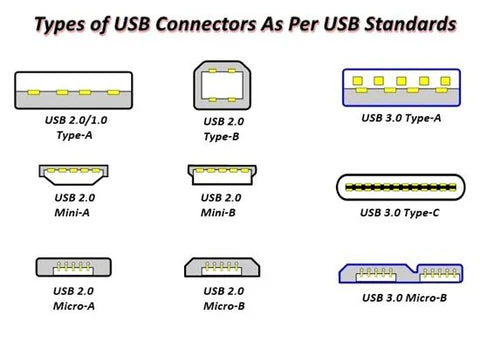
Types of USB Connector
One of the lead types I use most often has a USB-A at one end and a mini-B at the other. The “A” end now has a red and a yellow band, while the mini-B end has the same colours reversed with the yellow band closest to the mini-B connector.
Not only can I tell the type of lead at a glance, but which end each type of connector is at.
Leads with a USB-C connector rather than a mini-B use red and green.
An iPod lead has red and white bands.
A lead with a micro-B connection for attaching to drive enclosures uses red and blue.
A lead that has two type-A connectors, or two type-C has only one band at each end, respectively with red or green.
Leads with a type-A to type-B are rarer and usually stay plugged into a scanner or printer. For these, each end has red, yellow and blue bands.
Initially, I added the coloured bands using electrical tape. Perhaps I should have used longer bits, since several have detached.
So I invested in a bag of mixed coloured cable-ties/zip ties.
100 x 2.5 mm are ample size for this application. I found I needed extra red and yellow.
Best review your connector types before you order.
If you make a mistake, a cable-tie may be opened again using a pin. This is a variation of shimming.
If a cable-tie loosening is a concern, the cut end may be melted into a blob by gentle heating with a lighter flame or application of a heated metal implement.
My current earphones are shaped specifically for the left or right ear. I have tagged the left one with a cable-tie so it is easily distinguished by sight or touch.

Labels on USBs

My USB flash drives range from old examples with two gigabytes to more recent in 32 gigabyte sizes. Some of the smaller capacity drives are still handy for some purposes.
You can save a lot of time if you write the capacity of a USB drive on the outside.
There are two ways to plug in a USB. The right way and the first way you tried. Put your labels on the upper or outward side.

Paint Your Plugs

Ever unplugged your computer when you wanted to disconnect the device plugged in beside it?
I used to think plugs should have those little windows you can insert a piece of card into.
One day I remembered all the model paint I have, some of it in bright colours I seldom use.
So now my electrical plugs have legends such as “XBox”, “PSP”, “DVD”, “Comp”, “Shredder”, “Hoover” and similar in a variety of colours.
If you lack paint, stickers and a wide pen are an alternative.
Providing that I look at what I am doing, it is a lot easier to plug-in or unplug the device that I want.

Find the Remote

On the topic of stickers, the black TV remote control is often hard to locate when watching late at night.
I have added luminous star stickers to both sides in different configurations.
Now, not only can I find the remote, I can tell which side it is up and which end is which.

Hair Today…

Einstein
I suppose, given the great diversity of humanity, there may be someone who enjoys removing hair from the plughole. Probably whole forums, websites and fetish magazines about it.
Best not look.
You may have a sink strainer in your kitchen sink. Few people seem to think of using one in the bath/shower and bathroom sink.
Removing hair from a sink strainer is a lot easier than fishing it up out the plughole.

Final Thought

A lot of time would be saved if when a website asked for a password, it included the information that the password included numbers, capitals and/or non-alphanumeric characters.
Categories
Barata

Happy Medium

The other day I had a good chuckle at someone calling a six-inch blade a “full‑sized knife”.
Aww! That is so precious and adorable!
Silliness aside, and (mostly) avoiding the “size matters” jokes.
After many years and too many purchases, I have concluded I do not have much use for medium‑sized field knives.
For purposes of the following discussion, let us define “medium‑sized” as a fixed blade survival/field/bushcraft knife with a blade between six and eight inches/15 to 20 cm.
Before you spend good money on a knife (or most other things) it is a good idea to have a think about what it is likely to be used for.
If there is a chance I might need to construct a shelter or build a campfire, I will try to have a big blade to hand.
Kukri, machete, parang, barong, golok, cane‑knife, billhook or hatchet. Many of these are available at any hardware store for a reasonable price.
Useful tools for self‑defence or if you need to butcher wild game too.
If I need to do finer work, a fixed blade of three to five inches is generally handier for such tasks than a medium knife.
A big blade and a small blade can cover most bushcraft roles: woodworking, food preparation and self‑defence.
So where does that leave the medium knives?
Many, many years ago I jotted down some ideas on a concept I called a “Desert Knife”.
If you were in an environment where trees were rare, it can be argued that you might not need to carry a blade that was an effective wood chopper.
You could carry a small blade in such an instance, but might feel this is not sufficient for defence.
This is one argument that might be made for carrying a medium knife.
An urban environment might meet the above criteria. Concealment may be a factor here, and a medium knife may still be too big.
As an aside, an urban environment often includes closed doors. A kukri or hatchet can prove useful there.
Suppose you want a medium knife or two, anyway.
There is a vast range, and some cost way more than good smaller or larger blades.
The following are some personal recommendations, mainly based on knives I have acquired or handled over the decades.
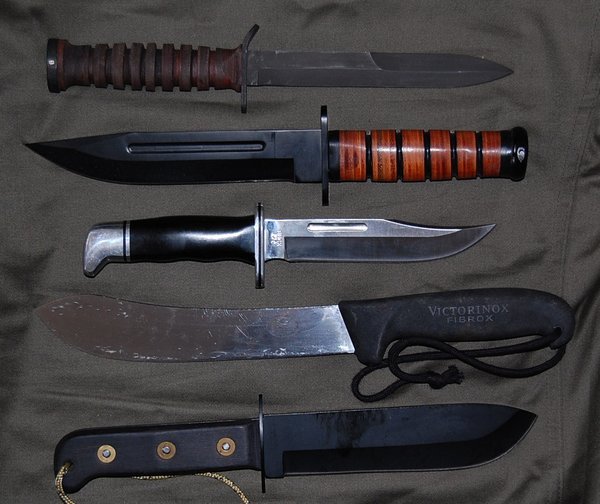
A selection of medium-sized field knives
From top to bottom: M3 Trench Knife, Ka-Bar USMC Survival Knife, Buck 119 Special, Victorinox Butcher Knife, MOD Survival Knife

M3 Trench Knife

The M3 trench knife is one of my favourite medium blades.
The blade‑form and balance are well suited to defensive use. Unlike, say, the Fairbairn‑Sykes commando dagger, the M3 is useful for many utility tasks too.
The M3 was sometimes marketed as the (Eickhorn) “NATO Combat Knife”, usually combined with the M8/M8A1 sharpening scabbard.
Some reviews suggest the sharpening scabbard had little noticeable effect on making the blade sharper.
The leather sheath seen with many examples has staples around the mouth, which seems a great way to get the blade finish scratched up. 
The Camillus “economy” leather sheath without the staples is nicer and more practical. If you cannot get this, use the fibre-glass M8.
The M3 is not a knife for skinning a buck, fine whittling, carving or cutting in depth. The broad angle is good for woodchip removal when chopping.
Like the Ka‑Bar, the M3 has a grip composed of leather washers. The grip has deep grooves, an oval cross section, and is also oval in plan and profile.
In other words, it is a pretty secure grip.
The butt has a metal plate to facilitate hammering, breaking nutshells, smashing windows and so on.
The M3 was so successful, the M4, a bayonet version for the M1 and M2 carbines was created.
The army began to issue M4s to troops who did not carry carbines, so the M3 was phased out.
The M4 was to evolve into the M5 (Garand), M6 (M14) and M7 (M16). The bayonet versions had phenolic handles and the associated hardware for fitting to a rifle.
Replica M3s may still be found at reasonable prices, often sold by suppliers to re-enactors.
The M7 bayonet may also be found, although the bayonet ring and butt piece may constitute unnecessary weight. The M7 is quoted as massing 1.19 lb!
I also own an Imperial M7S Survival Knife. This is based on the M7 bayonet. An odd blade shape to provide with three types of saw tooth. This was actually my first ever fixed blade survival knife.
I would love to find a source of M3/M7 blades so I could fit it with a grip such as the thistle‑top.
Incidentally, my notes show the “Desert Knife” design resembled an M3 with a serrated section.

Ka‑Bar US Marine Survival Knife

The Ka‑Bar is the blade most associated with the USMC.
I have never owned a genuine Ka‑Bar. Buy more books!
I have a rather nice copy of the Ka‑Bar, acquired relatively recently.
The Ka‑Bar is more of a traditional survival knife than the M3 and correspondingly, a more versatile choice.
Downside is Ka‑Bars tend to go for three‑figure sums.
The blade is a little longer and broader than the M3, having a Bowie‑shape.
The steel butt is designed for hammering with, and a little more elegant in shape than the M3 version.
Like the M3, the grip is composed of leather washers. Unlike my M3, the grip of my Ka‑Bar-oid is varnished. The marines were discover untreated leather washers did not hold up well in the jungle.
While some reviews will describe the leather washer handle as offering a great grip, other sources say the opposite.
I showed my lady the Ka‑Bar clone just after it arrived. Misunderstanding my intentions, she thought I was offering it to her. She told me “I already have my knife [a Mora Companion], and the grip is too slippery.”
She knows her knives, and is very practical. She uses her Mora as a diving knife when foraging for seafood. Interesting that she did not see any practical difference between the Ka‑Bar and a Mora.
I have heard of roughening and even reshaping a Ka‑Bar using sandpaper.
Tape of the sort used for gold clubs or tennis racquets may be another option.
A number of variants on the Ka‑Bar are on sale, including a USMC bayonet. Some have alternate grip materials. Some offer partially serrated edges.
I have no personal experience of these. I do have a tanto with a grip that looks identical to some Ka‑Bar versions. This tanto is an oddly “unlively” knife.
Ideally, try handling some Ka‑Bar examples before you part with your hard‑earned cash.

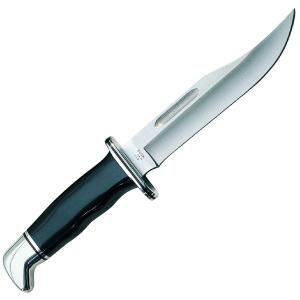
Buck 119 Special

Buck 119 Special

The Buck 119 is my favourite medium knife.
For a more extensive review, see my article here.
Blade is about an inch shorter than the Ka‑Bar.
The grip is smooth phenolic, since I could not afford the cocobolo version.
Despite the smooth surface, I find this a very secure and comfortable grip due to the subtle finger grooves and thumb depression. That is me, however.
A friend of mine finds the grip does not suit his hands.
Wrapping the grip with tape or line is an option.
My only criticism of the 119 is the polished finish. I suspect many potential buyers would prefer something less shiny.
I suggested to Buck that a tactical version with a non-reflective finish and coyote‑brown or khaki‑drab grip would be popular. I got told that Buck “no longer accepts customer suggestions”.
I have both five and seven‑inch Buck Nighthawks, but the 119 much is better.
The Nighthawk 651 Pigsticker is really nice, but your changes of getting one are remote.
The Buck 120 General was not available when I brought my 119. The 120 seems to have been put back into production.
The 120 is a 119 with a 73/8" blade.
I do not own a 120, but if any reader wants to give me something for my upcoming big number birthday…

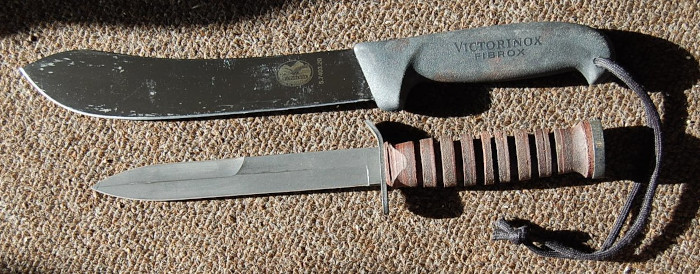
20 cm Butcher Knife

Butcher knife and M3 Combat Knife
Butcher Knife and M3 Trench Knife
I have already covered the merits of a good butcher knife in a previous article.
While possibly a little thin for woodworking, a butcher knife is unsurprisingly good for food preparation and self‑defence.
Might be prudent to invest in one of these before you pay three figures for a Ka‑Bar or Buck.

MOD Survival Knife

MOD Survival Knife

The MOD (British Ministry of Defence) survival knife is about as basic and no nonsense as you can get.
A thick bit of metal with a slab of wood each side.
The point seems like an afterthought.
As a general rule, you should not dig nor pry with a knife. If you were to do either of these, the MOD would probably be the tool to use.
The MOD will not earn you admiring glances around camp. It is, however, robust and capable of most survival duties.
If space were severely limited, this might be the knife I took with me. In practice, my 10" kukri is only a shade longer and probably lighter.
If your reason for choosing a medium was to save weight, the MOD is probably not the medium for you.
MODs were once popular for custom projects. The grips were an obvious target for improvement. The tendency to cause blisters could be mitigated by wrapping with cord or tape, or wearing gloves.
Personally I do not find the grip that bad. That might change if I had to put mine to hard use.
Blades were sometimes reground or reshaped.
The bad news is the price of an MOD survival knife has risen in the past few years, now crossing triple figures.

Honorary Mentions

In addition to some of the models already mentioned, I would not mind owning or reviewing the Morakniv Garberg Grand, Morakniv Bushcraft Pathfinder and the Sissipuukko.
My SRKC has got me interested in the Cold Steel SRK 6".

Conclusion

If starting from scratch, I think the butcher knife and the M3 would be my first purchases.
All of the described knives have their pros and cons. A medium-sized knife is something of a compromise, after all. Notable is that the MOD is the only model provided with a channel for a wrist-loop.
It becomes apparent that a very nice and useful medium knife could be created if the Ka‑Bar blade was mated to a Buck 119-type handle.
Categories
Barata

Cold Steel 5 inch SRKC

Birthday coming, so some self‑indulgent purchases recently.

Cold Steel

In fairness, I must start by admitting to being a little ambivalent towards Cold Steel.
Some of their stuff is very interesting. Some is very expensive, while other items seem good value. Some of their products are praised to the skies, while others have issues. I have an impression that price and quality do not always correlate.
On Venice Beach, I had a conversation with an entertainer who claimed he used Cold Steel True Flight Throwing (TFT) knives out of “economic necessity”. He claimed TFT were incorrectly heat treated for their role. He threw them until they inevitably broke. He claimed to have a bucket filled with broken TFT. Cannot say I liked the ones that I threw.
That was a couple of decades ago, but more recent reviews still mention breakages.
Cold Steel make kukri‑inspired knives, and I would love to see how these compare to the real thing. The grip shape of a kukri is near perfect for its role. I am doubtful that the evident changes to the grip made by Cold Steel are for the better.
Unfortunately, the CS kukri‑oids come with a high price tag. I am not going to spend good, hard‑earned money on what may prove inferior to what I already have.
On the other hand, I have drooled over the Thai Machete, but have been unable to source one this side of the pond.
I have also been tempted by Cold Steel's copy of the TruBal Bowie Axe thrower, the Perfect Balance Thrower. I mention the former in “Survival Weapons”.
As I sat down to write this, I was a little surprised to realize the only other Cold Steel implement I owned was a Mini‑Flight Thrower sent to me by a good friend.
In this video it is claimed that the SRK was the first knife issued to SEALs for their Basic Underwater Demolition training (BUDS).
You can take that two ways.
SEALs would not issue something that was total dross, but most SEALs progress to other designs.
The SEALs issue the 6" model.

SRKC

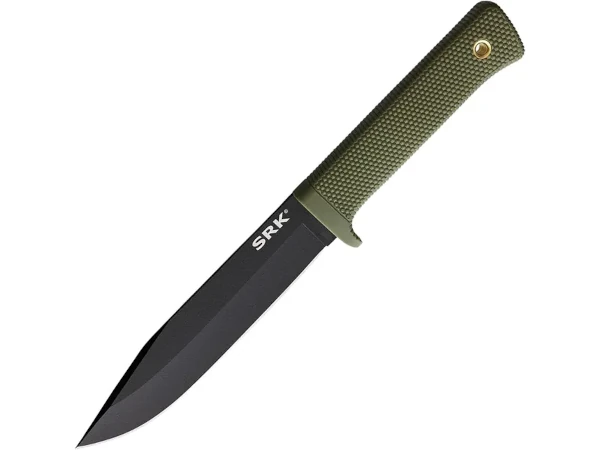
Cold Steel 5" SRKC

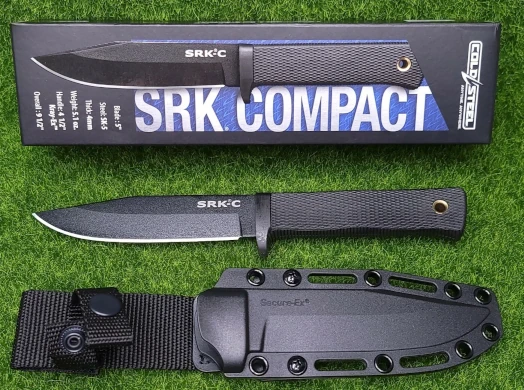
I decided on a Cold Steel 5" SRK (aka SRKC/SRK Compact). I was interested in this as an alternative “pec‑knife”. A knife this length is generally handier than those in the six to eight inch category.
The 5" version differs from the 6" model in thickness, grind and grip width.

Sheath

I had heard the sheath of the SRK had been changed, and was not very good.
The sheath of mine is quite reasonable, so may be it got changed again, or that comment did not apply to the SRKC.
Cold Steel SRKC and Sheath
The knife clicks into a collar on the sheath. Not quite with the crisp “snap” of my Moras or Gerber Strongarm, but it keeps the knife in if you give it a good shake, so good enough.
For added security, there is a retaining strap with a popper. This is better than the example on my personal Strongarm. It is a generous (slightly loose) fit, and the pull tab is a good size so may be unpopped with just a flick of the thumb.
The sheath is not ambidextrous. You have to align the blade correctly before reinserting it.
The belt hanger has a loop large enough to fit most belts, and has a popper and velcro so it may be easily removed from a belt without unthreading.
The belt hanger is secured by two bolts, so it may be removed and remounted for handle‑down carry. The sheath as a number of eyelets and slots, so other configurations may be possible.
The cross slots in the bolt heads are compatible with the small (can‑opener) screwdriver of a Swiss Army Knife, so no searching for an Allen key or Torx wrench, and it is possible to reposition the belt‑hanger while out in the field.
There is a choice of handle colours, but the sheath is “any colour you want so long as it is black”. You could probably paint it.
Knife and sheath together are quite light, which is good.
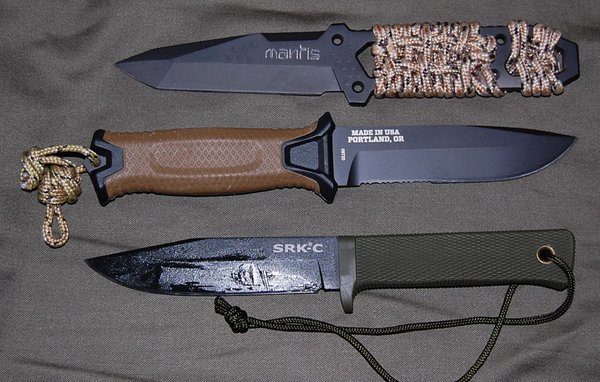
Selection of Pec-Knives
Pec-knives: Mantis MF-1, Gerber Strongarm and Cold Steel SRK-Compact

Blade

Blade thickness is important for pec‑knives and “cross‑over” survival knives. They may be put to heavier use than most knives of similar size.
The SRKC is about 4 mm thick, putting it midway between my Moras and the Strongarm.
One side of the blade was smeared with some grease. The blade is carbon steel, rather than the stainless I had assumed.
The box cautioned me that Cold Steel knives are “extremely sharp”. Not even close. Straight out of the box, this one wasn't.

Grip

The handle is a hard, rubber‑like material (Kray‑Ex) with a slight tackiness and good checkering.
There is a brass‑lined channel for a wrist loop, which is a good feature. A lot of very expensive knives do not have such.
My only criticism of the Moras is this lack, but their handle and tang construction makes it an easy task to add one with a gimlet.
What I do not like about the grip is the cross‑section. It is basically a rectangle with inwardly tapered long sides. An oval cross‑section would be more comfortable, more attractive and more practical.

Butt

There is a slight flare towards the butt, aiding retention.
The butt of the knife is covered in the same material as the rest of the grip. It is ridged, presumably for grip if you use an ice‑pick, hook or ninja hold.
On the plus side, no bare metal if you use the knife in sub‑zero conditions. Possibly it will provide electrical insulation if you cut a live wire?
Grip length is ok for me (Size 8 hands). If you have really big hands, you might find the butt within your palms.
On the other hand, the covered butt may not be ideal if you have to use it for pounding or hammering.
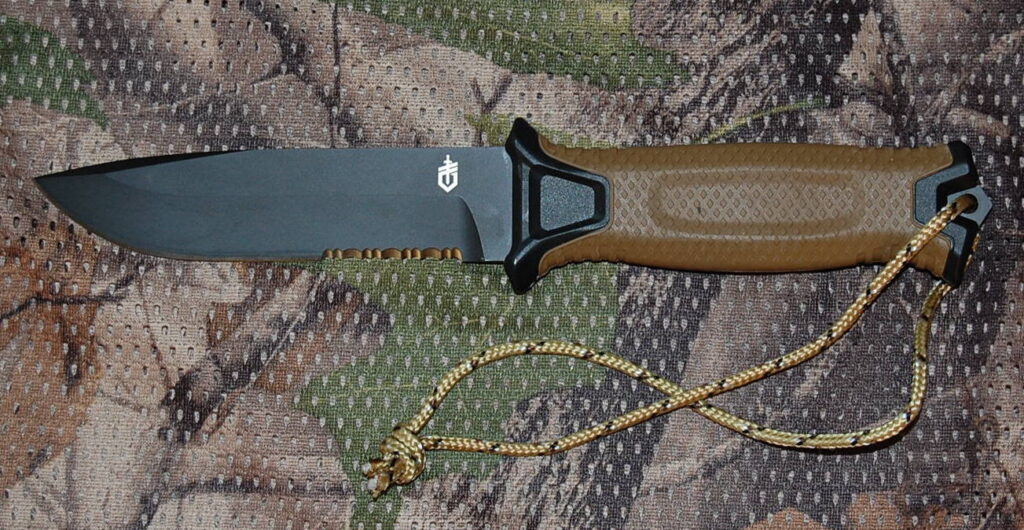
Gerber Strongarm
Gerber Strongarm
In contrast, the Strongarm has an exposed section of tang at the butt that may possibly be used as a window breaker.
In “Northern Bushcraft”, Kochanski suggests a “knife should have a strong pommel that will protect the handle if the knife is driven tip first deep into wood.”
Arguably, the Mora(s) Kochanski famously usually carried does not meet that criteria.

Price and Value

My SRKC cost me £52, but I have seen them offered at £39.99 (Out of stock). A Mora will be under £14, and a Strongarm is currently £89 to £100+. Prices tend to be higher on this side of the pond due to less competition and demand.
Personally, I feel the SRKC is a little overpriced for what it is. This seems much more a £30+ knife.
Shop around and be on the lookout for deals. In the US, prices under $40 may be encountered, which is a more reasonable price.
I was a little underwhelmed when I unboxed the SRKC. I am beginning to warm to it.
Consider it as an option if you can find it at a good price.