After yesterday’s blog on cloaks I came across mentions of a foul weather cloak called the Birrus Britannicus. It seems the Romans associated Britain with cold and wet weather, hence the name. Such cloaks were widely used in Britain by both the locals and Roman visitors.
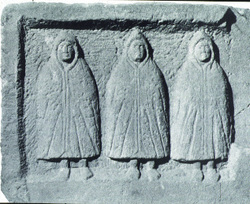
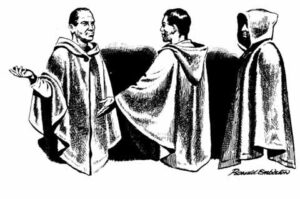
This website has some information on making one with a “bindweed leaf” shaped hood that was often associated with these cloaks. (Note that the page uses the spelling “byrrus” rather than the more commonly used “birrus”. The site has a number of other basic grammatical mistakes so this is probably an error).

The hood is made out of two pieces described as “diamonds”: actually kite-shapes with two sides of 55cm and two of 68cm. No information is given on the angle between these sides so you will probably have to construct a mock-up to get the volume right. The two 55cm sides are sewn together to make the top and back of the hood and one of the 68cm sides sewn to the cloak. You may like to make the hood part double thickness or line it. The article mounts this hood on a semi-circular cloak but it seems Birrus Britanicus could also be oval or circular designs, as described in my last post. The “triangle piece at the throat” is not clear in the photographs but is evidently a fly or baffle type piece to prevent drafts at the neck area. I suggest you reserve some material, join the cloak and hood and then work out the shape and form of this piece.
The most practical fastening for such a cloak is probably one or more hook and loops, with another to secure the throat bit.
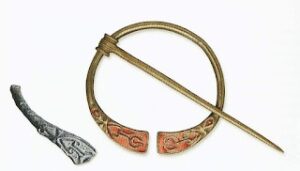
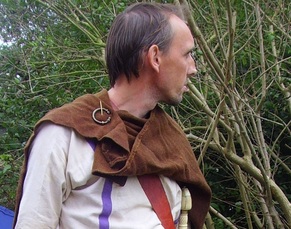
On the subject of fastenings, I mentioned cloak pins in the last post. I have seen scores of these in museums with no indication on how they were actually used to fasten a cloak. The answer is both simple and ingenious! A functional example could easily be made with some pliers and heavy wire!




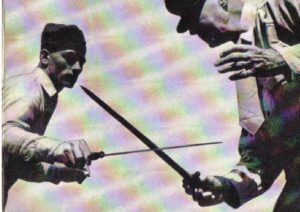





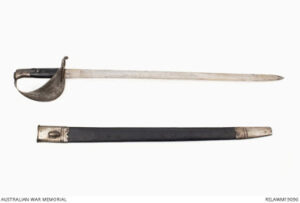

 derived from a civilian tool favoured by outdoorsmen. Hangers, “short hunting swords” or “couteau de chasse” were useful for chopping firewood, clearing brush and butchering game. They were carried by noble and commoner alike. There are exciting accounts of them being used to hunt game and they were a useful defence against both beast and man. Decorated versions might be worn out court to display one’s affection for hunting. They might also be worn in town as a handy defence against robbers, in many cases being more effective and convenient than rapiers or small swords. Understandably the common foot soldier found the hanger to be a useful implement. In addition to the sword bayonet the hanger is probably the ancestor of both the naval cutlass and the machete, and is why you occasionally come across machetes referred to as cutlasses. Sword bayonets were created to produce a bayonet that also served as an infantryman’s hanger. The yataghan configuration blade provided better clearance for the hand when reloading a muzzle-loading weapon. The blade shape is not without other merits so a number of breech loaders also used sabre bayonets.


 you can see them wearing a tube-like item that resembles a thin blanket roll. This would be made of silk, cotton or even from a bicycle inner tube and carried the fighter’s rice ration.