The other day I had a good chuckle at someone calling a six-inch blade a “full‑sized knife”.
Aww! That is so precious and adorable!
Silliness aside, and (mostly) avoiding the “size matters” jokes.
After many years and too many purchases, I have concluded I do not have much use for medium‑sized field knives.
For purposes of the following discussion, let us define “medium‑sized” as a fixed blade survival/field/bushcraft knife with a blade between six and eight inches/15 to 20 cm.
Before you spend good money on a knife (or most other things) it is a good idea to have a think about what it is likely to be used for.
If there is a chance I might need to construct a shelter or build a campfire, I will try to have a big blade to hand.
Kukri, machete, parang, barong, golok, cane‑knife, billhook or hatchet. Many of these are available at any hardware store for a reasonable price.
Useful tools for self‑defence or if you need to butcher wild game too.
If I need to do finer work, a fixed blade of three to five inches is generally handier for such tasks than a medium knife.
A big blade and a small blade can cover most bushcraft roles: woodworking, food preparation and self‑defence.
So where does that leave the medium knives?
Many, many years ago I jotted down some ideas on a concept I called a “Desert Knife”.
If you were in an environment where trees were rare, it can be argued that you might not need to carry a blade that was an effective wood chopper.
You could carry a small blade in such an instance, but might feel this is not sufficient for defence.
This is one argument that might be made for carrying a medium knife.
An urban environment might meet the above criteria. Concealment may be a factor here, and a medium knife may still be too big.
As an aside, an urban environment often includes closed doors. A kukri or hatchet can prove useful there.
Suppose you want a medium knife or two, anyway.
There is a vast range, and some cost way more than good smaller or larger blades.
The following are some personal recommendations, mainly based on knives I have acquired or handled over the decades.
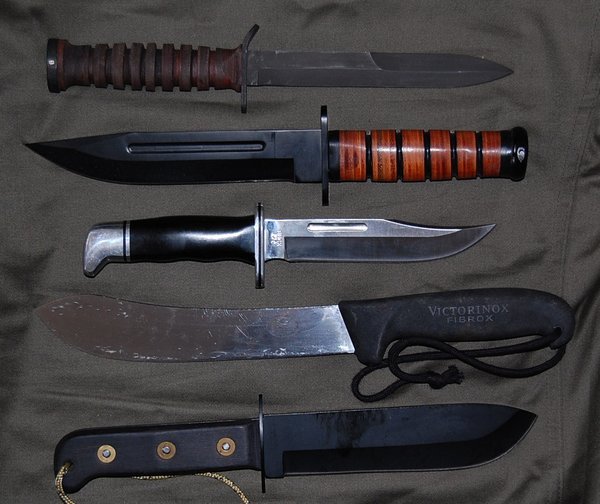
M3 Trench Knife
The M3 trench knife is one of my favourite medium blades.
The blade‑form and balance are well suited to defensive use. Unlike, say, the Fairbairn‑Sykes commando dagger, the M3 is useful for many utility tasks too.
The M3 was sometimes marketed as the (Eickhorn) “NATO Combat Knife”, usually combined with the M8/M8A1 sharpening scabbard.
Some reviews suggest the sharpening scabbard had little noticeable effect on making the blade sharper.
The leather sheath seen with many examples has staples around the mouth, which seems a great way to get the blade finish scratched up.
The Camillus “economy” leather sheath without the staples is nicer and more practical. If you cannot get this, use the fibre-glass M8.
The M3 is not a knife for skinning a buck, fine whittling, carving or cutting in depth. The broad angle is good for woodchip removal when chopping.
Like the Ka‑Bar, the M3 has a grip composed of leather washers. The grip has deep grooves, an oval cross section, and is also oval in plan and profile.
In other words, it is a pretty secure grip.
The butt has a metal plate to facilitate hammering, breaking nutshells, smashing windows and so on.
The M3 was so successful, the M4, a bayonet version for the M1 and M2 carbines was created.
The army began to issue M4s to troops who did not carry carbines, so the M3 was phased out.
The M4 was to evolve into the M5 (Garand), M6 (M14) and M7 (M16). The bayonet versions had phenolic handles and the associated hardware for fitting to a rifle.
Replica M3s may still be found at reasonable prices, often sold by suppliers to re-enactors.
The M7 bayonet may also be found, although the bayonet ring and butt piece may constitute unnecessary weight. The M7 is quoted as massing 1.19 lb!
I also own an Imperial M7S Survival Knife. This is based on the M7 bayonet. An odd blade shape to provide with three types of saw tooth. This was actually my first ever fixed blade survival knife.
I would love to find a source of M3/M7 blades so I could fit it with a grip such as the thistle‑top.
Incidentally, my notes show the “Desert Knife” design resembled an M3 with a serrated section.
Ka‑Bar US Marine Survival Knife
The Ka‑Bar is the blade most associated with the USMC.
I have never owned a genuine Ka‑Bar. Buy more books!
I have a rather nice copy of the Ka‑Bar, acquired relatively recently.
The Ka‑Bar is more of a traditional survival knife than the M3 and correspondingly, a more versatile choice.
Downside is Ka‑Bars tend to go for three‑figure sums.
The blade is a little longer and broader than the M3, having a Bowie‑shape.
The steel butt is designed for hammering with, and a little more elegant in shape than the M3 version.
Like the M3, the grip is composed of leather washers. Unlike my M3, the grip of my Ka‑Bar-oid is varnished. The marines were discover untreated leather washers did not hold up well in the jungle.
While some reviews will describe the leather washer handle as offering a great grip, other sources say the opposite.
I showed my lady the Ka‑Bar clone just after it arrived. Misunderstanding my intentions, she thought I was offering it to her. She told me “I already have my knife [a Mora Companion], and the grip is too slippery.”
She knows her knives, and is very practical. She uses her Mora as a diving knife when foraging for seafood. Interesting that she did not see any practical difference between the Ka‑Bar and a Mora.
I have heard of roughening and even reshaping a Ka‑Bar using sandpaper.
Tape of the sort used for gold clubs or tennis racquets may be another option.
A number of variants on the Ka‑Bar are on sale, including a USMC bayonet. Some have alternate grip materials. Some offer partially serrated edges.
I have no personal experience of these. I do have a tanto with a grip that looks identical to some Ka‑Bar versions. This tanto is an oddly “unlively” knife.
Ideally, try handling some Ka‑Bar examples before you part with your hard‑earned cash.
Buck 119 Special
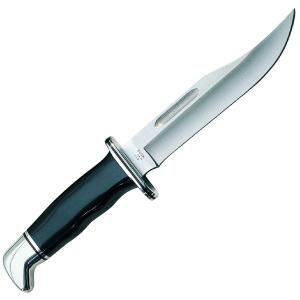
The Buck 119 is my favourite medium knife.
For a more extensive review, see my article here.
Blade is about an inch shorter than the Ka‑Bar.
The grip is smooth phenolic, since I could not afford the cocobolo version.
Despite the smooth surface, I find this a very secure and comfortable grip due to the subtle finger grooves and thumb depression. That is me, however.
A friend of mine finds the grip does not suit his hands.
Wrapping the grip with tape or line is an option.
My only criticism of the 119 is the polished finish. I suspect many potential buyers would prefer something less shiny.
I suggested to Buck that a tactical version with a non-reflective finish and coyote‑brown or khaki‑drab grip would be popular. I got told that Buck “no longer accepts customer suggestions”.
I have both five and seven‑inch Buck Nighthawks, but the 119 much is better.
The Nighthawk 651 Pigsticker is really nice, but your changes of getting one are remote.
The Buck 120 General was not available when I brought my 119. The 120 seems to have been put back into production.
The 120 is a 119 with a 73/8" blade.
I do not own a 120, but if any reader wants to give me something for my upcoming big number birthday…
20 cm Butcher Knife
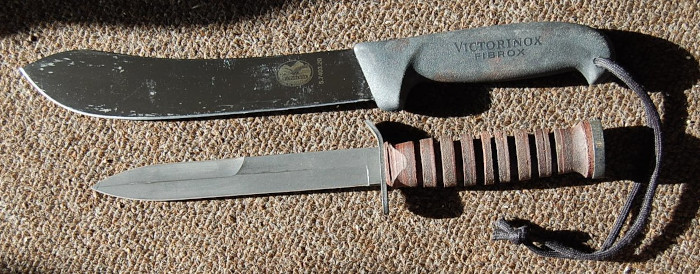
I have already covered the merits of a good butcher knife in a previous article.
While possibly a little thin for woodworking, a butcher knife is unsurprisingly good for food preparation and self‑defence.
Might be prudent to invest in one of these before you pay three figures for a Ka‑Bar or Buck.
MOD Survival Knife

The MOD (British Ministry of Defence) survival knife is about as basic and no nonsense as you can get.
A thick bit of metal with a slab of wood each side.
The point seems like an afterthought.
As a general rule, you should not dig nor pry with a knife. If you were to do either of these, the MOD would probably be the tool to use.
The MOD will not earn you admiring glances around camp. It is, however, robust and capable of most survival duties.
If space were severely limited, this might be the knife I took with me. In practice, my 10" kukri is only a shade longer and probably lighter.
If your reason for choosing a medium was to save weight, the MOD is probably not the medium for you.
MODs were once popular for custom projects. The grips were an obvious target for improvement. The tendency to cause blisters could be mitigated by wrapping with cord or tape, or wearing gloves.
Personally I do not find the grip that bad. That might change if I had to put mine to hard use.
Blades were sometimes reground or reshaped.
The bad news is the price of an MOD survival knife has risen in the past few years, now crossing triple figures.
Honorary Mentions
In addition to some of the models already mentioned, I would not mind owning or reviewing the Morakniv Garberg Grand, Morakniv Bushcraft Pathfinder and the Sissipuukko.
My SRKC has got me interested in the Cold Steel SRK 6".
Conclusion
If starting from scratch, I think the butcher knife and the M3 would be my first purchases.
All of the described knives have their pros and cons. A medium-sized knife is something of a compromise, after all. Notable is that the MOD is the only model provided with a channel for a wrist-loop.
It becomes apparent that a very nice and useful medium knife could be created if the Ka‑Bar blade was mated to a Buck 119-type handle.