We tend to associate mosquitoes with the tropics.
During summer in Alaska, however, caribou can lose a pint of blood a day to mosquitoes. This may prove fatal to the younger or weaker caribou.
Little wonder AFM 64.5 (1952) recommends:
Arctic: In the winter, in addition to the essentials recommended above, carry a sleeping bag, parka, mittens, snowshoes, or skis, and mukluks. In summer don't forget mosquito netting and repellent, extra clothing (socks especially) and shoepacs. Wear sunglasses when sun is high on snow surface. Keep feet dry, summer and winter.
Then there are the diseases and parasites that mosquitoes carry. Mosquitoes are probably the greatest man-killers on the planet, after humans themselves.
And not to forget midges, horse flies, black flies, tsetse and a variety of other biting insects.
Biting insects can range from a nuisance to life‑threatening.
I have dozens of recommended kit lists, and several of them include an insect repellent wipe in a sachet. One wipe is not going to last long.
I have a bottle of insect repellent in my travelling bag, but I am well aware that it is a finite resource. Some insects dislike it more than others.
Many kit lists do not mention insect head nets.
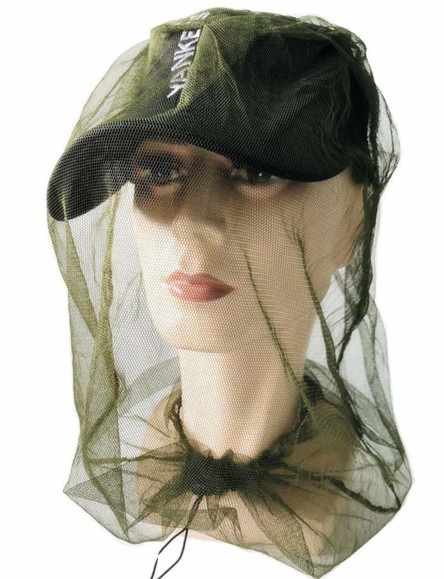
A good insect head net will probably cost you less than a pint of beer. They weigh practically nothing, and take up very little space.
You have to ask yourself why you would not have at least one?
You can even keep an insect head net in your skin-level EDC, helping pad the other items in a cargo pocket.
There are numerous brands of insect net, but one bag of fine mesh is pretty much like another. You might like to try out one of the cheaper options before you part with a wad of hard‑earned cash.
The main criteria to look for is that the net be black or some other dark colour.
Lighter colours will reflect light and be harder to see clearly through.
A few people have suggested light mesh as a camouflage eye covering in snow or desert. This is why it is probably not a good idea.
The insect net in my EDC is a British Forces Mosquito/Midge Micro Head Net (NSN 8415-99-519-8268).
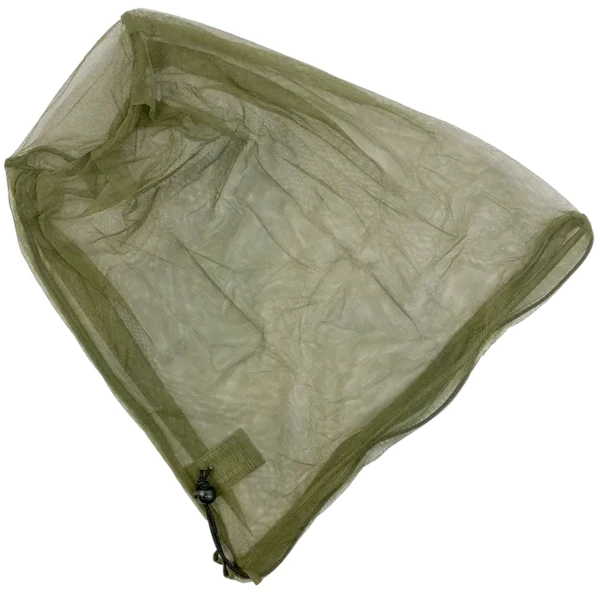
This head net is 45 cm deep, and 45 cm at its widest, tapering down to 16 cm at the closed end. It will fit over most headgear, has a neck drawcord, and is “olive” in colour. The olive is dark enough to see through.
If you have added an insect head net to your kit, it is reasonable to consider what other uses it may be put to.
• The insect head net is a large mesh bag, probably with a drawcord. It can be used as an emergency carrying bag.
I would not recommend it for heavy or dense items, but if you come across a thicket of ripe blackberries…
You could also tie it to the outside of your pack and use it to let your wet socks dry.
• A head net could be used as an improvised fishing net. It may be sufficient to catch shrimp and the sort of small fish that can be used as bait for something bigger.
• An insect head net may be used as a pre-filter to remove debris and large material from water before you heat or chemical treat it. Use several folds of material.
I have seen it suggested that an insect head net may be used as a filter or strainer for making tea or coffee.
It should be obvious [hopefully], that these applications are not suitable for a mesh treated with agents such as permethrin.
• Eyes are a difficult area to camouflage. You can do artistic things with camo‑cream but the white of the eye (sclera) and the iris colour remain.
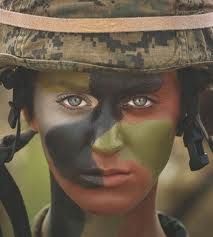
Eyeglasses may reflect the light and draw attention.
A dark‑coloured insect head net can help with this. The insect head net should be combined with other measures such as a camouflaged head covering and facial covering.