
Many, many decades ago, I began to investigate this “internet-thingy”.
While many of my contemporaries discovered previously undreamed of access to pornography, I went looking for information on knife throwing.
I was lucky enough to come across the “thrower” site, run by a gentleman called “MJR”.
Something of a renaissance man, MJR’s site included sections on other topics. This was my introduction to solar cooking, and the related field of water pasteurisation.
Most of the world’s diseases are water‑borne.
To render water safe to drink, it is not, however, necessary to sterilise it.
What is needed is to pasteurise it, neutralising the organisms that are harmful.
I have read numerous survival manuals, and many of them have advice based on the old WHO recommendation for sterilising water, that a rolling boil maintained for ten minutes.
One book recommended boiling water for twenty minutes, then leaving it an additional twenty. No idea what the author based this advice on, but it was not science.
The WHO recommendation itself is overkill and has been revised.
Why does it matter? Better safe than sorry, surely!
Following the old WHO guideline results in a massive waste of resources that may be scarce to start with.
Boiling for ten minutes is going to use at least twice the fuel you actually needed. Boiling for ten or twenty minutes is likely to result in significant loses of water from evaporation.
Pasteurising Water
To safely pasteurise water, the water needs to be raised to a temperature of 65℃ for six minutes.
In many parts of the world, this may achieved using local sunlight rather than burning down the local forest.
Some of you may know that storage of hot water in buildings must be kept at above 60℃ to prevent microbial growth such as legionella. Some cheap maintenance companies supply the water at this temperature from the taps because they are too cheap to install thermostatic mixer valves.
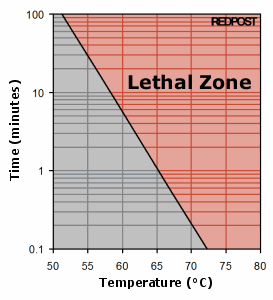
What is interesting is that heat treatment is an exponential process. An increase of only seven to ten degrees results in a ten-fold increase in microbial death.
So water at 75℃ needs around 0.6 minutes (36 seconds) to safely pasteurise. The graph above suggests less than 6 seconds.
At 85℃, approximately only 0.06 minutes or 3.6 seconds is needed.
Determining whether water is at 65 or 85℃ is difficult without instruments such as thermometers.
Bringing water up to a rolling boil ensures it is fully pasteurised, and makes a better cup of tea too!
While I have known about water pasteurisation for a long time, many of the survival manuals and websites out there make it clear the message is not getting to those that need it.
The other day I came across a very interesting innovation of water pasteurisation.
Bring water to a rolling boil will pasteurise it, but this high a temperature is not really necessary. The rolling boil is a convenient indication the water has exceeded the necessary temperature.
Why not use this boiling water to increase the temperature of more water, adequately heat treating more water for the same quantity of fuel? Up to 50% more safe water for the same energy!
Boil 3, Add 1
This is the basis of the “Boil 3, Add 1” method.
Three volumes of water are brought to a boil, then a single volume of unheated water added. The resulting temperature remains hot enough (65℃) to pasteurise the water in the time it takes to cool.
Boil 3, Add 1 was calculated assuming a worst case that the unheated water was at 1℃.
If conditions are warmer, and altitude is below 4,000 metres, it is possible to use a Boil 2, Add 1 for more efficiency.
At above 4,000 metres, use a 5:1 ratio.
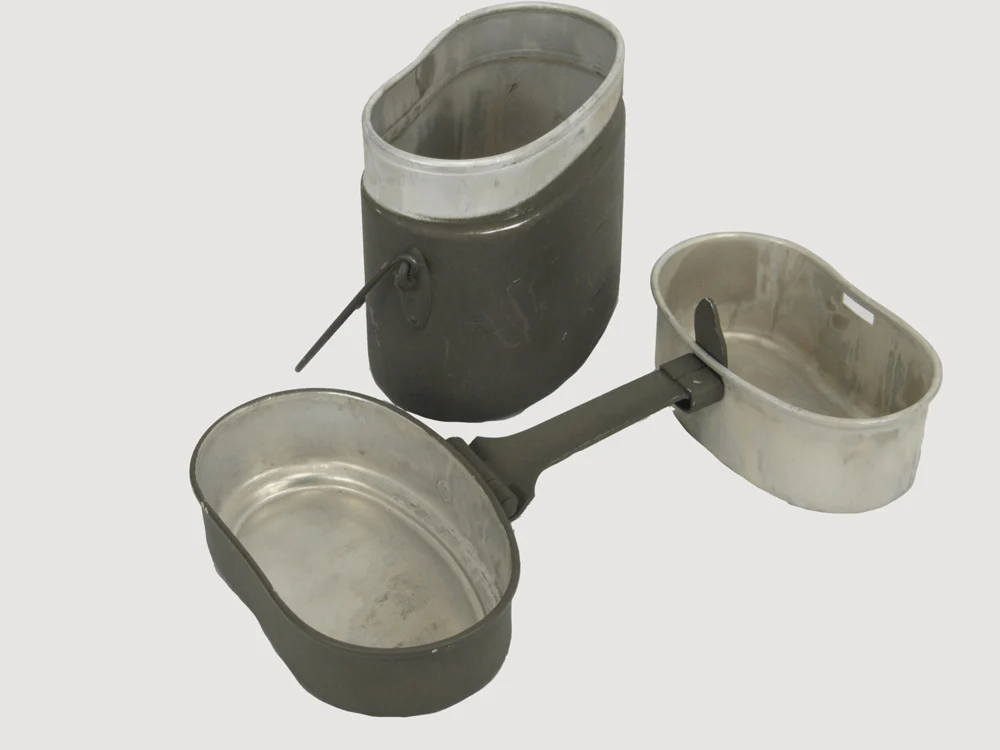
As a practical example, I will assume I am using my German mess tin.
Collect your untreated water. Allow sediment to settle out. Filter it to remove debris and mosquito larvae. Many ways of doing this are covered on other pages in this blog.
Remember that filtering will not render water safe. Even commercial filters may let some viruses through and water will still need to be chemically or thermally treated.
The billy of the German mess kit can take 1.5 litres and is marked off in half litre increments.
The lid/pan and the bowl of the kit both have a capacity of about 400 ml, so it is more practical to use one of these to place two measures (about 800 ml) of water in the billy.
This gives an airspace above the boiling water in which vapour may condense.
Obviously, whatever vessel you use must have room for the volume of unheated water you will add.
Add a little more water if you want some to make tea or coffee.
Covering the pot conserves heat and keeps the bugs out. The pan/lid may be used to cover the billy either mouth up or mouth down. This may be used to hold the measure of unheated water and allows this water to be pre-warmed.
The outside of the pan/lid must be relatively clean to prevent condensing water contaminating the pot contents if used in this fashion.
Bring the water in the billy to a rolling boil, then shut off the heat to conserve fuel. Pour off the boiling water you want for coffee or tea.
Pour the unheated (but possibly pre-warmed) water into the remaining boiling water. Pour it from a good distance so the waters mix.
Pour a measure of water into your measuring vessel. This is important since the vessel that held the unboiled water will be contaminated and needs to be decontaminated by holding the hot water within for a couple of minutes.
Alternately, if you have a heat-resistant water bottle: Fill bottle a third full of unheated water. Bring double that volume to a boil and pour into the bottle, decontaminating bottle and contents.
A Boil n, Add 1 is simple process if you remember two rules.
* The volume of unheated water must not exceed a third (or quarter or fifth, as appropriate) of the final volume.
* Decontaminate your measuring vessel.
Mixing boiling and unheated water has a long history.
Long before thermometers were available, some brewers used this method to ensure water was the correct temperature.
A variation was to cook malt as a sort of porridge and mix it with a suspension of malt in cold water. Changes in the texture of the porridge indicated it had received sufficient heat.
This has also answered a couple of questions I have idly wondered at.
In previous eras campfires and households often had a kettle of water constantly on the boil. Why did it not boil dry? If it was topped up with only small volumes (less than a third), the water/stew temperature could be kept reasonably high.
In movies, one often sees a bathtub that is evidently filled by buckets, the water heated elsewhere. What was to keep the water in the tub from cooling while the next bucket was warmed?

I now suspect the tub was initially filled with water at ambient temperature, and one or two buckets of very hot water added just before bathing began.
I suspect if I search the internet for an infinite time, I may discover some historic almanac that gives the correct ratio of buckets to give a comfortable 35 to 40℃ bath.
That also explains how some traditional Japanese baths are said to have reused the water for multiple occasions. Add very hot water just before bath time.