Disclaimer: “As an Amazon Associate I may earn from qualifying purchases.” Adsense and Infolinks were no help at all.

If you have enjoyed this article or it has been helpful to you please feel free to show your appreciation. Thank you.

Read The Third Wave by Alvin Toffler!
Categories
Phillosoph

Sleeping Bags for Hostelling

A few weeks back I got talking about my experiences of youth hostelling when younger.
I didn’t get into hostelling until I was in my early twenties so was often the “old man” of a dorm. That said, I often struck up enjoyable liaisons with some of my fellow travellers. Some of these only lasted a couple of days until our paths parted, others were friendships that remained active for many years.
I was asked to write a little on the blog about my experiences and conclusions. .
One of the first topics I was asked about was sleeping bags for hostelling.

Do you really need a sleeping bag for hostelling, I was asked? My answer would be yes. 
While many hostels provide some bedding there are many that do not. It depends where you are in the world and whether it is an official IYH hostel or not. .
I will note that some of my most memorable experiences have been at “unofficals”, although by no means should you avoid the official places. There have been some fun times in those too. .
Another reason for having your own bedding is that there will be times when you want to travel overnight by train or bus, saving yourself the price of a room for the night.
This is not going to be a generic article on selecting sleeping bags. I will save that for another day if there is interest.

Too Much of a Good Thing?

The most common mistake when buying your first bag is magnum-itis!.
A common mistake when buying a bag is to buy one that is too warm. .
Look around any hostel and you'll see several roommates with legs draped out of too hot five-season expedition bags.
I did exactly the same when I brought my first bag (labelled as -15°C). I still have that bag but now reserve it for outdoor use or buildings that I know will be insufficiently heated. .
In truth, I have seldom used it. 
Use your hard saved money for a more practical purchase.
I soon invested in a one/two-season sleeping bag that folds up to the size of a rugby ball without the need for compression straps.
My bag of choice was a Snugpak Merlin Softie 3, which I am happy to say are still in production. There are several variants available now. There are lengthened versions for the very tall. A tactical version has a reinforced lower for users that might need to sleep in their boots. (Put sandbags over them first!). 
Looks like the modern versions do have compression straps, probably because users expect them. My original stuff-sack neither had nor needed them.
The latest versions may have higher specs than my bag. According to its label my original bag is a “summer” bag for -5 to +10°C, comfort 0°C. The shop I brought mine from had them catalogued as 1-2 season, which they defined as +5 to +15°C.

My Merlin Softie has been all around the world with me and is still good to go. I have used it for both hostelling and camping.
I prefer bags with two-way zips for hostelling and similar travels. They provide better ventilation and are easier to get into in a dark dorm room. 
Some designs can also be zipped together, if your bag has a right hand zip and your loved one's a left.
The compact size allows me to carry a very small pack, with plenty of room for everything else. 
The larger sleeping bags often take up most of your rucksac volume or become large unwieldy lumps lashed to the outside. 
Should conditions be colder than expected, I can always add more insulation in the form of clothing or blankets. Taking insulation out of a heavier bag would not be possible. 
Conceivably I could use my lower performance bag inside another bag.
I suppose if I had my time again I'd buy a one or two season bag and a two or three season and have a really versatile system for all conditions.
I have a lightweight down bag that might work well with the Merlin but I cannot recall any instances where I was cold in the Merlin bag. 
Bear in mind that many of your travels will be to warm places in summer and you will see that such a bag is more than adequate. 
You’ll spend a third of your time on holiday sleeping, so a good bag is a good investment.
Many hostels will provide blankets but expect the guest to provide a sleeping bag liner. A sleeping bag liner is basically a sheet sewn into a bag-shape to keep the bedclothes clean. Some hostels may also have sheets or bags for hire.

For a long time I carried a simple, easily washable cotton sheet bag, both for hostel bedding and to protect my own sleeping bags.
One morning in a German hostel it disappeared from my bed! The maid had mistaken it for one of the hostel’s sheets and sent it on to the laundry. This was my last morning before moving on to Holland, so there was no way my bag would be returned to me in time.
The hostel owner was most embarrassed by this and gave me a set of sheets as a replacement. Once I'd returned home I set about sewing these sheets into a replacement liner, with two modifications:
  • One was to sew the sheets into a mummy shape to match the shape of my sleeping bag.
  • The other was to sew round the opening several pieces of brightly coloured material. This was partially to make my bag instantly recognizable to prevent the same happening again, and also so that I could locate the opening of the bag by touch, saving me from using a light and disturbing my roommates.
Although quite reasonably priced, liners can be very easily made, and there's no reason why they have to be white.
Make them from something you can recognise in an instant and line the neck with something that feels different and identifies it further. Some of you may consider a piece of lace.
I’m still using my homemade liner. Nowadays you can find pile liners to make your bag warmer. There are also silk liners and pertex ones, which have tempted me but I have yet to try.
If you are a restless sleeper who often gets tangled up in their bed clothes, you can make or modify your liner so it has separate legs.
Categories
Phillosoph

Simple Effective Personal Camouflage

For a long time I have advocated the use of camouflaged smocks. Surprisingly it is hard to get the idea that camouflage should be worn over the armour into some heads!
In a previous blog post I discussed the idea of camouflaged aprons or tabards. While I like the simplicity of this approach I feel it still has a way to go. Some of the illustrated examples are overly long and have too rectangular and regular a shape. Most obviously they do little to camouflage the distinctive arm and shoulder region.
Recently I was having a conversation and recalled this:

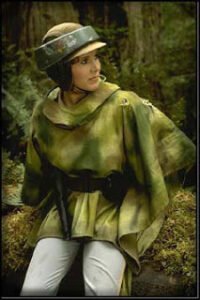
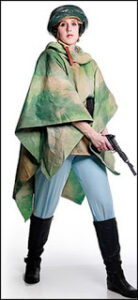
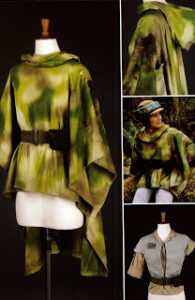
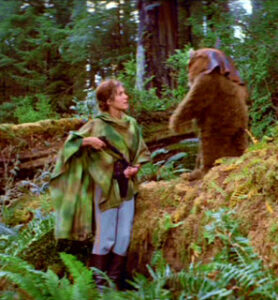
Several of the rebel characters on Endor wear these ponchos. Since it is not raining they seem to be primarily for camouflage. Leia’s, at least, seems to be rigged so that it is relatively short at the front, providing freedom of movement.
In his book mentioned in the previous post Langdon-Davies notes that the sniper suit (and personal camouflage in general) is:
“to destroy your human shape, as well as your human features. It is therefore cut as unlike a Savile Row tailor’s suit as possible”
and that “For many purposes the sniper’s suit may be thought too clumsy and readers are advised to experiment by making hoods of a larger size reaching to the waist. These can easily be taken off when the moment comes to run, and they do not in any case impede the movements of the legs”
A poncho is very good at concealing the shape of the human body. In previous posts I have discussed ponchos and shelter cloths as rainwear and I have discussed ponchos, blankets and cloaks as cold weather wear. Suppose we merge the idea of the camouflage apron and poncho to create a garment intended for camouflage rather than warmth or rain protection. Here, a similar idea is called a bush rag.
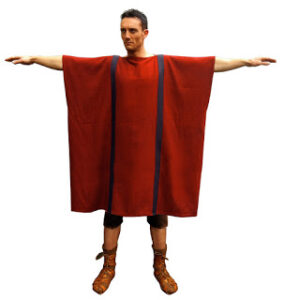
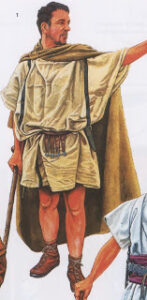
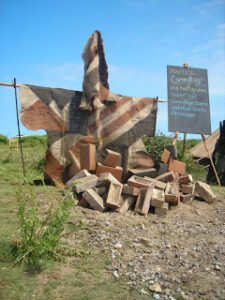
What I suggest is something roughly hexagonal in shape, folded across two opposite points. Its width would be about an arm span as measured between the elbows. This would be half an wearers height by Vitruvian proportions. At the front and back it would be about mid-thigh length to provide freedom of movement. Using the Roman tunica as an illustration, the camo-poncho would not be as long and would taper towards the lower edges. The sides would not be seamed. One of my reasons for mentioning the tunica is that like this garment the poncho would most likely be clinched, the equipment belt or webbing securing the flaps. Tapes or cords can be added for when a belt is not worn. The sides below the belt would not be joined for better freedom of movement when crawling or climbing.

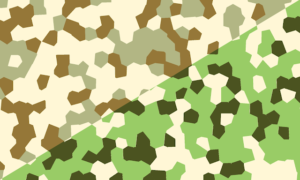
Being a very simple garment it is more practical to make the camo-poncho double-sided. One side could have a verdant pattern and the other a more brown and tan pattern suited to semi-arid, autumnal and many urban environments. Another version would have a desert pattern on one side and a semi-arid pattern on the other. Another variant would have pure white on one side and a pattern for broken snow on the other.
The camo-poncho (smocklet, ponchoet?) would use a contrasting macro-pattern that breaks up its shape. There is little point trying this concept with some of the multi-coloured patterns currently in vogue that blob-out into a single monocolour. In the pattern below individual polygons should be about three or four inches across. Mesh in useful patterns such as CCE can be found.

The double-sided camo-poncho could be created by simply sewing two differently patterned sheets together. A hexagonoid shape can easily be made from rectangles and rectangles cut diagonally. The hem would be made several inches from the edge and the cloth outside allowed to fray. It might even be cut into tassels like a buckskin shirt. The frayed edges and tassels further break up the recognizable shape and assist in the garment drying when wet.
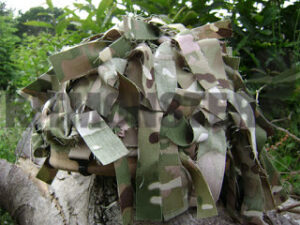
Since the camo-poncho is unlikely to see a parade ground we can add some patches of cloth, hessian and netting to make it three-dimensional, as was discussed for headgear. The poncho could work in conjunction with other ideas such as the soldier’s mantle.
Just to be clear. The camo-poncho is not intended to replace the rain poncho or poncho-liner. The soldier would also carry these items and use them when needed. They are vital components of his lightweight sleeping system. The camo-poncho is not intended to act as a shelter or provide warmth. One of its advantages is that air easily circulates under it, which will be welcome in hot climates. The camo-poncho is designed to provide the wearer with concealment. Warm clothing, including a poncho-liner, can be worn under it if the climate warrants. The camo-poncho can be worn over a waterproof jacket or rain poncho, providing camouflage and snag-protection and also muffling the noise of these materials.
Hunters, wildlife photographers and the like should feel free to try this concept out. It requires minimal sewing skills and is likely to be far superior to more expensive, tailored options.
Categories
Phillosoph

Langdon-Davies Home Guard Camouflage Suit

As I have already pointed out, I am getting old and my faculties are declining. Every now and then I look back for an article I have written to refer to and discover I have never posted it.

During the discussion of camouflage I referred to “The Home Guard Fieldcraft Manual” by Maj John Langdon-Davies.
Despite its age, this is a book I would recommend to anyone remotely interested in camouflage or not getting shot.

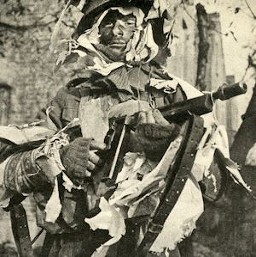
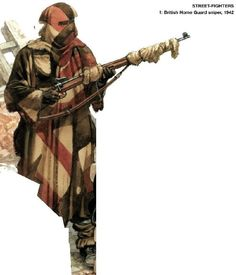
One of the most memorable parts of the book is Langdon-Davies’ instructions on how to create a “sniper suit” from open weave hessian.
Don’t get too hung up on the “sniper” label.
Langdon-Davies considers camouflage to be a skill that all soldiers should be adept at and comments that “twenty rifle rounds at 25 yards will be far more effective that fifty at 250 yards”.
If further proof were needed, note that one of the photos below shows a camouflaged sub-machine gunner.
The basic garment is a loose fitting smock. Its construction is not unlike some of the Roman tunics I discussed in a previous blog.
The seams are some distance in from the edge of the sleeves and sides and these parts are deliberately irregular. These would be permitted to fray to further break up the shape.
The garment was to be worn over the woollen battledress and webbing equipment. A flapped opening was provided for accessing the pouches and pockets within.  
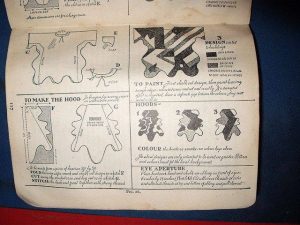
The hood illustrated is a separate piece.
For vision, alternate threads are picked out to create a “slot”. Langdon-Davies cautions against distinctive paired eyeholes. He provides some examples from nature of animals disguising their distinctive eyes with band-like markings.
The book also suggests an alternate design that resembles a short poncho with an integral hood.
He describes this as a waist-length hood with arm openings.
Obviously a poncho with a separate hood is possible too.

One of the advantages of using hessian is that it has a light, natural colour to begin with. This forms a good base on which to paint contrasting colours, giving good disruption of the human shape.
One interesting suggestion Langdon-Davies makes is that the front and back of the garment might have different patterns.
The camouflage needs of a kneeling man viewed from the front may be different from those of a prone man viewed from above.
Camouflage should be thought of as 3D rather than being two-dimensional patterns.
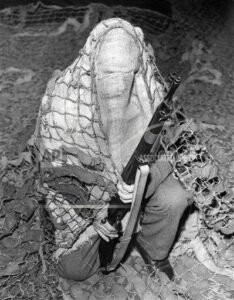
Additional patches of frayed hessian or cloth can be added to the garment, as can pieces of netting that allow the utilization of natural materials.
Categories
Phillosoph

Compact Living Space

A friend of mine recently contacted me to discuss his accommodation plans. Local zoning laws allow him to build a structure of ten square metres so we soon got onto the subject of optimizing compact living spaces. This topic has applications in many other fields, including survival so I thought I would blog some of our thoughts.
Firstly, make the best use of light. Pretentious interior designers on house makeover shows disparage marigold-painted walls. There are good reasons why marigold is so commonly chosen. It is light and it is warm, so a very good colour for living space walls. My own walls are a cream colour that works well with white trim and furnishings. If you have to live in a small space chose light and warm colours, not just for your walls but the other items that surround you.
Personally I never use curtains. If you do make sure the rail is wider than the window. This allows you to fully expose the window when the curtains are drawn, maximising the light entering your compact space.  
Intelligent use of mirrors can increase the light and illusion of space. Shop around since large mirrors can be expensive. Mirror tiles, on the other hand can be quite reasonable.
Compact living requires efficient use of space. Most caravans have seating areas that convert to beds at night. The table between the seats forms the centre part of the bed and the cushions become the mattress. This has some advantages. Unlike a conventional mattress the cushions can be easily taken outside to sun or air. Beat them with a carpet beater to get the dust out.

In all the caravans I have slept in the tables have been one-legged affairs that engaged a rail on the wall. A more conventional table with folding legs may be a better choice for our compact living space. This allows the table to be taken outside if the weather is nice. Ideally the legs would be an inverted “T” shape so you can easily take your seat. The table is your dining area and desk. At night it is part of your bed. When not needed it folds up and can be placed out of the way.
The lower part of the seats are also storage boxes. Logically this would be a good place to store your bedding. Install some vent panels so the bedding can air and dry during the day.
For bedding use rectangular sleeping bags or duvets. Sleep on one and under another. Have a light blanket, duvet or bag for summer nights and as additional insulation when it is really cold. Air your bedding outside regularly.
I discussed alternate sleeping systems such as hammocks and cots with my friend and these may be the subjects of future blogs. The caravan-style convertible sleeping/ seating area seems the most practical choice for this application.

Above is a rather nice example of a compact living area from an IKEA site. It could be improved by replacing the conventional bed with the system described above. I like the laundry bag that fits at the end of the bed. Ideally this bag would also let you carry the laundry to the machine or laundrette.

Storage space is an important consideration of a compact living area. Unlike a typical caravan you may be living in this area for months or years at a time. The IKEA photo shows most of one wall used for storage areas. These should be as tall as possible. If they do not reach the ceiling it should be practical to use their tops for additional storage.
Conventional wardrobes have doors that swing out into your limited living space.  The above arrangement uses a rail mounted in a storage unit to hang jackets and trousers. Obviously the unit needed must be about half a metre deep. If you do not like your clothing out in the open like this or fear some items might get faded by the sun fit this section with a light-coloured curtain.
Even if your storage units are free-standing it is prudent to attach them to the walls to “earthquake-proof” them. Open fronted shelving units create a feeling of space and make it easier to find things. Transparent boxes are useful here too. If your compact living area is mobile your storage areas will need doors. Sliding doors are worth considering.  Shelves should be detachable so height and arrangement can be changed easily to suit the contents.
Other areas can also be used for additional storage area. The areas under the seating have already been mentioned.  Shelves can be mounted above the seating/ sleeping area but must be high enough that you do not hit your head on them when you stand. Very tall visitors will need watching! If you want a bedside table make it a short shelving unit. If you have room for a free-standing chair have one that folds up when not needed. A stout storage box with a cushion on is a stool. Without the cushion it can help reach those high shelves.
Categories
Phillosoph

Price Drop!

Good news for some of you! I have dropped the price of “Survival Weapons: Optimizing Your Arsenal”. If you do desire a copy please buy it through the Lulu website. Not only will this give you an additional discount but it ensures that more of the money you spend goes to support my loved ones.

Thank you for all the support and interest.

Categories
Phillosoph

Sam's Van: Kitchen Equipment

Sam’s Van is an idea from a friend of mine from Tennessee. When he was in his late twenties he proposed that a person should only have as many possessions as could be transported as a single van load.
For a variety of reasons, I can no longer meet this ideal, but it is a useful concept to help you declutter and reorganize your environment.
There are some interesting websites about minimizing your possessions and these can provide useful inspiration. However, Sam’s Van is about optimizing what you have rather than minimizing it.
Recently I began to consider what I have in the kitchen.
This caused me to look at some lists of “essential” items of kitchenware, which did give me something of a chuckle. I quite like cooking so my kitchen contains some items I would not put on a basic start-up list.
The list below is a combination of what I have in my kitchen and items that appear on lists of essentials. If you are equipping a new kitchen or wish to declutter an old one, this list and my comments may be of help.

Plates, Bowls and Cutlery

At least four of each, with six preferable. The more you have, the less often you will have to wash up!
Bowls end up being used for microwaving veg and other uses so a few extra of these is prudent.
I found that teaspoons tended to be in short supply too so I brought a bundle more and released them into the drawer in the hope that they will breed.

Mugs

Extra mugs save on the washing up and let you be sociable.
Eight is a good number if you are on your own, twelve if a couple.
Mugs also get used as little mixing bowls for making sauces, instant gravy, mustard or similar.

Beer and Wine Glasses

You do not want to drink your beer and wine from mugs.

Pots and Pans

You will need two, maybe three, saucepans of a suitable size for your requirements. For example, if you are mainly cooking for yourself, a pot of about a litre size is going to be the most useful.
Make sure all the pots have lids and that they are of a configuration that you can use the lid to drain the pot.
Avoid steam-release vent knobs unless you like scalded fingers.

Wooden Utensils

You will need some spoons to stir your cooking and spatulas to flip frying or grilling food over. Since some of your cookware will be non-stick it is prudent to get non-metallic items.
If the local pound store does sets of wooden utensils, you can soon acquire half a dozen or more items of varying shapes and applications.

Frying Pan

If you are getting only one, get a non-stick one of reasonable width.
A frying pan can also be used for making and reducing sauces.

Mixing Bowls

A couple of bowls are useful for mixing stuff in, serving fruit or popcorn in and so on.
If you are smart you will select some that you can use in the microwave (and halogen oven). Some glass/pyrex bowls often have measuring graduations too.

Measuring Jug

I measure out the quantity of rice or pasta that I intend to cook using volume, so a measuring jug proves very handy. I also use it to fill the coffee maker with water.
It is used so often that it seldom leaves the draining board.

Chinese Cleaver

Something like 90% of cutting jobs in my kitchen are done by my Chinese cleaver. If I am using another knife it generally means the cleaver is in the wash.
Unlike the western cleaver, the Chinese model has a full bevel and a relatively thin blade. This type is sometimes called a vegetable cleaver but you can use it on anything you might wish to eat. As well as chopping, it can also be used for slicing, dicing and all sorts of fine cutting too.
Best place to get one is a Chinese supermarket, preferably one in a Chinatown district.
I have yet to cook anything the Chinese cleaver could not cut. Should such a situation occur, I have a Buck Ax in the kitchen too. The back of this gets uses as a hammer to break up frozen veg.
How to Use a Chinese Cleaver

Chopping Boards or Mats

Have at least one, and have it of a type that is easily washable. Use it to cut your veg before your move onto the meat or fish or use a different one for each.
If you want to have different boards for meat, vegetables and bread have them different colours.

Paring Knife/Knife Block

The other knife I use a lot is a “bird’s beak” paring knife. These are also called “shaping knives” or “peeling knives”.
This can be used for most of the jobs that a cleaver is not really suited for. Mine came with a knife block set. Its hooked blade is very useful for opening packaging.
I brought the knife block set to stop a certain “guest” abusing my boning knife.

Scissors

Modern packaging means that the scissors get used a lot too. I ended up putting a screw hook to hang them from inside the kitchen drawer so I could easily locate them.
Some lists of kitchen equipment have kitchen shears, which are presumably used for food preparation. Never used or owned these. The scissors or cleaver should serve.

Bread Knife

Whether you need a bread knife will depend on how you buy your bread and how much bread you eat at home. I have one as part of the knife block set and it sees occasional use.
Bread knives should also be used for cutting acidic fruits, so you should probably have one.
If you buy bread, have a cloth bread-bag to keep it fresh.

Carving Knife

There is one in the knife block set. Before I had that I usually used the cleaver.

Butcher’s Steel and Ceramic Rods

No point in buying a cleaver and knives if you cannot keep them in working condition.
I have a pair of ceramic sharpening rods and a butcher’s steel in my kitchen, ready to be used as needed.
See my book on how to use them.

Filleting and Boning Knives

I don’t have a filleting knife, and I find I have seldom used my boning knife.
Good ones tend to be expensive, so do not buy unless you expect to get lots of use out of them.
 

Whisk

Whether you need a whisk depends on your cooking abilities and style. If you have no idea on how to make a sauce or batter you do not need them.
I like the “magic” whisk type that look like they have a spring bent into a horseshoe-shape. I brought two or three of these to save on washing up.
Never felt the need for an electric mixer or blender.

Skimmer

This is a Chinese item like a cross between a ladle and a metal net. It is used to fish stuff out of boiling water or deep fat.
I have seldom used it.

Electric Kettle

You could get by with a saucepan if you have one clean but an electric kettle is worth having. Open flames and being half awake in the morning are to be avoided if possible.
Get the sort of kettle that will only boil the amount of water you need.

Toaster

The usefulness of a toaster depends on whether you have bread in the house. I had a friend staying with me who would buy bread for sandwiches so the toaster saw some use.
Since he has gone it has not been used much.

Garlic Press

I have not seen mine in over a decade.
When I need crushed garlic I simply flatten it between the cleaver blade and chopping board, which also makes it easier to peel. Then slice or mince further with cleaver as necessary.

Potato Masher

Use a fork unless you make a lot of mash.

Pizza Cutter

Just use a table knife.

Ice Cream Scoop

I seem to have inherited one! If you do not have one, simply use a spoon.

Can Opener

I don’t eat a lot of canned food.
When I needed something like canned tomatoes for a chilli con carne, I’d use the can opener on a penknife. A spare penknife is a useful thing to keep in the kitchen drawer.
A friend who was staying with me ate more canned food, so we brought a turnkey-type can opener from the pound-store.
Unless you are disabled or work in an industrial kitchen you do not need an electric can-opener. They are a waste of energy and money.

Bottle Opener/Corkscrew

You should have these. The penknife stands in reserve.

Pepper Grinder

Unsurprisingly, for grinding peppercorns.

Vegetable Peeler

I’m sure I have one of these somewhere but have not used it in years. Often you can simply scrape or wash fresh vegetables instead or use your paring knife.

Grater

I like grated cheese on my spaghetti, so I brought a grater from the pound-store. You can get by with cutting the cheese with a knife so this is an optional item rather than an essential.

Lemon Juicer

Lemon juice for pancakes gets brought ready squeezed. If I have to get juice from a fresh lemon, lime or orange I squeeze them manually or mash them with a spoon.

Pressure Cooker

I probably do not use this as often as I should.
It gets forgotten in the cupboard so I will try keeping it on a shelf instead. I eat a lot of rice and pasta and pressure cooking these does not offer much of a real time saving and the pot is large for the volumes that I cook. The pressure cooker is good for cooking rice or pasta with other ingredients.
Frozen veg is quicker and simpler in the microwave.
The pressure cooker does get used to make the Ham in Cola that I usually cook near Christmas.

Wok

I’m told that most people buy a wok, use it for a few meals then forget about it. I have been using mine for several decades for a variety of meals.
There are lots of things you can use a wok for other than stir-fries. If you do stir-fry, however, buy a chuan to move the food around with. This resembles a cross between a spatula and a shovel.
You will also need a bamboo brush to clean your wok with.
It is worth having a lid for your wok too. My lid got damaged in a move several decades ago and I have managed without, however.
You can buy a wok set in a nice box from many supermarkets. For a fraction of the price you can pick one up unboxed from a Chinese supermarket. Buy a cleaver, brush and chuan while you are there.
Don’t bother with non-stick or stainless steel woks. Get a carbon steel wok of 13-14 inches and season it.

Microwave

I use my microwave a lot but I really should use it more creatively. Mainly I use it to cook frozen vegetables. A bowl of frozen veg can be cooked in just a few minutes. I also use it to make polenta or mug brownies.
The microwave is used for defrosting too but it is less wasteful to let items thaw naturally in the fridge overnight.

George Foreman Grill

The grill in my oven is very inefficient, and the one in the microwave/grill is not that great either so I brought a George Forman grill.
I will admit I have used my wok and frying pan much less since I brought my George Foreman. Bear in mind it cooks both sides of the food at once so will cook quicker than a conventional grill.

Halogen Oven

This is a relatively recent addition to my kitchen and I probably use it more than any of the other cooking devices.
Make sure that your ovenproof bowls, baking pans and casseroles are of a suitable size and shape for use in the halogen oven.

Tongs

I don’t think I have ever owned kitchen tongs. The closest thing I have to them are cooking chopsticks, which I seldom use. A wooden spatula serves for flipping food.
This has changed with my use of the halogen oven. You need tongs (or chopsticks) to reach down into a hot halogen oven to turn or pick-up food. I also have tongs designed to pick up the racks or trays in a halogen oven.

Porridge Pan

If you like porridge, a small non-stick milk pan is worth having. It lets you make breakfast if the pans from the night before have not yet been washed.
I have a spurtle too, but you can use the handle of a wooden spoon instead.

Ladle

I have a couple of these but seldom use them. I do use one as a measure when pouring pancake batter.
You can also use some as very small saucepans for melting a few grams of butter, for example.
I would not class a ladle as an essential. I’d not throw my away but I’d not rush out to buy them if I didn’t have them.

Casserole Dish

Whether you want a casserole dish will depend on your cooking skills and inclinations.
It is a good idea to select one that can also be used in the microwave and halogen oven. I fill mine with tortilla chips and melt grated cheese over them.
A nice looking casserole dish can also be used as a serving dish too.

Measuring Spoons and Measuring Cups

I don’t own any of these and have managed without them. The scales, measuring jug and eating spoons get used instead.
I did, eventually, buy a couple of sets. Many recipes on the internet use volumes rather than weighing.
I also try to measure out high-calorie foods rather than serving myself too much.
Oddly, one set of cups I brought is based around a 200 ml volume rather than 236.6 ml, 240 ml or 250 ml.

Scales

Depending on your cooking style, these can be handy to have.

Timer

Handy to have, particularly if you are easily distracted or not that experienced at cooking.

Colander

Generally, I use the saucepan lids to drain pots. A colander can be useful for some other tasks such as washing fruit or veg. Can also be used as a well ventilated fruit bowl. 

Sieve

I seldom use mine but it is worth having one. A sieve can be used to drain stuff that would go through a colander. It can also be used to sift flour or icing sugar.

Baking Tin

If you want to use your oven, you will need at least one ware that can be used in it. You can use your casserole dish and get by using foil instead of a baking sheet. A non-stick backing tin a few inches deep can be used to make pies or toad in the hole.
According to at least one website a 9 x 13" dish will be the most useful. A square or round dish 8 to 9" across is more useful if there is just one or two of you. Round dishes are more useful for use in a halogen oven.
You will need a non-metallic cake slice (above photo) or knife to use with your non-stick containers.

Tupplewares

A few plastic boxes can prove handy.

Oven Glove and Tea Towels

My girlfriend’s sister took a dislike to my oven glove and it disappeared. Tea towels work just as well and are more versatile.
Towels are great for swatting houseflies from the air to keep your kitchen a “no-fly zone”. (Fitting fly-screen to the windows is a really cost-effective investment!)

Food Processor,  Blender,  Liquidizer

Personally I have managed to cook for several decades without owning any of these so I would dispute that they are “essential”.
Categories
Phillosoph

Preventing Terrorist Attack.

The primary means to counter terrorism are policework and defence in depth. “Policework” encompasses the fields of surveillance, investigation, intelligence gathering and patrolling. Note that most of these activities are the province of law enforcement and intelligence agencies rather than that of the conventional military. To put it another way, preventing a terrorist action is achieved in the same way as the prevention of any other criminal activity.
It is interesting that many of the voices I see demanding that “something be done” after a terrorist attack are the same that so loudly complain about police and intelligence services attempting to do their jobs. A large chunk of our society wants to “cut off the nose to spite the face” and bend over backwards making excuses for our attackers.
Suppose, for example, an individual is suspected of being involved in terrorist-related activities. The first thing that needs to be done is to investigate if these suspicions have any veracity. The only way to do this is surveillance and investigation. It may be necessary to follow that individual. It may be necessary to investigate his friends, acquaintances and contacts. It may be necessary to read his mail or monitor his conversations.  Such things are necessary if terrorist attacks are going to be prevented. They are also necessary to establish the innocence of a suspect.
Think about this the next time you read the latest “scandal” that our intelligence services tapped a phone. How can you demand that they do their job when you simultaneously bind and blind them? After attacks there are often complaints that “known extremists” were operating, ignoring the lack of legal options that could have been used on them.
Do not misunderstand me. Civil liberties, freedom of speech and privacy are all important. A healthy society balances the requirements of the individual and those of the many. Our police and intelligence services do need overview and culpability. An overview panel should be drawn from all of the major parties. The panel would prevent information and resources being used for personal or partisan agendas. Unlike the public hearings in favour in certain circles the panel would not be used to generate publicity for its members.
In many worldviews criminal activity and terrorist activity are distinct. Organised crime groups can be just as serious a threat to public safety as terrorist groups. Certain terrorist groups are active in organized crime and many criminal groups will use terrorist tactics and weaponry. Criminals and terrorists can be countered using the same tools and techniques. In some countries the responsibilities for surveillance, investigation and intelligence gathering are spread between half a dozen or more agencies. There may be unproductive lines of demarcation between them and sharing of information may be variable.
Since terrorism and criminal activity can be countered in the same way it would be prudent for the relevant sections of police and counter-intelligence forces to act together. Ideally this would become a chimeric “corporation” that gathers and processes data from local, national and international sources. It would deal with both criminal and political threats. Personnel would be drawn from law enforcement, intelligence, military and civilian career paths.
More efficient support of investigation, surveillance and intelligence gathering will help prevent terrorist attacks. No human system can be expected to be perfect, however, which brings me to defence in depth.
As I have stated in my books and other posts, the reason shootings and stabbings occur at schools is that our schoolchildren are unprotected. Machete attacks occur in public places because the attackers know their victims will be unarmed. Gunmen shoot into crowds because they know no one will be shooting back. Bombs get planted because they can be. Soft targets invite attack.
In 1940 Britain lived in fear of sudden Nazi paratroop attacks. The solution was bands of local armed volunteers who were to become the Home Guard. If such attacks had ever occurred these men would have taken up their rifles and held the invaders until reinforcements could arrive. Incidentally, many Home Guard units kept their arms caches separate from the local police station since they knew the police station would have been a priority enemy target.
Modern “pop-up” terrorists attacks are actually a similar tactical problem to the anticipated Nazi paratroopers. The difference is these will emerge from the crowds rather than down from the sky.
Where is our “defence in depth”? Where is our local defence response? How often do you see even a single policeman walking around a public area? And if there is one, it is likely he has nothing more than a handgun or tazer. If something happened in your area right now, how long would it take an armed squad from the local station or barracks to reach you?
I recently visited a museum with my girlfriend. On entry her bag was checked but the cardboard box I had under my arm was ignored. It held a new laptop, but the box could easily have accommodated an AK47 and a few grenades. The “increased security measures” in this building at the moment are that an unarmed, overweight security guard asks for my photo ID.
Defence in depth is about effective security precautions and being able to back them up in a timely fashion.
Yes, it may mean more searches. It may mean random traffic stops. There may be more armed police on the streets, or even military.
I often hear bitching about police looking too military. I am more concerned with them not having sufficient means or dispersion to deal with threats. On the rare occasions I do see a police officer with an SMG I am more concerned that he does not appear to be carrying any reloads. 

My suggestions have been misinterpreted as being that I am advocating martial law. Quite the contrary. I am suggesting that we make better use of available resources by using the military to support the police.

You may not like surveillance cameras. You may not like being delayed by a search. Weapons detectors at schools may make you “uncomfortable”. It is time to grow up to the facts that the alternatives are worse.
Categories
Phillosoph

The "Murray" Troop Training System.

One of my more regular correspondents recently mentioned that he had brought a copy of “Crash Combat” and was finding it a “great read”. This is always nice to hear. He is in Australia and this reminded me of the Australian connection that the book has. Readers will know that the concept of the book was indirectly inspired by a section in John Vader’s “Battle of Sidney”. I thought I had already made that passage the subject of a blog. Turns out that I never got around to it, so here it is.
…editor whose reporter named Murray as his source. He was taken to the GOC, General Maitland, who at once asked, “Well, Brains, what's the big secret?” Colonel Murray, forever to be known as “Brains”, explained his theory:
“In a situation like the one existing now in the country, there no time for special training to deal with all the conditions which are likely to be presented to the infantryman. To begin, the fittest men must be chosen and every part of boredom in training must eliminated. There is no need, for example, to learn how to salute, since nobody salutes at the front except the peace-time men who can,t drop the habit. Naming the parts of a Bren or Vickers is a waste of time: tell a man which part may cause a blockage, show him how to clear it and he will be as efficient as an instructor. Retire the fire and brimstone sergeant-majors until the war is over and replace them with sergeants who know how to give simple orders in simple teams which will get their meaning across. Take out all the "snarlers" and "bludgers" — there is no time to make them into soldiers. Send them to dig holes.
When men choose their own leader they are usually right and recruits should be allowed to choose their corporals, the section leaders. Then send them out to live in the bush for two days, to cook their own food and make their way to certain points by a certain time. They have to learn how to stay alive both fending for themselves and avoiding enemy fire. On their first or second day — as soon as possible — give them trenching tools and tell them that in, say, ten minutes, machine-guns will be firing live bullets across the ground where they are standing: they'll learn that to stay alive they must dig quickly, and when the bullets fly over their heads they'll get a quick and impressive example of the value of cover. Also within the first couple of days give them rifles and targets — without bothering about rifle ranges — and let them get the feel of the Lee Enfield. As many practice rounds as possible should be issued to them so that they can be confident that they can actually hit a man at a hundred yards, for that is about the distance where most men are accurate and anything further be left to the good shots.

They should all fire the Bren, Vickers, Owen and Thompson guns, and if possible let them see an anti-tank and bigger pieces fired so they'll know what slow and cumbersome things they are to move about when the infantr’ call for their support. Any farmers who have driven tractors should be made members of Bren-gun carrier crews, either as drivers or as gunners who can drive in an emergency. On the third or fourth night send them on night exercises. Most of them will get lost but they will learn the importance of control, identity and perhaps how darkness can be used to an advantage.
If there are no commanders of the new battalions being formed who will accept these ideas then anybody, whether sergeants, junior officer, who has the will and ability to adopt this system should be promoted to battalion leadership. Cut out drill al- together. On long route marches and training exercises they will soon learn to march in step for the convenience it offers, and when they march they will also know that it is easier to march in ranks Of two or three than in straggling lines. Australians have a good instinct for soldiering — both in attack and defence —and the best way to bring it out is to teach them how to use a gun. I certainly believe that the majority could, with the right leadership in platoons and companies, be made into soldiers in one week.”
(From Major-General Murray’s Australia Invaded.)
Murray’s ideas were readily accepted by General Maitland: field commanders were instructed to follow detailed training systems for new recruits as well as transport supply, artillery and other non-infantry units who could be used as infantry in an emergency. The response was most encouraging. When battalions, freed from parade ground bull and dull repetitive lectures, were given a greater opportunity to release the men’s initiative and show in field exercises a more dashing spirit. The AIF battalions were surprised to find themselves being challenged in these exercises by militia battalions whose previous conduct was careless and indifferent. The new mood of the Australian Army was to prove as important as the material help from Britain and America, for in the long run it would be militia and ATF infantry who would be standing against the invader.
Categories
Phillosoph

Common Mistakes in Military Writing

For the latest version of this article, please see here.

You may be working on a TV or movie script or creating a video game. You may be writing a news report, sourcebook, article or novel. The chances are that sooner or later you will have to deal with weapon or military related topics. Using the wrong term can easily make your efforts worthless nonsense. Here are some common mistakes that can easily be avoided.

Magazines

One of the most common and prevalent mistakes is also one of the easiest to avoid. There are few ways that will as easily destroy your credibility or that of your character as this mistake. A “clip” is not a “magazine”. Despite common misuse “clip” is not an alternative term for “magazine”, they are separate and distinct things.  A clip is a mechanical component that fits inside a magazine. To say they are the same is like claiming a rabbit is the same as a burrow or a sock the same as a foot! It is not “semantics”, it is just plain wrong! I have known at least one veteran soldier who would grind his teeth every time a journalist, screen writer or supposed “expert” gun writer made this mistake. Details that you may not appreciate may matter a lot to others. If you cannot get a basic detail like this right you might as well give up writing.

The quick rule of thumb is, if you want to use “clip” you should use “magazine”. Any time you want to use “clip” you have a 99% chance of getting it wrong, so don’t! For small arms clips are something of an anachronism and only found is some vintage weapons. Very few modern firearms require ammunition to be loaded into a clip. Rounds fit directly into the magazine. Futuristic weapons are very unlikely to use a clip. See here for more detailed explanations. If you take one thing away from this article, make it this and your writing will have improved considerably.

Shrapnel

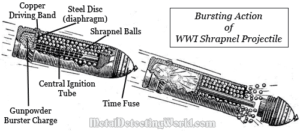
Shrapnel is a term that needs to be treated with some caution. Any time you want to use “shrapnel” instead of “fragments” or “splinters”, there is a 95% chance of being wrong. Strictly speaking shrapnel comes from a shrapnel shell. Typically a shrapnel shell contains a mass of musket balls of around half an inch diameter. Unlike a shotgun shell or canister load, a shrapnel shell explosively ejects its contents in mid-air. Shrapnel shells were adopted in 1803, copied by other nations and saw a decline in use during the First World War, the large infantry formations that were the intended target becoming uncommon. Some later designs such as the AHEAD anti-aircraft round could be legitimately described as shrapnel. The term is actually seldom used in modern military technology publications. See here for a space warfare application of shrapnel.
Most of the time someone uses the term “shrapnel” they actually mean splinters or fragments. It could be argued shrapnel has become a generic term for such things but its more definite meaning can cause problems. I recently read a book where the author spoke of “ground strewn with jagged shrapnel”, which is a ludicrous oxymoron to the educated reader. A very nice example of the problem was in the BBC Musketeers series, where a character claims men have been wounded by shrapnel. Not only did she actually mean wooden splinters and stone fragments, but this constitutes an anachronism too.
Incidentally, true shrapnel munitions usually do not produce fragments too. The ejection charge is too weak to rupture the casing.
It is tempting to use specialized jargon to create the impression that you are knowledgeable. Not doing your research and using it wrongly can create the opposite effect.
Shrapnel is a term best reserved for character dialogue only. A good rule of thumb is “shrapnel” is within the casing of a munition while “fragments” are from the casing of a munition.

Shells, Shot and Grenades

A shell is a container. There are explosive shells, gas shells, incendiary shells, smoke shells, HEAT-shells and so on. Shotgun cartridges are also called shells. Shot are solid projectiles. The pellets from a shotgun are shot. Non-explosive armour-piercing rounds fired by tank and anti-tank guns are shot, not shells. A grenade is a munition either thrown by hand or by a low-velocity launcher. In some languages the equivalent word has a broader meaning, closer to that of shell. This use is creeping into English, via such uses as mistranslations of RPG. A German term for a mortar literally translates as grenade-launcher, but using this term in English causes confusion.

HEAT Warheads

Also known as “shaped-charge” or “hollow-charge”. The name is from the acronym “high-explosive anti-tank” and is not related to temperature. Several misconceptions about these warheads are related to temperature. One is that the jet the explosion produced melts its way through armour. In reality, the blast forces its way through the armour. There is insufficient time and heat to melt the armour. A related idea is that the penetrating jet is of molten metal. While the jet is very hot, it does not reach a sufficient temperature to melt the cone-liner, which is usually a high melting point metal such as copper or steel. The liner is formed into a hot, malleable solid that is forced through the armour.

Suppressor

You will find assertions that the term “silencer” is wrong and that the correct term is “suppressor” or “moderator”. This is a modern affection and is actually wrong. Maxim’s first designs were called “silencers” so the term is legitimate. Many people who claim this is wrong call magazines “clips”, which tells you all you really need to know about them! Suppressor and moderator are more fashionable terms in modern usage so are the terms more likely to be used by characters familiar with firearms or military hardware. What term a character uses will depend on their familiarity with such devices and their era. A cop in the 1920s or a modern civilian non-shooter is likely to claim a suspect had a silencer.

Graticule vs Reticule

This is an easy one to remember. A graticule has some form of graduations, a reticule does not.

Calibres

Weapon calibres are nominal, rather than accurate measurements. Two weapons of the same nominal calibre may use quite different rounds of ammunition. It is not advisable to round up calibres, nor convert them between imperial and metric. Don’t call a 7.92mm rifle 8mm. Don’t describe a Browning HMG as 12.7mm, nor a DShK as .50.

Revolver

In some older books “revolver”, is used as a generic term for a pistol or handgun. Characters will draw a revolver which in a later passage is identified as a Luger! You will also see revolvers treated as being distinct from pistols. This confusion is the result of “automatic” being dropped from “automatic pistol”. Revolvers are actually a subset of pistols or handguns, so calling them pistols is permissible.
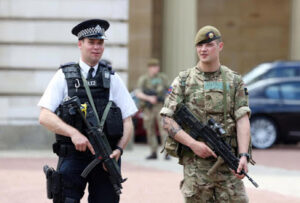
I have seen a couple of books or movies where a character asks something like “How many bullets are in the chamber?” The only possible answers to this are “one” and “none”. This error comes from confusing a revolver's cylinder with a chamber. A revolver has a cylinder with a number of chambers in it. One round goes into each chamber. Typically there are six chambers. Small revolvers and large calibre designs may have fewer chambers. Small calibre revolvers or some more modern designs may have more. You can say that a revolver only has “two shots in its cylinder”. You cannot say it only has “two shots in its chamber”.
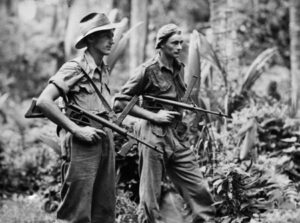
Revolvers have a gap between the barrel and the chamber. Therefore most revolvers cannot effectively use a suppressor/ silencer. There are exceptions to this but that stable of 70s cop shows, the detective special with a little Champaign cork-sized thing on the muzzle, is pure fantasy.

Trading Shots

If two units are “trading shots” they are shooting at each other. I would have thought that this did not have to be explained, but I recently read a book where several times artillery “trade salvos” and the shots are then described as being targeted against other units.
Incidentally, a weapon is not “the answer to…” another system unless it is a direct counter to it. The German Nebelwerfer was not the answer to the Soviet Stalin’s Organ, it was its equivalent.

Jargon

Like many institutions and cultures the military have their own jargon, some of which are effectively shibboleth. You should familiarize yourself with some of these before writing on the subject. For traditional reasons the British rifleman will call his bayonet “a sword”, no matter how short the blade. A private of a rifle regiment will be a “rifleman”, not a “trooper” incidentally. A more common tradition is the US military practice of calling caps and hats “covers”.

A tradition to note is that US marines do not refer to themselves as “soldiers”. One marine will never call another a soldier. I have even seen a marine chewing out kindergarten children on this when the children had sent a letter “hoping that he and the other soldiers were safe”. Traditions and terminology matter.

Rank

In the English-speaking militaries, an NCO is never addressed as “sir”. Civilians may be addressed as “sir”, officers are “sir” but corporals, sergeants and warrant officers are never “sir”.
You should not write on military matters unless you have some comprehension of rank and how it fits into a military structure. A major would not normally command a rifle squad, nor would he be commanding a division. There is a movie where a character is introduced as “a colonel in the SAS”. Generally regiments only have one colonel, and they are unlikely to be twenty-somethings who are sent to single-handedly deal with alien invasions.

Details Matter

I could fill a book with dumb and avoidable mistakes in modern media. Don’t assume you know things, do some research. Some of your assumptions will prove to be misconceptions, which may be uncomfortable and difficult to accept. Don’t claim an aircraft has a twelve-cylinder engine when a couple of seconds’ research will tell the reader it had nine. Don’t fuel your T34 with gasoline. Don’t give a character a laser weapon and then have him notice the increased recoil. A shotgun is not a rifle. “RPG” does not actually stand for “rocket propelled grenade”. “Chain-guns” do not have multiple spinning barrels. They have single barrels and use a chain to operate the bolt. Decimate does not mean “nearly wipe out”. “Point blank” does not mean close, it means aimed without adjusting for drop. A machine gun is not the same as a submachine gun. A misfire means a gun does not fire, not that it fires accidentally. Most tracked vehicles are not tanks. Calling them tanks is cheap sensationalism.
Good writing is in the details. Not bothering to get the details right shows a contempt for your reader and your subject. Even if your writing is not sympathetic to the topic getting your details right can only help you convey your message.
Just as important as getting your details right is to be consistent. I have read books where a firearm changes calibre four times in a short paragraph, sometimes within the same sentence! In a book I read recently a character is described as a “dashing colonel”. Later in the same scene he worries about offending a superior officer who is a major. On the next page he is engaged in conversation and is frequently addressed as “major”. In a later scene set a day or so later he is once again called a colonel. This is just sloppy and there is not really any defence for this.
Categories
Phillosoph

Getting Old

Recently, I have been re-reading Appleseed, trying to pin down the aspects of utopias hinted at in the first two books.
I have been using the snipping tool to copy particularly relevant panels for later consideration.
The panel below is not relevant to this theme, but is an interesting idea in its own right.
Then, two days ago, facebook publishes a “memory” from several years back.
Turns out that I have already written a blog about Appleseed, utopias and competition.
I had completely forgotten about this.
So effectively had I forgotten this article, that I actually enjoyed re-reading it. It had some insightful points and is probably far better than the article that I was intending to write.
Evidently I am getting old and my memory is failing.
On the positive side. I guess that will allow me to better enjoy my movie collection once again.
Providing I can remember where I live!