Disclaimer: “As an Amazon Associate I may earn from qualifying purchases.” Adsense and Infolinks were no help at all.

If you have enjoyed this article or it has been helpful to you please feel free to show your appreciation. Thank you.

Read The Third Wave by Alvin Toffler!
Categories
Phillosoph

YEC and the Cognitive Dissonance Trap

In general I try to avoid political posts on this blog.
I try to avoid attacking the beliefs of others.
This blog is about dealing with life and some of the problems that it may send against you.
There are times, however, when established mindsets can come into conflict with dealing with problems.
Some of you may stop reading my blog because of today’s post, which is not my intention.
My intention is that this post will give you some pause for thought and change your priorities a little to give you better tools for problem management.
Every now and then I come across some meme that is trying to disprove evolution. Why does this matter?
Firstly, constantly trying to “prove” the Bible in actuality displays a lack of faith.
The Bible has many useful lessons we can all learn from but constantly trying to prove it by dubious means causes people to neglect these.
You are missing the important parts of the Bible and driving others away from them.
“They're making the mistake of linking their belief in faith, in their religion, to actual factual tenets. These are not factual stories to be taken as historical events, they're really stories about how we should live our lives. They're moral homilies. What can I personally get out of the Bible for me, today. That's what those stories are about. And to take them literally is; you're missing the point of the Bible!
Secondly, you do not “believe in evolution”.
This is a relatively unsubtle manipulation designed to make you think in an unrealistic either/or mode. 
Evolution is not a religion or faith, it is a body of evidence supporting a hypothesis.
Evidence denial is a very dangerous mindset. Evolution-denial is akin to holocaust-denial but more insidious since its effects are more widespread.
Many of the world’s current problems are due to the encouragement of cognitive dissonance.
We need leaders that make the best decisions based on available evidence, not that ignore what they do not like, understand or agree with.
This is how we ourselves need to deal with what life throws at us.
Thirdly, if your support of Young Earth Creationism is that you consider the Bible is literal, you do not get to cherry pick which other bits you hold to be true.
If the Earth was made in six days then it is also flat, with corners, as the Bible tells you.
It is the centre of the universe and the sun circles it.
You do not get to eat pork, shrimp or oysters, do not get to have tattoos and are to support slavery.
You must hold that certain insects have only four legs and must perform calculations using a value of 3 for π.
Nuclear weapons do not exists since radioactive decay is not constant.
Most sciences, including astronomy, geology, mathematics and physics are all false so you should not be using their products.
You need to believe in not one, but two different creation stories as literal truth! (Chapter one and chapter two of Genesis have conflicting details!)
If you are a women you should be silent, obedient, submissive and not try to teach or have authority over men.

Vast amounts of money, effort and time are wasted on evolution denial.
Money and effort that could be put towards far better causes.
Young Earth Creationism is missing the point of the Bible and is counter-productive.
If faith or any other belief makes you a better person, it is a good thing. Any belief that blinkers you to things that may harm you is not.
Categories
Phillosoph

Soviet Soldier Simplicity

The other day I was reading an article about small unit actions. In the introduction it was explained that the men and women recruited as Soviet soldiers were used to living close to nature and tolerated and even thrived under conditions that would defeat German soldiers.
The questions that spring to mind are how was this done and how can this be applied to modern soldiers? I made a few posts on the Soviet soldier’s equipment some months back. It is apparent that the Soviet soldier of the Great Patriotic War got by with relatively little equipment. Let us start by looking at his clothing.
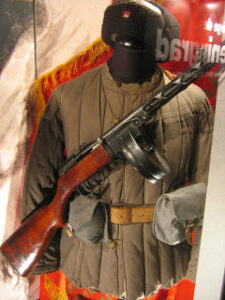
The basic Soviet field dress was a pull-over tunic and a pair of long breeches. This was an outfit that European fighters have used for many centuries. The Soviet tunic and loose trousers would not seem that unfamiliar to a Viking, Celt, Saxon or a medieval peasant.
Like many uniforms of the Second World War, it was constructed of wool, which has the advantage that it does not chill the wearer that much if wet. The Soviets also had a cotton version for summer use.
The tunic and trousers were worn directly over the underwear. The underwear seems to have been a long-sleeved undershirt and long johns for both summer and winter use. Both of these items were issued in summer and winter forms. Both forms were made from cotton, the difference being the winter version was fustian with a fluffy nap on the inside. The use of cotton for both the summer and winter underwear is interesting. I suspect this may have been selected to simplify mass laundering of items. Theoretically the Soviet soldier exchanged his underwear for a fresh set every ten days.
There were relatively few items for use in sub-zero temperatures. Each soldier had a greatcoat, which was also used instead of a blanket when sleeping so was carried all year. When not worn the greatcoat was usually carried rolled up and worn across the chest
The distinctive telogreika padded jacket and vatnie sharovari trousers were made from cotton and filled with cotton wool. It was cheap and simple to manufacture and very effective. Its thickness and wearing the garment over woollen clothing helped counter some of the disadvantages of cotton if it got wet. Below zero conditions meant that rain was seldom a problem. Telogreika and vatnie sharovari are often seen as outermost garments but were intended to be used under the greatcoat or sheepskin coats.
I am unsure as to how the telogreika and vatnie sharovari were carried if they were not being worn. They look like they would be too bulky to carry in the soldier’s backpack. Perhaps they were rolled up inside the greatcoat. Possibly they were treated as baggage items and only issued when the winter tunics were. Sheepskin coats might be worn in winter instead of the greatcoat. Some books claim the sheepskin coats were for cavalry and tankers but photographs prove that many other units acquired them. The greatcoat or sheepskin and telogreika were worn with ushanka fur hats, balaclavas, mittens/gloves and valenki felt overboots. With these few items the Soviet soldier operated in minus 50 conditions.
The rest of the Soviet soldier’s equipment also forms a relatively short list.
• A weapon and ammunition and grenades.
• An entrenching tool: numerous uses including as a close combat weapon.
• A canteen.
• Gas mask case and contents.
• A rain cape (plashch palatka)
• A simple haversack (myeshok).
The haversack contained a bag of tent pegs and a pole-section for constructing shelters. Contents also including a mess pail, shaving kit, soap, toothbrush and weapon-cleaning kit. There is no bayonet scabbard since bayonets were always carried fixed to the weapon.

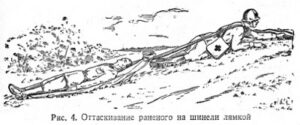
The rain cape might be carried folded up in the haversack. It could also be rolled around the outside of the greatcoat roll or carried as a roll instead of the greatcoat. These rolls were also used to carry items. The cape is another item that would be familiar to a viking etc. Effectively it is a rain-resistant cloak and thus could be used for warmth as well as protection from the rain. The rain cape was a heavier item than modern ponchos but was also more robust. It could be used to drag a wounded man to safety, for example. One cape could be used as a shelter and another as a ground-cloth to accommodate two men, who slept together in their greatcoats. Capes could be combined to form larger shelters.
The haversack also carried rations. While I have found descriptions of what a Soviet soldier would carry, I have yet to find indications of the quantities.
Other notable items used were one or two-piece camouflage outfits designed to be worn over the field uniform. Generally these were used by scouts, snipers and engineers. White coveralls were used for camouflage in winter.
Post-war, a few interesting wrinkles were added to this basic equipment. In another post I have detailed the spetsnaz use of cotton string vests and coats with a “skirt” extension piece.
The equipment listed above is very brief compared to that of a modern soldier or outdoorsman. Part of the reason for this is that some items such as the greatcoat and raincape were multipurpose. The list above is probably incomplete. Historical sources often do not mention items such as tinderboxes and matches since it was inconceivable to the author that a peasant or outdoorsman would need to be told to carry these.
Some items we have now simply did not exist then.
Personal night-vision equipment and radio communicators had not yet been developed. The use of flashlights was restricted in the Soviet army, whilst the modern soldier often finds himself searching dark places. There is no compass and map-case in the standard Soviet field kit since navigation was for NCOs and officers.
Very often the Soviet soldier did without many of the things we regard as essentials such as kipmats, blankets, sleeping bags and tents.
The last sentence brings me to another thing that should be considered. What items on your equipment list are truly essential and what are just useful and nice to have?
Categories
Phillosoph

Simple Russian Ration Pack Stove.

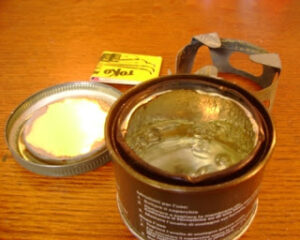
I have just come across this article on Russian ration packs. Included in the sundries was a pouch of moist-wipes, a small pack of storm matches and a pack of fuel blocks.

I could not make out what the item packaged with the fuel blocks was so searched for other images. I think it is a can-opener, which would be logical given many of the ration pack items are canned. Discovered that a stove is also included in the pack of fuel blocks. A simple piece of metal that can be folded into a raised platform with pot support. Probably not that efficient, but ingenious!

Categories
Phillosoph

The Emperor’s New Clothes : The Untold Part…

…and after the child had cried out that the emperor had no clothes, he was surrounded by the emperor’s aides and advisors.
“Are you a tailor?” asked one councillor.
“No” said the child.
“Are you a fashion designer or some such?” asked a colonel, “or perhaps have been making clothes for several decades?”
“er, no”
“A fashion writer perhaps?” suggested a major.
The child shook his head.
“Some other branch of the press…?” ventured another minister. Again, the child replied negatively.
The aides huddled together and conferred.
“The emperor does look rather cold!” Observed the child. It is not very warm today. He really should wear something warmer.”
“Enough!” barked a councillor “We have determined that you are not an accredited subject matter expert, nor have you any experience in haute couture. Your opinion is irrelevant!”
With that, the aides walked away.
The emperor was allowed to continue his procession. He contracted a nasty chill and died three days later, much to the bafflement of the aides.
Categories
Phillosoph

Hayfever Cure.

Luckily I was not bothered by hayfever during my childhood or academic career. Many of my classmates had this added misery as they revised for and sat their exams. I believed that I was not susceptible to hayfever
Things changed when I went out into the big nasty world and took my first full-time job. I was working in the middle of a large country estate. One of the predominant crops in the surrounding fields was rapeseed. While the bright yellow fields were attractive I discovered they induced a hitherto unmanifested hayfever reaction. For weeks I felt like I should scrub at my eyes with a scouring pad.
During this period I had brought myself a book on acupressure. The research that had discovered that acupressure and acupuncture stimulated endorphin production was relatively new at the time. That didn’t sound like anything that would help with an immune reaction like hayfever but there was an entry for hayfever in the book. Not expecting much, I gave it a try.
Below is the page showing points that I used. Note the pencil drawing on the left. This was copied from another book and shows some points to stimulate around the eyes.
Much to my surprise, the next day my symptoms were gone! Several decades have pasted and my hayfever has not returned. OK, perhaps I tend to sneeze a bit more often during summer, but nothing like the torment I was undergoing.
Since it is now hayfever season in the northern hemisphere this seems like a good time to pass on this knowledge and hope that it works as well for some others.

Categories
Phillosoph

1942 Battle Jerkin

My researches often take unexpected paths. While looking up something about Viking tunics I came across this interesting item:

 From "British Infantry Equipments 1908–1980 Men at Arms series"

Load carrying vests or jerkins are relatively commonplace. Whether a vest or a more traditional webbing system is the best way to carry gear over body armour is still debated. Adding pouches directly to the armour and making a heavy item even heavier does not seem to be the most prudent option. What is most impressive about the 1942 Battle jerkin is its versatility. Not only will it hold a lot of equipment, but a great variety too. The designer remembered to make provision for “non-standard” items such as machetes and commando knives. Some modern vest designers would be advised to take a good look at the 1942 Battle Jerkin!
Categories
Phillosoph

The Higher Education Swindle.

One of the less welcome parts of this year has been several weeks of debate about student behaviour. Numerous emails and meetings with higher-ups and constantly having to argue the same point over and over again.
What was the topic of dispute? We had suggested that well-educated twenty-somethings should dispose of rubbish safely in bins! Not just general waste but that chemical and clinical waste should be safely and promptly disposed of. Given that my girlfriend had a pair of nine-year old nephews who manage to put rubbish in the bin without even being asked to I had not regarded this as an unreasonable request for people who theoretically are being trained as the next generation of scientists.
One of the arguments made to me was “students really enjoy this course”. “I like doing it” is not actually an adult argument for anything, but here we get to the crux of the matter.
Science is a discipline. That means some things have to be done a certain way. There are right ways to do things and there are wrong ways. You only learn the right ways and get into the habit of using them if the wrong ways are corrected. Being told “don’t do that” or “tidy that up first” is not fun, however. So there are whole courses where basic safety and good practice are not enforced. People pay thousands to come to a university and supposedly learn a trade yet leave without the basic skills and disciplines they need. But that is fine, so long as “student satisfaction” levels remain high. Those might fall if someone who is being a jerk and endangering others is told not to be a jerk!
 
 
The problem revolves around money. In the past few decades the idea has arisen that each university should make a profit. The more students we can run through the machine and the more fees the better. However, the desired product of a higher education should not be a satisfied graduate. Students, by definition, do not know everything. They have no idea if they are getting an adequate education or not. Looking at each university as an isolated money-generating system is a fallacy Universities are supposed to produce graduates who are prepared for their future working roles. The better the quality of graduate the better for industry, the economy and the society as a whole. Institutions such as road-repair or the police force are not expected to make a profit. They exist because we know that their function facilitates the rest of society running more effectively. Universities should be regarded in the same light.
At the moment very little has been changed by our complaints about safety and professional behaviour. In fact the main result is that our warning has gone on record against the day when inevitably these laissez-faire practices result in someone being seriously hurt. Practical classes are little more than a crèche in white coats, but everybody is having fun and fills in the feedback reports as desired. I resign myself to the fact that courses are now entertainment rather than education.
Categories
Phillosoph

Red Next To Your Head

I was having a light-hearted discussion on “field uniforms” with a friend.
The idea was a practical uniform that could be used for general tasks rather than as a dedicated combat dress.
I believe the latter role would be better served by combat smocks that can be worn over body armour.

One source of inspiration was the British battledress.

I was also looking at the Afrika Korps.

Why the Afrika Korps? Unlike most European combatants, Germany had very few colonial holdings so when they went to war in Africa they had to design everything from scratch. It was a useful crucible to determine what traditional uniform features they were using were worth keeping.

The first attempt included high lace-up boots, breeches and a sun helmet.

Experience in Africa produced radical changes in the uniform.

Ankle-length boots with trousers that could be bloused into them, or shorts, became commonplace.

So too did a long shirt which could be worn instead of a tunic (and also served as a nightshirt!).

The most distinctive uniform item, however, was the peaked Afrika Korps cap.

During my reading, I turned up the interesting piece of information that these caps were lined with red material.

Some green aircrew clothing has an orange lining. The idea is that if the crashed crewman wants to be seen rather than camouflaged he wears the item inside out.

If a similar idea was intended for the Afrika Korps cap, why red and not some other colour that might be more visible in desert conditions?

It is possible the red lining was intended for another form of signalling.
Placing a luminous panel inside a patrol cap is described in this article.
But if signalling with the red interior of a cap was a common technique, why did later German Army designs of headwear not have a red lining too?
I have a post-war BW hat of similar design, but no red lining.
Another possibility was that the red cloth was the cheapest cloth available.
A friend who is an English Civil War reenactor has often pointed out to me that “many civil war regiments on either side wore red. It was often the cheapest cloth that could be had”.
Including in this was Cromwell’s New Model Army, establishing the penny pinching and “just make do” traditions that the British Army has struggled with for so many centuries!
The actual answer is in fact far more interesting.
Red lining was believed to improve protection against the sun. Read more on this topic here!
Categories
Phillosoph

Dreaming Again!

A somewhat restless night, but some interesting dream fragments.
Generally it is advisable to attack or defend against an enemy from their outside gate. This train of thought naturally got me to thinking about ways to handle being on the inside gate. This train of thought evidently occupied the deeper parts of my brain and my sleeping mind had some insights.
According to my dream, part of the body can be viewed as a sort of arc shape. This runs from one hand, up the arm, includes the shoulders and head and goes down the other arm to the hand. These body areas constitute the most accessible targets if fighting on the inside gate. Certainly the arms need to be controlled or dealt with to facilitate access to other target areas on the rest of the body.
The second image I got had the defender viewed from above with his arms out straight holding the attacker away. The perspective changed so the defender could be seen to be actually in a crouch, hands about waist level on the attacker. At this stage my sleeping mind was drifting off into thinking about vampires. Against an attacker whose main weapons are his teeth crouching down out of reach and holding him at arm’s length does have a certain logic I suppose. There is a Capoeira technique where one squats down under an attack and then springs up and kicks with both feet. Perhaps my dreaming mind was thinking of this
Before my mind drifted into a dream about an Irish actress being interviewed about a movie, it provided one more martial technique. The straight arms on the waist were swung up, the hands pointing upwards to strike with the finger tips in spear-hand form. Obvious use was to strike up under the jawbone and attack the throat. I had recently seen straight-arm double upward strikes in some Wing Chun manuals. These tended to hit with the upper wrist or backs of the hands. Using upward angled spear-hands like this was a new idea to me.
As stated, these were things from a dream so how logical they are remains to be seen. Perhaps these ideas will inspire someone.
Categories
Phillosoph

You Might As Well Jump!

As I mentioned in a recent post, jumping is something that has occupied my mind recently.
While I was writing the bayonet (or rather, bayonetless!) sections of Crash Combat, I came across suggestions that a soldier should jump to change facing, or even to move around. If terrain is uneven jumping has obvious advantages over the shuffle step often suggested for martial arts or bayonet training.
Joseph Wayne Smith’s book on Wing Chun notes that jumping up and jumping down from heights is a good exercise for a martial artist. He doesn’t make the logical leap that jumping may be part of the solution to some of the deficiencies in manoeuvre that he identifies.
Other than some rather cinematic techniques such as flying kicks, jumping is something that many martial arts overlook.
In Viktor Suvorov’s book “Spetsnaz” he relates how spetsnaz puts great emphasis on a soldier’s legs and jumping ability.
“And there is good reason why the training of a spetsnaz soldier starts with the training of his legs. A man is as strong and young as his legs are strong and young. If a man has a sloppy way of walking and if he drags his feet along the ground, that means he himself is weak. On the other hand, a dancing, springy gait is a sure sign of physical and mental health. Spetsnaz soldiers are often dressed up in the uniform of other branches of the services and stationed in the same military camps as other especially secret units, usually with communications troops. But one doesn't need any special experience to pick out the spetsnaz man from the crowd. You can tell him by the way he walks….I shall never forget one soldier who was known as `The Spring'. He was not very tall, slightly stooping and round-shouldered. But his feet were never still. He kept dancing about the whole time. He gave the impression of being restrained only by some invisible string, and if the string were cut the soldier would go on jumping, running and dancing and never stop. The military commissariat whose job it was to select the young soldiers and sort them out paid no attention to him and he fetched up in an army missile brigade…. The officer commanding the spetsnaz company noticed the soldier in the missile unit who kept dancing about all the time he was standing in the queue for his soup….”
This energetic soldier was there and then immediately recruited into spetsnaz.
“The long jump with no run has been undeservedly forgotten and is no longer included in the programme of official competitions. When it was included in the Olympic Games the record set in 1908, was 3 metres 33 centimetres. As an athletic skill the long jump without a run is the most reliable indication of the strength of a person's legs. And the strength of his legs is a reliable indicator of the whole physical condition of a soldier. Practically half a person's muscles are to be found in his legs. Spetsnaz devotes colossal attention to developing the legs of its men, using many simple but very effective exercises: running upstairs, jumping with ankles tied together up a few steps and down again, running up steep sandy slopes, jumping down from a great height, leaping from moving cars and trains, knee-bending with a barbell on the shoulders, and of course the jump from a spot….. At the end of the 1970s the spetsnaz record in this exercise, which has not been recognised by the official sports authorities, was 3 metres 51 centimetres.”

Where I work is a popular area for Parkour training. As well as the more spectacular techniques I also observe apparently more mundane drills such as jumping from post to post.

Parkour itself has been described as a non-contact martial art. As originally conceived it placed considerable emphasis on self-discipline and humility. That is something a number of sportsman and modern martial artists would be advised to emulate. Like many martial arts parkour is in danger of having its core values diluted by pressure to create a sporting, competitive form
Parkour has a number of things that the modern martial artist can learn from.
A fate would have it a movie featuring Parkour/ Freerunning was on the other night. The athleticism and coordination was impressive as always, but I was also struck by the realization that the techniques themselves were relatively simple.

I noticed that two landing techniques were often used. One was obviously an adaption of the parachute landing fall. As owners of my first book or Crash Combat will know, I include this technique alongside more traditional breakfall techniques. It use in parkour is logical. The second technique commonly used was the shoulder roll variant of the forward breakfall. Some websites on parkour have some nice sections on how to perform this technique. If the forward breakfall is something you need to improve you could do worse than have a look at how the parkour community learns and practices it. They are making it work for 20 foot jumps down onto concrete, after all!