I came across this title by accident.
The Survival Book by Bruce Tegner and Alice McGrath, 1982/1983
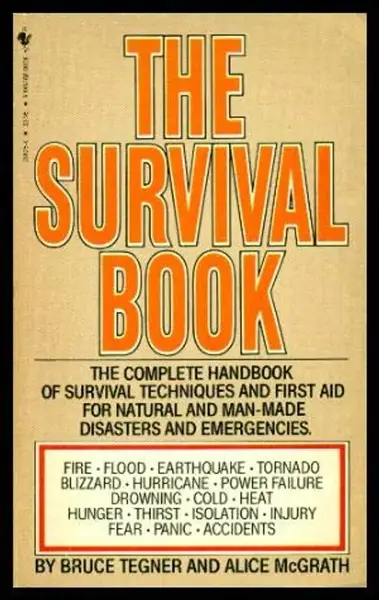
The name “Bruce Tegner” will be familiar to many readers. He wrote a long list of titles on martial arts and self-defence.
Alice McGrath, Tegner’s wife, co-authored some of these titles, but is probably more well known for her work in other fields.
First, a few minor complaints:
• “Distilled water does not taste as good as purified water, but it is salt-free.”
This seems to suggest that the authors believe (bottled) purified water contains salt?
• Mention is made of the “mammalian diving reflex”, but the diving reflex has nothing to do with breath‑holding and is irrelevant to the subject being discussed. [Contrary to what Wikipedia claims, the diving reflex still occurs in subjects using nose‑clips and a snorkel.]
• The end of the section on heat cramps ends in a pair of nearly identical but differing paragraphs.
• The book includes air-to-ground signals, but like many other books, misses out the most important: V (Require Assistance).
Four Necessities to Maintain Life
The main text begins with an examination of “The Four Necessities to Maintain Life”. These are defined as Air, Water, Thermal Balance, and Food.
“Air” includes such topics as treatment of drowning, asphyxiation during house fires and avoiding carbon monoxide poisoning.
A mantra to adopt for the latter is “No Combustion without Ventilation”
“Water” includes dehydration, water storage and water treatment.
There is good advice on when to and when not to ration your water.
“Your Body is the Best Canteen”. Drink what you need, but not more than you need.

The old chestnut of boiling water for ten minutes at a rolling boil is repeated, with the additional advice of an extra two minutes for every thousand feet above sea level.
While ten minutes was the WHO standard, it is overkill and scientifically gained information confirms shorter boiling times are sufficient to kill all harmful organisms while making more practical use of resources.
There is some discussion of the lack of taste of boiled water, but the authors wisely do not regard this as the terrible hardship that some books make it out to be.
“Thermal Balance” includes advice on dressing for very cold or hot weather, and related medical conditions such as frostnip, frostbite, heat cramps, heat exhaustion and heat stroke.
I expected this section to include information on shelters and fire making, but this is covered in a later section.
Being written for an American market, all temperatures are in Fahrenheit, and the arbitrary values of this obsolete and unnecessary system do make certain parts less than clear. Much easier when you can relate a temperature to freezing, boiling or body temperature.
“Food” includes advice on building and maintaining emergency food supplies.
The authors make the very sound point that in an emergency that is likely to last five days or less, an unhealthy diet will not kill you. There is much to be said for including some high-calorie, long shelf-like, tasty “junk” food in your supplies.
If you expect the food section to cover hunting, fishing and trapping, it doesn't.
Other Chapters
The following chapters cover a number of topics:
Emergency Communications, First Aid, Hygiene, Fire, Natural Disasters, After a Disaster, Evacuating Your Home, Urban Emergencies, Driving Emergencies, Boating & Water Safety and Private Planes, Wilderness Survival, Don't Get Lost and How to be Found, Animals & Insects.
As may be seen, this book is organised a little differently to most contemporary and modern survival manuals.
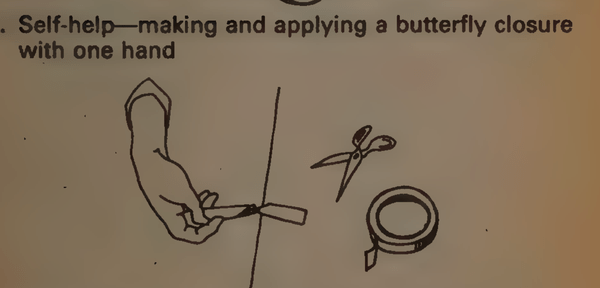
The book includes a useful way to improvise butterfly closures.
Topics such as shelter construction and fire-lighting are covered in the wilderness chapter, while other “traditional” survival manual topics such as signalling appear in several chapters.
Topics such as sailing and boating are covered in more detail than is found in many non-specialist survival books.

An interesting thing I found in the book was the existence of an “official” distress flag: a black “square and ball” on an orange background.
It occurs to me that greater use of such a flag/shemagh/bandanna might be made on land, although the colours may not be best suited for use in the desert.
Recommended Kits and Tools
Several chapters have lists of recommended tools, supplies or equipment for your vehicle, boat or home.
The Wilderness chapter includes a “Sixteen-Ounce Kit”
◦ Space blanket
◦ 1 oz of high energy food
◦ First Aid: 2 Aspirin, snake bit kit, band-aids, alcohol swabs. butterfly closures. Waterproof card with contact phone numbers, medical conditions, allergies, etc.
◦ Insect repellent and sunscreen
◦ Disposable lighter, tinder, candle
◦ Flashlight
◦ 2 safety pins
◦ 2 small plastic bags
◦ 12" square lightweight aluminium foil (folded)
◦ 15" coil of lightweight wire in a film canister
◦ 2 dimes (for phone)
◦ 6 water purification tablets in plastic waterproof container
◦ liquid-filled, plastic compass, map (cut section of the specific area only)
◦ pocket knife
◦ short pencil, sheet of paper
◦ toilet paper in a plastic bag
◦ plastic whistle
◦ metal mirror.
The book includes the day sack as a place to carry this kit. Becoming separated from your day sack may be what causes the emergency.
Like the book itself, the contents of the sixteen-ounce kit show a little more insight and originality than the more conventional survival kit/tin recommendations.
Most of these items have equivalences in the EDC kit I have recommended elsewhere.
What is striking is the many traditional survival tin contents this kit does not have.
No fishing kit, and the short length of wire carried is for repairs, not snares.
The aluminium foil is suggested as a windshield for a fire, or wrapping tinder.
It is suggested the plastic bags may be used instead of gloves, or as over-socks, but a later page shows a larger trash bag used as a waterproof garment and shelter.
Interestingly, the authors suggest signal mirrors with sighting holes may risk damaging the eye if the hole is used to sight the target.
There is a rather long section discussing when and where it is safe to drink wilderness water without treatment. The more up-to-date answer is never.
Preparation and Precaution
The somewhat different arrangement of topics in the book is a refreshing change to many of the survival manuals out there, and has some points in its favour.
Where this book is most useful is its emphasis on preparation and precaution. There is much more emphasis on what to do before problems start, and this advice is provided for areas other than just wilderness travel.
While it is a little dated in places, I think The Survival Book brings something different, and is a useful addition to any survival library.