Disclaimer: “As an Amazon Associate I may earn from qualifying purchases.” Adsense and Infolinks were no help at all.

If you have enjoyed this article or it has been helpful to you please feel free to show your appreciation. Thank you.

Read The Third Wave by Alvin Toffler!
Categories
Phillosoph

Handcarts: AfriCart

Today I am going to talk a little more on handcarts.
Researching something quite different, I found myself on a page on USMC TOEs and once again encountered the following illustration.
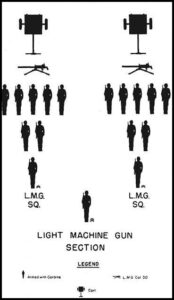
Each machine gun section was provided with a MC-1942 handcart. Each 81mm mortar section was provided with two. The 60mm mortar sections, however, had no handcarts!
Looking for more information on the MC-1942 I instead found myself on this page on US Army handcarts. Notable was the information that such handcarts were intended for motorized troops. A pair of loaded carts fit between the seats of a 212 ton truck. When the truck could go not further, the infantry advanced with their handcarts.

US Army handcart with cover. Note detachably hauling ropes with handles.
Given the bulk and mass of some modern weapons and their ammunition, handcarts could still prove useful.

AfriCart

The marine and army carts use a T-shaped handle. Is this the best configuration? I wondered.
A quick look at rickshaws and similar devices suggested that a rectangular arrangement might be better. That, in turn, led me to the following interesting blog:
Note how the bicycle wheels are supported on both sides. Also note the easily adjustable handle and the folding stand legs.
The cart bed is 24 x 32" area, exactly the same as used in the US Army cart.
I am sure many of my readers could construct similar carts for their own use.
Don’t forget attachment holes for lashings or bungees and drainage holes.
A wire-mesh base is a possible option if you can source a suitably sized piece.
Non-pneumatic tires may be a sensible investment.
Categories
Phillosoph

Don't Carry a Rucksack (If you can help it)

A friend of mine e-mailed me recently and told me he felt it was impractical for him to carry his bug-out gear in a rucksack. There was just too much, he said.
I pointed out to him that others had been managing this for centuries, and that it wasn’t actually a “bug-out kit” if he couldn’t move it anywhere.
Same friend often e-mails me wonderful, must-have gadgets that he has found. The two facts may not be unrelated. 🙂
Your core bug-out kit should be man-portable.
What is lost on many people is that you should not be carrying it on your back if you can avoid it!
This is something we seem to have inherited from the military.
A fundamental of military training is marching long distances with heavy loads.
As well as the physical conditioning, this provides it also improves traits such as self-discipline, determination and resolve.
Unfortunately there is a downside to the old adage that “You fight as you train!”
Lost on many officers is that long marches with heavy rucks’ may be great training, but in an actual operation are to be avoided whenever possible.
Most combat theatres are “vehicle-friendly”. Infantry may need to operate on foot, but gear they do not immediately need may be carried on vehicles and brought forward once an area has been pacified.
Many soldiers during the Second World War learnt to operate effectively in “light order” and many modern “irregular” fighters do the same. Many armies need to relearn this.
Current efforts are towards exo-skeletons and robot mules that will increase the weight that can be carried. The opposite strategy may be more productive.
As an individual prepper or survivalist, you may not have a support unit that can bring your heavier equipment and supplies forward for you. Additionally you may be in “vehicle-proof” terrain where the operation of conventional or military vehicles is not possible or very restricted. Military forces sometimes find themselves in the same situation, of course.

A tried and tested solution is shown below.

Porter-bikes were modified to carry heavy loads. When fully loaded they could not be ridden. A pole extending the handlebars allowed one or more individuals to push the bike along by walking beside.

For bugging out, a bike has a lot to recommend it.
On terrain where it is difficult to ride, you can push it, and use it to carry your pack rather than your back.
Overall load should be kept in the man-portable range since there may be obstacles you will have to carry bike and pack across.

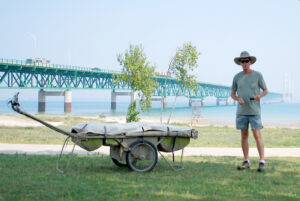
Another interesting option is found on this site and others. Its inventor calls it a “travois” but it is actually a hand-cart (or possibly a “man-cart”?)

As an aside, a real travois is an option you should always consider if you have to move something heavy over relatively soft ground.

Handcarts were once not uncommon in armies.

After WW2, the “big ruck” mentality seems to have taken hold and handcarts become rarer.

In the early days of ATGWs, some models were offered with golf-trolly-like contraptions so a dismounted infantryman could move them.

Nowadays a few mortars are provided with trolleys, but in most forces they are unknown.

If a skier can tow a pulk, why not a a walker a cart?

The wheeled travois has been designed with ease of manufacture in mind.
I would suggest making the poles a little longer so that if necessary the cart can be carried over an obstacle like a stretcher.
For ease of use in vehicle-proof terrain ,I would suggest reducing the width so that it can be used on narrow paths and trails.
Bicycle wheels may be a good source for the wheels.
I particularly like the net that forms the bed of the cart. With a bit of ingenuity this might double as a camouflage screen.
Categories
Phillosoph

Handcarts and Alternatives

The last couple of posts have been on martial arts so today’s will be more survival-orientated.
Recently I saw a comedian who commented:
“We put men on the moon decades before we thought of putting wheels on suitcases.”
I have been researching a few other topics that are out of the scope of this blog, but a common thread that keeps turning up is that of handcarts.

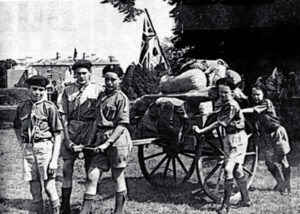
There was a time when every scout troop had at least one handcart to move their tents and supplies. Many of these would have been made by the troop themselves. Below is a rather nice illustration of a stretcher case suspended below a handcart. Perhaps the Scoutmaster was having a nap.

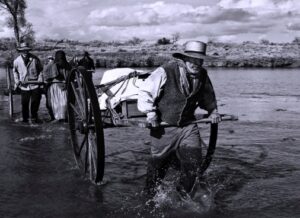
When 3,000 Mormons chose to migrate to Utah in the 19th century they travelled in companies of handcarts. Some of these families came from as far away as the British Isles and Scandinavia.

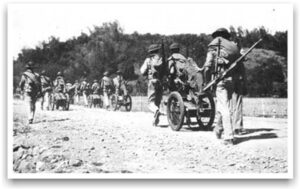
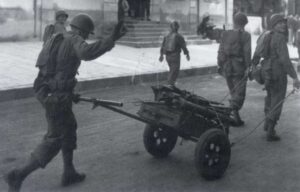
I have come across many photographs of handcarts in use during the Second World War. This is a nice webpage on the US military handcart. A couple of these could ride on the flatbed of a truck and still leave room for a squad or two of troops seated on the side benches. Handcarts are shown towed behind jeeps or riding in the cargo area of the jeep.

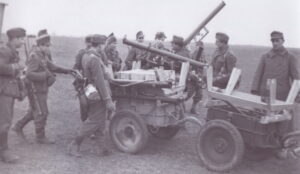
The picture below depicts a 1944 USMC machine gun section, and you can clearly see they had a handcart as standard equipment for each squad. As an aside, I note the 1944 MG squad had seven men and a handcart to service one M1919 MG. With one leader, a gunner and an assistant gunner that leaves four men to carry ammo and for local defence.

An equivalent unit these days has two MGs, seven men and no cart, which implies only one ammo bearer per gun. Modern troops are probably vehicle mounted but that is no comfort if you have to move the MG and ammo more than a few metres.

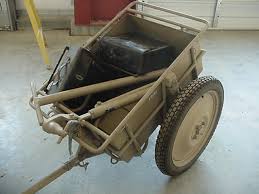
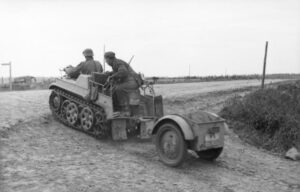
The German Army also made use of handcarts. These were designed so they could be towed by men, horses, mules, dogs or vehicles and even had their own tow hooks so a train of them could be constructed.

<
One thing that you notice about the military handcarts is that they are quite narrow. This is logical since the main place you would want them is where you cannot take a vehicle.
The handcart must be narrow enough to navigate a jungle trail or mountain path.
A “T” shaped shaft seems standard for military handcarts, probably since it can be more easily disengaged from than the “rickshaw” style of two shafts and a crossbar.
For some reason, modern outdoorsmen and soldiers overlook the utility of a simple handcart.
Some of you reading this blog will have created bug-out bags and perhaps even supply caches. How much better would your chances be if you also had a nearby handcart of additional supplies, water and equipment?
If you are building or buying a handcart there are obviously a number of features to look for.
We have mentioned the T-shaft and that narrowness is a desirable characteristic. Ideally a loaded military handcart should not be so heavy that a couple of men cannot lift it over an obstacle. If you are on your own you may want something lighter.
Being able to float the cart across a river is a desirable design feature. Some carts I have seen are narrow but about five feet long, making them suitable for transporting an injured companion in an emergency.
It may be useful if you can convert your handcart into a sled or pulk when weather requires. In fact a sled or pulk may be a good starting point for a handcart construction project.
I’ll end this discourse by looking at a few interesting alternatives to the handcart.
Wheelbarrows can be used as emergency handcarts. They have the merit that in some neighbourhoods they are fairly common.
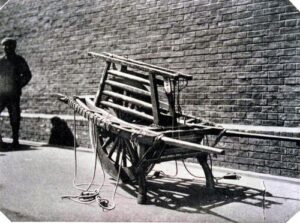
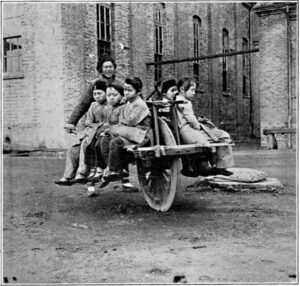
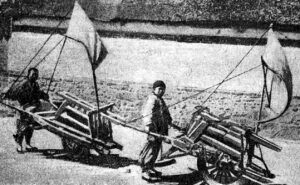
An extension of this idea is the Chinese Big Wheel wheelbarrow. You may need some skill distributing the load in a balanced fashion but it is evident these can handle heavy loads and quite rough terrain.

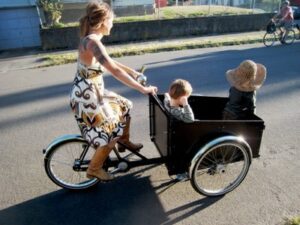
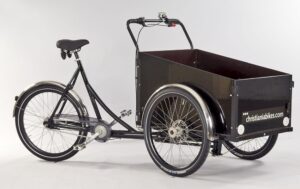
Another alternative is the Christiania Bike. (I know it is a trike, but they are usually called bikes!).
If you have visited Copenhagen you will know these are a common sight in that city.
Young Danish mothers use them to transport their children to school and then pick up a heavy load of shopping.
After dark, you sometimes see drunk couples returning home in a Christiania bike.
This culture of cycling everywhere may explain why nearly every second woman in Copenhagen is worth a second look!
The Christiania bikes are very nicely designed.
In most of them the large box at the front contains a smaller box that serves as both a seat for passengers and a locked storage compartment.
The Christiania “as is” is not really designed for rough terrain but the basic idea could be adapted to use mountain bike tires and gearing. Add a few lifting handles. One might even design it so that it can be towed like a handcart when possible.
It would be good to see vehicles like the Christiania trike using resources such as bamboo and cardboard.