Disclaimer: “As an Amazon Associate I may earn from qualifying purchases.” Adsense and Infolinks were no help at all.

If you have enjoyed this article or it has been helpful to you please feel free to show your appreciation. Thank you.

Read The Third Wave by Alvin Toffler!
Categories
Phillosoph

Battle of Jangsari: Camouflage

Recently I watched the movie “Battle of Jangsari”, set in the Korean War.
I enjoyed it, and many of my readers may do so too.
So as not to spoil your enjoyment, I will try to avoid any possible spoilers that I can in the following passages.
The photo below shows the North Korean troops that are sent as reinforcements. Notable on their first appearance is the bundles of grass/straw/rushes that each infantryman has sprouting from his back.
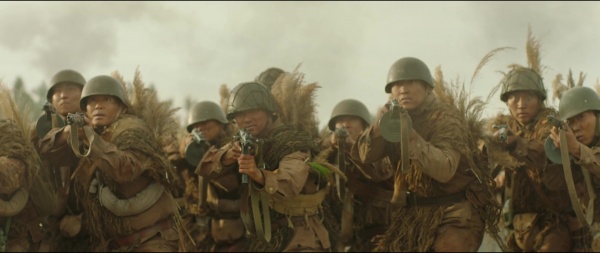
At first glance I thought this might be an earlier example of the device described as in a previous post as the Vietnamese Camo Ring.
Subsequent scenes show the foliage attached directly to their shirt/blouses.
The intention is the same, however. If an enemy aircraft had appeared these infantrymen would disappear.
“Osprey Men-at-Arms 174: The Korean War 1950-53” includes the following passage (p.37) on the North Korean summer field uniform:
“The uniform had reinforcing patches on the elbows, trouser seat and knees, and frequently single or double rows of horizontal ‘zigzag’ stitching around the cap and across the shoulders, chest and upper sleeves, which were used to hold leaf camouflage. ”
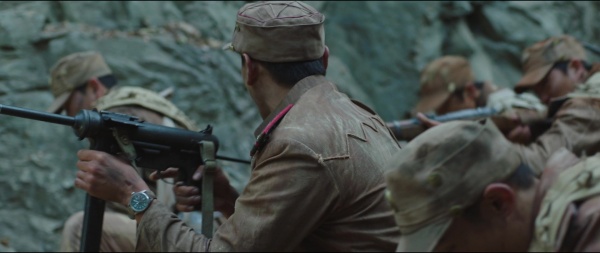
For some of the movie the South Korean (ROK) soldiers wear captured North Korean uniforms.
They do not use camouflage materials, but the means by which they can be attached are clearly seen in some shots. In these examples the “stitching” appears to be relatively substantial cord.
A side view of foliage attached to a machine-gunner’s back.
Some North Korean troops also have foliage attached to their upper arms, although the means of doing this is not clear in the film. Presumably loops might also be sew to the sleeves.
Many of the North Korean soldiers are also wearing short capes of what appears to be camouflage net.
In the movie this was not clear and appeared as an irregular shape of mossy green-grey on the upper chest. In the stills this is much more clearly seen to be net.
The Russian-style shoulder-boards worn with the North Korean uniforms appear fairly impractical. Men-at-Arms 174 notes that these shoulder-boards tended to fade less than the rest of the uniform, making them stand out as regular shapes and thus detrimental to camouflage.
Also note that none of the actors have camouflaged their helmets, leaving a distinctive, recognizable shape.
As I have pointed out in recent posts, shape disruption and texture contribute far more to camouflage than colour.
Notable in this movie is that the North Korean uniforms work far better in the terrain shown than the green American fatigues worn by some characters.
The Osprey publication states that the North Korean summer field uniforms was “olive khaki shade faded rapidly to a light yellowish hue”. Actual appearance varies in the photos since the soldiers of both sides get realistically dirty.
Minor spoiler follows:
In one scene the first sergeant stamps on a mine several times and chides the student soldiers, telling them it is an anti-tank mine and ten of them could run across it without setting it off.
This is not strictly true.
The mine shown is an American M15 that is claimed to need a force 159 to 340 kg (350 to 750 lb) on pressure plate to set it off.
“Taming the Landmine” (p.51) by Peter Stiff describes how repeated passages over an anti-tank mine would “settle” the trigger mechanism of some models until they became sensitive enough to be set off by a pedestrian, donkey cart or bicycle tire.
As an aside, in “Vietnam War Booby Traps”(Elite 236) by Gordon L. Rottman, p.25 the author notes he has been unable to find any real world mine that activates when someone removes their foot, as usually shown in movies.
Categories
Phillosoph

In Praise of Shemagh and Keffiyeh

Previously, I wrote about the fallacy that most face masks would protect you from infection. Inevitably, most of humanity has ignored the facts and taken comfort in superstition. Somewhere along the way members of our kleptocracies have realized just how much money can be made selling ineffective protective measures to the gullible.
Wearing face covering has become a requirement on public transport and in certain buildings. The stated purpose is to prevent carriers infecting other people, which admittedly has some merit. My objection here is in the lack of enforcement. As a microbiologist and a scientist I believe any safety equipment should be used properly. Masks serve no purpose if they do not cover the nostrils or are worn on your chin! I also, unreasonably, believe that laws and rules should apply to everyone. Being overweight and being unable to stop stuffiing your face on the bus is not a legitimate reason to go unmasked.
I have taken to wearing a shemagh/ keffiyeh when I travel on public transport. Looking like a pissed-off Palestinian shows my contempt for the farcical handling of the situation. Does it look intimidating? Probably, but I don’t really want people getting close anyway. Perhaps I should carry a rucksac too; I might get the whole carriage to my self!
On a more practical note, I have discovered a new respect for the shemagh. I had been thinking of it as a large banana, (or possibly a tea-towel!). The weave of my shemaghs is very loose, allowing the easy passage of breath or perspiration. On one particularly sunny day I kept my shemagh on when back on the street. It successfully kept the sun off my bald dome, and I was not bothered by perspiration running down into my eyes. It also helped keep my earphones in. Being cotton, dunking the shemagh in water may be a good way to keep cool in hot weather.
I have discussed the need for facial camouflage on other pages. I believe I have also mentioned one of the purposes of the ninja ensemble is to muffle the sound of breathing. The shemagh can meet these needs. In cold weather the shemagh may help prevent your condensed breath revealing your position. Something to experiment once it gets colder.
A brightly coloured shemagh might be used for signalling. One of mine is red and black, although in honesty this a bit dull in colour for signalling or location. Might be good in snow. Most shemaghs are white and have little virtue as camouflage save in snow. Dying them more tactical colours may be possible. Most “tactical” shemaghs are green/ olive drab, but except in jungle this is not as versatile and useful a practical colour as brown. I have one of brown and black, but ideally brown and sand or brown and grey would be most useful.

Tying the Shemagh

You will find a number of videos on how to tie a shemagh on-line. My usual method is to take the short, right end up near my left temple. Take the long end round the front, round the back and tie the ends together. I have been using a reef knot, but may experiment with a simpler overhand (half a reef!). This may be easier to untie when necessary. Tied correctly, the shemagh forms a hood and face-covering that can easily be lowered or raised. Down, it makes a useful neck gaiter. Position the part over your head so it does not expose a large area of forehead.
Another simple tying method can be used if you just need to cover your lower face, such as in the event of a dust storm. Fold your shemagh diagonally and place the widest/ tallest part over your mouth and nose. Take the ends behind your head and bring them around the front and tie them together under your chin. This gives your lower face area an irregular texture that contributes to shape disruption.
You should always have a bandanna or two on your person. A shemagh is a very worthy addition to a coat pocket or rucksac.
I am prone to migraine attacks, and one of the remedies is to breath in carbon dioxide-rich air. Carbon dioxide is a vasodilator so this increased blood flow to the brain. Note that this is not the same as re-breathing from a paper bag. You need to take in fresh oxygen as well as an increased CO2 level. One way to achieve this is to cover your mouth and nose with your hands. This is a little inconvenient, and my fingers get in the way of my glasses. Last night I grabbed my shemagh and knotted it around by lower face. As the migraine attack eased off, I was amused to note that I was wearing the two garments that pretty much summed up my lockdown: a dressing gown and a shemagh.