Disclaimer: “As an Amazon Associate I may earn from qualifying purchases.” Adsense and Infolinks were no help at all.

If you have enjoyed this article or it has been helpful to you please feel free to show your appreciation. Thank you.

Read The Third Wave by Alvin Toffler!
Categories
Phillosoph

My Left Pocket

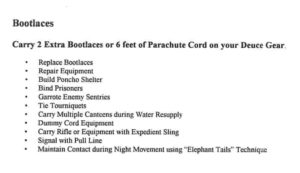
A common piece of advice is to re-lace your boots with paracord. The more thoughtful of you may have wondered about the wisdom of being in a survival situation with unlaced boots!
What is usually omitted is that in an emergency you are supposed to take the cores out of the cord, then re-lace your boots with the empty outer or some of the core cords. This assumes you did not buy the budget cord that doesn’t have particularly good cores!
Re-lacing your boots with paracord isn’t a bad idea. It cannot hurt. One day you may find yourself cold, tired and wet, your numb hands trying to unlace your boots, gut the paracord and then re-lace your boots. That sounds like something you may want to avoid if possible!
In my post on an EDC shopping list, I suggested that you add about two metres/a fathom/an armspan of paracord to your everyday carry (EDC). Or a pair of long, strong bootlaces, whichever you can acquire more easily.
The utility of this was expanded on in one of the links from my 4-4-4-4 article. In the event you missed it:

I had a quick look in the left front pocket of my trousers. The contents were:
  • One bandanna, various uses.
  • Disposable lighter, for emergencies.
  • Two hanks of paracord, roughly two metres. An arm-span and a bit.
  • A actual length of shoelace. I tend to pick up potentially useful bits of cordage! Useful for stuff that does not require the paracord. There was another shoelace but I used it to make an iPod carrier.
  • A tubular spectacle safety cord. My habit of acquiring cordage paid off here. What I thought was a bit of shoelace turned out to be something very useful to me. If the situation requires, I can retrieve this from my pocket and add it to my glasses.
  • A couple of metres of cotton string. Saves the paracord for important jobs. Potentially could be used as tinder. 
Categories
Phillosoph

Arrows: Time of Flight and Momentum

Many thanks to Ric Morgan for his donation to support the blog.
Recently I got to thinking about archery. In particular, I was curious about the time of flight of arrows and quarrels. This seemed quite a practical thing to know. I was a little surprised at how little information on this could be found on the internet.
Most modern archers are target shooters, so not particularly interested in how long the arrow takes to reach a static target.
They also shoot at ranges that provide very little insight into, say, bows being used on medieval battlefields.
If you play role-playing games, arrows probably hit in the same turn, which may be the same second, of firing.
You would think there was considerable discussion of flight times among bowhunters, but not according to my search engine.
One target site did inform me:
“Recurve bow arrows can travel up to 225 feet per second (fps) or 150mph while compound bow arrows can travel up to 300fps (200mph). Longbow arrows travel slower due to the weight of the arrows. Even at 300fps, it takes around a second to reach a 90 metre target. You hear your release first followed by the thud of the arrow hitting the target a second later (you can’t see it unless you use a telescopic sight).”

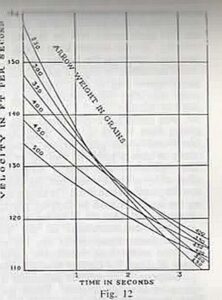
More trawling found me this article, with the following table:

I also remembered an old book I had, which gives the following table:

90 metres in the first second sounds like a good rule of thumb, although I would like to know how this changes beyond this range. 
Why does it matter?
If in an emergency situation a bow may be one of your options for defence or food gathering. Much of the information relevant to arrows will also apply to other hand-thrown missiles such as spears or rocks.
Contrary to what you see in action movies, bows are not “silent killers”. Some of the energy stored up in a drawn bow is released as sound.
Your arrow will travel at 100-200 fps, while sound travels at about 1,100 fps. The animal you are shooting at will hear you before the arrow arrives. Many animals survive by being paranoid, so there is a good chance it will begin moving before your arrow arrives.
Thus, you need to lead your target. For this, you need to know time of flight. Calculating lead and other parameters is covered in my book on survival weapons.
While there was very little discussion of time of flight, it seemed initial velocity and kinetic energy seemed to be of great interest to bowhunters.
The V0 of a bow is the equivalent of the muzzle velocity of a gun. Most bows don’t have muzzles.
Arrows lose energy at a pretty steep rate. One of the above sites uses a working figure of 3% per 10 yards. This means that the terminal velocity of an arrow is going to be very different from the V0. Failing a really strong tailwind, V0 is the one velocity your arrow will not be at!
As discussed elsewhere, kinetic energy is something of a red herring when predicting bullet performance. It is popular in the gun press. It is far more impressive to say a round has 2,352 ft/lbs of energy than that it has 1.7 ftlb/sec of momentum!

Terminal performance of arrows is somewhat easier to estimate than for bullets. Arrows mainly rely on cutting to produce blood loss.

Given similar size and configuration of arrow heads, it seems reasonable that the more effective arrow will be that that penetrates more. Just for fun, I ran some figures using the following formulae:

Energy (ftlbs) = [(Velocity (fps))^2 x Weight (grains)] ÷ 450,240

Momentum (ftlbs/sec) = Weight (grains) x Velocity (fps) ÷ 225218

From the above chart, I selected a 450 gr arrow at 130 fps and compared it to a 350 gr arrow at 147.4 fps. These would both have a kinetic energy of about 16.89ftlbs. Since weight is different, so will momentum be.
The heavier arrow is at 0.2597 ftlb/sec while the lighter is 0.225  ftlb/sec. That is about 15% difference.
One would expect the arrow with more momentum to penetrate more due to its higher inertia, but would the difference be significant in real world applications?
Something to think on.
Categories
Phillosoph

Lock Picks from Soldier's Handbook.

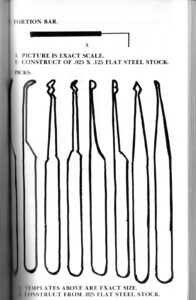
Long ago, before we had the internet, one of the books talked about in certain circles was “The Soldier’s Handbook” by Anthony B. Herbert. This included information on how to make lock picks! It also came with a hefty price tag, so only serious/rich readers could dream of obtaining a copy. Wealthy people never misuse information, of course.
The Soldier’s Handbook has some interesting sections, but in retrospect I am glad I never tried to make lockpicks from the designs given. Here is a scan of the relevant page. Looks like a batarang, a half-ball, half-snowman, a full diamond and what look more like dental tools. I would not have gotten far! The instructions on how to use lock picks, and other entry techniques are not that bad, in fairness.

How lucky we are now! There are plenty of good sources of information on how to use lock picks, including, I hope, this blog. Companies such as UKBumpkeys and WithoutAKey offer good quality picks at reasonable prices. And if you are really on a budget there are Chinese-made sets from companies such as Goso and Klom. Not so nice but they are good for learning.
Categories
Phillosoph

I'm Coming In.

One weekend I was watching a few movies. At least two of these movies had a scene where someone punches through a glass panel and reaches in to open a door. Having a glass panel within reach of a lock is foolish, but it is commonly done. Your own door may be of this sort.
Chris from UKBumpkeys has passed on an excellent video on ways to bypass locks without lock picking. It is quite long, but well worth a watch.

Categories
Phillosoph

DePugh on Wilderness Food and Gear

A friend of mine had some questions about food, and this reminded me of a section in Robert DePugh’s book “Can You Survive?”.
DePugh was on the run for seventeen months, and estimates that  about twelve of these were spent in the American wilderness.
Can You Survive? was written after this, and his insights into what was and was not useful makes interesting reading.
Not surprisingly, the need to avoid detection and capture influences his choices:
“Clothing has already been mentioned and the first aid kit will be considered in a following chapter. This leaves a long list of items that might be labelled “miscellaneous.”
In our previous list, we included a nylon cord. This item I would still retain but not more than 20 or 30 feet. A climbing rope is nice to have if several members together are working their way through mountainous terrain but unless some definite need is anticipated, I would leave such heavy and cumbersome items at home.
In our previous list of materials for the backpack we included such food items as these: dehydrated meals for at least 14 days, boullion cubes [sic], coffee or tea, sugar, salt and pepper, vitamins, halazone tablets, malt tablets and chocolate. Of all these items only one that I would include in a backpack survival ration today would be the halazone tablets—but I would include an abundant quantity of them. The dehydrated foods are fine so far as weight is concerned but I am more convinced than ever that cooking must be kept at an absolute minimum. There are times perhaps when it may be essential to cook certain vegetable items to guard against toxic substances or to cook animals that have been captured and might be infected by some disease. Except for these necessary occasions, even the smallest fire places such a traveller in great danger of being discovered by the enemy. For these reasons, the coffee, tea and boullion cubes are also out. Sugar can best be carried in the form of candy that cannot be spilled or be easily ruined by moisture. Most medical authorities agree that the American people eat more salt than is healthy for them. Ordinary foods contain all of the salt that a person normally needs for good health. Pepper, of course, is one of those niceties of civilization that are best left behind along with your cigarettes and pipe.
Of those foods that are readily available, the best in my opinion for emergency survival rations would include canned meats and cheese, peanut butter mixed with sugar packed in plastic containers, and various types of candy that are customarily sold in small pieces and in plastic bags. All of these items are very low in water and therefore contain a high proportion of nutritive value and they can be eaten with knife and fingers out of the container in which they are carried. For the person who may be required to flee for his life at any time, survival foods beyond the amount he can carry in his pack are a very dubious investment.
Our previous equipment list also included several items for cooking such as a nesting set of cooking utensils, heat tabs or sterno, knife, fork and spoon, plate, cup and scouring pad. Of these I would make do with my canteen, canteen cup and a good hunting knife. Such cooking as may be essential can be done in the canteen cup. If you know where to look, tinder is always available for starting fires. Sand can be used to clean your canteen cup thus eliminating the scouring pad. Under desperate circumstances, good table manners do not justify the extra weight of a fork and spoon.
Other items from our previous list which I would now eliminate include candles, shovel, ax, wire, rubber tubing, folding saw, pliers, wirecutter, screwdriver and file. Items which I would retain include matches in a waterproof container (I'd carry along a lot of these); a flashlight is good so long as the batteries will last; a sharpening stone is worth the weight; compass, maps, ground cloth, thread, safety pins, needles and extra buttons are well worthwhile but since they weigh very little a few fish hooks, line and sinkers might be included though I have grave doubts as to their practical value. Except in the high mountains I would say that a good insect repellent is worth its weight in gold.
A small towel or washcloth has many uses that justify the weight involved. Soap and toothbrush are essential. For men, a razor and blades may be necessary to avoid looking conspicuous on those occasions when contact with other civilians is unavoidable. Other desirable miscellaneous items include a small magnifying glass, paper and pencils.
The dangers of shooting or trapping wild animals while trying to evade hostile forces has already been referred to. In this regard a good slingshot might be worthwhile in killing small game silently as the opportunity presents itself. In capturing wild game, beware of those animals that are caught too easily. They may be diseased and therefore, unsafe to eat without cooking.”
Does “canned meat and cheese” mean canned cheese? Canned cheese may sometimes be found, and would make a change from the tinned meats. Presumably he does not mean the spray can cheese, which would be mass inefficient. Many uncanned cheeses keep fairly well if kept dry, including the often maligned processed cheeses.
Eating boiled leaves with a hunting knife sounds like a chore, so I think a spork is worth the weight.
Trail mix may be worth carrying for a little variety.
One can get a little more creative with the peanut butter.
A quick browse of the internet turns up two-ingredient cookies (peanut butter and syrup), three-ingredient cookies (peanut butter, sugar, egg), four-ingredient cookies (+baking soda), no-bake cookies and oat-squares (peanut butter, honey, rolled oats).
These probably do not have the shelf-life of peanut butter and sugar but can be used on shorter trips.
Categories
Phillosoph

Don't Carry a Rucksack (If you can help it)

A friend of mine e-mailed me recently and told me he felt it was impractical for him to carry his bug-out gear in a rucksack. There was just too much, he said.
I pointed out to him that others had been managing this for centuries, and that it wasn’t actually a “bug-out kit” if he couldn’t move it anywhere. Same friend often e-mails me wonderful, must-have gadgets that he has found. The two facts may not be unrelated. 🙂
Your core bug-out kit should be man-portable. What is lost on many people is that you should not be carrying it on your back if you can avoid it!
This is something we seem to have inherited from the military. A fundamental of military training is marching long distances with heavy loads. As well as the physical conditioning this provides it also improves traits such as self-discipline, determination and resolve. Unfortunately there is a downside to the old adage that “You fight as you train!” Lost on many officers is that long marches with heavy rucks’ may be great training but in an actual operation are to be avoided whenever possible. Most combat theatres are “vehicle-friendly”. Infantry may need to operate on foot, but gear they do not immediately need may be carried on vehicles and brought forward once an area has been pacified. Many soldiers during the Second World War learnt to operate effectively in “light order” and many modern “irregular” fighters do the same. Many armies need to relearn this. Current efforts are towards exo-skeletons and robot mules that will increase the weight that can be carried. The opposite strategy may be more productive.
As an individual prepper or survivalist you may not have a support unit that can bring your heavier equipment and supplies forward for you. Additionally you may be in “vehicle-proof” terrain where the operation of conventional or military vehicles is not possible or very restricted. Military forces sometimes find themselves in the same situation, of course.

A tried and tested solution is shown below. Porter-bikes were modified to carry heavy loads. When fully loaded they could not be ridden. A pole extending the handlebars allowed one or more individuals to push the bike along by walking beside.

For bugging out a bike has a lot to recommend it. On terrain where it is difficult to ride you can push it, and use it to carry your pack rather than your back. Overall load should be kept in the man-portable range since there may be obstacles you will have to carry bike and pack across.

Another interesting option is found on this site and others. Its inventor calls it a “travois” but it is actually a hand-cart (or possibly a “man-cart”?)

As an aside, a real travois is an option you should always consider if you have to move something heavy over relatively soft ground.

Handcarts were once not uncommon in armies. After WW2 the “big ruck” mentality seems to have taken hold and they become rarer. In the early days of ATGWs some models were offered with golf-trolly-like contraptions so a dismounted infantryman could move them. Nowadays a few mortars are provided with trolleys, but in most forces they are unknown. If a skier can tow a pulk, why not a a walker a cart?

The wheeled travois has been designed with ease of manufacture in mind. I would suggest making the poles a little longer so that if necessary the cart can be carried over an obstacle like a stretcher. For ease of use in vehicle-proof terrain I would suggest reducing the width so that it can be used on narrow paths and trails. Bicycle wheels may be a good source for the wheels. I particularly like the net that forms the bed of the cart. With a bit of ingenuity this might double as a camouflage screen.
Categories
Phillosoph

Vanishing Infantry

I came across the interesting photo sequence shown here. Some time ago I made a post about the Vietnamese use of a framework on the back for camouflage. Here we see its use in action:
This is a Viet Minh force from the Indochina war. This trick was still in use in the Vietnam war.
Possibly at the sound of an aircraft, the men have moved off the road and dropped down. As the threat passes men “grow” first from one side of the road and the other.
The final image is a close-up. Interesting is that their uniforms appear to be beige rather than the green associated with the later NVA. VM Regular uniforms have been described as “khaki-drill” but apparently light-green, khaki and a variety of other drab shades were used.
According to Osprey Men at Arms 322, “The French Indochina War 1946-54.”:
“Viet Minh Regulars, and many Regional units, were first class; it is clear that they had successfully made the mental transition from guerrillas to soldiers. Neutral journalists who managed to spend time with Regionals were impressed by their discipline and preparedness. Throughout the VM attention to tactical detail was excellent, both in camp and on the march – great emphasis was laid on camouflage, night movement, dispersal and reassembly in the face of the enemy, and endurance with the simplest rations and minimal medical care and comforts.
“The VM were skilled at concealed cross-country movement in the worst terrain, carrying all essentials with them. This gave them significant advantage over motorised French troops, whose more complex logistical needs kept them tied to the inadequate and vulnerable road network. Generally only the best French paratroop units could match their cross-country speed in the jungle hills, and that for only limited periods. It was rare for French aircraft to inflict much loss on Regular units on the march, though their supply lines suffered much worse (e.g. in 1954, during the huge effort to supply the Dien Bien Phu siege army 500 miles from Viet Bae bases)…
“…Reports speak of Regulars carrying a wire mesh panel on their backs when on the march; at each halt the soldier changed the foliage camouflage of the man in front to match the locality exactly.” 
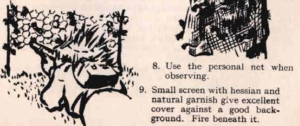
Some WW2 British Manuals advocate the use of net or chicken wire screens for troops to hide behind or under. The back-screens described above could thus serve more than on application.

Categories
Phillosoph

Blanket-Coat

Often I come across something I want to place on the blog but don’t get around to it until much later. I seem to have two speeds: immediate and much, much later.
This is something I came across when I was discussing ponchos or cloaks, I think. It has some relevance to the recent post about simple ways to create a smock.
As you can see, construction is very simple:
Categories
Phillosoph

More On Camouflage Ponchos

Today’s post is a follow-up to my blog on camouflage capes.
Shortly after writing that post I acquired a length of camouflage cloth and set about creating a camouflage cape. Since cloth comes in 1.5 metre widths and I am quite a big lad, I brought two metres, with the intention that it should be about a metre at the front and 1.5 at the back, so could drape over a pack if necessary. Making a cape is a relatively easy sewing task, run a hem an inch or more from the edge to arrest any fraying. Cut the cloth on the outside of this into tassels. Doesn’t matter if these fray, it adds to the disruptive effect. Similarly,your sewing does not need to be particularly neat. Irregular and non-uniform is good for real camouflage.
Good camouflage is three-dimensional, so the most time consuming phase of production was attaching the textilage. I suspect this process could be speeded up with a staple gun, but have yet to try this.
Once I finished, I realized there was a bit of a problem! I cannot really photograph this to show you. You cannot really judge personal camouflage unless it is on a human form. Lying it on the ground or over a chair does not really tell you anything, and I do not have a mannequin or taylor’s dummy. Use the girlfriend? She is petite and shapely, while I am big and ugly, so showing you something made for me on her is not accurate. And we get little chance to be together these days, so Ive not been able to get her and myself in the same place as cape and camera.
I can, however, pass on some of the lessons learnt while constructing this. The first is that it may be a little long. I could have made it a little shorter without much loss of performance. Secondly, underestimated the effects of the textilage so the base cloth could have been a lighter shade. I could have probably used a monocolour of beige or similar since the textilage adds quiet a lot of shape disruption.

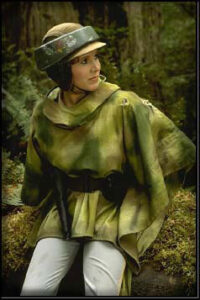
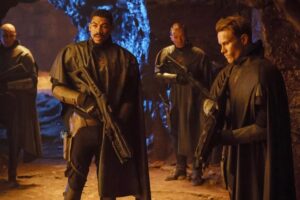
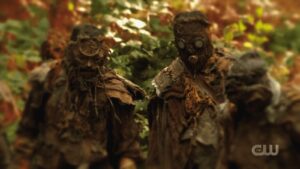
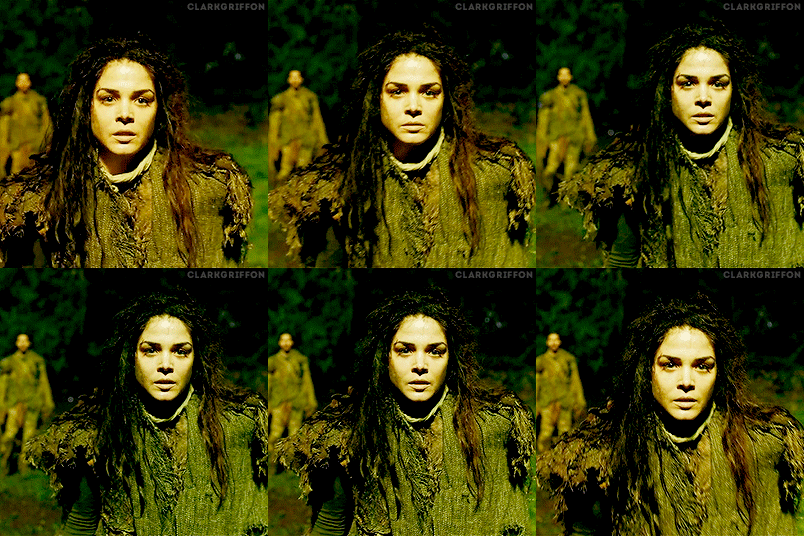
Next time I would not opt for a cape design. Regular readers will recall the “Endor poncho”. Recently two other sci-fi sources have reminded me of this. One is the series “Krypton”. Sagitari on the moon Wegthor wear a brown poncho. While it is not intended as camouflage it does make the wearer appear less of a conventional humanoid shape. The second is season six of The 100. The “Children of Gabriel” wear camouflage that uses textilage. Octavia and Diyoza wear examples too. and in their scenes it can be seem the basis is a poncho/ apron overhead garment.

One could easily construct an over-garment that combined the features of a short-poncho and a smock. The poncho part should be of a width to reach the elbows. Cut the edges into tassels. Don’t bother with a hood since the brush can catch such things. A properly camouflaged helmet or boonie hat camouflages your head. You can add a rectangle of cloth to make a collar for the neck opening if you wish. This can be used to show rank-insignia.

Adding sleeves to your ponchoette is simple. You just need two tubes of camouflage cloth. These need a generous width since they will have to fit over other garments. Trouser legs from old combat trousers can be used, or you can make simple tubes from any suitable cloth. If doing the latter put the hems on the outside, like the Langdon-Davies smock design and tassel them. Anchor the sleeves to the inner side of your poncho. The bottom parts of the poncho can be sewn together or you can apply other fastenings such as poppers. Leave generous side vents for freedom of movement and so you can access pocket or equipment on your trouser belt. As can be seen, the basic garment is formed from three or four rectangles

Your poncho/smock will need textilage. Some of this will be from the cloth you have left over. Use any other scraps of camouflage or suitable materials too. Apply to the sleeves and shoulder parts. The chest area does not need so much if you wear webbing or a chest rig. Apply the textilage to this instead.
Categories
Phillosoph

Camouflage and Surface

One of my readers/sponsors has reminded me that it has been a while since I wrote about camouflage. As it turns out, I have a few thoughts to share.
A mnemonic often taught is the “Five S’s of Camouflage”.
These are usually Shape, Shine, Shadow, Silhouette and Spacing. There are variations on this, some schemes adding extra factors. These may include Smell, Speed, Sound, Skyline and Smoking.
Some even fly in the face of alliteration and suggest “Movement” and “Aircraft!”
Skyline can be considered an element of Silhouette.
Smell is something that is sometimes neglected. A human’s sense of smell may be inferior to that of many animals but can still prove useful if the brain interprets to significance of a familiar or out of place odour.
Sound is not just obvious things like talking or gunfire. One of the reasons for the ninja covering his face was to muffle the sound of his breathing if he had exerted himself.
The noise of chewing gum or tobacco may tip off an attentive enemy or prey. Give up both habits.
Smoking is another habit to drop. As well as being an aiming point and location signal at night, the smell of the smoke and on your clothes may give you away.
Many smokers are litterbugs and a discarded cigarette butt can tell a competent tracker many things.
Shade/Shadow is something I found myself considering the other night while watching a movie.
A cowboy rides ahead of a posse to scout a valley. He really should not ride straight down the middle like that, I thought. He could have easily swung into the big patch of shadow cast by the cliff on one side.
Shadows in your environment can be very useful.
If you have to cross a forest road follow the shadow cast by a tree. You may be under aerial observation.
If you are attempting to conceal something, the shadows cast may negate your efforts. Remember that the angle and direction of light will vary with time.
Another factor to consider is texture, or in keeping with the theme “Surface”.
This is an element that seems to be often neglected these days.
You can paint your vehicle in different colours but it will still be an object with many flat, smooth surfaces, most of them vertical or horizontal.
Back when camouflage was taken more seriously, I can recall Land Rovers covered in nets and hessian, sometimes looking like mobile blocks of heather.
They still looked a bit boxy but viewed from the air they could easily be overlooked if they were static and positioned irregularly.
You can still see similar examples, although oddly this seems more common on soft-skins than on actual fighting vehicles.
Stowing gear under the nets can make the vehicle shape less regular. This is a variation of the old idea of placing balls of grass under a helmet net.
Surface is also the problem with most modern camouflage clothing.
As has been discussed elsewhere, many current patterns lack the element size and contrast to disrupt body shape.
Even when this is not the case, the garments conform to the easily recognized shape of the human body.
Smooth surfaces are not that common in nature.
A good camouflage pattern is only the foundation upon which personal camouflage is built. Let me provide some illustrations:
These US troops are fairly typical.
A patterned cloth cover does not camouflage a helmet, it remains a distinctive shape. No attempt has been made to paint or cover the distinctive black NVG brackets. These could at least be made in brown.
Breaking up the shape of the helmet is perhaps moot when you have an uncamouflaged rosy-pink face beneath it.
Note that none of these individuals have scarves they could use to veil their faces or make the head and neck area less distinctive.
Other clothing has no attempts at shape disruption. If it was looser it would be more comfortable, better ventilated and more irregular in shape.
Troops need a smock that fits over body armour and trousers that fit over the outside of knee-pads.
Also note that there are not even temporary measures to conceal the distinctive shape of their weapons.
Next are two photos of British troops.
These guys have camouflaged their helmets. One pair has used natural materials from their surroundings, the other appear to have used artificial materials (“textilage”). But they have stopped there.
Notice also how the camouflage pattern of the clothing blobs out and becomes effectively a single colour at just a few metre's viewing distance.
No materials added to the webbing, packs or pouches to break up their regular shape. No textilage added to the upper arms and shoulders to break up the shape. This would have also broken up the smooth appearance of their clothing, which takes us back to Surface.
Even if you are in a desert or urban environment with very little apparent vegetation, adding some texture to your helmet, clothing and gear can make you harder to see, and harder to target.
Personal camouflage is an important defence against snipers and observation.
Conventional forces assume they will always enjoy air superiority, but modern technologies such as drones may negate this on a local level.