Sometimes a diversification can let us view a topic from another direction, casting new light on it.
Size Matters
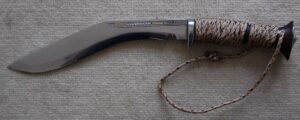
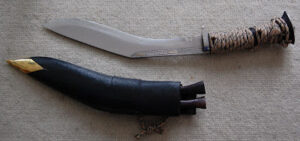
The last blog made it clear to me that the many medium-sized (6 to 8") general-purpose knives that I have do not really have a role. That includes my beloved Buck 119 and the various five to eight inch kukris that I have acquired.
If SHTF or TEOTWAWKI occurs, I will be reaching for one of my larger blades and complementing it with one of my puukkot (plural of “puukko”).
I have my favourite ten-inch sirupate kukri ready to go on a belt alongside a Mora Companion. A small pouch on the belt contains a fire kit and Lansky multi-sharpener.
Nearby is my barong-handled machete and a crowbar, ready to be added to the rucksac.
Already on my person I have my Swiss Army knife and mini-Leatherman, along with other items.
If you are planning to spend good money on survival knives, the sound advice is to “go big” and “go-small”.
Buy yourself a good chopper that can produce a fire and shelter with minimum effort when they are most needed.
Get a good fixed blade small knife that can handle more intricate duties. Puukkot are hard to beat for value and quality. Get what folders you want for EDC.
Another topic I touched on was that most of the original Bowie knife designs were designed to be primarily weapons. This can be seen in the shape of their point profiles, which are often combined with a long false edge.
The Bowie/Machete
With the above in mind, I will share a passage I came across in “Gun Digest Book of Knives, 4th Edition”, p.111-113:
“Another category of knife is the hybrid Bowie…The Bowie/Machete is made by Collins Machete, Case Knife, Western Knife and Legendary Arms.
Bowie/Machete came about when a South American customer went to Collins and wanted a machete made like a Bowie knife.
Bowie/Machete came about when a South American customer went to Collins and wanted a machete made like a Bowie knife.
The result was a wonderful knife. It is one of the finest large skinning and butcher knives ever made. It is one of the few knives that can hold its own with a commercial slaughterhouse curved skinner and large butcher knife. These purely single-purpose knives are hard to beat at their specialities, but the shape and curvature of the Collins design is a most useful compromise of their features in a large knife.
The oversize butcher knife shape with the Bowie clip blade has a deep enough belly and enough sweep at the point to approximate the sweep of the professional skinning knife. In the hands of an expert, it is the best knife for skinning and butchering large game. For use as a small machete, the deep grind employed on these knives allows the same cut a much thinner machete would make. While a little light and short for heavy woodcutting. this is still a practical short machete knife.
For a working knife to carry in South America where it was intended, or anywhere else for that matter, this is a hard one to beat. When used as a fighting knife, it is an excellent chopper, while its broad blade produces more damage on thrust than lesser knives…
It should be noted that the simple tapered grip with the pronounced neb to anchor the hand found on these is an elegant masterpiece of a functional grip in its own right. These knives feel good in the hand where they lock in and go to work naturally. The hand is positioned for proper leverage with a heavy double guard to bear against at the front and a neb at the rear similar to the grip taken with an Indian Talwar sword. It is most effective for a working knife and far better than gimmick grips on some custom knives. Remember. everything possible with knives has been tried. This is an old, standard, elegant solution to the grip. Like the rest of the knife. it is conservative and effective all the way through.”
This sounds interesting!
No image of the “Bowie/Machete” is in the book. There is a photo of a Legendary Arms Bowie that it might be, but unhelpfully the blade is in its sheath!
Websearching on “Bowie/Machete” proves useless.
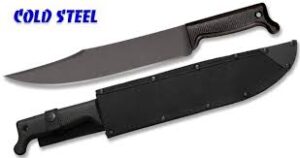
The Cold Steel design of this name post-dates the book, and it is evident from the shape that the Cold Steel offering does not have the features described.
The Bowie/Machete Identified?
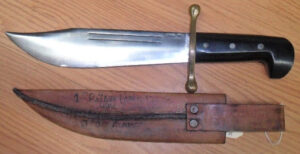
Eventually, I pieced together enough clues to suspect that the model described is the Collins & Co. Machete No.18.
Not actually a machete as most of us understand the term these days, but that was how the company designated it.
In 1942, the 10-inch Collins was adopted for survival kits of air crews operating in the Pacific, including at Guadalcanal Canal.
The marines took notice, and the model was widely used by the 2nd Marine Raider Battalion.
Maj. James Roosevelt, son of the then President, was involved in their procurement, and carried one numbered “30”.
One of my references, (“Fighting Knives. An Illustrated Guide to Fighting Knives and Military Survival Weapons of the World” by Frederick J. Stephens p.67) confirms that wartime production of this model was also undertaken by Case Cutlery, Western Cutlery and an Australian source.
“Knives of War” by Hughes, Jenkins and Buerlein adds a company called Kinfolks Inc to the list.
It is from Case that the frequently used, but incorrect designation “V44” or “V-44” seems likely to have been acquired. (The V42 discussed in the last blog was a Case design.)
Knives of War p.68-70 calls ithe No.18 a “Gung Ho Knife”, “Survival Bowie” and mentions an aviator’s example labelled “9-inch machete”.
Actual dimensions are given in Knives of War as a blade of 97⁄8" and 2" at its widest. Total Length is 14½". I believe the blade was ¼" thick.
Minor variations between manufacturers can be found, variations including grip shape, grip construction and whether the false-edge was sharpened.
Some Collins examples had a grip of green horn, which has a very attractive camouflaged appearance.
Some sheathes had the tip cut-off to improve drainage.
Knives of War p.69: Former Marine Raider Rosenquist reports: “It was a real good, multi-purpose knife. We used it for opening ration cans, coconuts, cutting fire lanes, etc. It was handy as a small hatchet for cutting small trees and coconut-log bunkers and in combat as an effective fighting weapon.”

The No.18 Today?
The No.18 is a Bowie design with a proven record of survival utility, not to mention it might also find its way to certain kitchens or meat-packing plants.
As well as its practicality, it has historical connections.
Many people understand the value of preparedness, and Americans love Bowies, so you might think a number of companies would be offering “Gung Ho/ No.18 Survival Bowies” and that they would be flying off the shelves!
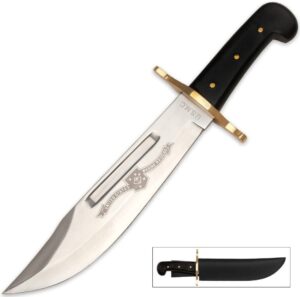
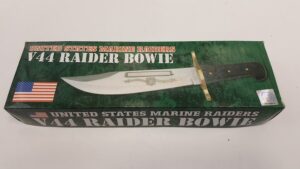
Well, I have not had much luck locating any!
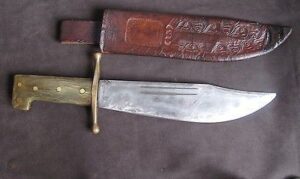
There is a reproduction “V44 Raider Bowie” (above). This is apparently low-quality steel, since it is intended to sit on a shelf rather than be put to use. Note that it is not a particular accurate reproduction, the blade having a single broad fuller rather than the two narrow fullers of the actual No.18.
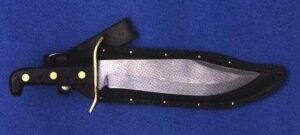

Legendary Arms offers a Bowie and a “Throwing Bowie” that has some resemblance (above), but note both have a short bevel grind rather than the blade section of the originals.

Western Cutlery is now Western Knives, with production in Asia. Their W49 (above) is/was not their version of the No.18. Dimensions are slightly smaller and the blade has a short bevel.

Best candidate seems to be the Ontario SP10 “Marine Raider” (above). Despite the name, the blade form is different.
The Ontario SP53 is probably closer to the No.18 in spirit, but is not a Bowie.
Most obvious difference for both of these is the grip. I quite liked the machete-style grip of the original Collins.
As regular readers will appreciate, a flared or hooked grip is a very good feature for a chopping knife.
The Future?
Ideally, someone would bring out a nice No.18 Bowie blade blank that I could fit with a grip.
If anyone has been inspired by this to bring out a modern day No.18 Bowie, I would suggest having a good look at the modified original shown below.
The upper quillon has been removed and the lower bent so that it is out of the way when the strongest part of the blade is used for tasks such as batoning through material.