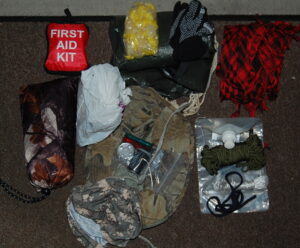
The battle order suggested in the previous blog raises an interesting question: How does the soldier carry his poncho?
Items such as bayonets and ammunition have obvious places on the webbing.
Not only must a poncho be carried when not worn, but it must be protected from unnecessary damage.
The official solution was most probably to carry the poncho in the butt-pack. As I have discussed in previous posts, there are objections to using a butt-pack or similar. Its capacity is a temptation to carry extra gear. Its position makes it hard to easily access, and it is inconvenient if sitting in a vehicle for any time.
Military Soft-Core Bag
In a previous post I described my “soft-core bag”. This idea can easily be adapted to military applications.
The military version of the soft-core bag actually may be lighter than my version. Items such as the fire-kit, first aid kit and sweets can be omitted, since these roles will already be met by items hopefully carried on the soldier’s webbing or person.
For the same reason, the water-bottle in the soft-core pack can be omitted unless operating in particularly arid conditions.
Contents
What should the military soft-core bag contain?
• A poncho. This should ride at the top of the bag for easy access. If the poncho has its own stuff sack, add two three metre lengths of cord. Paracord stretches, so something non-elastic is preferable. Loops of cord for pegging should already be attached to the poncho side and corner eyelets.
• Accessory clothing items such as warm hats, work protective gloves, spare socks, bandanas, shemagh.
Many outdoor coats lack sufficient pocket space to carry such items, and you may need your pockets for more tactical items.
The soft-core bag is a practical solution. Wrap in plastic bags to waterproof them. The majority of these items would stay in the large pack. The soldier dresses in what he needs when he caches his large pack.
• A spare shirt, jumper, jacket or liner, “ranger-rolled”. Useful if the temperature drops or you reduce your actively level. Wrap in plastic bags to waterproof them.
• Toilet roll in waterproof bag. As well as the intended use, good for fire starting. Use a bag that can be sealed against water. A 100 ml bottle of alchohol hand-sanitizer may be added to this bag.
• A small notebook in a waterproof bag may be useful.
• Items such as cordage and space blankets are optional for the military soft-core pack. You may decide these are better carried in your trouser or shirt/jacket pockets.
• A “non-soft” item of equipment that might be carried in your soft-pack are your goggles.
These can get in the way if you are not wearing them. When not in use they need to be covered for camouflage purposes.
Stowing them in your soft-core bag is a very practical solution. Place them in the middle of clothing to provide padding and protection.


Carrying Bag
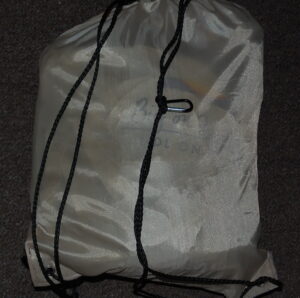
Like the other version, the military soft-core bag fits in a simple draw-cord bag. This is stowed in the top of your rucksack so the poncho or other contents can easily be accessed if needed.
When you stow your rucksack, you pull out the soft-core pack and wear it as part of your battle-order. When seated in a vehicle, the soft-core pack should act as additional padding for your back.
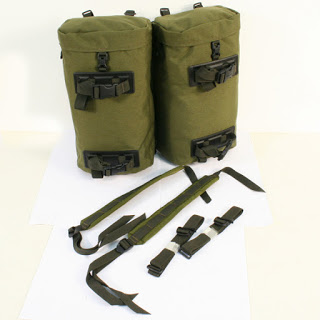
Nearly all of the contents of my civilian version of the soft-core bag may be fitted in one of the detachable side pouches of a bergen.
There is room for a water bladder and a few “mission” items.
Ideally, there should be provison to stow the mini-medical kit directly under the lid,
Tent poles that can fit down the sides of the pack, and a small bag of pegs would be useful. Currently I am not aware of any off-the-shelf shelter poles that break into sections of less than 32 cm.
The other side pocket may be used for NBC gear. When NBC (CBRN) is not a likely threat, the single side-pouch may be carried as a patrol pack.

Camouflage
Ideally, your draw-cord bag should be of an effective camouflage pattern.
A grey-beige-brown scheme may be more versatile than the green-dominant examples shown in the photos.
Sewing some textilage to the outer side is a good idea too.
If you cannot get a camouflaged example, a suitably neutral-coloured bag can be camouflaged with a few passes of spray paint.
Making a camouflage draw-cord bag will be within most reader’s capabilities. Note that the bags shown have carrying cords created by taking the cord down to eyelets at the bottom corners. If your bag lacks these, they can easily be added.
Dark or unsuitably coloured cords are easily replaced with something such as “desert-camo” paracord.