Disclaimer: “As an Amazon Associate I may earn from qualifying purchases.” Adsense and Infolinks were no help at all.

If you have enjoyed this article or it has been helpful to you please feel free to show your appreciation. Thank you.

Read The Third Wave by Alvin Toffler!
Categories
Phillosoph

Bush Shirts

You may have an emergency kit or bug-out bag ready packed, but what clothing do you have stored with it? Your emergency kit should include an outfit of clothes suitable for travelling. This must include underwear, outerwear, footwear, headgear and insulation suited to any season. There are many possible choices, some better than others. What are our best options, particularly if on a budget?
For most of the nineteeth century the US Army wore a dark blue woollen uniform. This was considered suitable for all climates, regions and seasons within the US. In practice the material and colour were uncomfortable and impractical for the hotter months and latitudes. Durability was also an issue. Troops often returned from campaign with uniforms in a very poor state. The blue woollen uniform was also poorly suited for the various menial tasks a soldier might be called on to perform.
Troops on campaign were, however, allowed considerable latitude when it came to clothing. During the Geronimo campaign some infantry in Mexico and Arizona are known to have marched wearing only their army underwear of undershirts and cotton drawers. (Uniforms, Arms, and Equipment: Headgear, Clothing, and Footwear by Douglas C. McChristian) Historical accounts mention soldiers on campaign wearing their “overalls” as an alternative or replacement for uniforms. The overalls in question were a two-piece alternative to the stable frocks mounted troops were issued. Mounted troops were required to conduct stable duties twice a day. Horse hair and dust would have rapidly fouled the blue wool uniforms so troops on stable duty wore either frocks or overalls of white cotton duck garments over their blue uniforms. These overalls and smocks saw use as campaign wear or unofficial uniforms. The white colour was less than ideal, but a few weeks of campaign often turned them another shade.
Officially, the US Army remained resistant to issuing a summer uniform. When regulations were relaxed to permit the wearing of a white summer uniform, the soldier was expected to pay for the garments out of his own pocket at whatever prices sutlers asked. It was not until the 1880s that a summer uniform was issued. Quartermaster General Holabird ordered surplus shelter tents to be made into coats and trousers. Experiments with dying the canvas brown also proved successful. The uniform was clearly intended to serve as a summer uniform and campaign wear. The jacket was of blouse or sack-coat style, rather than a stable frock coverall. I have seen it suggested that the canvas uniform was designated a fatigue item so troops would not have to pay for them from their clothing allowance.
Jump forward about half a century and things come full circle. World War Two saw fatigue-duty clothing being used as hot weather combat wear. By the Korean War this had become common practice and “fatigues” became synonymous with hot-weather combat dress.
When selecting outdoor gear it may seem logical to copy what the army uses. After all, the army spends millions developing and testing gear, and surely wants our troops to have the best possible. Sadly, no! If this hypothesis was true, why do different armies produce different solutions to the same problem? Why is gear changed and replaced with such frequency?
If you study the history of, say, US combat/ field jackets, you observe a repeating cycle. Something practical is designed. After a few years in service it is noted the practical item is not that smart looking. A new, smarter replacement is adopted. Troops complain the smarter item is not that practical, so a replacement is designed, and so on. This cycle dates back well into the blue woollen uniform era. The army wants practical field and work wear that still looks soldierly. (This trend can be seen in a number of books on the history of US Army uniforms. Several of the “U.S. Army Uniforms of…” series by Shelby L Stanton are a good starting point) The US Army currently seems to be in a “non-practical” phase. Trousers are cut too narrow to fit over knee-pads or to allow good air circulation. Shirts intended to be worn under body armour have no camouflage on the torso, with tight-fitting sleeves that do nothing for shape disruption and air circulation. Camouflage that does little to hide the wearer.
As preppers, survivalists or outdoors-people, looking neat and soldierly is low on our list of priorities. We want versatile, practical gear that hopefully will not break the bank.
As I have mentioned in the previous post, for many conditions, jackets are too warm, particularly if lined. This holds true for many designs of combat jacket. As might be expected from the introductory passages, an unlined fatigue jacket is a possible option, if you can find such a thing at a reasonable price. More readily available are medium or heavyweight shirts, which we will designate “bush shirts”. A pair of cargo trousers and a bush shirt over suitable underwear is the start of a very practical clothing system. Notable is that the upper garment of US Army fatigues was originally designated a jacket, but troops were usually required to tuck it into their trousers. Eventually it was re-designated a “utility shirt” and redesigned with shirt-type cuffs.
If you now jump to googling “camouflage shirt” you will discover most of your hits are tee-shirts, which are not what we are looking for. Those that are not tee-shirts tend to be pricey!
Forget about camouflage patterns for a while. Smocks and other camouflage measures will be dealt with in other posts. For the moment we will be satisfied if our bush shirt(s) is a low-signature “neutral or natural” colour. Google “khaki shirt” and you should discover a wide variety of choices and colour shades. The true green coloured are best reserved for summer or jungle use. Similarly, very light khaki shades may be best kept for bright environments such as desert. This still leaves us a wide choice ranging from light tans to olive-brown. Mid to light greys and possibly pale olive are also acceptable shades.
Whatever shirt you opt for, buy it larger than you would usually wear. In cold weather that space allows you to wear more insulation under the shirt. In hot weather that space allows air to more freely circulate. Your shirt should also be long-sleeved, for when insects bite and thorns come scratching. Here is a good place to repeat a piece of advice from the Victorian explorer Francis Galton: “When you have occasion to tuck up your shirt­sleeves, recollect that the way of doing so is, not to begin by turning the cuffs inside out, but outside in-the sleeves must be rolled up inwards, towards the arm, and not the reverse way. In the one case, the sleeves will remain tucked up for hours without being touched; in the other, they become loose every five minutes.” Try it! He is right!
Most of the potential bush shirts you will encounter will be cotton or poly-cotton.  Microfibre shirts are becoming more widely available and often with a similar price tag to cotton. These are breathable synthetics, so should be quicker drying.
Other features are up to the buyer. A pair of practical breast pockets are useful, although your trouser pockets should be where your primary EDC gear is carried. The shirt is also your nightshirt, so overfilled pockets may be uncomfortable. A “traditional” shirt collar can be turned up to further protect the back of the neck, although since your outfit should include a neckerchief, shemagh or scarf this is probably moot.
Your bush shirt(s) can be customized, should you feel so inclined. Reinforcements can be added to the elbows and possibly the shoulder area too. Elbow patches should not hinder the sleeve’s ability to be rolled up or stay up. Breast pockets may be covered by pack straps, so sleeve pockets are a useful addition. These should be long enough to hold a pen or pencil. Poppers may be preferable to buttons. Vent zips or holes under the armpits can be added for increased ventilation. Additional pockets can be added to the lower part of the shirt, although these will not be accessible if the shirt is worn inside the waistband. If the shirt is worn outside the waistband the sides may be vented to allow access to a belt-worn knife or pistol. If desired, a bush shirt can be converted to a pullover style by sewing up the lower half of the front opening. This can reduce drafts around the midriff and keeps biting insects out.
In many conditions your bush shirt will be your outermost garment. When it gets colder it is an additional mid-layer beneath a jacket or coat. It may also be your nightshirt.
While I was planning this article, I came across the following passage in the Boy Scout Handbook (1911) “It is well to carry a spare shirt hanging down the back with the sleeves tied around the neck. Change when the shirt you are wearing becomes too wet with perspiration.”
Tying a jumper around your waist was standard practice when I was a schoolboy. The jumper tied and draped over your shoulders is a familiar 1980s icon. Carrying and using a second shirt this way is something quite different, and potentially very useful. If not worn in this way the spare bush shirt should be kept somewhere easily accessible, such as the outer pocket of a pack. The merits of being able to change out of sweaty gear were addressed in the last post. If the weather turns colder you can wear both shirts. The spare shirt can also serve as an emergency face or head covering or as a scarf. A wet shirt can be hung down the back, or the back of the pack, to dry. This is one of the reasons we choose neutral or natural tones for clothing, even undergarments. Drying laundry can act like a signal flag!
Categories
Phillosoph

The Layer System

I plan to make some posts on clothing.
Before I do so, it is appropriate that I address the commonly encountered concept of “the Layering System”.
Many websites and books pay lip service to the Layering System. The problem is that this is usually oversimplified into a “lie to children” that omits important facets.
The typical version goes something like: “Your clothing needs to be in three layers. The under layer (buy some wicking underwear), the mid-layer (we sell really nice fleeces!) and the outer layer (have you seen our Gore-tex range?)
Not technically false, but also lacking a lot of information you should also know.
The most important concept to grasp is that it is not the clothing that keeps you warm, but the air that the clothing traps.
Several layers of thin garments may keep you much warmer than a single thicker (and possibly heavier) layer. The best insulation is still, dry air. Most materials that we call insulators serve to catch and hold such air.

Underwear

I have addressed the topic of underwear in a number of other posts, so I will be brief here (pun intended!). Underwear is not just for wicking sweat off your skin surface. It is also there to prevent your body soiling the outer layers of clothing. Clean clothing traps air more effectively than that clogged up with oils, salt and other crud. Undergarments should be selected with of washing and quick drying properties in mind. Thin items will dry quicker than thicker. If it is very cold wear multiple thin layers of underwear. Carry a spare set of underwear. Depending on climate this may be simply a tee-shirt/ vest and a pair of underpants. Kephart tells us to change into our cleaner set for sleeping. If your underwear becomes sodden from exhaustion, change into the drier set. Use the dirty set to give your body a rub-down before donning the cleaner. Whenever practical, give the set your are not wearing a rinse or a wash. It may be prudent to change first if the set you are wearing is the dirtier.

Mid-layer

This should actually be “mid-layers!”. A thick fleece jacket or jumper can only be on or off. This may mean a choice of too-cold or too-hot. Many of the mid-layer garments sold in outdoor shops tend toward being overly insulated. If your mid-layer is actually several layers of thin garments you have a more versatile system. This is likely to be warmer and lighter. Individual layers will be easier to wash and quicker to dry. Chances are you have a number of old shirts or thin jumpers that can be combined as very effective mid-layers. Minor damage or marks are not a problem in this role. Shirts may be more comfortable as mid-layers with the collars removed.
Your body may be sweating as well as producing heat. You want to get rid of this water vapour before it can condense, or even freeze. Even if there is metre-thick snow on the ground, vent your clothing occasionally to remove humid air.

Outer Layer

The mid-layer(s) trap a layer of air that your body warms up. The outer layer prevents the wind blowing this warm air away, or the rain soaking into the mid-layers and displacing the air. Fleece jackets are often seen worn as the outermost garment. While this works with some models or under certain conditions, you will also find in other situations the wind will cut right through them.
You actually need a choice of outer layers. A rainproof is great if it is actually raining. In other conditions, even the breathable models may become clammy inside. Regularly venting your mid-layers is an important habit to acquire, even if you have top of the range breathables.
The more you wear rainproofs, the greater the likelihood they will be holed by thorns or other hazards. A few decades back “pac-a-macs” were fairly common. Rainproof garments that folded up into a small pocket or pouch when not required. These now seem hard to find and modern rainproofs tend to be more substantial, bulkier and more expensive. I have to think this may be a step backwards. On the other hand, some of the rain-ponchos on offer seem to be very light, compact and reasonable in price. They can also be used as groundsheets, shelters and so.
If you are not wearing your rainproof, you still need an outer layer that will retain the air your mid-layers are holding. Most cloths of a sufficiently tight weave can serve as a windproof. Most of your likely options are going to be cotton.
Cotton is not ideal as an outdoor material. If wool gets wet it retains most of its heat. Wet cotton is cold, and drains the body of heat trying to dry. While this is relatively well known, outdoor shops are full of cotton items they will try to sell you. Most military surplus items you may consider will be cotton. Cotton is easier to print in camouflage patterns, although the wide use of cotton in certain armies predates their adoption of camouflage. Most civilian, non-specialist items you might use instead of the above are also likely to be cotton.
You probably cannot avoid having some cotton items as your windproof layer. Sensible precautions are keeping a fire kit and rain-poncho on you. A change of clothing, carried in a waterproof bag, is also prudent.
For the lower body, cargo trousers and gaiters are a reasonable choice. The former can be modified as suggested elsewhere.
Combat jackets may seem a logical choice for the upper body. Their main problem is that in many conditions they tend to be too warm. You may be better basing your clothing system around a couple of bush-shirts, much as Kephart did. Field jackets and parkas can be added if the mercury drops.
A good bush-shirt may be cotton, but may also be found in fast-drying microfibres. Bush-shirts are a topic I will discuss in more depth in a future post. Relevant to today’s subject is that any shirt (or jacket) you plan to use as an outermost layer should be selected with room to wear several layers of insulation underneath. It should be at least a size larger than your usually wear. You should be able to comfortably wear it over a fleece jacket or NATO sweater, or their equivalent in thinner layers. In hot weather that space lets more air circulate.
As an aside, wearing a shirt over any insulation is a useful dodge to remember should you become separated from your jacket. A similar idea was to wear a combat jacket or bush-shirt over a waterproof jacket. This protected the waterproof from damage and reduced the noise that such a garment might make. It also might contribute to visual camouflage too. Although the outermost layer of clothing might get soaked, the waterproof kept the inner layers and wearer dry.
A few final points about the Layer System. The idea is that you can regulate or comfort and temperature by removing or donning garments as needed. Some means to carry unworn items will be needed. Stopping to change may not be practical. The rest of the platoon may not want to stand around while you redress, especially if your garment is under a mass of LBE and body armour! A common error in cold climates is to over-dress/ over-layer. If you are mobile, your level of clothing should ideally feel slightly chilly when standing around. Static roles such as sentry duty or manning foxholes will need more insulation. In any climate, do not neglect ventilation.
Categories
Phillosoph

New Survival Tool: The Brick Hammer

Some time back I was reading a number of manuals written for the British Home Guard.
Fighting in an urban environment was a common theme.
Many of the authors drew from experience in the Spanish Civil War. They had learnt that urban terrain could negate an enemy’s advantages in air power and armour.
Urban operations was expected to be routine, rather than exceptional.
It is safer to be firing from loopholes rather than from windows, but I began to wonder about the practicalities of cutting a loophole in a brick or similar wall.
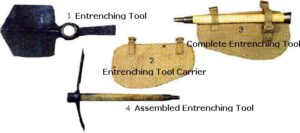
The Home Guardsmen probably would have had available the 1937 entrenching tool, which included a relatively stout pick. Troops with other designs of entrenching tool may be less capable.

A bit of research turned up the tool shown below.
This is sold as a “brick hammer”. I will confess, I have yet to try cutting loopholes with it. My landlord would probably object
This is potentially quite a useful survival tool.
The adze part can be used for digging, and should be more than adequate for such tasks as creating cat-holes or Indian Wells.
The hammer part can hammer things, such as tent pegs if stealth is not a requirement.
Shank and head are both steel, so the adze could also be used as a prying tool or crowbar.
If necessary, it can serve as a passable hand weapon or missile.
It could potentially be used as an anchor or for hooking.
The brick hammer is relatively compact and light (718 grams with tape and cord), and very reasonably priced.
For trips that are unlikely to require building foxholes, this may be all the entrenching tool you need.
In its original state, this particular brick hammer was polished steel and a black rubber handle.
I have given the metal parts some paint, although I expect this to wear off with use. The handle was covered by some self-adhering grip tape I had, and I have added a thong for retention.
Categories
Phillosoph

Battle of Jangsari: Camouflage

Recently I watched the movie “Battle of Jangsari”, set in the Korean War.
I enjoyed it, and many of my readers may do so too.
So as not to spoil your enjoyment, I will try to avoid any possible spoilers that I can in the following passages.
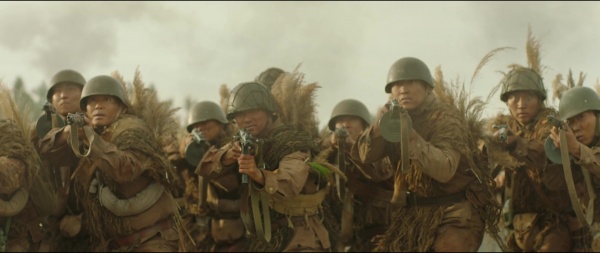
The photo below shows the North Korean troops that are sent as reinforcements. Notable on their first appearance is the bundles of grass/straw/rushes that each infantryman has sprouting from his back.
At first glance I thought this might be an earlier example of the device described as in a previous post as the Vietnamese Camo Ring.
Subsequent scenes show the foliage attached directly to their shirt/blouses.
The intention is the same, however. If an enemy aircraft had appeared these infantrymen would disappear.
“Osprey Men-at-Arms 174: The Korean War 1950-53” includes the following passage (p.37) on the North Korean summer field uniform:
“The uniform had reinforcing patches on the elbows, trouser seat and knees, and frequently single or double rows of horizontal ‘zigzag’ stitching around the cap and across the shoulders, chest and upper sleeves, which were used to hold leaf camouflage. ”
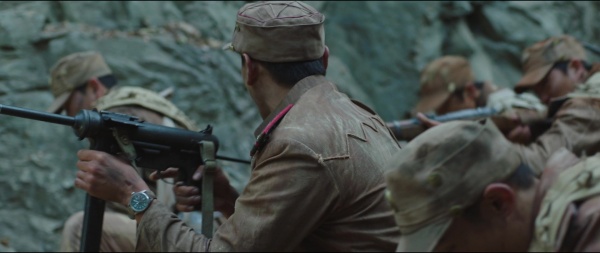
For some of the movie the South Korean (ROK) soldiers wear captured North Korean uniforms.
They do not use camouflage materials, but the means by which they can be attached are clearly seen in some shots. In these examples the “stitching” appears to be relatively substantial cord.
A side view of foliage attached to a machine-gunner’s back.
Some North Korean troops also have foliage attached to their upper arms, although the means of doing this is not clear in the film. Presumably loops might also be sew to the sleeves.
Many of the North Korean soldiers are also wearing short capes of what appears to be camouflage net.
In the movie this was not clear and appeared as an irregular shape of mossy green-grey on the upper chest. In the stills this is much more clearly seen to be net.
The Russian-style shoulder-boards worn with the North Korean uniforms appear fairly impractical. Men-at-Arms 174 notes that these shoulder-boards tended to fade less than the rest of the uniform, making them stand out as regular shapes and thus detrimental to camouflage.
Also note that none of the actors have camouflaged their helmets, leaving a distinctive, recognizable shape.
As I have pointed out in recent posts, shape disruption and texture contribute far more to camouflage than colour.
Notable in this movie is that the North Korean uniforms work far better in the terrain shown than the green American fatigues worn by some characters.
The Osprey publication states that the North Korean summer field uniforms was “olive khaki shade faded rapidly to a light yellowish hue”. Actual appearance varies in the photos since the soldiers of both sides get realistically dirty.
Minor spoiler follows:
In one scene the first sergeant stamps on a mine several times and chides the student soldiers, telling them it is an anti-tank mine and ten of them could run across it without setting it off.
This is not strictly true.
The mine shown is an American M15 that is claimed to need a force 159 to 340 kg (350 to 750 lb) on pressure plate to set it off.
“Taming the Landmine” (p.51) by Peter Stiff describes how repeated passages over an anti-tank mine would “settle” the trigger mechanism of some models until they became sensitive enough to be set off by a pedestrian, donkey cart or bicycle tire.
As an aside, in “Vietnam War Booby Traps”(Elite 236) by Gordon L. Rottman, p.25 the author notes he has been unable to find any real world mine that activates when someone removes their foot, as usually shown in movies.
Categories
Phillosoph

In Praise of Shemagh and Keffiyeh

Previously, I wrote about the fallacy that most face masks would protect you from infection. Inevitably, most of humanity has ignored the facts and taken comfort in superstition. Somewhere along the way members of our kleptocracies have realized just how much money can be made selling ineffective protective measures to the gullible.
Wearing face covering has become a requirement on public transport and in certain buildings. The stated purpose is to prevent carriers infecting other people, which admittedly has some merit. My objection here is in the lack of enforcement. As a microbiologist and a scientist I believe any safety equipment should be used properly. Masks serve no purpose if they do not cover the nostrils or are worn on your chin! I also, unreasonably, believe that laws and rules should apply to everyone. Being overweight and being unable to stop stuffiing your face on the bus is not a legitimate reason to go unmasked.
I have taken to wearing a shemagh/ keffiyeh when I travel on public transport. Looking like a pissed-off Palestinian shows my contempt for the farcical handling of the situation. Does it look intimidating? Probably, but I don’t really want people getting close anyway. Perhaps I should carry a rucksac too; I might get the whole carriage to my self!
On a more practical note, I have discovered a new respect for the shemagh. I had been thinking of it as a large banana, (or possibly a tea-towel!). The weave of my shemaghs is very loose, allowing the easy passage of breath or perspiration. On one particularly sunny day I kept my shemagh on when back on the street. It successfully kept the sun off my bald dome, and I was not bothered by perspiration running down into my eyes. It also helped keep my earphones in. Being cotton, dunking the shemagh in water may be a good way to keep cool in hot weather.
I have discussed the need for facial camouflage on other pages. I believe I have also mentioned one of the purposes of the ninja ensemble is to muffle the sound of breathing. The shemagh can meet these needs. In cold weather the shemagh may help prevent your condensed breath revealing your position. Something to experiment once it gets colder.
A brightly coloured shemagh might be used for signalling. One of mine is red and black, although in honesty this a bit dull in colour for signalling or location. Might be good in snow. Most shemaghs are white and have little virtue as camouflage save in snow. Dying them more tactical colours may be possible. Most “tactical” shemaghs are green/ olive drab, but except in jungle this is not as versatile and useful a practical colour as brown. I have one of brown and black, but ideally brown and sand or brown and grey would be most useful.

Tying the Shemagh

You will find a number of videos on how to tie a shemagh on-line. My usual method is to take the short, right end up near my left temple. Take the long end round the front, round the back and tie the ends together. I have been using a reef knot, but may experiment with a simpler overhand (half a reef!). This may be easier to untie when necessary. Tied correctly, the shemagh forms a hood and face-covering that can easily be lowered or raised. Down, it makes a useful neck gaiter. Position the part over your head so it does not expose a large area of forehead.
Another simple tying method can be used if you just need to cover your lower face, such as in the event of a dust storm. Fold your shemagh diagonally and place the widest/ tallest part over your mouth and nose. Take the ends behind your head and bring them around the front and tie them together under your chin. This gives your lower face area an irregular texture that contributes to shape disruption.
You should always have a bandanna or two on your person. A shemagh is a very worthy addition to a coat pocket or rucksac.
I am prone to migraine attacks, and one of the remedies is to breath in carbon dioxide-rich air. Carbon dioxide is a vasodilator so this increased blood flow to the brain. Note that this is not the same as re-breathing from a paper bag. You need to take in fresh oxygen as well as an increased CO2 level. One way to achieve this is to cover your mouth and nose with your hands. This is a little inconvenient, and my fingers get in the way of my glasses. Last night I grabbed my shemagh and knotted it around by lower face. As the migraine attack eased off, I was amused to note that I was wearing the two garments that pretty much summed up my lockdown: a dressing gown and a shemagh.
Categories
Phillosoph

Cleaning Up Blood

My first post on the relocated blog, and in truth, I wish it left me under happier circumstances.
Both the girlfriend and myself are experiencing considerable health problems, compounded with some insidious behavior from several sources.
I will spare you the details, but will note that one of the “lighter” incidences in the last week was a cat giving birth, then rejecting and trying to kill its kittens!
Luckily one of the other cats stepped up and the kittens are now safe and doing well.
The other cat had decided it wanted to give birth while wandering around the house, often trailing a kitten still attached by its umbilical cord. Blood and other secretions were left around the house, which was not conducive to finding new tenants for vacant rooms.
This situation reminded me of a piece of knowledge that is not as widely known as it deserves.
In the past, I have been called upon to clean clotted blood from scientific equipment. Often these clots were within very narrow tubing. Anything that would fit down the tubing had insufficient strength to break up the dried blood.
The movie “Carrie” was on last night, so the fates seem to be telling me it was time I passed this knowledge on.
The solution (literally!) is 0.9% (isotonic) saline.
Nine grams of common table salt/sodium chloride dissolved in a litre of tap water. Or 0.9g in 100mls, 4.5g in 500mls, or any variation of such.
One advantage of using isotonic saline is that it will dissolve clotted blood without causing further lysis of the blood cells, and releasing the pigment.
A friend of mine once got blood on his jeans and asked on facebook how he should remove it.
Luckily for him I responded first and told him about isotonic saline.
There then followed numerous other suggestions, many of them exotic or expensive, several of which that would have marked or destroyed his jeans.
This was a nice example of what is so often bad about social media.
My friend used saline, and his jeans survived.
Categories
Phillosoph

Many Thanks

The last month has been a tough one, financially. My girlfriend has been allowed to reopen her business, but we had to spend a lot of money to meet new regulations arising from the pandemic. Unfortunately, the lockdown means that there is very little custom, so I suspect it will be a long time before we recover the monies spent. All this has left me so short of money I could not visit my lady. 

Therefore I would like to extend a special and heartfelt thank you to the few of you that brought books over the last couple of months. The IRS took a big bite, as usual, but the little I did receive in royalties was certainly significant in keeping me out of the red. Some of you brought the recently updated new edition of “Crash Combat”. The Global edition of “Attack, Avoid, Survive” also took some takers, which is pleasing. I will keep the original edition on sale, but the Global edition has been significantly extended, so I recommend considering this version. I am a little disappointed that “Survival Weapons” has not seen any recent sales. This is an informative and useful book, and I think it should have received a much wider audience than it has. 

As for my fiction stuff, let us just say level of sales has been consistent. A pity, since those who have read “Anatopismo” have enjoyed it and been very positive about it. Certainly not the worst novella that you will ever need. “Hell-Ay: Angel Town” was always going to be a bit of a niche book, but it seems its potential market has yet to discover it. Perhaps I should have pitched it as a travel book or tourist guide! A friend enjoyed the jokes and satire, so not a total loss.
Once again, thank you to those of you who have made purchases or have been kind enough to donate keep the blog running. If you have enjoyed the books or articles, or found them useful, please spread the word.
Categories
Phillosoph

Compact Living Revisited

Recently I read a sci-fi where it was described that a single individual’s living space was 200 square feet (just under 19 square metres). In many parts of our world this would be considered quite luxurious. Nevertheless, this got me thinking about strategies for compact living, once again.
In my previous article, I talked about maximizing natural light. I may not use curtains, but I did nag my landlord into fitting blinds in the living room. This room is south-facing, so sunlight is sometimes a problem on my computer and TV screen. I had asked for Venetian blinds (under orders from the girlfriend). Instead, he fitted roller blinds. These fit the criteria I specified in my previous article. They block the light when needed, yet provide no obstruction to lighting when not used.
An area that was not considered in the previous article was the bathroom. Most bathrooms I have known were close to minimum size already. (I imagine in Texas they probably have bathrooms you need to drive around!). As long as one side of the room is more than a metre and a half, I would like a bathtub. Mainly I shower, but sometimes my kidney or back bother me and a soak is welcome. Recently my washing machine broke down and my tub got used for laundry. A bath with a shower takes up little more room than a stand-alone shower. For smaller spaces, a deep, Japanese-style furo bath (with a shower fitting) might be practical. 

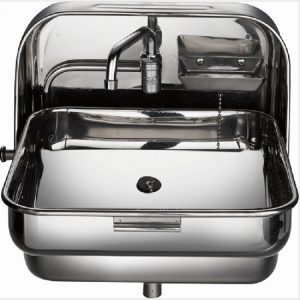
All a bathroom really needs is a sink, toilet and a bath and/or shower. Perhaps enough floorspace to undress or redress. You are unlikely to need all three facilities at the same time, so perhaps a folding sink can make more effective use of available space, folding out either over the bath or over the toilet. Some Japanese toilets feature a basin on the top of toilet tank.
The smallest configuration of bathroom has a toilet and sink, with a shower-head. The whole room serves as a shower cubicle, with a floor-mounted drain.
A mirror on the wall is not only useful, but creates the illusion of greater room and improves lighting. A sliding or outward opening door creates room.
A floor-mounted drain is a useful feature for any design of bathroom. A bathroom should also be well-ventilated too. 

A small kitchen can be more efficient; it saves on unnecessary walking and reaching. Ventilation is an issue for small kitchens, however. Rather than a separate, enclosed room it may be better to have an open kitchen area, perhaps with a breakfast bar that can also be used for food and cookware storage. A sliding partition may be used to isolate the kitchen area if necessary. Space-saving features for a kitchen include a sink and stovetop that can be covered by a working surface. Due to the noise, an open kitchen is not a good location for a washing machine. If there is room, this may be better located in the bathroom.

Most places that I have lived have seemed short on storage space, no matter what their size. If you have a small room, rather than thinking of it as a small bedroom or spare room you may be better treating it as a large closet. Chances are you were using it for storage already. Go the full-hog and fit it with shelves, clothes rails, stackable boxes, ceiling hooks for bags and so on. Remove or sell furniture and items in this room that do not contribute to storage space.
This leaves the living area, which may double as the sleeping area. Some options for this were discussed in the previous article. A sofa bed is probably the most space-efficient option. A sofa that provides storage space for a Japanese futon and bedding is another option. A murphy-bed is a possibility, but occupies a large area of wall space that cannot then be used for many other purposes. I have a soft spot for cot beds, which seem to me somewhat more hygenic than traditional mattresses. A cot bed is light enough to be stood on end against a wall or side of a wardrobe when not in use. If beds are packed away during the day, storage space will be needed for bedding.

For a single person’s dwelling, a sofa meets most seating needs. If long enough, it can serve as your bed, even if not a sofa-bed. If extra/ alternate seating is needed, folding chairs are worth considering. Storage boxes, with cushions, can also serve as seats. Cushions should be removable so that boxes can be used as steps to reach high storage areas. Obviously such boxes should be capable of taking your weight. A lightweight step-ladder is a good investment if you utilize the tops of shelving units and cupboards for storage. A folding table maybe useful if you need a desk or want to host a dinner party. Space under non-folding tables can be used for storage boxes.
Fitting shelves with doors gives you space to display paintings and photos without reducing storage space.
Categories
Phillosoph

A Walk to the Park: Lessons Learned

The other day I went for a walk. As it turned out, I was overly ambitious. Due to lockdown and other issues, I have not got out of the house much recently, and this has had more of a toll than I anticipated. After about the fourth or fifth mile my feet were aching, and worse, my hip joins were giving me considerable trouble. I was not able to walk properly for several days after.
One of my excuses for making this trip was I wanted to test a pair of shoes for this blog. About halfway into the walk I realized this was not practical. I have flat feet and torn tendons. In other words, my feet are atypical and whatever I experience, good or bad, is not relevant to most readers.
However, the day did yield a few lessons and observations that I thought I would pass on.
One thing I discovered is that I have lost some weight over the past few months. Normally this would be a good thing, but it meant my trousers were loose on me even with the belt drawn to the last notch. The shoes I was using also had less heel than my usual boots, which meant my trouser bottoms were catching and dragging on the ground. Rolled up, they would not stay up! I resorted to the safety pins in my EDC. I only had two, so this was only partially successful. Conclusion: add more safety pins to the EDC kit. At least half a dozen.
I could have used the two long cords in my pocket to improvise braces for my trousers. I was nearly at my destination by the time this occurred to me.
I was running late that morning, and was keen to get out. Thus, I forgot some things that might have been useful. I only realized that I had forgotten my iPod when I heard some idiot sqwarking down their phone. More importantly, perhaps, I should have added some boiled sweets to my bag. I had planned to buy something for breakfast along the way, but with lockdown there were fewer places open and I didn’t seem to get a chance. Keep a stock of sweets for travelling at “base camp”, and don’t eat them all watching the telly!
The second lesson from this is “make a list”! Do not just have a packing list for when the balloon goes up or the zombies arrive, but one for more mundane expeditions too.
If, like me, you have several rucksacs and daysacs, a practical idea is to have a box with your “rucksac things” in. When you get home, empty your rucksac paraphernalia into the box. When you head out, select items from the box and load them into whatever pack you have decided to use. And have a list! Not everything you might want will be in the box; at least one of my water-bottles lives in the fridge. Similarly, you pick and choose from the contents of the list. Warm hat and gloves may be low priority in summer, for example.
What I did remember to add to my pack was a bottle of water, my boonie hat and a rain-poncho. The hat was for if it was really sunny; it wasn’t. The poncho, on the other hand, got used several times. This was my first time trying this particular one out and it came through very well. It is very light (240 g, in stuffsack) and was quick to unpack and put on. I also like that it covers my daysac as well as myself. Another feature that endears it to me is the stuffsack is so sized that it does not take a mastership of origami to get the poncho back in.

Multi-role solid-state communication and repair system.
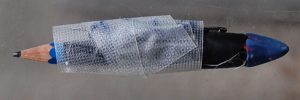
Incidentally, I have made another modification to my EDC kit. Originally it did not contain a sewing kit. My travel sewing kit has seen a lot of use over the years, so I decided some sewing capability should be in the EDC. The weight of a single needle and thread is negligible, yet potentially very useful. In fact I have added two. One is a standard needle with about a metre of doubled invisible thread already attached. The other is a larger needle with just over half a metre of doubled stouter thread. I would have used dental floss for this normally, but had some kevlar cord from Shomer-tech that I wanted to try out. Both needles have been threaded beforehand and are carried taped to the side of my pencil. I gave them a few score strokes of a magnet so they may also serve as a navigation aid.
Categories
Phillosoph

The Worlds of James Schmitz

Version 1.1
Science fiction is an important genre. Not only can it speculate on what might be, but often it holds a mirror up to what is.
Being imaginative people, I suspect many of my readers enjoy a good sci-fi.
Various names will spring to mind, but one that many of you may not think of is James Schmitz. That is a shame, since he is well worth a read. I have enjoyed his stories.
His most well-known works are set in a community of planets called the Hub Worlds. The Hub Worlds grew from a long period of strife called “the War Centuries”.
While Schmitz never states it directly, it is probable the Earth was one of the worlds lost during the conflict. A couple of stories mention characters from Earth, but this thread seems to have been dropped.
The structure of the Hub Worlds is not described in great depth.
One gets the impression that planets or regions are allowed to administer themselves, provided certain statutes and laws are observed.
An establishment called the “Overgovernment” exists, and presumably has jurisdiction over interstellar matters, such as exploration, colonization and peacekeeping.
The Overgovernment seems to be concerned with strategy for the Hub Worlds and the humans within it.
One instrument of the Overgovernment that features in many stories is the “Psychology Service”.
The title itself is misdirection, since one of the Psychology Service’s primary concerns is the regulation and control of human psis.
Psi-powers have an unusual status in the Hub Worlds.
Machines that use psionic abilities are well-known, being used in the judicial process or for spaceport security.
It also seems to be accepted that certain animals and aliens have psi-powers. Devices such as mind shields are worn by some.
Officially, human psi-powers do not exist, however. One of the functions of the Psychology Service is to ensure that humans who do have psi-powers do not abuse them nor their fellow citizens.
Refreshingly, Schmitz does not make the Psychology Service the usual two-dimensional Gestapo-witchhunters.
Often, we see the Psychology Service using prudent and subtle measures.
As noted in the essay “The Psychology Service: Immune System of the Hub” by Guy Gordon:
“The Psychology Service is not out to protect society by eliminating psis. Quite the contrary. They will protect the Federation by immunization. To eliminate psis would leave the Federation defenseless against external threats (such as the Elaigar), and internal threats such as undetected psis…instead controlling a serious problem as nondestructively as possible. More than that, they are trying to turn this serious problem into a strength…also pushing the use of psionic machines in the Federation. People with no psi talent of their own will be empowered to deal with psis. Mind shields are available for defense, and powerful mind-reading machines, such as the ones at the Orado City Space Terminal or Transcluster Finance, will provide the advantages of psi to ordinary people.”
Gordon also notes:
“This attitude pervades the top level of the Federation Overgovernment. They treat the human species as an evolving animal and the Federation as an ecology. They aren’t out to create perfection. If survival is a good enough goal for nature, it’s good enough for the Federation and the Psychology Service.”

Unlike some authors, Schmitz does not delve deeply into the nuts and bolts of his scenarios. Many of the themes introduced are thought-provoking, however. 

An interesting discussion of the Overgovernment occurs in the story “The Demon Breed:

The nearest thing to a war the Hub’s known for a long time is when some sub-government decides it’s big enough for autonomy and tries to take on the Federation. And they’re always squelched so- quickly you can hardly call it a fight.”
“So they are,” Ticos agreed. “What do you think of the Federation’s Overgovernment?”

She hesitated. One of the least desirable after effects of a nerve gun charge that failed to kill could be gradually developing mental incoherence. If it wasn’t given prompt attention, it could result in permanent derangement. She suspected Ticos might be now on the verge of rambling. If so, she’d better keep him talking about realities of one kind or another until he was worked safely past that point. She said, “That’s a rather general question, isn’t it? I’d say I simply don’t think about the Overgovernment much.”

“Why not?”

“Well, why should I? It doesn’t bother me and it seems able to do its job—as witness those squelched rebellious subgovernments.”

“It maintains the structure of the Federation,” Ticos said, “because we learned finally that such a structure was absolutely necessary. Tampering with it isn’t tolerated. Even the suggestion of civil war above the planetary level isn’t tolerated. The Overgovernment admittedly does that kind of thing well. But otherwise you do hear a great many complaints. A recurrent one is that it doesn’t do nearly enough to control the criminal elements of the population.”

Nile shook her head. “I don’t agree! I’ve worked with the Federation’s anticrime agencies here. They’re efficient enough. Of course they can’t handle everything. But I don’t think the Overgovernment could accomplish much more along those lines without developing an oppressive bureaucratic structure—which I certainly wouldn’t want.”

“You feel crime control should be left up to the local citizenry?”

“Of course it should, when it’s a local problem. Criminals aren’t basically different from other problems we have around. We can deal with them. We do it regularly.”

Ticos grunted. “Now that,” he remarked, “is an attitude almost no Palach would be able to understand! And it seems typical of our present civilization.” He paused. “You’ll recall I used to wonder why the Federation takes so little obvious interest in longevity programs, eugenics projects and the like.

She gave him a quick glance. Not rambling, after all? “You see a connection?”

“A definite one. When it comes to criminals, the Overgovernment doesn’t actually encourage them. But it maintains a situation in which the private citizen is invited to handle the problems they create. The evident result is that criminality remains a constant threat but is kept within tolerable limits. Which is merely a small part of the overall picture. Our society fosters aggressive competitiveness on almost all levels of activity; and the Overgovernment rarely seems too concerned about the absolute legality of methods used in competition. The limits imposed usually are imposed by agreements among citizen organizations, which also enforce them.”

“You feel all this is a kind of substitute for warfare?”

“It’s really more than a substitute,” Ticos said. “A society under serious war stresses tends to grow rigidly controlled and the scope of the average individual is correspondingly reduced. In the kind of balanced anarchy in which we live now, the individual’s scope is almost as wide as he wants to make it or his peers will tolerate. For the large class of nonaggressive citizens who’d prefer simply to be allowed to go about their business and keep out of trouble, that’s a non-optimum situation. They’re presented with many unpleasant problems they don’t want, are endangered and occasionally harassed or destroyed by human predators. But in the long run the problems never really seem to get out of hand. Because we also have highly aggressive antipredators. Typically, they don’t prey on the harmless citizen. But their hackles go up when they meet their mirror image, the predator—from whom they can be distinguished mainly by their goals. When there are no official restraints on them, they appear to be as a class more than a match for the predators. As you say, you handle your criminals here on Nandy-Cline. Wherever the citizenry is making a real effort, they seem to be similarly handled. On the whole our civilization flourishes.” He added, “There are shadings and variations to all this, of course.

The harmless citizen, the predator and the anti-predator are ideal concepts. But the pattern exists and is being maintained.”

“So what’s the point?” Nile asked. “If it’s maintained deliberately, it seems rather cruel.”

“It has abominably cruel aspects, as a matter of fact. However, as a species,” said Ticos, “man evolved as a very tough, alert and adaptable creature, well qualified to look out for what he considered his interests. The War Centuries honed those qualities. They’re being even more effectively honed today. I think it’s done deliberately. The Overgovernment evidently isn’t interested in establishing a paradisiacal environment for the harmless citizen. Its interest is in the overall quality of the species. And man as a species remains an eminently dangerous creature. The Overgovernment restricts it no more than necessity indicates. So it doesn’t support the search for immortality—immortality would change the creature. In what way, no one can really say. Eugenics should change it, so eugenics projects aren’t really favored, though they aren’t interfered with. I think the Over-government prefers the species to continue to evolve in its own way. On the record, it’s done well. They don’t want to risk eliminating genetic possibilities which may be required eventually to keep it from encountering some competitive species as an inferior.”

This is complemented by a passage in “Glory Day”:
In certain confidential Overgovernment files, Askanam was listed among the Hub's experimental worlds. Officially, it was a world which retained a number of unusual privileges in return for acknowledging the Federation's basic authority and accepting a few balancing restrictions. Most of its surface was taken up by the balaks of the ruling Askabs, ranging in size from something not much larger than a township to great states with teeming populations. It was a colorful world of pomp and splendor, romance, violence, superstition and individualism. The traditionally warlike activities of the Askabs were limited by Federation regulations, which kept Askanam pretty much as it was though individual balaks not infrequently changed hands. Otherwise Federation law didn't extend to the balaks. Hub citizens applying for entry were advised that they were going into areas where they would receive no Federation protection.
Telzey was aware that the arrangement served several purposes for the Overgovernment. Askanam was populated largely by people who liked that kind of life, since nothing prevented them from leaving. They were attracted to it, in fact, from all over the Hub. Since they were a kind of people whose romantic notions could cause problems otherwise, the Overgovernment was glad to see them there. Askanam was one of its laboratories, and its population's ways were more closely studied than they knew.
For individuals, of course, that romantic setup could turn into a dangerous trap.
The societal template that Schmitz seems to be suggesting the Federation has is interesting when viewed alongside the problems for utopian societies that Appleseed raises.
A friend suggested that sport might serve as surrogate warfare, but historically this has proved partially effective at best, and has often provided opportunities for crime.
Major warfare is obviously undesirable, yet utopia is likely unattainable, and possibly undesirable.
Does human nature mean the “simmering pot” is the best we can realistically hope for?
Is criminal and anti-social behavior the price of personal freedom?
In the introduction to “Crash Combat” I noted that most modern conflicts tend to be varieties of low-intensity warfare, local vendettas, guerrilla uprisings, terrorism, sabotage and civil disturbance.
This may be the normal condition of humanity!
Whatever way you interpret this, some individuals will potentially suffer, and those may be your loved ones or yourself. Prudence suggest preparation!