Disclaimer: “As an Amazon Associate I may earn from qualifying purchases.” Adsense and Infolinks were no help at all.

If you have enjoyed this article or it has been helpful to you please feel free to show your appreciation. Thank you.

Read The Third Wave by Alvin Toffler!
Categories
Phillosoph

Guns for Commandos

Following my recent look at covert and James Bond firearms, I thought a look at armament for more “overt” special operations might be instructive.
In addition to special forces, this includes the reconnaissance sections of more conventional units and hostage rescue units such as SWAT.
If our TV screens are to be believed, special forces always favour unsuppressed MP5s, which will seldom be fired in bursts of less than ten rounds. Some MP5s used as props have probably logged more screen time than Richard Jaeckel!
There is no single “best” weapons for such operations so I will limit this post to the subject of suppressed weapons.
There are a number of reasons why suppressed weapons might be used.
The obvious one is to avoid unwelcome attention. As well as the military advantages of this property, it is also welcome for applications such as pest control.
In confined spaces, gunfire can be deafening and disorientating, which is a reason to favour suppressed weapons for overt CQB operations such as SWAT assaults.
Suppressors also protect the hearing of shooters (and that of their dogs) so can be beneficial in situations where more conventional hearing protection is impractical.
I recently read a statement that some suppressors make shooting in volatile atmospheres such as drug labs less hazardous.
Below is a British weapon known as a “De Lisle Carbine”.
These were built from a number of existing constructions. The action is from an SMLE, the magazine from a Colt 1911, the barrel from a Thompson SMG and the sights from a Lancaster machine carbine. The stock of the folding variant looks like that of a Patchett/Sterling, a weapon being developed in the same factory at the same time.
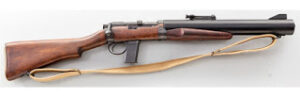
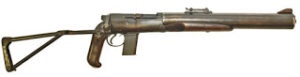
Allegedly, the loudest noise when firing the De Lisle was the striker hitting the cap!
The bolt handle included a rubber pad on the underside to muffle the metallic click of operation.
Operating the bolt was the loudest part of operating the De Lisle, but being a manual action the user could at least choose to do this when they thought it most expedient.
Unlike many of its contemporaries, the De Lisle uses the .45 ACP round and is effective to three or four hundred yards.
The De Lisle was used in the latter half of World War Two and the Malaya Emergency. It may have been used in Korea, Northern Ireland and later conflicts.
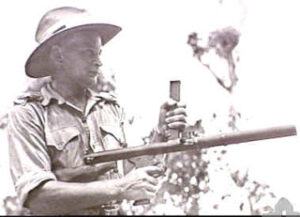
The De Lisle was an excellent weapon for dispatching sentries at relatively long ranges.
It was not so useful if you needed to quickly neutralize a guardroom full of enemies.
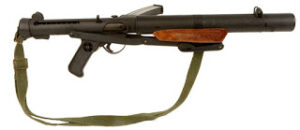
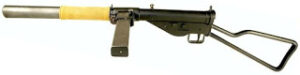
For such missions there was the silenced models of the Owen, Sten mk II and mk VI, and later the silenced Sterling L34.
These selective fire weapons all use the 9mm Luger round. which is supersonic in its standard loading.
There are two approaches to this problem, neither really ideal.
The first is to port the gun barrel and bleed off propellant from behind the round, reducing the velocity of standard ammunition. This requires a bulkier and more complex suppressor to deal with the bled off gases.
The other approach is to issue special subsonic loadings of ammunition, such as the 139gr Nahpatrone ‘08S or the MEN 155gr in 9x19mm.
Small quantities of specialist items have a tendency to get lost in the supply system or not reach where they are needed.
For suppressed applications, the .45 ACP has a number of advantages.
It is subsonic in its standard loadings and is widely available.
The bullet is also heavier than that of most subsonic alternatives. If you fire two bullets of similar design at the same velocity, it is the heavier that will usually travel furthest and hit harder.
The formative years of the SMG were centred on Germany, so designs not in 9mm are rare.
Suppressed .45 weapons are even rarer, but not unknown.
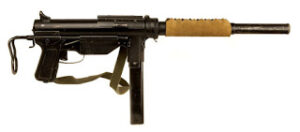
One design that has seen some use is the suppressed M3 and M3A1 “Grease Gun”.
Below is the wartime version. The OSS Weapons and Equipment Catalogue (p.41) comments that the bolt movement is still noisy but at least the operator is no longer deafened by the clatter of the piece.
The weight of the suppressor also counters muzzle climb.
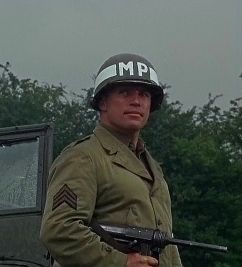
In US hands, the suppressed M3/ M3A1 served at least until Vietnam.
In the hands of other nations these weapons served even longer.
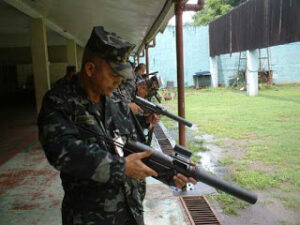
Below are a number of M3s used by Philippine troops. Some appear to have new designs of suppressor and modernized sighting systems. Wisely, the operators have camouflaged their weapons.
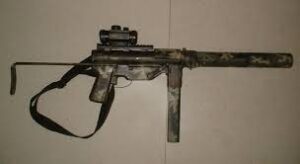
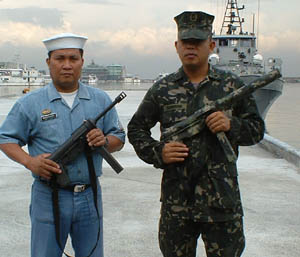
There are two objectionable features of the M3 as a commando weapon.
One is that it fires from an open bolt.
The second is that it can only be fired fully automatic.
Neither of these features lends itself to medium range precision fire such as eliminating sentries or cameras.
Many years back, I proposed that a .45 version of the suppressed Sterling would be a very useful weapon.
The configuration of the Sterling allows a prone shooter in an OP to stay really low and hidden.
Police variants of the Sterling are designed to be fired from a closed bolt. Potentially the bolt could be locked in the forward position, functioning like a slide lock on a suppressed pistol.
Noted as a very reliable design, Sterlings sold worldwide with 400,000 being produced. Its production and distribution might actually exceed that of the MP5, but Hollywood seldom shows them!
Sadly the production lines for the Sterling has long since been scrapped.
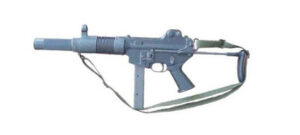
Another user of the M3 was the South Korean special forces.
When replacements became necessary, someone had the smart idea of adapting the Daewoo assault rifle into a suppressed SMG.
I think they would have been wiser to have made it .45 rather than 9mm, but they were on the right lines.
Several designs of assault rifle such as the AUG and Tavor can be modified into 9mm weapons. There are also other SMG designs that use components of assault rifles, such as the Chilean SAF and the Colt 9mm.
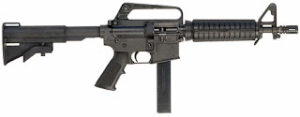
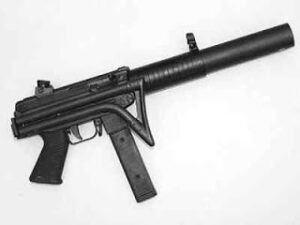
Basing a suppressed SMG on an assault rifle has a number of advantages.
Troops need little additional training and supply and maintenance are simplified.
Assault rifles generally use closed bolt operation. This can be retained even if the design switches from gas to blowback operation.
Many assault rifle designs have non-reciprocating bolt handles which may decrease the mechanical noise of firing.
It might be prudent to take a leaf from the PB pistol’s book and construct the suppressor in two parts: a rear section to deal with bled gas and a detachable forward section to handle muzzle blast.
The detachable section will make transporting the weapon more convenient and allow the firer to make noise when attention is desirable for signalling or distraction.
The envisioned weapon would have both close range assault application and a medium precision role, so might more accurately be termed a carbine.
There are some newer subsonic rounds such as the .30 Whisper, .30 Blackout and 9x39mm but I think the .45 still has much to recommend it.
Possibly .45 magazines could be compatible with handguns.
Some years ago I wrote an article on a “magsub” using the .45 win mag for an unconventional warfare weapon.
This is still an attractive idea but would mainly be useful if the round can use heavier subsonic bullets than the .45 ACP.
Compatibility with handguns would also need to be investigated.
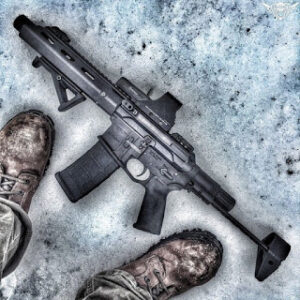
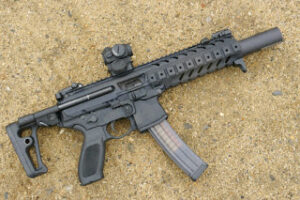
Below are rather nice images that give an idea what a suppressed .45 AR-15-based weapon might look like. Magazine would be different, of course.
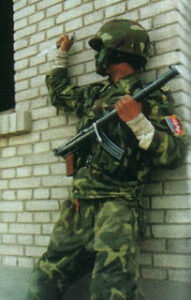
Below is a Chinese soldier armed with the Type 64 suppressed SMG.
The standard Chinese SMG and pistol load is the 7.62x25mm Tokarev, an 85 gr bullet noted for its high (1,650 fps+) velocity. The Type 64 uses a subsonic load using a bullet of between 187-202 gr.
One wonders if these are rifle bullets and how bullets of that mass can fit in the cartridge case.
Allegedly the Type 64 can use standard pistol ammunition but I wonder if any modifications are necessary or loss of performance results.
Categories
Phillosoph

Guns for James Bond : Keep it Quiet!

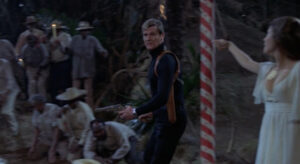
A friend of mine is a major Bond fan, so rather enjoyed the Bond hook I put in the last blog. I thought it might be interesting to look a bit closer at the firearms of Commander Bond.

I’m not going to make an in depth study here, since there are many webpages that have done this already. This one is particularly worth a read.

Bond has been armed with some oddities over the years. In the early books his primary weapon was a .25 Beretta, most likely an M418. About the best thing you can say about this pistol is that it was most certainly concealable. A .25 ACP (6.35mm) is a bit like a knitting needle. It is lethal if you can put it in the right place, but only a “darn” fool would choose it as his main defence. Incidentally my book “Attack, Avoid, Survive” has some advice on getting the most out of “mouse guns” such as the .25.
 
One reader who objected to Bond’s use of such a puny weapon was Geoffrey Boothroyd. If the name seems familiar it is because Fleming named a character after him and the character of this name appears in some of the books and movies. Boothroyd suggested that Bond be armed with the Smith & Wesson Centennial Airweight, supplemented by a .357 magnum for longer range situations.
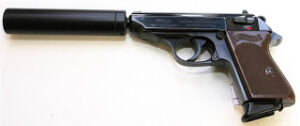
In Dr. No Fleming equips Bond with a Walther PPK and a Centennial for longer ranges. In Fleming’s defence, an automatic is more logical for an agent who might need to use a suppressor. Some reviewers have noted that Fleming seems to have had a fondness for two-part names such as “Aston Martin” and “Vodka Martini”, so “Walther PPK” may have appealed to him. The claim that the 7.65mm/ .32 ACP gun has “a delivery like a brick through a plate-glass window” is, of course nonsense. The main merit of the .32 is that it is better than a .22 and .25.
 
The most likely explanation for the Centennial as a long-range gun is that Fleming did not understand what Boothroyd was suggesting. The Centennial seems to have been quietly dropped from later books, probably because Fleming was embarrassed by such a foolish mistake.
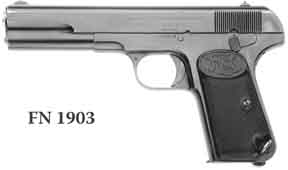
When John Gardner took over writing the Bond novels he inflicted a variety of personal firearms on Bond. The most bizarre was a Browning M1903 automatic chambered for 9mm Long cartridges. It’s an elegant looking weapon but offers not advantages over more modern weapons. Ammunition would be very hard to find, and when found would be of questionable age and reliability. In later books Gardner’s Bond uses a H&K VP-70, a P7/ PSP and an ASP, a customized Smith & Wesson M39 automatic. In one of the films Bond switches to a Walther P99. The particular movie is notable for some very unsubtle product placement, BTW.
 
My friend voiced the opinion that Bond needed a new, compact 9x19mm weapon, and I had to disagree.
If we accept that Bond is theoretically more about stealth than assault then the Walther PPK remains a good choice, although he’d be advised to use a .380 ACP/ 9x17mm version. It’s a compact, double action weapon and the round is subsonic, making it more compatible than a 9x19mm for suppressed shooting. Bond finally gets a PPK/S in .380 in Skyfall.
 
A more logical choice, however, might be for Bond to acquire a 9x18mm Makarov. The Makarov PM is very similar to the Walther PPK/ PP. The round was designed to be the heaviest load that could be accommodated by a simple blowback design. In short-barrelled pistols it is usually subsonic. The weapon, and its ammunition will often be encountered in the hands of likely enemies, many of which may be armed with vintage Soviet or Chinese armaments. Notable is that Bond never selects an identifiably British handgun. Having a weapon with Chinese, Bulgarian or Czech markings may promote disinformation.
 
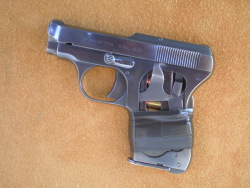
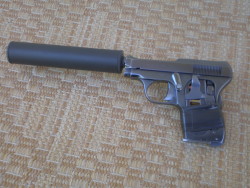
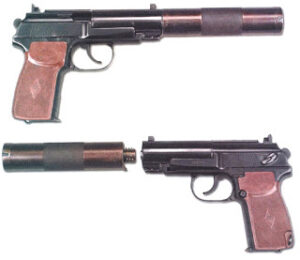
There are a couple of alternatives to the Makarov pistol that use the 9x18mm. The Stechkin is probably too big. The Hungarian PA-63 is apparently a little more compact than the PM but cannot use PM magazines. The Czech Vz 82/ Cz 83 is a 9x18mm with a 12-round magazine, but if a bulkier weapon is warranted Bond may be better off with one of the compact .45s now available. The Makarov seems like the best choice. Perhaps Bond might even acquire the PB suppressed variant. At low temperatures the 9x18mm round may become transonic. The PB has a ported barrel to bleed some of the gases off and reduce muzzle velocity even further. The gases are bled off into a suppressor chamber that surrounds the barrel. A second suppressor that captures any muzzle blast can be attached to the muzzle.
 
(The real) Boothroyd’s idea of a second gun for longer-ranged and more combat-orientated situations does have some merit. In some of the books Bond keeps a Colt .45 in his car. Fleming gets the name wrong, but the article here deduces that this is most likely an M1911A1 Government model. A .45 auto is a good choice, since the round is still suited to subsonic shooting. The modern Bond has a wide choice of high-capacity .45s to choose from. The HK .45 Compact Tactical must be in the running, and would honour Flemming’s preference for two-part names. In some of Gardner’s books Bond keeps a Ruger Super Blackhawk .44 Magnum in his car. “Live and Let Die” is one of the few movie instances where Bond chooses to upgrade his armament before the mission. Here he carried a Smith & Wesson Model 29 .44 Magnum but uses most of his ammunition shooting the statue of Baron Samedi! 
Categories
Phillosoph

Firearms for Covert Missions

Regular readers will know that Friday blogs tend to be a little more off-topic than usual.
They will also know that I play the occasional video game and that sometimes these inspire eccentric trains of thought.
Recently, I was playing a scenario where I had to infiltrate disguised as a civilian. The game let you arm yourself with any of the weapons you had unlocked, however. The game makes you use full-automatic fire when the weapon has the capability, so my “covert” weapon was a Mk48 GPMG!
This got me thinking about what would actually be practical in the real world.

Usually this comes down to two choices, neither of them ideal.

One option is a compact submachine gun.
A problem with these is that while there are a number of models with small dimensions even these can be surprisingly massive. Very few of them are less than six pounds.
The main exception that springs to mind is the Czechoslovakian Škorpion, but this is somewhat underpowered.
A few of the more recent designs like the Steyr TMP/Brügger & Thomet MP9 are under six pounds.
Machine pistols have other undesirable features.
Most fire from an open bolt and the movement of a relatively massive component does not facilitate accurate fire, even when firing semi-automatically.
Most designs are single action, requiring a safety to be disengaged or the weapon to be cocked before firing.
Not idea for a covert weapon that may be needed at very short notice!

The usual alternative to machine pistols are handguns. The main problem with handguns in this role is accuracy.

A real world attempt at solving these problems was the Soviet APB aka APSB weapon.
I first saw one of these back in the 1980s in a magazine. It had been taken from a German “lorry driver”.
The APB/APSB is a modified Stechkin APS pistol.
The most notable feature is the modifications made for use with a suppressor.
In most weapons, 9x18mm ammunition is subsonic.
The longer barrel of the Stechkin took velocity up to the transonic range.
Cold weather might also lower the speed of sound to levels where any shots might break the sound barrier.
To prevent this the APB had a port drilled in the barrel and bled-off gases were diverted forward into the suppressor.
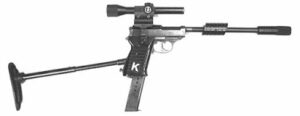
Like the APS, the APB can be fitted with a shoulder stock. This increases the accuracy of the pistol and is probably the main reason the APS was chosen as the basis of a covert weapon system. The stock also improves control when the APB or APS is used for fully automatic fire.

I suspect, however, that the main intention of the APB was to provide an agent with a compact means of accurate, suppressed fire.

The APB was an good answer to the problem of covert/clandestine armament.
The TV show “Man from UNCLE” seem to have reached a similar conclusion, although their “Specials” often mounted an extended barrel rather than or as well as a suppressor.
Vietnam-era SEAL “Hush Puppy”(above). US Army was using subsonic .45 ammunition as its standard pistol round.
North Vietnam was using subsonic 9x18mm Makarov ammunition.
Hush Puppy was based on a weapon that used supersonic 9x19mm Luger ammunition so needed special subsonic loadings…!?
If we update this concept, the first decision is a suitable weapon, or more specifically a suitable calibre.
On another blog, I explain that the only logical choice for a military pistol calibre is the .45 ACP. It is a proven effective combat round and it is subsonic, facilitating use with suppressed weapons.
All other likely choices are either underpowered or supersonic.
Back in the late 80s and early 90s, the US Special Forces began shopping for an “Offensive Handgun Weapon System” (OHWS).
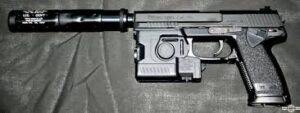
The weapon selected became the Mk23.
Logically enough, it was a .45 ACP.
The barrel of this weapon was a shade under 6" long. The motivation for that feature may have been to surpass the Colt Govt model that this weapon would inevitably be compared with.
A friend of mine got to try out some of the early Mk23s on a shooting range.
The extra barrel length caused many of the standard .45 loads he was trying to go supersonic.
This drew considerable attention from other shooters.
It was not, however, an ideal feature for a weapon that was intended to be used with a suppressor!
Any pistol used for a “Covert Offensive Weapon System” (COWS (I truly suck at naming things!)) should have a barrel length consistent with keeping bullet velocity subsonic under likely temperature ranges.
A feature of the OHWS worth emulating is its flashlight/Laser Aiming Module.
As an intended primary weapon system, it would be useful for the COWS to have a source of visible and infra-red illumination.
A visible aiming laser can be useful for intimidating an enemy and encouraging them to surrender.
It can also be used to designate points of interest or potential threats.
An IR laser may be the most practical way to aim the weapon when using night vision goggles.
The role of the COWS will be to provide accurate, suppressed semi-automatic fire.
The most obvious difference between systems such as the OHWS and the COWS would be the provision of a shoulder stock to facilitate accurate shooting.
Some readers will be aware that shoulder-stocked Mauser pistols were a very practical alternative to conventional rifles in the early part of the previous century.
An updated design of pistol stock might be telescopic or folding.
Unlike some current commercial offerings, it would attach to the weapon, not the magazine.
To use a pistol stock, the weak hand can be used to support the butt.
This is similar to the way you would fire a bipod-mounted rifle or machine gun.
A variation is to place the weak-side arm under the stock and place the weak-hand on the strong-arm forearm or biceps.
UNCLE wisely provided their agents with a small optic scope.
Accuracy is often improved by a better sight picture.
A reflex sight would improve the effective accuracy of the weapon system.

A foregrip for the COWS may also improve effective accuracy.
An interesting option is to use a spare magazine as a grip.
A dedicated design of grip offers a good location to mount the flashlight and laser systems. It may still be possible to use the forward pistol grip to store a spare magazine.
A foregrip that mounts under the barrel could also be used as the mounting point for a telescopic or folding stock. Mounting such a grip would immediately convert a pistol into a COWS.
COWS is essentially a collection of accessories.
A suppressor, a reflex sight and a foregrip/stock.
This means it can be used with existing weapons rather than having to go through the prolonged process that often accompanies the adoption of a new weapon.
So far, I’ve not seen a flashlight/laser/foregrip that also mounts the stock.
If you saw the movie “John Wick” or the Bond film “Spectre”, you may have noticed the KPOS carbine conversion for Glock pistols.
Not quite as elegant as the one-piece COWS grip I suggest, but along the right lines.

The Belgium VBR-B PDW would serve as a COWS if it was available in .45 ACP calibre.

Categories
Phillosoph

Assumed Guilt, Assumed Blame and Assumed Persecution

"None of us took this city from Muslims. No Muslim of the great army now coming against us was alive when it was lost. We fight over an offense we did not give, against those who were not alive to be offended."
 
This is a subject I have been meaning to write about for some time. In fact it concerns a revelation I had several decades ago. It concerns a fallacy that most of the world’s population holds to be true. One that is responsible for much of the misery and strife in the world.
Let me begin with a silly illustration. Suppose an Italian flies into London from Rome. Once in the city he announces:
“You see those straight roads? It’s me you should thank for those. Like the alphabet? Yup, me again”.
Or perhaps an Englishman flies to India:
“You like those clocktowers in the town squares? Us to thank for those. Enjoying the cricket? You are welcome!”
This is obviously stupid. Someone taking credit for something that was done generations ago. Something that would have been done long before they were born. There is a good chance that no one directly related to him was involved whatever.
This is evidently preposterous. Why then, does most of humanity hold a view that the opposite is true. Why do we maintain that someone shares the guilt for acts done generations before? Acts that may not even have been made by their ancestors. Acts that are simply accredited to the national, ethnic or religious group they are identified with.
Talk to most young Germans and they have an admirable abhorrence of the crimes of Nazism. But they have also assumed responsibility, which is a quite different thing. You are not responsible for something that happened before you were born. You are not responsible for something that if you had been around you would have had no control over anyway. This does not mean that we ignore that such things might have been wrong or even downright evil. If the human race is ever to progress it must stop blaming innocent people for the crimes of others.
For all I know my great-grandfather may have spent his Sundays running through orphanages with an axe and a flamethrower. I never met the man. If I had I would have probably had no influence over him. His guilt is not mine. Nor is that of my grandfather nor father. Nor is that of the millions of people who just happen to be of the same nationality as me. I have very little influence over the actions of my nation's politicians. Many of the choices they have made I am against. You might just like to ask what I thought before you automatically tar me with the same brush.

Many decades back an intelligent but often confused friend told me that I should feel guilty because I am White. I was in Tennessee at the time, but this still baffled me. “Being White gives you privileges and you should feel guilty about that.”
No, that is bollocks! Firstly I dispute that being White does give you privileges anymore. Tell that to my girlfriend who cannot get the money she is legitimately entitled to from the DSS because the staff at the local branch are only helping their friends and families. Secondly, I’ve never owned slaves nor dealt in them. If any of my ancestors ever were involved in the slave trade they were probably the poor sod with the mop and bucket who had the worst job on the ship! Thirdly, I have never, to my knowledge, ever met a slave. Yes, I have met people whose ancestors may have been slaves. Or whose ancestors may have been slavers, for that matter. Often glossed over is that many African tribes happily sold their enemies and prisoners into slavery. But no one I have met actually had this happen to them. That such a thing did happen to an ancestor is terrible. But it did not happen to them. Here we have the third corner of a toxic triangle. With “Assumed Guilt” and “Assumed Blame” we have “Assumed Persecution”.
Terrible things have been done in the past and we should not forget these, lest we fail to learn from them. Your ancestors may have been subject to persecution, genocide, slavery or eviction from their lands. But these things did not happen to you. This does not entitle you to do similar things to someone else. And the people you are blaming and victimizing probably are not personally responsible.
The whole world works on “I hate you because your grandfather might have done something to my grandfather”.
 

Currently in the world millions of people are blaming millions of other people who were not responsible for wrongs that they did not experience. And we use these crimes of previous generations to justify new crimes against the innocent.

 There is a school of thought that the only real right is to be responsible for your actions and choices. If that is the case then perhaps we also have the right not to be held responsible for the actions and choices of others.
Punishing someone for their origin or heritage rather than their own actions is as good a definition of RACISM that you are likely to find.
Categories
Phillosoph

The Soldier's Mantle.

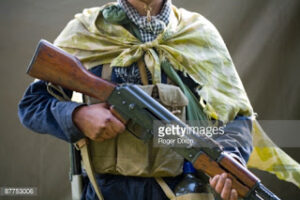
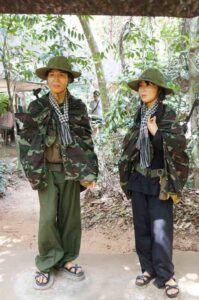
In previous blogs we have seen how useful items such as scarves, keffiyeh and bandanas can be. North Vietnamese soldiers often favoured a neckerchief cut from camouflaged cargo parachute material. This was generally worn inside the jacket but could be spread over the shoulders for additional camouflage. A similar idea is seen below using capes of more conventional camouflage material. Capes and cloaks have often been a topic of these blogs but so far I have not made much discussion of their merits for concealment.

Recent posts should have made it clear that there is a lot more to camouflage than simply colours and pattern. Shape and silhouette are also very important. There is very little point in camouflaging your face and headgear if a distinctive head and neck shape is visible.
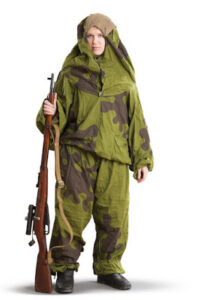
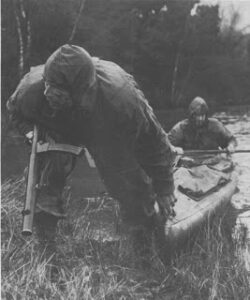
Some camouflage systems recognise this. The Soviet system shown below is obviously designed to conceal the distinctive head and shoulders shape. Modern sniper ghillie suits often address this too. There is, however, in some quarters, a silly attitude that such levels of shape disruption are “just for snipers or special forces”. While it is not practical for all infantrymen to operate in ghillie suits improvements can be made over current levels of camouflage. There is more involved in camouflage than simply wearing a patterned jacket and helmet cover!

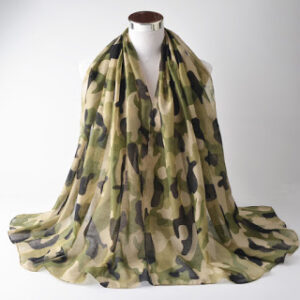
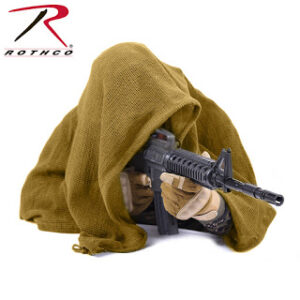
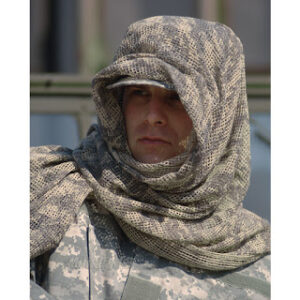
Possibly the most practical approach is to create a sort of “soldier’s mantle”. In effect a short cloak or shawl. Shown below is a small net-like item that might be a good starting point. Ideally it would be a light sand colour to be suitable in the widest range of environments. A few blobs of a darker, contrasting brown colour would not hurt. Like the helmet camouflage that was described in a previous blog the camouflage effect is greatly improved if three-dimensional materials such as hessian, scrim and raffia are added. One of the reasons for selecting a net-like material is so that natural materials can be added too.

To correctly position the mantle drape it over the head as was described in this post. The material can be then folded back to gather around the neck when on the move, draped over the head for better concealment when more static. The best way to keep the mantle in place is to sew laces or toggles where you jacket collar meets the shoulder. This leaves most of the mantle free to be draped over your webbing or rucksack straps. The material hanging down in front may help conceal your weapon and chest equipment. Material at the rear will help conceal the top of your pack. The mantle should be of a size that it just covers the upper arms. The folds of the cloth help break up the shape of the shoulders, even when not worn over the head.
Categories
Phillosoph

The Non-Slip Knot

Yesterday I learnt a new knot! I came across a rather informative article on the Kryston website which includes the “non-slip knot”.
The non-slip knot resembles some of the honda knots in that it is made from an overhand knot in the standing part. If you tie the overhand by passing a bight through a loop the knot will be half-tied already. Wrap the running end around the main part and feed the end back through the overhand knot.  This knot forms a very strong fixed size loop.
The article was about fishing line but the knot also seems to be suitable for larger cordage. It is easy to learn, easy to tie, easy to adjust and relatively easy to untie. The knot itself looks compact and neat. This is a knot that is worth adding to your repertoire.
The non-slip knot has been added to the new version of “Scrapboard Knots”.

Categories
Phillosoph

The Isotonic Trap

 Osmosis “is a process by which molecules of a solvent tend to pass through a semi-permeable membrane from a less concentrated solution into a more concentrated one”. It is distinct from diffusion, which is movement from a region of a high concentration to regions with a lower concentration.
What has this got to do with survival, self-defence or any of the other topics this blog has been known to cover? Keep reading and all will become clear.
Suppose you have an orange. You peel the orange and drop it into a vase of water. What happens? After a while the orange begins to swell up as it absorbs water. This is osmosis. The interior of the orange is relatively concentrated with lots of sugars and other molecules. Proportionally its interior is rather low in water compared to the liquid it is floating in. The orange skin is a semi-permeable membrane in that it will let water across but not the larger molecules.
Suppose we take a big bag of salt or sugar and empty it into the water in the vase. If we add enough we may see the orange begin to shrivel. The solutes in the solution surrounding the orange are more concentrated than the orange’s interior so water is being drawn out.
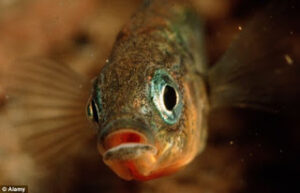
This is a very important mechanism in nature and biology. To give you another example. A freshwater fish is more concentrated than the water it swims in. Its body is therefore constantly absorbing water and the freshwater fish must constantly pee to maintain an equilibrium. The sea fish, however, is surrounded by fluid that is saltier than its body fluids. Water is constantly being drawn from the sea fish and it must constantly drink to avoid “dehydration”.

Some of you may have realized that the concentration of the fluids in the glass could be adjusted so that it matched that inside the orange. There would be no net water gain or loss. Such a condition is called “isotonic”. If an environment is more concentrated than another it is termed “hypertonic” and its less concentrated compliment “hypotonic”.
Isotonic is a word you will have encountered. Many sports drinks are described as isotonic. Very often the marketing of these involves misrepresented facts and sometimes outright “snake oil”.
Sports drinks fall into two categories. The first are “power drinks”, which are effectively liquid food. They are intended to replace energy and salts (aka electrolytes) consumed during heavy exercise. They contain lots of carbohydrate, usually in the form of sugars. There will also be a smidgen of salts and other stuff. Because they contain so many solutes power drinks tend to be hypertonic.
The second category of sports drink are designed to rehydrate the body and replace salts lost from sweating. Some of these drinks are hypotonic. Many promote the fact that they are isotonic. The blurb often says something like “by being in balance with your bodily fluids drink XXX rehydrates you better than plain old water”.
Sound logical? Think back to our orange in a glass. Imagine the orange is the lumen of your gut and the liquid it is floating in is the rest of your body. When the two were isotonic there was no net movement of water! If we wanted water to leave the orange the interior of the orange needed to be hypotonic.
So, are these drinks more efficient than water? There is a grain of truth here but it is often misrepresented. I will need to sketch a crude picture of how the body moves water out of the gut. In essence what the body does is create a very high, localized concentration gradient across the gut wall. It “pumps” sodium ions across the gut wall. This is an active process that requires energy. The energy comes from ATP, which is generally generated from sugars in the gut.. This osmotic gradient created pulls water across the gut wall. Moving small quantities of sodium allows the movement of large quantities of water. It’s a bit like moving a herd of donkeys with a single carrot.

So yes, a little bit of sugar and salt will aid water uptake. But that sugar and salt don’t need to be ingested with the water. Except under extreme circumstances the body generally has sufficient reserves and humanity has managed to rehydrate drinking just pure water for millennia. Carry some raisins or boiled sweets. The replenishment of water and supply of sugars can help offset fatigue.
Taste is another factor. Because they are sweet and/or acidic it is easier for some people to drink larger volumes of sports drink than they would of water, so actual intake of water is higher. There is an interesting experiment that you can try. Take two glasses of water and add just a dash of lemon juice to one. Try each.
It should be obvious that for rehydration you need to drink something that is hypotonic, although a pinch of salt and a little sugar won’t hurt. Drinks with high carbohydrate concentrations will be poor for rehydration, despite some manufacturer’s claims.
Many sports drinks may be isotonic when they are in the can, but is this still true when they reach the gut? Isotonic saline is 0.9%. Incidentally it is useful for soaking bloodstains out of laundry. You can make some isotonic saline by dissolving 4.5 gms of salt in half a litre of water. Taste it. You will find it is way too salty to make a pleasant sports drink. Whilst sports drinks do contain some salt they mainly use sugars to make them isotonic. A body that has been exercising wants sugars and sugars are needed for water uptake, so this seems logical. An isotonic glucose solution is 5% and isotonic sucrose solution is about 9.75%. 47.25 gms per half litre! Yes, that is a lot.
Another factor to consider is that sugars and other complex carbohydrates are mainly digested in the small intestine. They are broken down into monosaccharides such as glucose and fructose and most of them will be absorbed in the small intestine. The majority of water absorption does not take place until later in the large intestine. By the time your sports drink reaches here it will have lost most of its sugars and no longer be isotonic.
Let me return to the topic of power drinks. Most people do not need to ingest calories in this manner. That includes most athletes. You are being subjected to marketing to make you think you are not really trying, not a true athlete, unless you use drink XXX. Taking in lots of calories in liquid from is a bad idea. The lack of solids means that you never feel sated. This is why we have an obesity crisis. People are drinking vast quantities of sugar as soda or fruit juice and never feeling full. It seems likely that even isotonic drinks have way more sugar than they need. You may be drinking more calories than you exercise off!

If you do need a sports drink dilute some cordial and add just a pinch of salt. A friend of mine and myself discovered that “fruit squash” is much more refreshing if you make it very dilute.
I am a qualified biologist who used to try to teach medical students science and physiology. But as always, don’t take my word for it. Do some research of your own, but be wary of advice that is actually just a rehash of marketing. Start by reading the links below.
Categories
Phillosoph

Cross Stepping Post: Part Three

Some time ago I started what was intended to be a series of posts on the “Cross Stepping Post”.
Part One introduced two of the movements and the intention was to let the reader try these out for a couple of weeks before covering the thing as a whole.
Part Two gave some advice on learning part one. As with most of my plans, real life intervened and a year has gone by! Here is part three, the full sequence. (or rather, one side of it!)
For part three, we will only consider the footwork, which is the essence of the thing. There are some hand movements that can be added but it is better to concentrate on your footwork, balance and co-ordination for now.

Setup. Begin with your right foot slightly advanced and your left foot angled out.
Your spine should be straight, your belly and bum pulled in.
Your knees are slightly bent, your shoulders are relaxed and your arms hang down by your sides.
Try not to look down at your feet.
If you have some familiarity with tai chi or other soft or internal martial arts these conditions will be familiar.
If you are not familiar with this body condition, consult the tai chi section of my book or other good works on the subject.
I have shown the lead foot pointing forwards, but the toe can be turned inward, a the lead foot may even be parallel with the rear.
First Move: Step Back. Still with your feet in the starting position it should be possible to lift your right foot from the ground without noticeably shifting your weight.
If you are new to this, you probably cannot do this. This is one of the objectives you will aim for.
For the first move, you raise your right foot and place it behind your left. Your calves should brush or touch.
The right foot is raised “flat”, without the heel or toes lifting first. It is placed flat behind the left.
This will take practice, so persevere.
Second Move: Forward Foot Kick/Step. For the second move, the left/forward foot is raised and the heel passes down along the inside of the right foot.
As the left heel passes the right heel, the left foot straightens up.
The left foot is brought forwards in a sort of sweeping action and is placed on the ground.
The final foot position is a mirror of the start/setup position.
You should have maintained your balance throughout this sequence. The chances are you did not, but this will improve with practice.
Third Move: Forward Foot Across. For the third move, the left foot is raised and placed down ahead of the right.
The heel is turned in and the toes out. The lead leg will touch the rear knee.
Note that for the previous steps, the forward foot has been used. The right/forward foot is stepped back. The left foot is now the forward foot and is moved in the next two steps.
Fourth Move: Back Foot Kick/Step. The next move involves the rear foot, which in this case is the right. I think of this move and the previous as “the reset” since it takes you back to the setup position.

The rear/right foot makes a semi-circular step forward.
Again, lift the entire sole rather than the toes or heel. Place the entire sole down.
This move returns you to the start/setup position with your right foot advanced, although you may have changed location slightly.
Transition. The next move is the “transition” step. This will take you from a right-forward stance to a left-forward stance.
The action is the same as the third and  fourth step, but in this instance the right foot steps before the left.
The rear foot steps forward so that you are back in the starting position, but this time with the left foot forward.
You now repeat the sequence on the other side. Your left foot steps behind the right. The right then withdraws and advances etc.
Here is the sequence as a single image you can print or load onto your phone.

Categories
Phillosoph

Hearing Water Temperature!

As regular readers may have noticed, recently I have been perusing several World War Two British manuals. Both the official and the commercially published manuals for the army and home guard place a considerable emphasis on fieldcraft. One aspect of fieldcraft was training the soldier to use his ears more effectively. Langdon-Davies describes a number of demonstrations and exercises a squad may conduct for this purpose.
For the individual he suggests listening to music and trying to follow individual instruments. He also suggests that troops must become familiar with the normal everyday noises of an environment. The noise of sheep cropping grass, the singing of telegraph wires, the noise of cooling stones and so on. By doing this the soldier will better distinguish noises that are out of place, such as a buckle tapping a rifle stock, a branch slapping a steel helmet or a spade biting into dirt.
Aspects of using and training the hearing may be the subject of a future blog. Today I am going to pass on a video sent to me by a regular reader. It is an excellent demonstration of how your hearing may already be giving you far more information than you realised!
 
Recently we had trouble with the boiler, so the shower sometimes came through cold.
I found there were two ways I could tell if my girlfriend’s shower was coming through hot.
One, was that the cold shower sounded distinctly different, like a rain shower.
The other was by the sound of swearing in multiple languages!
Categories
Phillosoph

Facial Camouflage

Recently I have read books by Tom Wintringham, Bert Levy and John Langdon-Davies. A topic common to all three of these is the visibility of the human face.
If a soldier hears an aircraft overhead it is understandable that he might look up at it. An uncamouflaged human face is visible from a considerable distance so a pilot may observe his observer. Now imagine a company of infantrymen all looking up at an aircraft. Effectively this would be a sudden white flash saying “here we are!”
I recently read that “the secret to invisibility is to freeze like a lizard on a rock”. If an aircraft or other potential threat appears one should take cover if there is any nearby, freeze if there is not. Keep your eyes down on the ground. Only one or two men should observe the aircraft, and then only with adequate face camouflage. In a previous blog post I described a simple framework that could be worn on the back or the pack. These were used by the NVA and Viet Cong when on the march. Any time an aircraft appeared overhead they would drop to the ground and become bushes. Incidentally this also illustrates that marching formations should be irregular.
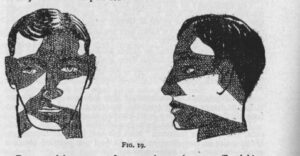
The following image was scanned from Langdon-Davies’ book.
Langdon-Davies notes that eyes are very distinctive and that many animals have colour schemes that make their eyes less noticeable. Often this takes the form of a line, stripe or blob that runs across the eye. Logically, he advocates that a human soldier’s camouflage should do the same. The human nose is another prominent feature so this needs to be shaded to compensate for this. The scheme he proposes was using a single colour of camouflage, such a burnt cork. It was sufficient to disrupt the palest skinned face. Nowadays multi-coloured camouflage kits are common.
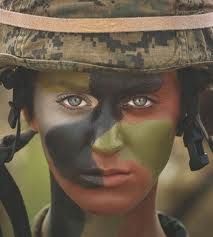
Camouflage creams may have advanced a bit but I have to question if the principles Langdon-Davies had described are being observed. It is not sufficient simply to get the face dirty or paint stripes across it. Prominent features such as the eyes and nose must be disrupted. Features that catch the light must be darkened and areas that are shaded must be lightened.
 
Langdon-Davies was writing for a primarily Caucasian audience but his comments also apply to other skin tones. Human skin can be reflective so needs dulling down. Blue eyes can be distinctive. Shade from suitable headwear can help.
While painting the face can be effective there may be situations where you will need to rapidly remove any facial camouflage. Face painting can be combined with other measures, of course.
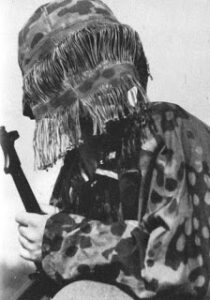
A tight-fitting face-net can be distinctive, defeating the purpose of the item. Face-nets or similar devices should be relatively amorphous. In a previous post we saw a face-veil used by German troops. While this was effective it was apparently impossible to run with this fitted. Such factors need to be considered if you have a mobile role. At night a net across the eyes may hinder vision to an unacceptable level.
One of the simplest ways to conceal the face is a scarf or bandana across the nose and mouth. Folds in the material help disrupt the shape. Since the face area may be shaded by headgear I’d go for a relatively light coloured material with contrasting disruptive blobs. As I have suggested in previous posts, children’s clothing or cheap t-shirts can be an economical source of camouflage material.
Even if you have correctly painted your face a cloth across the nose and mouth has other advantages. Facial recognition software has become commonplace in the last few years and we will undoubtablely see applications of it more lethal than the camera in your phone. A cloth across the nose and mouth also softens the sound of your breathing, which was one of the reasons the ninja favoured this. A ninja’s disguise might be a simple bandana and scarf. The bandana is folded diagonally and  worn over the hair. The scarf is pulled across the face and tucked up under the bandana. When not worn there would be nothing particularly suspicious about these items.
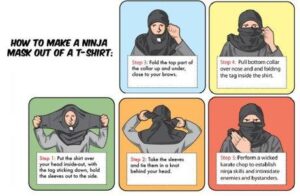
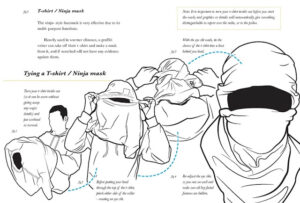
Make a web search of “ninja hood t-shirt” and you will find numerous sites and illustrations of how to make a ninja hood using a t-shirt or sweatshirt. Many of these are tongue in cheek but it should be apparent to the reader that if you use a shirt with a suitable camouflage pattern you may have the beginnings of something quite practical. Add some scraps of scrim and hessian to further disrupt the shape.