Disclaimer: “As an Amazon Associate I may earn from qualifying purchases.” Adsense and Infolinks were no help at all.

If you have enjoyed this article or it has been helpful to you please feel free to show your appreciation. Thank you.

Read The Third Wave by Alvin Toffler!
Categories
Phillosoph

The Monkeysphere.

           Last night I was thinking about some aspects of organization. One of the questions I was looking at was what is the optimum size for a task-orientated team? The correct answer to this depends on what the task is, and also who is making up your team. A grouping of individuals with self-discipline and a concept of duty are likely to achieve much more than the equivalent number of hippies. There is an allegedly Muslim trope I once read that explained why four wives are necessary. One is not enough; two will fight and if there are three two will gang up on the third. That does actually describe some social and working groups I have had to deal with. Answers about optimum team size vary: “no more than five”, “between five and seven”, “four to twelve”, “never more than nine” and so on. It does depend on the situation and the “materials” you are working with. Incidentally, army squad size is usually less than fifteen since this is about the limit of people one leader can co-ordinate with his voice before personal radios etc. For similar reasons, military companies tend to be 150 or less since this was the practical number that an officer could control with drums, bugles or flags.
 
           Following these lines of thought I recalled a section in Simpkin’s “Race to the Swift” that mentioned “packs” and “tribes”. This is on page 216 and attributes the idea to an Anthony Sampson. The pack may be up to a dozen and the tribe several hundred, according to Sampson. Simpkin's own observations were that a soldier’s loyalty seems to revolve around more immediate small units such as a tank crew, gun detachment, fire team etc. He also states that for the junior ranks of the British Army the key object of loyalty in achieving coherent behaviour under fire seemed to be the company.
           This obviously brought me back to the idea of Dunbar’s number and I finally got around to reading the “monkeysphere” article by David Wong. It is worth a read.
Categories
Phillosoph

Pimp my Fighting Staff!

Regular readers will know that I am fond of the occasional silly action movie. Pure escapism and sometimes that is not a bad thing.
Some of these movies have a plot where someone (usually with a history of special forces service!) drops through a dimensional gate/wormhole/timewarp/magic portal and finds themselves in a medieval/magical/fantasy realm.
Now, if I found myself in such a scenario what weapons might I request from the local armourer or blacksmith?
I would hope there was some local equivalent comparable to my kukri, of course. A machete or similar short sword such as a hanger would be welcome too.
Many of you will have said a bow, but if I am honest my skill with one is unlikely to be sufficient. Even if it is, one is going to need close combat weapons too.
In other posts I have discussed the merits of a staff weapon of less than my height. Something of about five foot long, or between armpit and brow height.
I have a fighting staff of these dimensions at home and this would be one of the first weapons I grab should I need one.
A good solid five foot wooden pole is quite a formidable weapon in itself if you know what you are doing and have studied the techniques in my book.
It is possible, however, that we can make the weapon harder hitting.

A number of options suggest themselves here.
One is for a short variety of naginata. Effectively a sword blade with a pole handle.
It is tempting to add a hook or two to the blade to let us pull an enemy’s shield aside.
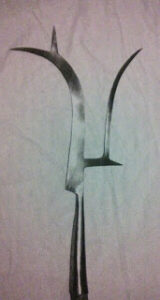
The blade begins to evolve into something like a welsh hook or English bill (above).
A drawback of cutting weapons, of course, is that they have to hit a target edge on.
Weapons like the naginata have an oval section haft to orientate the blade correctly. Similar weapons have a groove cut down the back of the haft to allow the user to determine the correct grip by touch.
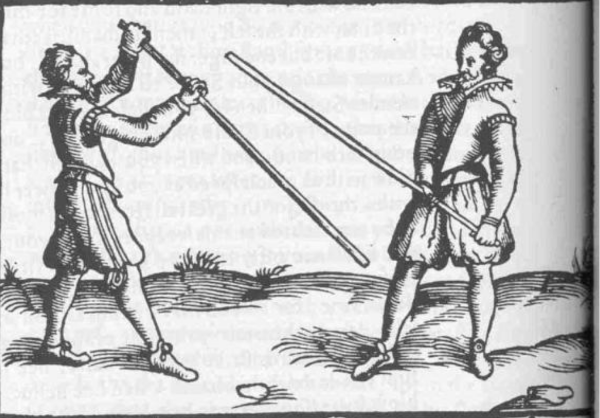
High and Low Guards for staff-fighting
My favourite ready position with a staff is a hanging guard, which means that any blows made start from low down.
Making a cutting edge arrive correctly for me would require some extra movement of the wrists for some angles of attack, which goes against my usual KISS approach to most things. Also, if I have to grab the weapon in haste, do I want to worry about hitting the foe with the back or flat of the blade?
Today I am going to explore another option of “pimp my fighting staff”.
Some of you will have encountered the Japanese weapon known as a kanabo. Kanabo come in many shapes and sizes, the most familiar resembling studded baseball bats.
A while back I came across this charming image of a samurai.
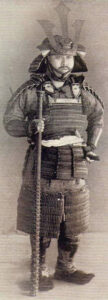
Wikipedia describes his weapon as a kanabo.
This particular version of a kanabo looks like a studded fighting staff. It is higher than his armpit but shorter than his brow.
Some sources claim his weapon is all metal, but some ambiguity in translation might exist here since kanabo means “metal stick”.
Some kanabo were all metal, while in some cases the word metal might just allude to the strength of the weapon, much as we say someone had “iron will” or a “fist of steel”.
A studded fighting staff sounds good to me.
Note that the butt of the samurai’s weapon has a useful short spike.
The shaft also broadens at the butt too, so the hand is less likely to slip off. This allows a weapon to the “darted” through a hand to increase reach quickly. This part may need to be made of metal to counterbalance the head end of the staff.
The studded section could probably use some langets to resist sword blades.
The main addition I would like is something like a spearhead or stabling spike at the top end.
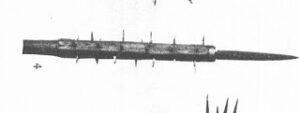
This picture of a medieval weapon gives an idea of what is practical. Perhaps something simple and functional resembling a boarding pikehead with langets and a triangular section blade?
A crossguard or “arrest” like a boarspear would be prudent, and if one tine is turned up and the other down like a manji sai/nuntebo, I am sure that such a feature will serve numerous uses, both martial and mundane.
Such a hook can be used like an ice axe to slow a slide down a snowy or muddy slope.
We might as well add a tassel just below the crossguard. A tassel helps divert rain from running down the shaft and can be used to distract an enemy or aggressive animal.
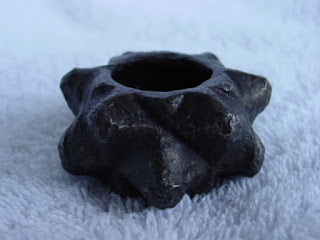
Cogwheel type British trench club
Alternately, a cogwheel-shaped disc mace head below the spike could serve as both an arrest, weapon and rain diverter. Perhaps it could include a gutter channel and spout to direct any liquid away from me.
A small guard or vamplate between the studded and grip section would be a nice feature too. Among other functions this would help divert rain or blood from making the handle slippery.
The Japanese sliding spear grip (kuda) might work with a fighting staff,

Categories
Phillosoph

Sword vs Pike

           A good friend of mine grows increasingly frustrated with facebook. I can sympathise with this. If it were not the only means I currently have of communicating with my girlfriend I suspect I would be spending much less time on it too. On the other hand it does occasionally inspire posts to this blog. Recently I saw an illustration on facebook showing swordsmen fighting against hoplites. Below there were many smug comments about “bringing a sword to a pike fight”. That is exactly what you do do!
           The history of swordsmen beating pikes goes back at least to the Romans. Many of the enemies of the early Roman army used the phalanx and the signature fighting method of the Roman legion grew from combat with such adversaries. Fast forward a few centuries and you have the Spanish “sword and buckler men” or “Rodeleros”. Like the Swiss halberdiers and German Zweihändermen they were used to attack and disrupt pike formations.
           To understand the mechanism here imagine you are holding a spear a couple of metres long. If an enemy steps a pace beyond the point of your spear you can bring your point back an equal distance by moving your hands back. Now suppose you are holding a long pike of five or six metres. The enemy slips past the point of your pike and takes a couple of paces. He is beyond the distance you can easily withdraw your point to stab him! You can try stepping back yourself or shortening your hold on the pike. However, pikes were used in massed formations so the comrades behind you will prevent you being able to make these moves.
           This is exactly what the Romans and Rodeleros would do. Shield and sword allowed them to deflect or block the thrusting pike points and close the distance. Allegedly some Rodeleros would throw themselves to the ground and roll under the points. Halberdiers and Zweihändermen used the same basic idea but different weapons. Some claim the Zweihändermen would simply chop through the pikeshafts before laying into the pikemen.
           To resist such tactics a pike square would include its own contingent of swordsmen or halberdiers.
Categories
Phillosoph

Simplicity and Omelettes

For today’s blog I will make some observations about how some people approach problems and also give you a simple recipe for when you need quick and simple.

I have had the misfortune to work with certain individuals that are quite incapable of doing things simply.

Some have even been considered “negative manpower” in that when they were involved in a job we needed more people to compensate for all the speedbumps they threw in our way and spanners they cast in the works.

It is quite incomprehensible to them that equal or superior results may be achieved by simpler means.

If they were in a fight and their attacker fell down they would probably go to ground themselves and try to apply some fancy holding technique.

Simply stomping on the attacker's leg and running away would never occur.

I am reminded of this since the other day I remembered that we had some eggs that were due to be used up. An omelette would be nice, I decided.

I recalled that somewhere in my collection of recipes was directions to make an omelette.

There was something about waiting 30 seconds and then bringing the edges into the centre, waiting another 30 seconds and doing something else, then another 30 secs and so on.

Sitting at work I decided to see if I could find this method on-line. I websearched “30 second omelette” and to my surprise got methods for cooking omelette in only 30 seconds!

Much mumbo-jumbo seems to have been written about the difficulty of making perfect omelettes!

The following may not be perfect or the best-ever, but I doubt you will be disappointed!

The basic method is this:

Add salt, pepper and three eggs to a bowl and beat with a balloon whisk or fork until mixed evenly.

Heat your frying pan good and hot. I use oil but add a blob of butter if I have some. Let the butter melt and wait until it just browns (or a few moments before!)

Give your eggs a final whisk and in one smooth, quick action pour the mix into the pan.

You now just swirl the mix around the pan and shake the pan to spread it evenly. Mine seem to take a little more than 30 secs but I am a little cautious with the heat.

Watch for when some of the egg is still liquid but cannot be sloshed around over the rest of the omelette. Underside should be golden brown.

This is when to add the filling and fold the sides over. The remaining “wetness” helps glue the flap over and will cook from residual heat while you are sliding the omelette onto the plate.

I like to use garlic salt rather than plain salt.

Some herbs or Worcestershire, soy or tabasco sauce added to the mix is not bad either.

I had a single rasher of bacon to use up so shredded this and fried it in the pan bottom before adding the omelette mix.

While I was writing this I came across a method for cooking an omelette in a bag claimed to be a “kitchen hack”. “Only” takes 13 minutes!

Categories
Phillosoph

A Thought on Christmas

One of the unexpected consequences of no longer being single has been my relationship with my girlfriend’s son. Every day I see young men with their crotches down near their knees and their hats on backwards, bleating about “Respek” while dressing like clowns. It is nice to know that there are some young men of this generation that are smart and polite and will probably achieve great things.
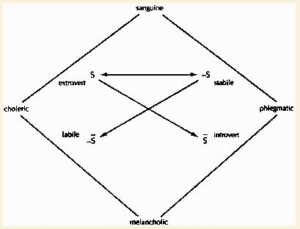
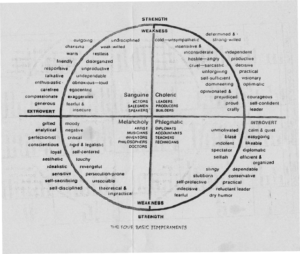
Currently I am reading “Red Mars” by Kim Stanley Robinson. There is a passage in this book where the psychologist reflects that most of his charges can be defined by a combination of the psychological categories of “stabile-labile” and “introvert-extrovert”. He muses that the various combinations such as “introvert-labile”, “extrovert-stabile” etc in fact correspond to the ancient system of four temperaments of choleric, melancholic, sanguine and phlegmatic. Interested in this I passed the passage on to my girlfriend’s son, knowing that it would interest him.

 
He responded with a true pearl of wisdom that I will leave you to enjoy and reflect on this Christmas day:
“Woow, isn't this too much to think?”
I think that is a question we should ask ourselves more often!

Categories
Phillosoph

Not Being a Sucker and Avoiding Head Punches

=

Many times on this blog and in my book I have stressed the need for personal vigilance. Quite simply, pay attention to what is happening around you. Just because you think that a text is important does not mean the universe will rearrange itself to keep you safe! I know I may sound like a broken record here but the importance of awareness cannot be over stressed.

A friend of mine sent me the following link: 

The tone of the article suggests that these are acts of violence committed just of the pleasure of seeing someone fall. I’ve had personal experience of attacks motivated by this. It is a useful reminder that predation is not always driven by greed or lust. Anyone can be targeted for violence. Awareness and some of the other factors that I discuss in my book can reduce your chances of being selected as a victim.
To be honest, I am rather surprised that we do not hear about more “sucker” attacks. So many people walk down the street with their eyes glued to their phones or music players, only marginally aware of their surroundings. A colleague of mine had her phone stolen. According to her a man simply walked over to her, slapped her and took it. As she is telling me this story I was acutely aware that there was some fact that she was omitting. Sure enough, it turns out she was using the phone at the time. Doubtless one of those long, drawn-out conversations with her son about precisely how to put a piece of fish in a microwave. Had the misfortune to overhear many of those while I was working with her and know well how oblivious she would have been.
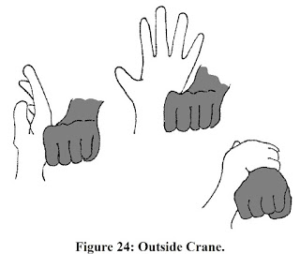
Your primary defence against a sucker punch is awareness. How close will you let another human being get to you, particularly if you do not know them, they seem drunk or furtive or there are few other people around? There are too many aspects of awareness to cover in today’s blog. Instead, I will briefly cover a couple of defences against a head punch. In other words you have become aware of a potential attacker but he has still got close enough to make his move. My book is filled with techniques you can use but today I will mainly look at Peyton Quinn’s outside and inside crane defence.
Peyton Quinn wrote “A Bouncer’s Guide to Barroom Brawling”, one of the books I recommend for further reading in my own book. Quinn very kindly gave me permission to detail a couple of his techniques in my own work. Quinn observes that the head punch is a very common move in real fights so has honed a couple of techniques to deal with such an eventuality. (Injuries to the hand from head punching are also common!)

The outside crane is best used if you can move to the outside gate. It is a fairly standard parrying move. Notice how the arm rolls the blow, leaving the hand in contact to detect and influence what the foe’s arm may do next. In the illustration a right to the head is intercepted with the right hand and as the punch is moved right the defender moves left, taking themselves out of the path of the punch.

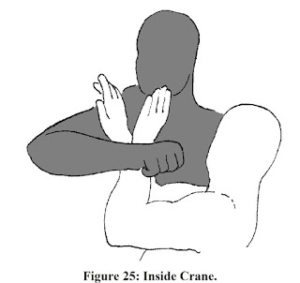
The inside crane is shown here against a hooking type punch. Both arms come up and body twist can be used to roll the attack past. This technique offers a large surface area against impacts so is a good defence against kicks to the head, should the foe be foolish enough to use them on the street. (Chances are he will rip a muscle without a warm-up and stretching!)

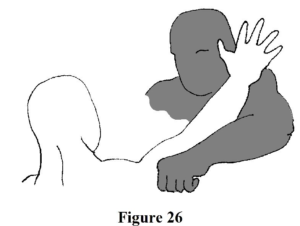
The inside crane leaves you on the foe’s inside gate so he will probably follow through with a punch from his other hand. The next illustration shows a follow on from inside crane, in this case a source block against a punch with the left. White would be moving to his left. Notice that the position of the arm also helps deflect the punch away from the head. This leads us to a third technique.
Western boxing uses a lot of punches to the head region so it is no surprise that simple and efficient counters to such attacks have been developed. The one we are going to cover is to simply place your hand on your head above the ear. The bent arm creates a large area to act as a shield. You will find that making this move on one side tends to make you duck to the other side, taking you out of harm’s way. This ducking action is also a good setup for a palm heel chin jab!

Categories
Phillosoph

Hybrid Societies and Incompatible Cultures

It is comforting for us to think of many things as static and unchanging. Many readers of this blog will have read about various martial arts and encountered the opinion that “this set of move is XXX-jitsu” and “these techniques are YYY-style kung fu” and so on. The truth is that many things are in fact constantly undergoing a state of change. It is now much easier for the practitioners of a certain style to learn about other styles and inevitably new ideas are encountered and some are adopted. This is true of many things that we may wish were unchanging. Our culture, our language, etiquette and many other things are all ever changing. Things change, and this is not necessarily a bad thing. With change comes selection and this is necessary if improvement is likely to occur.
Decades back I was part of various on-line discussion groups. One relatively new member had a habit of frequently introducing his pet topic/hate into discussions. “Isn’t diversity wonderful” he would sarcastically sneer. I think he might have been quite shocked if he had known just how diverse some of the other group members were. At least one was Jewish (!). A couple were even not American (!!). Yet another had some specialised (yet legal) leisure tastes, the details of which do not concern us today. Some of you will no doubt already be relishing the irony of a (presumably) white American complaining about diversity when the very culture he champions is itself a fusion of many others.

“Multi-culturalism” is a term that has been thrown about a lot in the last few decades. What is often ignored is that the multi-cultural societies that work best are in fact hybrid societies. Various communities may maintain their own identities but they are also willing to entertain the ideas and concepts of other cultures. We take what is best or most useful and make it our own. I am writing in an alphabet acquired from the Romans but perform maths with Indo-Arabic symbols. The language I am writing to you in draws on words from a smorgasbord of other languages. Our national dish is now curry and the little Moslem girls next door are just as excited about the fireworks on Bonfire night/Dwalli and Christmas as any other child in the city. The love of my life is a British Brazilian and has introduced me to many wonderful things from that culture. “Girl talk” between her mother and sisters is conducted in Portuguese, and that suits me fine, I am not expected to listen.
The reason I am writing about this today is because it has occurred to me that there is a flipside to this. If we accept the biological analogy of a hybrid society then the logical implication is that there possibly may be cultures that are simply not compatible with some others. Observation of the facts seems to indicate that this premise is more than just theoretical. Many societies (supposedly) practice sexual equality with respect to gender or even sexual preference. Some cultures have a deeply-ingrained patriarchalism and/or misogyny as a fundamental component of their identity. Others not only include homophobia in their beliefs but advocate active persecution and execution of such. There is at least one cultural group that is actively parasitical or even predatory, wishing nothing from other cultures other than a one way flow of wealth and resources.
I’ll refrain from further discussion along these lines since inevitably some fool will cry “racist” rather than trying to actually understand the concept I want the reader to think about.
It is nearly Thanksgiving in the US. A meme that some people have been circulating is that the Pilgrim Fathers were themselves refugees. Part of the folklore of Thanksgiving is that the Pilgrim Fathers were fleeing persecution. It seems in reality this is not strictly true and that many were a separatist minority whose main complaint was everyone else was not following their creed. Refugees are one of the topics of the day and some will have it that anyone who opposes the immigration of refugees is simply a racist. Perhaps things are not so simple. Some of the countries being criticised for reluctance are some of the most densely populated in Europe. Many richer Moslem countries are refusing to take predominately Moslem refugees. My recent meditations cause me to ask if certain new or existing cultural groups will contribute to our hybrid society or are they incompatible? Tolerance needs to work both ways. These are things that need to be recognised and intelligently discussed sensibly without knee jerk accusations of “racist!”

Categories
Phillosoph

Duodecimal Finger Counting: Counting to 60 on One Hand.

Currently I am reading “The Last and First Men” by Olaf Stapledon.
I’ve just reached the section on the third species of mankind. The third species have six fingers on each hand and Stapledon notes that they have a duodecimal mathematical system.
By a manifestation of synchronicity. I was watching “QI” that very night and a base- twelve finger counting system they attributed to the Babylonians was featured. Using this system it was possible to count up to or display numbers of up to 60.
Investigating the topic further, I came across a number of websites averring that the Babylonians in fact had a base-60 numerical system. Looking at their numeral system, however, seems to suggest a decimal system. Which of these is true is out of the scope of this blog.
I thought it would be handy (pun intended) for readers of this blog to know about a hand signal system that can represent relatively high numbers. Many measurement systems are based on dozens, 24 or 60, after all.

The system is very simple. There are four fingers on your hand and each has three joints and three bones. The joint or bone of the first finger nearest the wrist is “1”. The join of the little finger nearest its tip is “12”.
By pointing at a joint with the thumb of your other hand you can indicate any number from 1 to 12. If you point with your index finger instead of your thumb the joints are designated 13 to 24. And so the progression goes on up to 60, which would be the tip of your little finger pointing to the last joint of the other little finger.
Counting in dozens makes this technique even easier. For example, a count of “three dozen and two” can be easily converted to 38.  
The illustration above is labelled in “dozenal” notation so the upside down 2 () is “ten” and the inverted 3 () is “eleven” in base-10.
Twelve and 60-based counting has obvious applications to navigation using degrees, minutes and seconds, or calculations of time using hours, minutes and seconds.
That is the system. Perhaps you may find it of use sometime.

Update

You can actually count to 156 on your hands! Use the tip of your thumb of your same hand to touch the finger bones between the joints rather than the joints.
You may find it more logical to start with the little finger for the lower numbers.
For each dozen you count off, you touch the corresponding bone on your other hand with the thumb of that hand. 12 x 12 =144.
You other hand can actually represent any number from 0 to 12, hence this system can count up to 156 (12×12 + 12).
You can also do quick additions using this method. Shifting your thumb from a finger bone to the equivalent fingerbone on the next finger adds three, two fingers adds six and three fingers adds nine. Using the other hand, skipping a finger adds 36/three-dozen. For more on dozenal counting see here.
Using this method you can use your hands as a simple abacus in either base twelve or base ten. For the latter you just ignore the first two sections of your last finger.
Categories
Phillosoph

Facebook Friday Funny

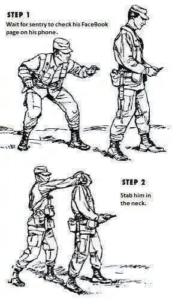
        A "Friday funny" for today's blog. I came across this image by accident yesterday. Regular readers will know I have often cautioned against paying more attention to your phone than your surroundings. I suspect this joke may be closer to the truth than some might wish!
……and then update his status: "Bleeding from carotid. LOL"

Categories
Phillosoph

Yule Be Sorry!

I once read a story in which Buddha was asked if he would ever eat meat. “Yes.” he replied. He then went on to explain that if his hosts at a dinner inadvertently served meat he would go ahead and eat it. It was better to be a poor Buddhist that a bad guest.

That is something that is worth thinking about, and not just if you are vegetarian. The reason that I am reminded of this is that I have just seen yet another story about the acceptability of saying “Merry Christmas”, “Happy Holidays” or whatever. The mass media loves to stir up and fan such stories. Various attention-seeking persons can be relied on to wade in and jump on the bandwagon or try to turn the discussion towards their own pet topic. We see the same rants and rages every year.

    Let me settle this issue once and for all with three points:

Firstly “holiday” derives from “holy day” so is an appropriate salutation and not the anti-Christian meme that many choose to take it to be. Holidays around solstice time probably date back thousands of years before Christianity.

Secondly, one should take a salutation in the spirit in which it is intended. Merry Christmas, Happy Holidays, Happy Yule, Happy Chanukah, Namaste or whatever. If they are given with good intention then they should be treated as such and not as an excuse to take offence, air your pet topic or introduce your personal interpretation of religion. This is, quite simply, just good manners. As a man once said “Be polite, tolerant; wear deodorant”.

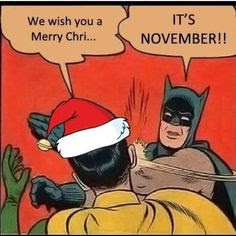
That being said, however, if someone does wish you Merry Christmas/ Happy Holidays in the next twenty days you are quite entitled to reply “IT’S NOVEMBER!” Save Christmas for December.