Disclaimer: “As an Amazon Associate I may earn from qualifying purchases.” Adsense and Infolinks were no help at all.

If you have enjoyed this article or it has been helpful to you please feel free to show your appreciation. Thank you.

Read The Third Wave by Alvin Toffler!
Categories
Phillosoph

Future Money


“I prefer hard cash. If you can’t scratch a window with it I don’t accept it”.

Roosta: The Hitch-hiker’s Guide to the Galaxy. (Fit the Eighth)
Regular readers will know that on Fridays blog posts here tend to stray a little from the usual topics of self-defence and preparedness. Today is no exception and probably diverges even more than usual. It is, however, a logical progression from the recent post on the design of money.
Recently I was watching a certain sci-fi series and two of the characters offered another character a bribe. What was notable about this is that you saw them physically offering money. The money offered was only seen at a distance and appeared to be coloured plastic cards.
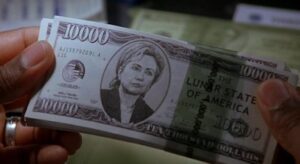
While money is often discussed in science fiction shows, I cannot recall that many incidences when you actually see the physical cash. (One exception to this that springs to mind is Pluto Nash and “the Hillarys”)

Hillary Clinton Banknote

What kind of form might a future hard currency take?
The above example did illustrate that cash did not have to be paper, or even flexible polymer. When you might be on another planet to the mint, there is something to be said for an exchange medium that is more durable.
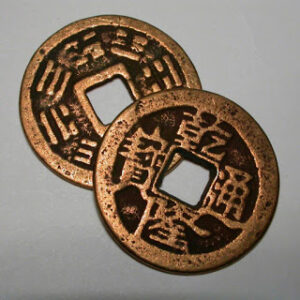
Chinese Coin
Coins are one of the oldest mediums of exchange.
The Chinese seem to have used the same basic design for more than a thousand years. The square hole in the centre seems to have been introduced as part of the production process, allowing a batch of coins to be threaded on a square rod for filing into their final shape. It had the added advantage that coins could be threaded on a string for easier bulk handling. This also resulted in the wide use of coins as ornaments or charms.
Coins from other countries show more variety but nearly all are circular or circle-like equilateral polygons.
Coins are convenient to carry in a pocket or pouch and can be stacked for bulk handling. Their shape also makes them suitable for vending machines and other coin-operated apparatus.
On the downside, coins are relatively heavy, which can be significant if handling large quantities.
The US military uses paper coins (technically “gift certificates”) in certain deployment areas. The use of these “Pogs” is to avoid the need to air-transport large quantities of coins. (The military might like to also consider removing chewing gum from the MRE packs and inventory in general as a non-productive item to save air-lift weight).
The weight of coins might not be a problem in an environment where most transactions are conducted electronically, since there would be less need to handle large quantities of physical cash.
I will discuss the implications of “e-cash” further in a moment.
A money exchange company designed some “space money” as a publicity stunt a few years back.
“The Quasi Universal Intergalactic Denomination – or Quid for short as interplanetary vernacular demands – had to be completely free of sharp edges, such as would be found on coins. Magnetic strips and electronic chips such as are found embedded within our credit cards would be also prove useless as they would be fried by cosmic radiation.

“In addition, the currency had to be completely independent of itself, unlike electronic banking, which would be useless in space due to the great distances signals would have to travel for confirmation, making for some rather lengthy check-out times.”

Very attractive, but somewhat bulky and they do not look like they will stack.
An alternative or supplement to coins might be a card-shaped currency as shown in the TV show I was watching.
Casino chips, for example, are supplemented by “plaques” for high denominations. Does a card-shaped currency need to use something the size of a credit card? No, it doesn’t.
A smaller card would allow more to be carried. The optimum size might be something like a stick of chewing gum, or more conveniently, the size of a Kimball tag, approximately 1" x 3". For want of any better term, let us call this format a “Kimball Note”.

A small plastic card along these lines would offer a number of advantages.

The obvious one is that it was inspired by a punched card and would readily lend itself to various types of mechanical handling ranging from counting machines to vending devices.

If you have ever tried feeding a bank note into a ticket machine you will know that they can be rather fussy in their diet. A rigid plastic card would be much easier to use.

The vending machine industry has sometimes suffered because their machines could only take small denomination coins. This new format of money would prevent this problem.

Like a punched card, a Kimball Note has one corner cut off so mechanical devices can detect its orientation. The other corners would be rounded to facilitate being carried loose in a pocket.
Adding a few holes to distinguish denominations is a tempting idea, but it might be more useful to place raised bumps or unified braille on the note too for the convenience of the partially sighted.
Notches in the edge of the note might be another identification feature and would allow one to verify at a glance that all the notes in a stack were of the same value.
A barcode embossed on the surface might further increase the ease with which machines can handle the cash.
“What about electronic transactions?” some of you may be asking.
You might regard the above suggestions as somewhat superfluous because in the future we will be in a cashless society.
We seem to be advancing along this route.
In many cities buses and other public transport no longer accept cash. Instead you present a travelcard to an electronic reader. In the past few years it has been possible to also pay by touching a “contactless” credit/debit card to the same reader. You can also now use your phone instead of a credit/debit card.
Banking apps allow you to use your phone to send money directly to someone’s bank account. Nearly everyone now carries a phone or similar device so it is only a matter of time before it will be commonplace to transfer money “phone-to-phone” in face to face transactions.
A “cashless” or “e-cash” society could have some interesting potential aspects.
As you transmit payment to the street hotdog vendor is someone “eavesdropping” on your signal and duplicating the debit, effectively an electronic pickpocket?
Of course, your unauthorized payment to a person unknown is going to show up on your bank records.
Your banking AI may even be keeping a tally of who you have interacted with and know you did not make a payment to “XXX”.
Can you mug someone in an “e-cash” society?
You can take someone’s phone by stealth or by force but that will be of little use without a way around the security protocols, which may involve biometrics and AIs.
There is the option of kidnapping someone and forcing them to disable the security, but this is rather involved for many petty criminals and likely to attract significant police investigation.
Protocols to prevent this will soon become common. For example, a freezing of all transactions should the bank customer disappear for any length of time. Essentially we are considering the electronic equivalent of the dye-packs that have now made bank robbery a much rarer occurrence these days.
In all these cases, once you have the e-cash, what do you do with it? Sending it to your own bank account is effectively a confession. Electronic money laundering will probably be quite involved and leave the thief with very little, if anything for himself.
Bribery also becomes somewhat difficult in an e-cash society since the sudden unaccounted for debit in your accounts will be plain to see. Likewise, if you steal goods or other materials you do not really want payment in e-cash.
It seems likely that in a cashless, e-cash society some form of hard currency system is likely to manifest eventually.
This may start as a barter system, using some medium of exchange of mutual value, such as narcotics. Inevitably the bulk of materials involved will give rise to some form of exchangeable token system, or in other words, hard cash.
We are used to thinking of governments issuing money, but there is ample precedent for commercial and non-government organisations creating mediums of exchange, particularly when official coins and notes are in short supply in an area.
It is not a far stretch of the imagination to envision a future society where organized crime or corporations produce their own hard currency.
If you have watched the “John Wick” movies you have seen an example of such a system:
When watching the first film, I assumed the “gold coins” referred to were Kugerrands or similar.
In the second movie it is revealed that the gold coins are manufactured by the underworld. Early in the movie, Winston receives a shipment and compliments another character on the workmanship.
Categories
Phillosoph

Night Demons, Sleeping and Yoga

Regular readers will know that this blog is mainly concerned with survival and self-defence.
The blog does allow me to occasionally address more diverse topics that I like to think of as ways of surviving the rat race or defence against the perils of modern life.
The night before last was unpleasant.
I awoke in the early hours and experienced an episode of sleep paralysis. (Somewhat misnamed I have to observe).
As I awoke, I was disorientated and struggled to recognise where I was. I had a feeling that I might not be alone.
I tried to make a noise but no sound came out and I was unable to move. The feeling passed and I regained movement.
I tried to sleep again. As I lay there, a wave of “immobility” affected my feet and began to move up my body.
I felt myself dropping off into sleep but also had the feeling this was something being imposed upon me so fought against it.
The rest of the night I had difficulty remaining sleeping.
The next day I read up a little on sleep paralysis. Very interesting stuff.
Most people will experience a couple of episodes of sleep paralysis during their lives.
It appears that as the body’s physical motion is inhibited, one’s paranoia goes into overdrive and familiar surroundings and sounds will be interpreted as potential threats. Hence the feelings of fear and that there is another presence in the room.
Nature of the threat varies with the experiencer's cultural icons.
A friend told me he had an episode of sleep paralysis where he heard a demon whispering unintelligible words into his ear. The same friend is a long time sufferer of tinnitus, so it seems likely this was his paranoia perceiving the usual background noise differently. 
One of the things I learnt from the British NHS website was that if you are experiencing sleep paralysis, you should attempt to wiggle your fingers or toes.
I was also reading about related folklore.
Stories of supernatural creatures that sit on your chest during the night and stop you moving or make breathing hard are common to many cultures.
Interestingly, at least one tradition suggests you can drive the creature away by attempting to bite your thumb or wiggle your fingers! Or you should attempt to steal the creature's hat!
The NHS site yielded some useful information on improving sleep patterns.
A useful tip was to tidy my bedroom to create a less chaotic and more relaxing environment. If nothing else, I no longer trip over stuff as much when going to bed!
Most of us are aware that drinking coffee close to bedtime is not a good idea but many of us will overlook the ingestion of other stimulants such as smoking or caffeinated soft drinks.
Unusually for me, I had drank a can of coke after dinner that night, so wonder if this might have contributed to my unpleasant night?

Strenuous exercise close to bedtime is to be avoided, the exception being sex, the one form of exercise that can be both vigorous and sleep-inducing.
Not a particularly practical option for me currently, so I looked at the second best option, relaxing using yoga.
The yoga that I am most familiar with is the “Salute the Sun” sequence but it occurred to me a set of exercises intended to be performed in the morning might not be the best choice to relax me before bedtime.
I came across this set of exercises which you can even do in bed!
I didn’t do the full eight minutes for my first attempts but did find them quite effective.
I had not expected to fall to sleep very quickly last night given how stressful the previous night had been, but I did notice I did feel more relaxed and less restless while I was lying in bed.
I will persist with the yoga and see how it goes.
Update: Since I first wrote this, I have had a couple of minor events. My half-awake mind tries to counter-attack, and making a palm-strike has much the same effect as wiggling fingers or making signs against evil.
A similar reflex seems to wake me up if I dream of something particularly disturbing.

I hope that this information has been of some interest or help to some of you. Pleasant dreams!

Categories
Phillosoph

The Medical Kit

Some of you found my suggestions about sewing kits useful, so I will continue this thread (!) with some details on the medical kit I took along too.
I don’t have the kit with me at the moment but since I replenished the contents just three days ago, I should be able to recall most of the contents.
Some medical kit lists can get very exotic! Keep in mind the basis of a good kit is aspirin and plasters. Make sure you have enough of each and most bases are covered.
The kit itself travels in a bag with two zipped compartments. The bag itself is kept dry by being carried in a “tuk-lok” freezer bag. This bag must be a good decade old but shows no signs of deterioration, nor have any of the seams opened. Freezer bags like this are worth looking into for stowing your gear.
I have replaced my original carrying bag with a new one more obviously holding a medical kit.

The outer pocket of the pouch has a pair of metal haemostats, one straight, one curved.
I have never used these to clamp an artery, and hope that I never need to. They are handy items to have for other purposes, however.
I have used them like pliers in the past or to clamp things together while I attempt repairs.
With them is a pair of needle-tipped forceps, still in its plastic wrapper. This can be used for finer work than is possible with the tweezers on my penknife. The forceps can be used to remove splinters or ticks. Thankfully I have never had to do the latter.
The final item in this pocket is a small bag of safety pins. These can be used to secure bandages (or broken flies!). They can also be used to drain blisters (flame the point for a second first).
The main pocket contains a number of items, many of them individually bagged to keep them dry or counter leakage.
One of the most useful items here is a bag of aspirin and similar pain-killers. Aspirin has multiple effects, such as reducing fevers as well as being an analgesic, so is worth carrying if you are not allergic. Some of the other painkillers contain paracetamol and caffeine.
Equally useful is a bag of plasters of assorted sizes. Some alcohol wipes are worth including with these.
There is a small bag of Imodium (loperamide) capsules for the more unpleasant kinds of stomach upsets. Also in the bag is a piece of the original box detailing the dosage and contents.
In addition to the plasters there is a roll of bandage. I added this after I hurt my ankle on a trip.
Travelling often involves carrying a rucksac or heavy load. You may wear different footwear to that you are accustomed to and the ground may be uncertain, even within a town. (Historic cobbled streets can sometimes prove treacherous!)
In short, there is an increased change of ankle injury and a roll of bandage can prove to be useful support if you do injure your ankle.
A recent addition is a roll of sticking plaster tape. This may be used for minor cuts to the fingers, or taping fingers or toes together if a break is suspected.
Given that survival and travel activities may involve edged tools, a roll of zinc oxide elasticated plaster, or “sport tape” is a handy thing to have.
Another recent addition is a measured scoop for making single glasses (200 ml) of oral rehydration solution. This scoop serves as a pull-tag for the main zipper.

My medical kit also includes a lice comb, added when I was contemplating a trip to India.
I’ve been bitten by a few cat fleas over the years but have never had lice. The comb is still a sensible precaution, however.
To use it, wet your hair to lubricate the passage of the comb and wipe the comb clean after each stroke. The comb pulls adult lice from the hair, usually breaking their legs. It will probably miss infant lice and the eggs (nits), so you will have to wet and comb at least once a day for several weeks to ensure the insects are gone.
The pouch also includes a bottle of Oil of Cloves and one of Oil of Olbas.
I’ve contracted colds on a couple of trips. Such things can spread through a hostel pretty rapidly. Olbas oil is well worth its weight, and can be used for other purposes too.
Clove oil is useful for toothaches.
The final container is a 50 ml plastic centrifuge tube of TCP.
It took me several attempts to find a container that closed sufficiently.
The first ones I used caused the kit to smell of TCP, demonstrating that they were not airtight.
I have removed the label from a glass bottle of TCP and taped it to the tube so I have the dilution information.
Applications include cuts, grazes, bites, stings, boils, spots, pimples, sore throats and mouth ulcers.
I prefer TCP liquid to ointment, since the ointment sometimes marks clothing and the liquid can also be used as a gargle if you have a sore throat. (Also, the ointment is no longer available).
The liquid can be used neat but for many applications it is better diluted, which makes your supply last longer.
TCP is great for mosquito bites, but if you do not have your kit nearby acidic solutions such as vinegar and lemon juice can provide relief.
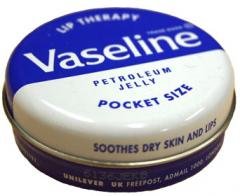
The final item of the basic kit tends to ride outside of the pouch but within the plastic bag. This is a small tin of Vaseline. These are sold for chapped lips, but Vaseline has a number of other uses and can be applied to cuts, grazes, bites and chaffing. The little tin is easily refilled from larger containers.
These are the contents of my medical kit, but not the limit of my medical items.
Insect repellent and sun-cream are usually carried where they are readily available.
There are some additional plasters and painkillers in my emergency kit.
My washing kit contains standard bathroom soap which is one of the most useful antiseptics that you can carry.
I also carry a supply of blood pressure medication and the other varied tablets a man of my advancing years seems to need.
I have a tendency to migraine attacks so I intend to add extra diclofenac to my medical kits.
I might add some tampons to the kit. As well as the obvious use, they can be used with the plasters or bandage to staunch freely bleeding wounds.
If you are involved in activities such as hunting, then some field dressings and the knowledge of how to use them is advised. Carry them where they are readily accessible.
Categories
Phillosoph

Some Thoughts on Money

Money has been a recurring theme in this recent holiday.
Most obviously we were travelling in Greece, which is undergoing a financial crisis.
This required me carrying far more cash than I would usually do since for a while the cash machines were offering a limited service at best.
My own finances were also somewhat turgid, our trip being necessitated by my girlfriend’s son’s visa being about to expire. We had to spend a week out of the country even though recent other expenses had made this a bad time for me to be spending.
If you have been considering buying any of my books or using the donation button, now would be a good time, thank you.
One store in town had a counter top covered with a variety of foreign bank notes under glass. Quite an impressive collection.
I took my girlfriend and her son there to see a British one pound note (long since discontinued). There was also an American $2 note and another note with a grinning Saddam Hussein.

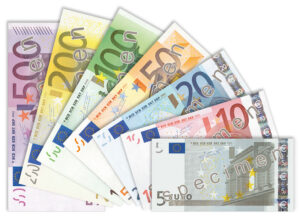
Something that came to my attention on this trip was the similarity between certain Euro notes.

Both the fives and twenties appear a blue colour, the tens and fifties a red.

They look distinctive in the above picture but in practice it was quite easy to confuse these if you were not careful.

Given that the Euro is a relatively new banknote design, it is a little surprising that more thought did not go into its design.

British banknotes, for example, are different colours. £5, £10, £20 and £50s are respectively blue, brown, purple and red. £1 notes were green and the £1 notes still issued by some regional banks are still this colour.

Some series of notes also featured a distinctive simple shape in this colour. For example, the £5 a blue circle, £10 had a brown/orange diamond, the £20 a purple square and the £50 a red triangle. (The current £20 seems to have dropped this feature)

These shapes were designed to further aide the partially sighted. Different denominations were also different sizes. I have been told that the visually handicapped were provided with a little gauge they could use to measure the length of a note to identify it.

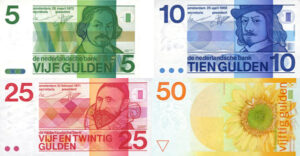
The now discontinued Dutch Guilder notes took this a step further by providing raised tactile markings to assist the visually impaired (the dots and triangles).
One might have hoped the designers of the Euro would have drawn on these sources for inspiration, but apparently not.

Some Canadian notes have tactile markings for the visually handicapped and it is apparently planned for some US banknotes.

It would, however, be more useful if this became a universal feature. Next year the Bank of England plans to issue polymer banknotes. This would be a good opportunity to introduce tactile markings but I expect this will not be exploited.

An even better system would utilize unified braille, catering for partially sighted visitors not familiar with the local system of symbols.

"Ecotopian bills seemed comic when I first saw them. Yet three weeks later I find them more attractive than the greenbacks left in my wallet. Very romantic in style: lush, Rousseau-like scenes, almost
tropical, with strange beasts and wondrous plants. No images of famous Ecotopian leaders—when asked why not, people just laugh. Maybe it’s a consequence of their informal, utilitarian attitude toward money— they bundle it up into rolls and toss it to each other in an offhand manner I've only observed among gamblers."

"Ecotopia" by Ernest Callenbach.

Categories
Phillosoph

Back Blogging: The Sewing Kit

Back from my trip abroad!
In my last post I described how baggage restrictions limited what I could take with me.
Since we were restricted to cabin baggage only, I was unable to take along my Swiss Army Knife, mini-leatherman or even the little penknife and can opener that usually rides on my keyring.
I will admit that there were several times I missed these tools. I doubt a trip of more than a week would be practical without them.
For one thing, my nails grow rather fast and need regular trimming.
One item I did insist on taking was my medical kit, although I removed the haemostats from it just in case there were any objections.
Most of my general emergency kit remained at home but I did decide to take my sewing kit from it and stow it with the medical kit.
I think it is seldom that I have had a trip where the sewing kit was not needed. Something about being far from home seems to increase the likelihood of breakage.
For this particular trip, its use was more mundane.
My girlfriend wished to modify her bikini to reduce the area of tan lines.
She was initially dubious about the “invisible” thread in the kit but once she tried it was of the opinion that it was rather clever.
As an amusing aside: One restaurant we frequented showed videos from a fashion channel, often promoting bikinis and swimsuits.
My girlfriend is Brazilian, and what many fashion designers regard as “daring” and “sexy” my girlfriend considered “massive” and “suitable for grandmas”.
My little sewing kit fits in a plastic tube of about 1 cm diameter.
At the bottom are two generic white shirt buttons. It also contains five safety pins, one needle, one sailmaker’s needle, a piece of silk, and a length of invisible tread wrapped around half a used matchstick.
The sailmaker’s needle is magnetized so can be used as a compass. It is wrapped in the silk to keep it isolated from the other metal items and can be remagnetized by stroking it with the silk, or the magnet with my penknife.
The safety pins can be used as general pins to hold things together while sewing.
Since my sewing kit saw use this trip, I replenished it yesterday.
To each needle I added about a foot of doubled invisible thread so they are ready to use in the future without any fiddling about.
Sewing is easier if you keep a relatively short thread on your needles and you have less trouble with knots undoing if you simply double the tread and join the ends in an overhand knot.
Several metres of extra invisible thread were wrapped around a new used matchstick and added to the kit to replace that used by my lady.
A repair item that I did not have but would have liked is my little roll of electrical tape.
My hand-powered torch from the 99p store got dropped out of the bag and the plastic lens holder broke. Having some tape and/or a small tube of superglue, as found in my larger kit, would have been useful.
The medical kit did see some use.
My lady rather misjudged how much sun she got on the final day and was in considerable pain since the nearly empty after-sun lotion got left behind.
She had also had something of an allergic reaction to something she had encountered while horse-riding this trip.
We had to buy some expensive products at the Duty Free, one of which she informs me contains so much yogurt it is edible.
Using yogurt for sun-burn is something one of our new Greek friends had introduced me to that very trip!
The painkillers in my kit did provide some relief from her burns, and the TCP in the kit had some effect on the allergy.
I did suggest she try the Oil of Olbas on her skin too, but she stuck with the TCP.
More details on my medical kit and other topics in future post.
Categories
Phillosoph

Away for a Week!

This will be the last post on this blog for a short while. For reasons I will not go into I am obliged to spend a week out of the country so will be taking a short holiday.
One of the great things about having a partner who is both intelligent and practical is that I can confidently leave important arrangements to her without any worries. She organised the flight leaving me to simply pack my own bag.
My first thought was to locate my holiday rucksack. This is a fine item with six large external pockets covering three sides. It is the sort of rucksack that converts into a suitcase with the harness covered so that it does not catch up in airport luggage conveyers. Clothing packs into it nicely and the pockets allow me to locate items in a moment. For such a short duration trip this bag has ample capacity so I offered to carry stuff for my girlfriend and her son too.
Things now get interesting. The flight has been booked with a certain budget company and one of their idiosyncrasies is that passengers only get cabin luggage in the price. Hold items require a hefty additional charge. Cabin bags above a certain size also incur an additional charge.
This has made me think good and hard about what I will actually take with me. Everything must fit in a smaller “cabin legal” bag. Usually I would comply with security restrictions by putting my penknife in my hold bag. No hold bag means I cannot take along this most useful of implements. The haemostats that I keep in my medical kit have also been put aside.
This is proving to be an interesting exercise. Future blogs will cover what I decided to take, what I decided not to take, and how things worked out.

Categories
Phillosoph

Cloaks and Plaids

Yesterday’s post provoked some comments from a Scottish friend of mine. These had the consequence of reminding me I had intended to blog about the plaid as a logical follow up to my post on cloaks.
The first obstacle here is one of terminology. “Plaid” essentially means “blanket”. A “belted plaid” was a blanket held in position by a belt. At some time in America’s past tartan patterned woollen shirts made of blanket material became commonly referred to as “plaid shirts” and the word got redirected to refer to the pattern rather than the material. Americans consider “plaid” and “tartan” to be synonymous but historically it will be seen that this was not the case and this use of “plaid” is inaccurate and confusing. In this article plaid refers to a garment, not a pattern.

The plaid will be more familiar to many people in two derivative forms. One is the kilt, a relatively modern addition to Scottish costume. The kilt simulates the appearance of wearing a plaid without the rather involved procedure of putting one on. The other derivative is a tartan sash worn as part of some Scottish costumes and uniforms. This simulates the upper part of a plaid. The plaid is sometimes called a “great kilt” but as far as I am aware this is a relatively modern term and likely to be a backronym that came into use after kilt wearing became common.
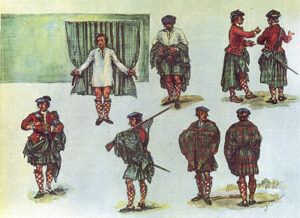
So what is a “real plaid”. As the name suggests, it is a woollen garment, effectively a blanket 60” across and 4 to 5 yards in length. A common method for turning this into a garment is to lay an belt on the ground and lay the plaid over it. The plaid is then folded and pleated to the wearer’s satisfaction. He then lies on the plaid, gathers it around him and fastens the belt to secure it.

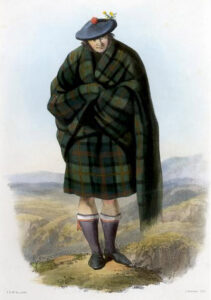
As commonly seen, a plaid appears to be of two parts. That below the belt resembles a kilt (or in fact the reverse is truer!). The upper part passes up the back and over one shoulder as a sort of sash, often held by a large broach.
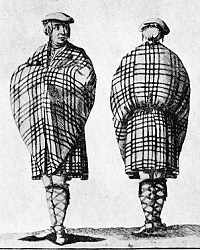
In actuality the upper part of the plaid can be spread out to cover both shoulders and keep the wearer warm, much in the same manner as any cloak. If it was raining or especially cold a fold of plaid might be passed over the head too.

This was not the limit of the plaid’s abilities, however. A Scotsman who found himself outdoors at night simply lay down, unbuckled his belt and rearranged his plaid so he was cocooned in a capricious blanket. As many readers will know, wool remains reasonably warm even when wet. The wool used to make plaids had the lanolin left in it so the cloth had a certain degree of water repellence. Next morning the Scot would rearrange his plaid, fasten his belt and stand up and be on his way.
As you may now appreciate, the plaid was an interesting variation of a cloak. While on the topic of Scottish clothing, a few interesting facts uncovered in my researches. Contrary to the usual Scottish jokes about kilts, it was apparently acceptable to wear a plaid over trews. I have seen contemporary illustrations of this but unfortunately have not located any on-line. For a big chunk of history, however, the Scotsman did not wear much more than his plaid. Socks and other foot coverings took some time to catch on, apparently and the Scots were noted for going bare foot and bare legged. Their main garment, other than their plaid was a shirt dyed with saffron. Apparently the latter had insect repellent qualities.

Categories
Phillosoph

Gird your Loins

It has been a while since I posted anything, but hope to rectify that soon.
As some of you may know, one of my many interests is in language. The other day I used the phrase “gird my loins”. It occurred to me that “gird” is an interesting verb that is nearly exclusively used for just this one phrase. It obviously has a connection with words such as “girdle”.
Today somebody pointed me in the direction of this on the Art of Manliness site.

A more extreme version of girding your loins before a fight was undertaken by Moro suicide murderers: “A strong band was wrapped firmly around the waist, and cords wrapped tightly around the genitals, ankles, knees, upper thighs, wrists, elbows, and shoulders, restricting blood flow and preventing the mag-sabil from losing too much blood from injury before accomplishing his gruesome task.”
Categories
Phillosoph

Tolerance and the Burke on the Bus.

Let me give you a hypothetical situation: You are sitting on a bus. A few seats ahead of you a man pulls out his phone. For ease of reference we will call him “the burke”. The burke begins to talk into his phone, loudly, in some language you cannot understand. His conversation goes on for five minutes, then ten and then fifteen and shows no signs of ending.
Would you find this irritating? I know I would, but why?
Permit me to set some background to today’s blog topic. A few days ago my computer at work picked up something nasty by some unknown route. Our computer guy decided that it was simplest to just rebuild the operating system. This will save the few files I had on the machine but will erase the useful programs I had installed. Once again, I am going to remind you all to backup both your files and your program installers I have been without my work computer for this time so I began to investigate my colleague’s book shelf. I picked a copy of what I thought was “King Solomon’s Mines” and saw it was actually “King Solomon’s Ring”. Not a sequel, as it turned out but a highly entertaining and informative book on animal behaviour by Konrad Lorenz. Finishing the book within a day I noticed another book by him, “On Aggression”. A lot of interesting things in this book, and this gave me some insight on why the “burke on the bus” can evoke such strong emotions.

What I learnt was that a culture or subculture has a collection of common habits/ rituals/ customs/ mannerisms. These are so omnipresent in our own culture that we will not be aware of many of them until they become notable by their absence in others. On the buses that I was used to when growing up people tended to be silent or talk at a discrete level. In some countries I have visited the inside of a bus sounds like a fishwife riot. It can be argued that mobile phones have created a change in social norms. That may be so, but it is not really relevant since social norms are not necessarily logical or functional but they are powerful. They are habits that will be strongly ingrained. Some of these conventions are very subtle, such as head position and other mannerisms when paying attention to someone. These can differ between different cities or social groups and encountering different mannerisms can cause wires to get crossed. I once watched a film from Africa. As one character explained something the person he was talking to made an “uh-ha” noise every few seconds. If someone I was addressing did this I would be inclined to perceive them as being rather moronic, irritating or possibly mocking me. To the Africans in the movie this was good manners and they would probably perceive my way of listening and paying attention as boredom and rudeness. Customs that are common in one subculture are repugnant in others. Walk the streets of Hong Kong for a day in the right season and you will hear someone hawking and spitting about every five seconds!
For many people on this bus the burke is violating at least one social norm as they perceive it. It may be in the sub-culture he is from people do talk loudly in buses so he is oblivious that this is not common where he is now. That he is not speaking English and that he assumes his conversation will not be intelligible to his neighbours may have an influence here. Whether he is operating in ignorance or arrogance is irrelevant. To some observers at least he is a social transgressor. A common selection of social norms is said to be a way of social bonding. What is apparent is that violation of these norms causes feelings of tension, discomfort, irritation, anxiety and even aggression.
There is another reason why the burke on the bus stirs such negative emotions. By talking loudly in public he is effectively announcing that anyone in earshot is irrelevant to him. Now, we do not expect a complete stranger on a bus to have any particular affection or concern for us but openly rubbing our noses in this fact is another matter. Unintentionally or not, the burke is effectively insulting everyone else present and our subconscious responds accordingly.
Sometime ago I visited a webpage where the author said something on the lines of “…I know this is about a British game but I am American so I will be spelling it ‘armor’!” It is hard for me to recall that without imagining him finishing with a smug, self-satisfied grin. This statement irritated me and my recent readings have explained why it was actually offensive. That an American should use American spelling is not an issue. What was offensive was his statement was attacking and demeaning English conventions. Before some of my American readers dismiss my reaction as oversensitive consider how you would react if a blog started with the declaration that words would be spelt “properly” in English fashion. Exactly!
As an aside, the reason why many words are spelt differently by Americans is that Noah Webster deliberately changed the spelling to promote American cultural identity. The cultural norms we are discussing include such factors as accent, lexical register, word choice and so forth. It is a common if somewhat juvenile occurrence for sub-cultures to deliberately change their vocabulary to promote cohesion.
Returning to the burke on the bus (who is still talking, no doubt!). He is violating at least one social norm and provoking negative emotions in his neighbours. Most social animals also have a collection of rituals/ laws/ social norms. On the rare case that a member of the group violates these rules it usually provokes immediate censure, sometimes by the rest of the flock/ group. The birds/ monkeys/ wolves descend on the miscreant, pecking and biting and it is soon made clear to him or her not to repeat those actions. Sadly, this will not happen to the burke on this bus. A social norm in many cultures is to mind your own business and avoid confrontation with strangers. Our custom of tolerance of different customs in this incidence promotes violence and friction. So the burke keeps on talking and those around him become more irritated and quietly seethe. I have frequently observed that trying to please everyone usually results in more people being dumped on and the inconsiderate individual being rewarded. The burke never learns better and more people suffer. When aggression cannot be applied to its cause it is often redirected in displacement behaviours. Human nature is such that many passengers will leave this bus and instead of feeling irritation at the uncouth burke will redirect these feelings into a more generic routes. It may become a more generic resentment of foreigners or immigrants
We are so imbued with our own cultural norms we have difficulty perceiving them yet they are very real factor in human relationships. I am fond of saying “tolerance works both ways”. I once encountered an American whose pet topic was a discourse on the “evils of diversity”. His (dream) world-view failed to understand that there are numerous variations in cultural norms between cities or within a single district. Whether you like it or not, any human society will contain multiple cultures. In a multicultural world all sides must strive to find common ground and adapt their habits and customs as necessary.
Categories
Phillosoph

Baton Thongs

Did you notice my “deliberate mistake” in the first draft of the previous blog? As I typed “wrist loop” something nagged me to use another term, but “martingale” is rather obscure these days, certain dictionaries no longer acknowledging it.
For a weapon such as a baton a wrist loop should never be used on the wrist! If it is and the baton is grabbed by an aggressor you will find yourself undesirably under their control.
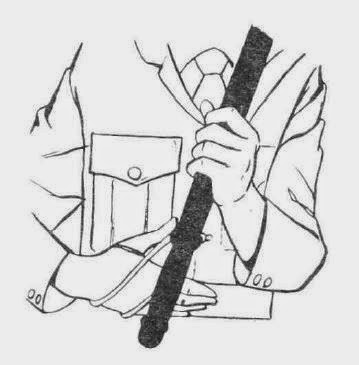
The correct way to retain a baton is to use the loop as a thumb loop. Hook it over your thumb, let the thong go around the back of the hand then grasp the grip. If the baton is seized you can just open your hand and let the loop slip off your thumb. Counter attack before the aggressor realizes you have let go.
Most batons you will encounter will have the thong mounted at the butt of the baton. The FBI Baton Manual (which is well worth a read, btw) recommends the thong is mounted above the grip and is about twice as long as you might expect is needed. Once again, the thumb is used. With this thong you have two options. The first is to let the thong hang down the back of the hand and then grasp the grip. This is effectively the same as the method already mentioned for a base mounted thong. The second method is to first let the thong hand down your palm, then take it up the back of the hand and pass the grip over the top of the hand and into the palm.

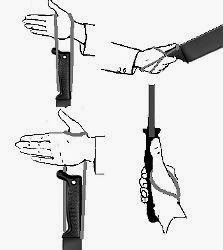
All of these methods wrap the thong securely around your hand but allow the weapon to be rapidly released if grasped. Those of you that brought my book on Survival Weapons will be familiar with the illustration below. This shows the same methods being used for a machete. Having a machete fly out of your hand when you hit a resilient piece of wood can make you unpopular so a thong is recommended!

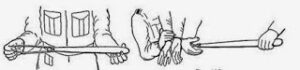
A long thong on a baton has other applications. Below is an illustration of a restraint. Both of the suspect’s hands are passed through the loop and it is then twisted and rolled around the baton to tighten it. A second way to use the loop is taken from Fairbairn’s “Get Tough”. The suspect does not have multiple arms! This shows the thong being tightened around the wrists of several prisoners so that they may be led.