Disclaimer: “As an Amazon Associate I may earn from qualifying purchases.” Adsense and Infolinks were no help at all.

If you have enjoyed this article or it has been helpful to you please feel free to show your appreciation. Thank you.

Read The Third Wave by Alvin Toffler!
Categories
Phillosoph

Lathis and Police Canes

For once, I will not describe the convoluted threads of thought that caused to research “Lathi”. Many definitions of Lathi have it as a bamboo stick of about five foot length, often with the ends bound with metal. Lathi actually means “stick” and the examples that seem to have been used by Indian police in more recent years seem to be shorter. Readers of previous blog posts may be recall my post on HG Lang’s book on Walking Stick defence, based on Vigny’s La Canne techniques. Lang’s recommendation was a light walking cane of malacca or ash root. It used velocity and fast manipulation by the wrist for effect rather than weight. Lang was an officer in India and mentions that some police forces there had shown interest in the ideas. Possibly the switch to shorter lathis for police use was influenced by this.
What is of particular interest is that the bamboo lathi seems to be being phased out. This article here sets the scene.
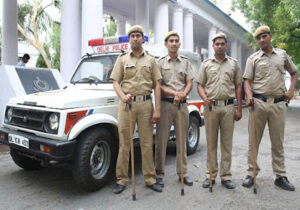
The upshot of this is that if you google “lathi” you will get a large number of hits offering you the plastic replacement. The suppliers, who are keen to sell these, call them “lathi”. I note that the article above seems to avoid calling the new version a lathi. “Lathi-charge” has similar connotations to terms like “baton round” in some other countries so I can see the Indian police might want to disassociate from the term.
Because so many companies are keen to market “lathi-replacements” gathering some data about the items was much less of a task than much of my research.
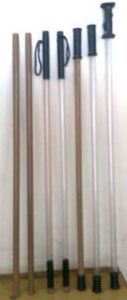
The sticks are about a metre long and 25 mm external diameter. They are made of polycarbonate. On one end is a 6" handle with a thumb loop ("wrist loop" is a misnomer for batons!). One site describes this as “mock-leather” so it is probably some form of rubber-like polymer. On the other end is a 4” cap, apparently of similar material. Surprisingly, the sticks are actually tubes! Internal diameter is given as 17 mm or 19 mm, giving wall thicknesses of 3 or 4 mm. One site gives the weight as around 350 g/12 oz. Sticks/ canes are available in black, khaki and clear.
One question that occurs to me is why such a subdued choice of colours? I think the police are missing a few good tricks here. Suppose we have “cop canes” in a nicely visible light blue? You do not even need to cast them in a new colour of polycarbonate. Pour a cup full of paint down a clear tube, pour it out again and you have your blue cane.
In “Kill or Get Killed” Rex Applegate talks of the psychological effect on a mob of being confronted with an obviously disciplined force with “white baton, white helmet and white gloves”. Highly visible metre-long blue batons would have the same effect. Blue batons would make officers more visible, useful when operating with police helicopters. Waving a blue cane above your head will alert comrades and civilians to the location of an officer. The highly visible cane has obvious applications for directing traffic or civilians. Held in two hands it can be used as a barrier to keep crowds back. Doubtless we will soon see a vocabulary of signals that can be made with the baton, useful when radio communication is not practical.
What is not apparent in the above article is whether these polycarbonate canes will just be issued for riots or will be carried routinely when on the beat. Personally I think the latter is the better option, at least for cops that walk beats rather than ride in cars. Police actually walking the streets seems to be on the decline in many cities. I think this is a mistake. Patrol cars are good for responding to crimes and traffic enforcement. Patrolling on foot detects and deters crime and other anti-social acts.
A long cane will be a great asset for a cop walking a beat. Firstly, it serves as a walking cane, and is useful if the ground is slippery. A cane will generally be carried in hand rather than worn on a belt or in a pocket. This means it can be rapidly brought into action should a sudden threat arise. The length of a cane gives an advantage against attacks from weapons such as knives or bottles. The officer has a chance to disable an attacker before he can close distance. The length of the cane allows the officer to strike targets such as the legs that would be difficult to reach with a truncheon or shorter baton. A cane is sufficiently light enough that the officer can still carry a PR24, flashlight or other impact weapons in addition to the cane.
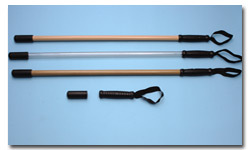
How to use a “police cane”? Given the light weight of these canes HG Lang’s book and techniques are the obvious starting point. Lang describes strikes to the head, throat and chin but primary targets for police use will be the limbs, it being understood that in this context this includes the trapezius and clavicle regions. The reach of the cane allows a fast painful strike to be snapped into the leg, arm or hand, as required. For closer ranges some of the techniques in my book such as the bumper method can be used. The rubber-like caps at either end of the cane allow thrusting and striking techniques with the ends with less risk of excessive damage. A variety of locks and restraining moves can be made with a metre long cane. I detail the principles behind these in my book. For a wealth of examples consult “Stick Fighting” by Masaaki Hatsumi. The FBI Baton manual and the baton and long baton sections of “Kill or Get Killed” are also worth a view.
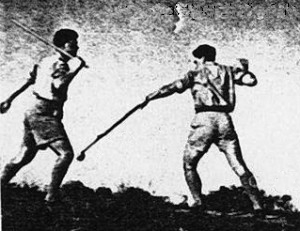
The tubular construction of the cane offers some interesting possibilities. If the canes prove to be too light a second, smaller tube or other material can be inserted inside to increase the weight. A small diameter flashlight, inserted in the handle end would turn the can into a metre long lightstick: which would make it look like the police are armed with lightsabres!
The police cane has much to recommend it. Having such devices “readily to hand” may mean less recourse to more lethal defensive measures.
Categories
Phillosoph

Of Boxers, Chariots and Fandom…

Given that I am the author of a comprehensive martial arts and self-defence book you might assume that I have a considerable interest in boxing. Those of you that have invested in a copy of my book will know that I do not underrate the potential potency of a trained boxer in a fight. Professional boxing, however, is of very little interest to me so I have not been paying much attention to the hype surrounding the Pacquiao-Mayweather fight. A considerable number of real life concerns has meant that it was only this morning that I heard about the size of the fees involved for this fight. 
The purse for this fight was set at $300 million to be split 60/40 in Mayweather’s favour. Additional funds will come from pay-per-view royalties and various other sources. It is an amazing amount of money for a single fight. A mere pinch of this could solve most of those real life concerns I mentioned. Some people will say that it is wrong for sportsmen to be paid this sort of money but it is worth remembering the boxers are only getting a fraction of the actual money involved. The promoters and TV companies must be making many, many times this. Is it really wrong that the fighters who take the blows get a reasonable cut of this fortune? Both fighters have trained and worked hard to get to where they are and a career in professional boxing is not without considerable real risk.
Yesterday my blog was about competition and I touched on the role sports can play in redirecting certain traits of the human psyche. Professional sports are one of the better value means to do this. The money paid to many professional sportsmen may seem obscene, but it is a fraction of the money the sport actually generates. Most professional sports factions are profit making and therefore self-funding. A team that fails to make money probably lacks a sufficient fanbase and is not that effective in fulfilling its sociological role, it can be argued.
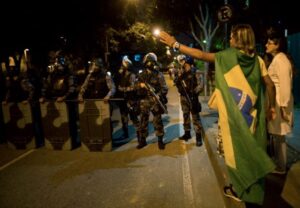
As I pointed out in the previous blog, not all sporting diversions are desirable. The Olympics is a good example of a very poor investment in time and money. Thousands of millions of dollars spent for just a couple of weeks of sport. Many of these sports generate so little interest tickets are given away for free to try and fill seats. The up and coming Olympics in Brazil is being used as an excuse for a land grab. Thousands of poor people are being forced out of their homes at gunpoint. Across the span of two decades it is estimated that the Olympic games have displaced more than two million people, often the most disadvantaged in communities. So much for peace and brotherhood through sport!

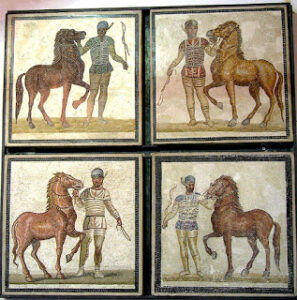
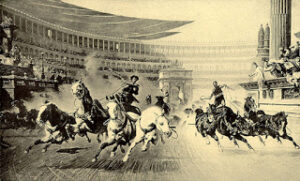
Following a faction or professional team is nothing new. “Circuses” of “Bread and Circuses” refers to chariot racing, Rome’s most popular sport. The chariot racers were divided into four factions, each with a distinctive colour. Fans would wear these colours and cheer for their chosen side. The emotional investment in their team would be familiar to anyone who has encountered modern day sports fans. Gladiators were also idolised and subject to marketing, souvenirs etc. Gladiators were followed as individuals, more like modern boxers. I have not yet found any references to fans favouring specific ludi. I don’t doubt that both sports had their “stats freaks”.

I have added a new link to yesterday’s blog. The comments at the start about the social role of the races is interesting:
“For the people—who once conferred imperium, symbols of office, legions, everything—now hold themselves in check and anxiously desire only two things, the grain dole and chariot races in the Circus” (Satires 10.77-81)…… Juvenal has put his finger on two of the most important aspects of Roman chariot races—their immense popularity and the pleasure they gave the Roman people, and the political role they played during the empire in diverting energies that might otherwise have gone into rioting and other forms of popular unrest.
Categories
Phillosoph

Utopia and Competition.

Recently I have been rereading Masamune Shirow's Appleseed books. Shirow’s writing style can be intricate. Often the reader encounters events that appear to have no connection to the storyline. The motivation or consequence of certain actions and threads are often not clear. The true loyalties of certain characters can be unclear too. In some instances this may reflect the subjective viewpoints of the main characters. They are involved in actions and conflicts but the movements of the greater political wheels and gears that drive them are invisible to them. Certain parts of a thread evidently happen “off camera”. For example, the character “Doric” is introduced as an infiltrator in Book 3 but does little except engage the protagonists in light dialogue. The next time Doric appears her allegiance to a foreign power seems to be well know and the relationship seems to be guarded but not overtly hostile
The reason I felt inclined to reread this work is a philosophical thread running through the first two books. The nation of Olympus is portrayed as being as near to a utopian state as mankind has been able to achieve so far. This, however, brings its own problems. Other nations resent Olympus’s influence and attempt to compete, undermine and subvert the nation in various ways. The rulers of Olympus identify a far greater problem with the potential to not only destroy Olympus but to plunge humanity ultimately into extinction.

As one elder explains “The core problem is that you can’t have a perfect society without perfect people.”…. “The society creates the people, and when the people come together, they create the society……..use ordinary people and all you get is an ordinary society”. In Olympus they have attempted to address this problem by making a significant proportion of the population, including its administration, of bioroids. Bioroids (in Appleseed) are a type of clone designed to be more rational and less emotionally extreme than “original” humans. Their duty and motivations are towards the welfare of the human species as a whole rather than towards themselves as individuals.
Not being as ruled by extremes of emotion as humans, the bioroids find themselves at a disadvantage grasping the potential extremes that human behaviour can reach. Once they see the problem they debate it with the nation’s government computer, “Gaia”. The bioroid council are supposed to be the “emotional interpreters” for the computer. Unfortunately the Gaia computer concludes the best prospect for the human race is the destruction of the Olympus utopia. Humans in a utopia will either stagnate or human nature will cause its self-destruction and a conflict that will destroy the rest of humanity. One human character describes Olympus: “I thought it was good here too…at first. But it’s not dreamland. It’s..it’s a zoo. A zoo for those weird animals that build their own cages and hide inside them.” How mankind would survive the likely word-wide conflict the power vacuum the destruction of Olympus would create is not explained
 If we ignore the science fiction elements in the above scenario we still have some important concepts to consider.
A utopian society implies that its members are immune to many of the harsher aspects of mother nature. Food, shelter and water are abundant. Children can be raised safely. Members are free from predation, both from their own species and other species. In some modern societies we can see some of these traits evident to a lesser degree. What we often see is that such advantages are not generally appreciated for the value they have. In many cases they are so much taken for granted that they are mislabelled as “rights”. People become soft and complacent.
One of Shirow’s characters briefly mentions a “domestication effect” and that members of a society would “channel stress into aggressive behavior”. “Stress” may not be the best translation here but I think we can understand what is being said.
If we look at a creature such as a lion, it seems happy to spend much of its time sleeping and raising cubs. It hunts when it needs to. It defends its territory and competes for a mate when it must. If we consider a human living a similar bare subsistence existence we see a much greater inclination to competition. Despite the struggle of keeping the family fed, the human will still find numerous ways to compete with their fellows. Some of these competitions have obvious prizes such as status to win mates or the expansion of territory. Many, however, are games or pastimes where the reward is pride or some other abstract of no real value.
The Romans summed things up neatly with “Bread and Circuses”. As well as food, shelter and other necessities humans also needed entertainment and distraction. “Bread and Circuses” is still a mainstay of government, the only difference being that it has now been realized the great unwashed can be made to pay money for such things. Many of our diversions are competitive in nature. When we do not have obvious tribal differences we create them. People invest their emotions into the fortunes of a particular sports team. They may not be from the region the team nominally represents, possibly not even from the same nation. I have met loyal Manchester United fans from as far away as China and Japan. The majority of a professional sports team are often not even from the same country, let alone the town they represent. When we lack actual competitors we will often create them. Sometimes this is simply following the fortunes of a particular team. Other times it can be based on divisions along social, economic, racial, religious, ideological and national groupings
Competition is necessary and unavoidable. Humans seem to have a need for it. A working utopian society would probably need to provide some form of healthy outlet for such inclinations. Ideally these would take the form of self-improvement activities whereby the individual challenges themselves and reaps some benefit in fitness or knowledge. Most likely for the majority this will be the easier route of following the exploits of some team of theirs against others.
A key phrase in the above passage was “healthy outlet”. The human need for competition can be met by conflict and warfare. Historian Niall Ferguson has made the observation that many human conflicts, whatever the apparent economic or ideological motivations can be boiled down to a conflict between different ethnic groups. While some people will choose to interpret that as justification for racial conflict I believe it is simply division along the lowest common denominator of social grouping. In many village societies sports such as wrestling or singlestick were often important. It allowed the young men of the village to compete against each other or neighbouring villages without too much likelihood of bloodshed or permanent injury. Perhaps the correct solution to football hooliganism would have been to provide areas where “firms” of consenting hooligans could have fought away from innocent bystanders and property.
Competition that disrupts a society is obviously unhealthy. So too is competition for disproportionate rewards. In the novel “Starmaker” by Olaf Stapledon the narrator observes of the civilizations he views:
“We were inclined to think of the psychological crisis of the waking worlds as being the difficult passage from adolescence to maturity; for in essence it was an outgrowing of juvenile interests, a discarding of toys and childish games, and a discovery of the interests of adult life. Tribal prestige, individual dominance, military glory, industrial triumphs lost their obsessive glamour, and instead the happy creatures delighted in civilized social intercourse, in cultural activities, and in the common enterprise of world-building.”
We are persuaded to buy new cars and other products we do not need supposedly to impress friends, neighbours and strangers. Often the opinions of people that do not matter or should not matter to us. Nations and societies are just as guilty. Despite economic problems, the UK spent thousands of millions to host the recent Olympic games, even though few Olympics have ever produced a profit for the hosting nation. The medals won have little real value. The army, health service and police services have all undergone funding cuts and downsizing due to the money wasted. Brazil has hosted the World Cup and will soon host the Olympics. Not only will the nation lose thousands of millions but the events are being used to steal property from some of the poorest elements of that society.
The philosophical concepts Appleseed raises are though provoking and I wish Shirow had pursued these threads further. But, as he says himself, he is just an artist and does not have all the answers.
Certain educators have tried to teach kindergarten children not to be competitive. Competitiveness is apparently an inherent and strong trait of the human psyche. Attempts to eliminate it are doubtless doomed to failure. What is needed is for our competitiveness to be educated along more rational rather than emotional imperatives. We need to learn to view competition and realize sometimes the result or prize does not actually matter! Warfare for defence is necessary. Warfare for national prestige/ patriotism/ religious dogma is seductive but false. Pride in your society/ nation/ self is a state of mind and should not require a vast expenditure of money that cannot be afforded.
Fights are not the only conflicts that we need to pick wisely!
Categories
Phillosoph

Grand Theft Autocracy

This weekend I was reading a short story and came across this passage:
"Society," mused Jadiver. "I always did think it was better to rob the rich … like Robin Hood."
"Sure," Burlingame said.
Jadiver tilted the glass. "Especially since the poor don't have much money."
"That has something to do with it," Burlingame cheerfully agreed.
Cobber broke in. He was a little gnarled man, older than the others. "A point, Jadiver. The poor don't have much money, but there's so many more of them. You can actually be more successful robbing them. But you have to keep at it every day in the year, and then you don't call it robbery; you say you're governing them."
Tangle Hold by F.L. Wallace
Yesterday, a friend sent me this interesting article which nicely echoes the above sentiment.
Grand Theft Autocracy.
Categories
Phillosoph

The War Arrow and The Deserter

Some of the articles posted on this blog are written just a few minutes before they are posted. Others are started some time in advance and may undergo several rewrites or modifications. Inevitably for me, some of the latter get delayed while other topics take precedence.
Around Christmastime I was drafting a couple of articles on cavalry swords. This lead me to some examination of cavalry tactics being used in the late 19th and mid 20th centuries. The widespread use of repeating weapons had a considerable effect on cavalry tactics. They did not, however, render the cavalry “immediately obsolete” as so many uninformed “experts” will tell you. Cavalry remained a useful asset until at least the 1940s, well into the age of repeating weapons and machine guns. I will discuss this in later blogs.
A side branch of this train of thought had me recalling an unusual western called “The War Arrow”(1953). In this movie a cavalry officer recruits some displaced Seminole Indians to help fight an aggressive faction of Kiowa. The officer trains his force in some unconventional (although appropriate) tactics. At one point in the movie another officer exclaims in scorn “…digging holes! Firing dismounted! Charging with just four men at a time!” The last part in particular is unusual and I wonder what source the script writer was using.
The unconventional training in this movie reminded me of another movie seen in my childhood. The officer recruits some of his force from the guardhouse and has them wearing buckskins rather than uniforms. The only bit I could really remember was that during training there was a duel with tomahawks. It has taken me several months to identify this second movie. My recollection was that one of the combatants was an imposing figure, someone like Woody Strode. Yesterday I successfully identified the movie as “The Deserter”(1971). As it turns out, the tomahawk duel in the movie is not actually that good. Just lots of muscle against muscle. If you want some information on how to use a tomahawk more effectively, check out my earlier blog and invest in my book.
The Deserter is, however, an entertaining movie and some of the other ideas in it are more informative. Give it a watch!
Categories
Phillosoph

Handcarts and Alternatives

The last couple of posts have been on martial arts so today’s will be more survival-orientated.
Recently I saw a comedian who commented:
“We put men on the moon decades before we thought of putting wheels on suitcases.”
I have been researching a few other topics that are out of the scope of this blog, but a common thread that keeps turning up is that of handcarts.

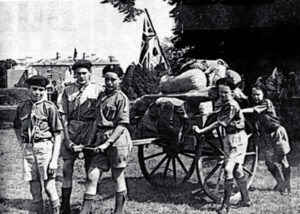
There was a time when every scout troop had at least one handcart to move their tents and supplies. Many of these would have been made by the troop themselves. Below is a rather nice illustration of a stretcher case suspended below a handcart. Perhaps the Scoutmaster was having a nap.

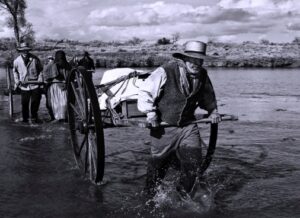
When 3,000 Mormons chose to migrate to Utah in the 19th century they travelled in companies of handcarts. Some of these families came from as far away as the British Isles and Scandinavia.

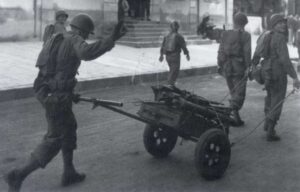
I have come across many photographs of handcarts in use during the Second World War. This is a nice webpage on the US military handcart. A couple of these could ride on the flatbed of a truck and still leave room for a squad or two of troops seated on the side benches. Handcarts are shown towed behind jeeps or riding in the cargo area of the jeep.

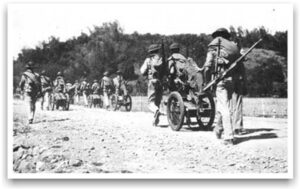
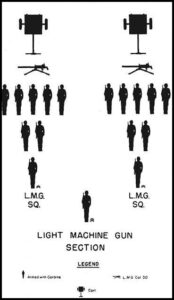
The picture below depicts a 1944 USMC machine gun section, and you can clearly see they had a handcart as standard equipment for each squad. As an aside, I note the 1944 MG squad had seven men and a handcart to service one M1919 MG. With one leader, a gunner and an assistant gunner that leaves four men to carry ammo and for local defence.

An equivalent unit these days has two MGs, seven men and no cart, which implies only one ammo bearer per gun. Modern troops are probably vehicle mounted but that is no comfort if you have to move the MG and ammo more than a few metres.

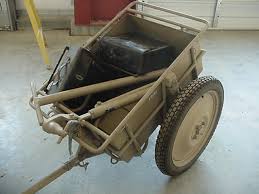
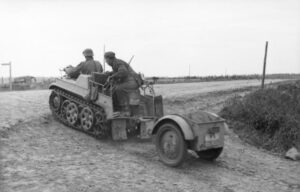
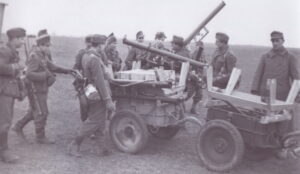
The German Army also made use of handcarts. These were designed so they could be towed by men, horses, mules, dogs or vehicles and even had their own tow hooks so a train of them could be constructed.

<
One thing that you notice about the military handcarts is that they are quite narrow. This is logical since the main place you would want them is where you cannot take a vehicle.
The handcart must be narrow enough to navigate a jungle trail or mountain path.
A “T” shaped shaft seems standard for military handcarts, probably since it can be more easily disengaged from than the “rickshaw” style of two shafts and a crossbar.
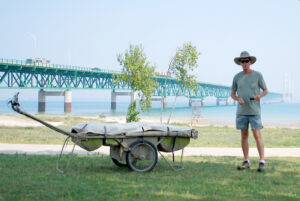
For some reason, modern outdoorsmen and soldiers overlook the utility of a simple handcart.
Some of you reading this blog will have created bug-out bags and perhaps even supply caches. How much better would your chances be if you also had a nearby handcart of additional supplies, water and equipment?
If you are building or buying a handcart there are obviously a number of features to look for.
We have mentioned the T-shaft and that narrowness is a desirable characteristic. Ideally a loaded military handcart should not be so heavy that a couple of men cannot lift it over an obstacle. If you are on your own you may want something lighter.
Being able to float the cart across a river is a desirable design feature. Some carts I have seen are narrow but about five feet long, making them suitable for transporting an injured companion in an emergency.
It may be useful if you can convert your handcart into a sled or pulk when weather requires. In fact a sled or pulk may be a good starting point for a handcart construction project.
I’ll end this discourse by looking at a few interesting alternatives to the handcart.
Wheelbarrows can be used as emergency handcarts. They have the merit that in some neighbourhoods they are fairly common.
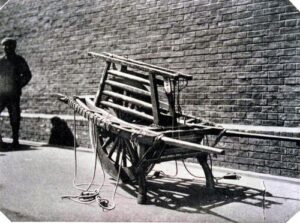
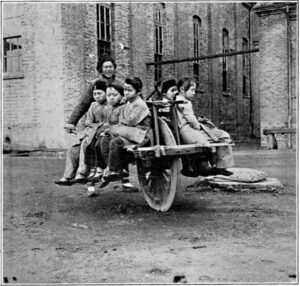
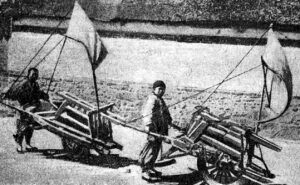
An extension of this idea is the Chinese Big Wheel wheelbarrow. You may need some skill distributing the load in a balanced fashion but it is evident these can handle heavy loads and quite rough terrain.

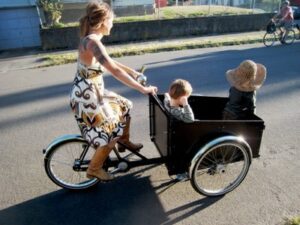
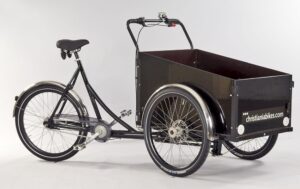
Another alternative is the Christiania Bike. (I know it is a trike, but they are usually called bikes!).
If you have visited Copenhagen you will know these are a common sight in that city.
Young Danish mothers use them to transport their children to school and then pick up a heavy load of shopping.
After dark, you sometimes see drunk couples returning home in a Christiania bike.
This culture of cycling everywhere may explain why nearly every second woman in Copenhagen is worth a second look!
The Christiania bikes are very nicely designed.
In most of them the large box at the front contains a smaller box that serves as both a seat for passengers and a locked storage compartment.
The Christiania “as is” is not really designed for rough terrain but the basic idea could be adapted to use mountain bike tires and gearing. Add a few lifting handles. One might even design it so that it can be towed like a handcart when possible.
It would be good to see vehicles like the Christiania trike using resources such as bamboo and cardboard.

Categories
Phillosoph

Moshé Feldenkrais's “Practical Unarmed Combat”

I have, over the past few years, acquired a sizable collection of martial arts books. Most of these are fortunately in e-format since empty shelves are somewhat rare in my household. A significant portion of these books were first published in the Second World War. A few of these titles were obviously written to make a quick buck. Many of the others, however, are genuine in their wish to teach the reader how to survive on the battlefield or during the anticipated invasion of the British Isles.
In the late 30s and the 40s there was much less awareness of martial arts than there is today. Judo and Jiu-jitsu were relatively well known with some clubs in Europe dating back to Victorian times. To this we can add various domestic variations of boxing and wrestling. Savate was also know although more popular in French-influenced areas. Karate was not particularly well known, having only become popular in mainland Japan a few decades before. Other arts, such as the majority of Chinese styles, were not taught to Westerners or foreigners.
Not surprisingly, the majority of these wartime close combat handbooks were chiefly based on Judo and Jiu-jsitsu techniques.
When looking at these wartime instruction books Moshé Feldenkrais's  Practical Unarmed Combat” does stand out as something a little different. Feldenkrais was asked to devise an effective combat course for units such as the local Home Guard, who did not have the time for extensive training in unarmed combat. Feldenkrais devised a ten lesson program, each lesson taking about an hour, including ample time to practice and repeat the techniques used.
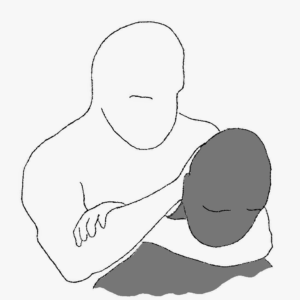
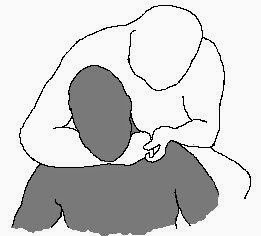
The foundation of this course was a single technique, taken from Judo. The technique used is a variant of Hadaka-jime. Hadaka-jime means “Naked Strangle”. Usually this term is used for a hold where one arm wraps around the neck and the other arm forces the head forwards. This variant is often called a “Japanese Strangle” or “Figure Four Choke”. If you google “Hadaka-jime” this will usually be the technique you see. The Hadaka-jime that Feldenkrais uses is somewhat different, using one hand to pull on the other and forcing the head forward with the right shoulder. My own name for this variation is a “Neck Roller”. I don’t think Feldenkrais ever uses the term “Hadaka-jime” in the original book. The original text was republished with some additional material as “Hadaka-jime: Practical Unarmed Combat” in 2009. Incidentally, the “Neck Roller” was part of the additional content added to the Global Edition of “Attack, Avoid, Survive”.

It is deceptive to think of the technique Feldenkrais advocates as a simple stranglehold. Applied with vigour it is also break an enemy’s balance, crush a larynx or break the neck. Practically, Feldenkrais notes : “You can also just bring the opponent on to his back, then kick in the region of his ear and you are again ready to fight other enemies” The early lessons of the book detail how to apply the basic technique under a variety of conditions and situations.
A later pair of lessons deals with knife attacks and deflecting them with an inward parry. The important concept of the timing of parries is introduced here, as discussed in yesterday’s blog. The parry can be followed by the Neck Roller attack to the neck learnt in earlier lessons.
The next lessons concern how to fight an enemy armed with a bayonet mounted on a rifle. As one might expect, avoidance of the bayonet is followed by a neck attack. For situations where this is not the most practical attack the soldier is introduced to a couple of kicks that can be applied to the groin, a knife-hand attack to the throat and a stomping kick to the back of the knee.
If you are on the inside gate and deflect an enemy’s bayonet attack an enemy may follow through with a butt strike. Feldenkrais’s solution to this is interesting.
The bayonet thrust is avoided by a twist of the torso and an inward parry with the left arm. The right hand makes contact with the rifle barrel to control it. The enemy then attempts to strike with the rifle butt so the left forearm is moved to intercept it with an outward action. With both hands occupied neutralising the rifle the soldier kicks the enemy in the groin.

Regular readers of this blog or readers of my book will recognize aspects of Long Har Chuan in this sequence. An inward parry is taken over by an outward action, the grabbing of the rifle barrel. The outward action of one side allows the other side to be used; the interception of the rifle butt. Each arm making an outward defensive action while one leg kicks? Yes, that is the same as Tai Chi’s White Crane Spreads Wings!
Categories
Phillosoph

Timing and the Moment.

Many decades ago I used to play Capoeira. It must be admitted that I was not the most athletic or acrobatic of players but what techniques I did use in the roda I was very sure of. That used to catch some of the younger players off balance. One in particular used to get quite worked up that he could make some fancy move and walk right onto a relatively simple attack from me.
My signature move was the Benção, which is the Capoeira name for a front thrust kick. Everyone knew I was likely to use this move, yet still it would seem to come out of nowhere and all of a sudden the sole of my foot would materialize inches from an opponent’s face. Some would just laugh at getting caught again, others would get worked up, actually making them easy meat for a repeat.
Front thrust kick was a technique I had barely practiced in my earlier Karate days, so it was perhaps surprising this became my signature. My success with this move was not that I could execute it fluidly and rapidly (which I could). The secret was in the timing. I could identify the exact moment in an opponent’s movements where they were committed to an action and I could insert my kick perfectly to interrupt it.
I’m recalling this today since I mentioned Moshé Feldenkrais in my post the other day. This inspired me to reread “Practical Unarmed Combat” and I even found a copy of the expanded later version “Hadaka-jime : Practical Unarmed Combat”. There will be some blog posts on Feldenkrais’ books but for the moment I will concentrate on a small section. In the book Feldenkrais illustrates a point by means of a little story, which I will paraphrase.
A samurai gathers his students together and gives them the following scenario:
“You are lying awake in your bed when you hear soft footsteps approaching. The door quietly opens and you see it is your sworn enemy, come to murder you in your sleep. He closes the door so that the light spilling in does not awake you. Thinking you still asleep, he approaches to murder you. Students, when was the best time to attack the intruder?”
What was your answer? The answer the samurai sought was when the intruder was closing the door. When he approached the room he would have been very wary. When he approached the bed, he would have been wary and there was very little time for the intended victim to untangle himself from his bedclothes and get up. As he was closing the door, he is in transition. Not only is he partially distracted by the task of shutting the door but he has also just completed one risky phase of his operation and is probably thinking about how to do the next.
Feldenkrais uses this story to illustrate parrying a knife or bayonet, although what he is saying holds true for other forms of attack. If you move too early against a trust the attacker can change his action and do something such as stick the knife in your hand. Too late with the parry and you may deflect it insufficiently to avoid it. Parry at the right moment and you avoid the attack and have a window of opportunity to counter attack. “Hadaka-jime : Practical Unarmed Combat” adds an appropriate quotation it attributes to Musashi “A skilful person may appear slow but he is never off the beat”. You may begin to see why a wartime manual about a Judo technique reminded me of my time in the roda.
In “The Tao of Jeet Kune Do” Bruce Lee talks about timing a lot, and it can seem somewhat daunting to a novice. I get the impression that Lee was wrestling with putting into text something that he had an inherent understanding of but was very difficult to put down on a page. If he had lived longer I suspect the Tao of JKD would have undergone a number of rewrites. “I cannot teach you, only help you to explore yourself.” Jeet Kune Do means “Way of the Intercepting Fist”. If you watch some videos of interviews and demonstrations by Lee you will appreciate that what he meant by this is what this today’s blog is about. As the enemy commits to an attack it is intercepted with a jab or side-kick at the optimum moment. Fencing also likes to talk about timing and rhythm. The stop-hit is the equivalent of JKD’s intercepting fist. In fencing one can get the impression that you need to spar with someone long enough to learn their rhythm and that being able to break rhythm is the mark of a master.
Personally, I am not sure that this is the best way to understand what is going on or what is needed. Perhaps it is better understood as recognising and acting in moments that occur within a sequence. You attack or parry not when you want to, but in the moments that your foe creates that you can act in. Timing is a very difficult thing to teach in a written format and rather than attempt to do so here I will be content that I may have given you something to think about and to be more aware of during your practice.   
Categories
Phillosoph

The Avengers

One of my recent pleasures is that a certain channel has been re-running early episodes of “The Avengers”. The British ones, that is, not the Marvel characters.
The Avengers was quite a significant show in the history of British television, being one of the first shows to be sold to the US for Prime-Time showing. It is not hard to see why it was successful. The show was “Spy-fi” at a time when “James Bond” films and “Men from UNCLE” were all the rage. The show was witty, often subtly surreal and had a good dollop of British eccentricity. Steed was suave and dashing, Emma was brilliant and beautiful.
The Avengers was never short of action either. “Martial Arts” was another trend of the time and like many series The Avengers included “kung fu” and “Judo” techniques. Every now and then I notice a technique that is more likely to have come from wartime commando training.
Most television series are not a good place to learn realistic fighting techniques, and we can include The Avengers in this. Every now and then, however, I notice a move or two that gets me thinking.
In episode 5-13 “A Funny Thing Happened On The Way To The Station” Emma immobilizes a man using an interesting hold. Her forearms form an inverted “L” shape and her hands are in what Erle would have called “a wrestler’s grip”: one thumb slipped between the fingers of the other hand. The horizontal forearm is across the man’s throat while the other comes up under his armpit in a sort of half full nelson. Interesting, and reminds me somewhat of the stranglehold used extensively by Moshé Feldenkrais in “Practical Unarmed Combat”.

The technique that inspired me to write something about The Avengers in this blog appears in episode 4-20 “The Danger Makers”. Blink and you may very well have missed it.
Emma parries a punch with a rather conventional forearm parry. Immediately the other hand swings up and slaps the attacker, sending him flying. There are several things I like about this apparently simple movement.
The first is that she makes the strike with an open hand. The slap is a much underrated defensive technique. With a relaxed arm it can be made with considerable speed and correspondingly hit with surprising force. A slap and a palm heel strike are not as different as some people think. In my book and on this blog I have often recommended the palm as a weapon since its use reduces the chance of hand damage to the user.
Another thing I like about Mrs. Peel’s technique is the economy of movement. As one hand does the parrying the other uses the same motion to counter attack. If you have brought my book, read this blog or read the Tai Chi book I wrote with Erle, you will recognize this as one of the fundamentals of Long Har Chuan. As one side of the body makes an outward parry the other moves in to make a second parry or an attack.
You will see this principle in a lot of effective combat moves. The one that The Avengers’ sequence most reminded me of was one of the applications of “White Crane/ Stork Spreads Wings” in “How To Use Tai Chi as a Fighting Art”. The most commonly seen application of this move is a pair of outward parries with the lead foot set up for a kick. Erle showed another variation. One hand makes an outward parry, preferably taking you to the foe’s outside gate. The other hand whips up in a fast, powerful centrifugal punch straight to the foe’s temple. Erle described this move using a punch, with the fist becoming fully inverted and striking with the first two knuckles. Since your target may be hard and bony there is considerable merit in practicing this as a palm strike instead. 
Categories
Phillosoph

Beds and Bugs and Cots and Carpets

This is probably one of my more off-the-wall blog posts, but hopefully it will inspires some ideas.
Recently I have been enjoying the company of a rather charming young Greek lady. Unlike many of her (professional) ilk, she is smart enough to know how little she knows. She has been avidly absorbing the more practical advice that myself and others have been providing to her.
This lady’s particular field of interest is dust mite allergens. Recently she was informing me that in Greece, fitted carpets are quite unusual. Greeks prefer bare floors and put down rugs in the winter. As well as being vacuumed rugs are taken outside for cleaning, often twice a week. You can also send them away to be cleaned. There are businesses that will store your rugs in summer if you do not have room. She is rather baffled by the preference for fitted carpets in northern Europe and the Americas. She has told me about scientific studies in homes that have experienced incidents of leukaemia that found connected carcinogens still present in the carpets four years later. Fitted carpets never get properly clean, she avers. She describes fitted carpets as being like Macdonalds in that “People know they are bad, but still have them”. Personally I think most people in northern Europe or America are actually quite unaware of this. We have just never thought about the pros and cons of carpets against other options.
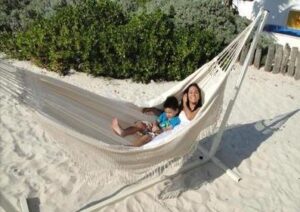
Another item you have probably never thought about is your mattress. A mattress is just a great sponge for absorbing dust, sweat and any other bodily fluids. None of that ever comes out and your mattress is probably a thriving ecosystem. I began to reflect on this a few years back when the mattress my landlady had supplied had become so worn that parts were sagging and metal springs poking through the surface. I began to look into replacements and half seriously gave some thought to a Brazilian hammock. I was single back then and looked like I was going to remain that way for the rest of my life. The fates had a surprise for me and rather than a Brazilian hammock I acquired a Brazilian girlfriend.
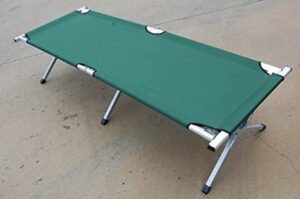
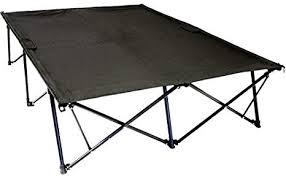
The advantage of a hammock is that the bit you actually sleep on is relatively thin. Dust can drop through it and the parts that might become dirty are relatively easy to machine wash. Hammocks are a bit of an acquired taste, however, particularly if you do not sleep alone. Back in my childhood the family would often holiday in a caravan. The upper bunk was effectively a sort of stretcher with the ends of the poles fitting into brackets on the walls. A similar idea are the camp beds or “cots” you have probably seen on programs such as “M.A.S.H”. A sheet of stout cloth, a frame to support it and some legs to raise it off the ground. It has some of the easy cleanable features of a hammock without needing a sturdy frame or walls to attach it too. Again, the main objection to these is if you do not sleep alone. Double camp beds are offered, but I have never used one personally. Many designs have a pole down the centre, which can cramp your style. What is probably needed is a camp bed with some form of mesh or net beneath the cloth part. Possibly the net needs to be in three sections. The outer nets would support the sleepers when they were apart, and the middle section provide more support when they are together. I am sure someone with a better grasp of engineering could come up with better solutions. I have seen it recommended to use a 1-2" thick memory foam mattress ("mattress topper") with a double cot. That may work sufficiently well while still being more easily cleaned than a traditional mattress.
This is an idea worth exploring. Not only would a camp bed be more hygienic but it would probably be much cheaper to produce. A colleague of mine recently had to replace his mattress and was quite stunned at the price!.