Disclaimer: “As an Amazon Associate I may earn from qualifying purchases.” Adsense and Infolinks were no help at all.

If you have enjoyed this article or it has been helpful to you please feel free to show your appreciation. Thank you.

Read The Third Wave by Alvin Toffler!
Categories
Phillosoph

Sandbags. Alternate Uses

Recently I have been reading about certain aspects of World War One, in particular the stosstruppen or “stormtroops”.
A common and distinctive element of the stosstruppen equipment is the grenade bags underneath the arms. These were often sewn from sandbags. Sandbags had other uses too. One illustration I saw had a soldier carrying a sandbag to collect any booty or intelligence material he came across in a raid. Another feature of the stosstruppen was that they did not bother to carry their backpacks into battle. Backpacks were for the march to a position and were usually placed in storage once there. Instead the stosstruppen created an “assault pack” by rolling their greatcoat in their shelter cloth and strapping it as a horseshoe shape around their mess tin.

If attempting to capture a position a unit was required to carry four days’ worth of rations. Units in newly captured locations could easily become isolated. The rations of a German soldier a century ago were somewhat more spartan and modest than those of modern soldiers but I suspect he would still be hard pressed to carry four days’ worth in just an assault pack and the “bread bag” on his belt. A feature of trench fighting was that it was often only the lead elements that would be doing any actual fighting. The point would be taken by a couple of rifle, pistol or SMG men and close behind a “bomber” would toss grenades into the next trench section. Most of the unit would be carrying entrenching tools, sandbags and any other items needed to consolidate a captured trench section. These bearers would doubtless have also carried the bulk of the unit’s four day ration. This still raises the question as to how to carry those rations without backpacks. What I suspect is that often the rations were carried in the unfilled sandbags the unit was required to take along.
Sandbags had many other uses too. A sandbag could be wrapped around a rifle barrel to camouflage it when sniping. Camouflaged face veils for snipers could also be made from sandbags. Sandbags were used to make helmet covers, making your head less of a target when moving behind sandbagged parapets. Frayed bits of sandbag could be sewn to a garment to break up the shape and provide additional camouflage.

When it comes to using a sandbag as a carrying sack it is informative to look at the Russian veshmeshok. The neck is twisted closed and the carrying strap used to form a sort of lark-tail knot. A typical sandbags is 14-15" x 26-32" and can hold about 30-35 lbs of dirt so a carrying bag made from one can hold a useful load. Holes punched in the bottom corners, possibly eyeleted can be used to take a cord and made adjustable with a simple bowline knot. Alternately a small object such as a stone can be placed in the lower corners and a constrictor knot or round turn and half hitches can be tied around the material behind the object. The latter technique, incidentally is useful when you need to use a shelter sheet that does not have eyelets. There is not frame in a veshmeshok or sandbag, of course, so you have to give some thought to what you put in and in what order. Make sure there is something soft against your back!

In my book I mention that claymore mine bags often were used as handy ammunition carriers. A sandbag could provide the basic material for a similar but lighter carrier with just some basic sewing. Sew up the mouth and open one side, divide the compartment in two and add a strap, flap etc.

To both the World War One and modern soldier, sandbags are readily available and worth utilising. If you are a civilian then sandbags can be purchased from builder suppliers and garden stores and can often be found for less than a dollar each. Modern types are of circular woven polypropylene but more traditional hessian is also still available. A synthetic may be better for a carrying bag while hessian is better for adding camouflage to a hunting outfit. Hessian is quite a useful camouflage colour, particularly if used with contrasting browns, greens or greys. If you are wrapping a rifle stock in hessian remember folds, creases and shadows help break up the shape. You can also apply some paint of dye in dabs of a contrasting colour but don’t go overboard. It is the contrast and irregular intervals that help break up the shape.
Categories
Phillosoph

A Possible Con trick?

A friend of mine went out for a bite to eat and a quiet drink the other night. When he came back he did not look too good.
As the bar was closing a girl sitting outside collapsed. According to her sister she had been taking drugs. They had brought something that allegedly was “MDMA”. I say allegedly since a friend of mine was once concerned with analysing a large number of MDMA samples taken as evidence. The majority of them contained very little, if any MDMA but contained a lot of other things, many of them quite unpleasant or harmful.
As my friend and another customer attempted to help the girl she stopped breathing several times. My friend was able to get her breathing again by using artificial respiration. An ambulance arrived and the girl and her sister were taken away.
My friend felt that he had panicked a little and could have done more. I pointed out to him that he had undoubtedly saved her life and that at least he had done something positive when challenged. Some people would have run around like headless chickens. Some would probably have stood around videoing it on their phones. I did joke with him that in some countries he would now be sued by the girl for malpractice and sexual harassment! A joke sadly too close to the truth.
This had not been his only adventure that night. Minutes before this a fight had broken out in the bar between the landlord and a customer and my friend had helped keep them apart. What is interesting about this is the fight broke out a closing time with very little apparent cause. After they were separated the customer reached inside his jacket and produced a pair of broken glasses from his pocket. He then began to claim that the landlord had broken these in the fight and that he wanted compensation for them.
Certain aspects of how this was described to me suggest this might be a variation of an old con trick. Something to watch out for.
Categories
Phillosoph

"The Northwest Passage" Lessons for the Modern World.

Yesterday I treated myself. I finally got around to unwrapping my copy of “The Northwest Passage (1940)” Finding this fine old film on DVD was to prove to be something of a task. After much searching I was able to find a copy in Spanish ("Paso al Noroeste"). Fortunately for me the DVD included the original English soundtrack too.

The reason I am posting about this movie on this blog is that a major theme in the movie is about motivation and leadership. If I had my way “The Northwest Passage” would be shown to all officers and NCOs.
Early in the movie Major Rogers (Spencer Tracy) realises that the way up-river is blocked by French forces. The only way pass involves carrying the heavy whale boats across country and up over a steep wooded hill. Instead of issuing orders Rogers asks his men (paraphrased):

“If you needed to get past the French without them knowing and knew you would need your boat later, what would you do?”
A ranger replies “I guess I would carry the boat overland till I found water again.”
“Then that is what we will do!”
Note that Rogers leads his men to the logical conclusion so that they understand the necessity, no matter how much toil and discomfort it implies. In some aspects the course of action seems to have been the suggestion of the men rather than an order by their commander
Another notable scene is when the rangers must cross a fast flowing stream.
Rogers: “If you had a chain stretched across this stream you would not think twice of about wading it. We will make a human chain! I do not know if such a thing has ever been done before, but we are going to do it!” Rogers is the first wade into the water and hook one arm around a tree to form the first link of the chain. This is an interesting technique for large parties to use to cross rivers, although I would recommend hooking arms rather than grasping wrists as shown in the movie.

The real Major Rogers’ “Rules of Ranging” and “Standing Orders” are worth a read, even today.
Categories
Phillosoph

Perception, Alien Autopsy and Yeti Footprints.

Today’s blog is about perception. I have touched on this subject once or twice before since how you process information is a useful survival and self-defence skill. What you perceive can often be influenced by what you want to see, expect to see or are expected to see.
Back in the mid 1990s a video claiming to be the autopsy of an alien was broadcast. Last year I came across an article written at that time by a writer who had attended a press screening of the video. Although he was writing for a science fiction publication the writer was sceptical and suggested that a telephone visible in the film was too modern for the date claimed for the film. This latter statement made me find a copy of the film and sit down to watch it.
One of the claims I had heard made for this film was that the men performing the autopsy seemed very efficient, professional and were evidently doctors, coroners or scientists. Watching the film my impression was quite the opposite!
Anyone with even a minimal level of medical training would use a Y-incision to open the thorax of a humanoid. Instead, in the video a clumsy cross is cut in the torso and organs fished out. No attempt is made to film the inside of the torso and the relative positions of the organs before they are removed. One of the “doctors” attempts to open the skull and to access this area he peels the scalp upwards and flops it over the alien’s face. The rather awkward action shows that the “doctor” has never before performed this action, nor has he ever given any thought whatever as to what would be the best way to accomplish this. Not only is it obvious to me the two “doctors” have no knowledge of medicine, it seems very unlikely they are hunters or butchers or any other profession used to handling animal carcasses.
The makers of the alien autopsy video have now admitted that it was faked. While some people choose to believe they have been made to lie about falsifying it, the actions of the “doctors” in the video speak pretty clearly. And yet, many people claimed the conduct of the “doctors” in the video was evidence of its authenticity!
Below is another famous mystery, the footprint of a yeti found by an Everest expedition. Spend a couple of minutes studying this photo and see if you can work out what is “wrong” about it.
 
If you look carefully you can see the footprint is curved on its left side, suggesting that if this is a primate foot it is from the right foot. The largest toe impression, however, is on the right of the foot print. Either yetis have a very odd way of distributing their weight when walking or they have their big toes or insteps on the outside of their feet!
Is there an animal in Tibet that has a large toe on the outside of its foot. Yes, bears have this feature. Another interesting thing about bear tracks is at certain walking speeds the front and rear pawprints often overlap, creating what appears to look a bit like an elongated human or primate footprint! If you look across the centre of this footprint there appears to be what might be a second set of toe impressions, supporting the idea that this might be a pawprint placed close to another.
The perception of these things is something to reflect on. Humans are most interested in humans so they perceive a vaguely human-shaped track as being from a hommid, ignoring large discrepancies as the big toe being on the wrong side!
Categories
Phillosoph

Goodbye to Two Longtime Travelling Companions.

Many years ago I purchased a pair of boots from a shop in Camden called “Outdoor Emporium”. They were a pair of black Hi-Tech Magnums and according to the label inside they had been constructed in Vietnam in 1999. They were an interesting design since they were rather like Vietnam Jungle boots in design. The bottom section of them was leather while the upper part was bulked nylon. The cuff of the boot had a suede-like material. I don’t recall exactly when I brought the boots, but it would have been before the old Wembley stadium was demolished in 2003. I had originally met the proprietor of Outdoor Emporium at Wembley market and had ended up helping on his stall, so I can recall I had a good view of the famous twin towers of the old stadium.

Initially I only wore the boots occasionally. My podiatrist one day advised me that given the problems with my feet and ankles I should wear something with more ankle support so I then began to wear the Hi-Tech Magnums all of the time. These boots are around fifteen years old. They have been worn constantly for at least eight years and perhaps as much as thirteen or fourteen years. The soles show a little wear but still have good tread on them after countless miles of London pavement. Finally a crack in the leather upper is beginning to go all the way through so in January I will buy a new pair. It is quite possible that they would have lasted me a few years more if I had been a little more diligent with polishing them more often.
I am pleased to see that these boots still seem to be in production. Hopefully my new pair will enjoy a similar lease of life.
Categories
Phillosoph

Deer and Detergents

A friend of mine mentioned the other day that deer can see into the ultra-violet range. Naturally I did some research myself to confirm this, and found this interesting article.
I learnt that deer can see in colour, but not very well at the red end of the spectrum, which is why red and orange clothing can be used for deer hunting. (Bird hunting is another matter. Birds tend to have very good colour vision in general).

The UV sensitivity of deer vision has some interesting implications. Many laundry detergents include whitening agents that reflect UV-light. In short, what to our primate eyes may be a nicely camouflaged jacket may look distinctive and out of place to a deer. I suspect as this information becomes more widely known some clever company will market a detergent especially for hunters. If you are going to use this as an excuse not to wash your favourite hunting coat remember deer have a very good sense of smell too!
The discussion of laundry soaps reminded me of this statement made about US Woodland pattern camouflage garments:
“… When they are brand new this pattern choice isn’t bad. With daily (duty, military) use and washing the pattern starts a light graying process and doesn’t stop until they are lightened and useless for their intended purpose. With that said some of the woodland fatigues do start to "brown out" and that is a good thing when it happens. With normal civilian wash and wear this seems to happen more often. With most military personnel we notice the graying on a larger more pronounced scale.”
If this observation is accurate a likely explanation is in the laundering process. Civilian owned garments are less likely to be washed by industrial laundries.
As many of you may be aware, the US Army has had considerable problems with its ACUPAT camouflage. Supposedly this pattern is a mix of grey, sage and tan. Most garments you see in use seem to appear to be various shades of grey and dirty white with very little contrast between the elements. Is it possible, perhaps, that some of the problems are a result of the Army’s laundering system? Another element of the problem may be in using combat-wear as general work and barracks wear, increasing the frequency of washing. Worth investigating.
Categories
Phillosoph

Umbrella Fighting : All the Links

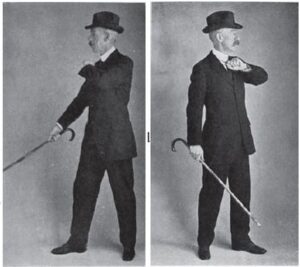
I have just acquired a new umbrella for my girlfriend and joked that she could read my "How to poke people with a brolly" blog.
With that in mind today's blog will gather the links about self-defence with an umbrella together in one place. These articles are now collected together as a PDF document here.

Part One Fencing Parries with an Umbrella.
Part One and a bit An Interlude.
Part Two Swagger Stick Techniques.
Part Three Commanding the Blade or Brolly.
Part Four Offensive Techniques.

Vigny on Umbrellas.
Light-Hearted Article from 1897
 

Categories
Phillosoph

Direction Finding by the Moon

The other night I was looking at the crescent moon.
Many readers of this blog are doubtless familiar with how to find direction from the moon, but some will not be, so indulge me for a moment.
By drawing an imaginary line between the horns of the crescent and extending it down to the horizon, the approximate position of south can be estimated if in the northern hemisphere, or north if you are in the southern hemisphere.
Idly, I wondered if the angle of this line had any relationship to the latitude of the observer. I recalled there was something about navigating by the moon in the Japanese Manual of Night Movements:
“Although it is difficult to determine direction by the position of the moon, the latter has the advantage of being recognizable even on nights when all the stars cannot be seen. The moon crosses the meridian about noon on the first lunar day, and it moves about fifty minutes behind the sun every day. Therefore, if the age of the moon be known, the approximate passing of the meridian can be easily computed. Its approximate age can be computed from the shape of its bright portion.”
Not really that helpful!
Something may have been lost in the translation.
Most websites I looked at had no answer but eventually I found this interesting paper and found the answer is “no”.
I later confirmed my latitude was 51 degrees so an angle of either 51 or 39 would have been expected if the hypothesis had been correct.
The range of angles the terminator can be at as it approaches and passes meridian will vary with latitude, however, but this has very little application to practical emergency navigation.
An alternate method for direction finding by the moon involves remembering that the sun sets in the west and rises in the east.
If the moon is up in the early part of the night, or in the evening before the sun has gone down, the illuminated side will be the western.
If the moon is observed in the latter part of the night or in the morning, then the eastern side will be illuminated.
In this context “latter” and “early part” of the night are defined in relation to the median point of the night, also known as Solar Midnight.
In other words, the middle of the period of darkness rather than the chronological “midnight”, 12:00am or 0000hrs on the clock.
This is more of a secondary method since if you can see the light and dark parts of the moon you can use the terminator method to find north or south. I suppose you could make a crude estimate of the time by establishing where south or north is located and then observing which side of the moon was illuminated.
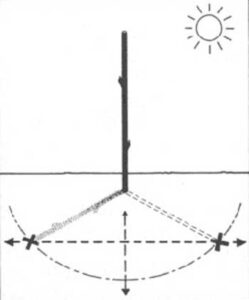
You can also estimate direction from the moon using the shadow tip method.
This is often illustrated using the sun but the principle is exactly the same using the moon.
Place an object such as a stick in the ground so that it casts a shadow.
Mark the tip of the shadow.
Wait for at least fifteen minutes so the shadow has time to move.
Mark the tip of the shadow’s new position.
A line drawn between these two points will run east-west.
The first point you marked will always be west, the second east.
Easy for me to remember since my name is “West” so “West comes first!” 
Both the moon and the sun move from east to west and in the northern hemisphere they are always in the southern half of the sky, so shadows cast have varying degrees of northward orientation.
A line perpendicular to the east-west line will be north-south and the shadow will be in the direction of the pole of the hemisphere that you are in.
The advantage of the shadow tip method is that you can use it when there is a full moon and you could not use the terminator method.
In the daytime you can use the shadow tip method when the exact position of the sun cannot be seen because of clouds, so long as there is enough light to throw a shadow.
Categories
Phillosoph

Christmas Creep – It Begins Again, Already!

A recent topic of some discussion on the internet was the Christmas tree in Paris that is widely regarded as looking like a butt plug. Most of us, however, missed the real issue, which is why is a Christmas tree of any form is being erected in early October?


I was in a restaurant with my girlfriend this Sunday. They had a Christmas tree of beer cans in the window. It was the twelfth of October! Last year I wrote on the topic of Christmas Creep and predicted that it may start even earlier this year. Already a TV station boasts that they will be broadcasting 24 hour Christmas movies. I so hate being right!
Categories
Phillosoph

Movement in Armour.

A common piece of Victorian whimsy was that the knight in armour needed a crane to haul him up into his saddle. In reality a suit of plate armour might weigh around 20-25 kgs. This is actually less weight than that of the equipment that a modern soldier or firefighter might carry. Certainly I have carried rucksacs of this weight when necessary. The weight of a suit of armour would have been better distributed than that of a modern pack.
Many years ago I read about the feats of a knight called “Jean le Maingre” (ca. 1366–1421), aka “Maréchal Boucicault”. Wearing armour he could climb up the underside of a ladder only using his hands.
“Boucicaut or Jean de Meingre marechal de France who commanded the vanguard of the French army at Azincourt in 1415 and was there made prisoner and died in England in 1421 used to go up on the lower side of a ladder leaning against a wall without touching it with his feet but only by jumping with both his hands together from one bar to the other and that he would do armed with a steel coat and having taken off the armour with one hand alone he could ascend several bars and these things are true and by many other hard exercises of such sort he so hardened his body that his equal was hardly to be found….
Boucicaut at one time used to accustom himself to leap in armour on the back of a horse and often he would walk or long distances to give him long breath and enable him to bear fatigue. He also used to strike for a long time with an axe heavy hammer to harden his arms and hands and to accustom himself to raise his arms readily. By following such exercises he strengthened his body so greatly that in his time there was no gentleman to compare with him. He could throw a somerset completely armed except his basnet and would dance when armed with a steel coat In full armour and without putting a foot in the stirrup he would jump on the back of a war horse. He would also jump from the ground astride on the shoulders of a big man or a tall horse without other help than a hold of the sleeve of a man's jerkin. Holding with one hand by the pommel of a saddle placed on a high horse and with the other grasping the mane a little below the ears he would from the ground jump through his arms to the other side of the horse and he would ascend between two side walls of plaster at the distance of a fathom from each other and by the force alone of his arms and legs without other aid without falling either going up or coming down."
Extracted from his Life pour servir a I Histoire de France
An Introductory Course of Modern Gymnastic Exercises
By George Roland
Boucicaut was obviously an exceptional individual but it is evident that the wearing of armour was much less restrictive than many people assume. Most of us have seen Medieval illustrations that show armoured fighters ascending ladders during an assault on castle walls. Illustrations also exist of knights mounting their horses without need for assistance.
A friend of mine sent me this video which shows two re-enactors performing various movements in armour. Bear in mind that these gentlemen do not wear armour as often as a Medieval fighter would have, yet still can move around freely.
Here are some additional videos I found.