Disclaimer: “As an Amazon Associate I may earn from qualifying purchases.” Adsense and Infolinks were no help at all.

If you have enjoyed this article or it has been helpful to you please feel free to show your appreciation. Thank you.

Read The Third Wave by Alvin Toffler!
Categories
Phillosoph

4-4-4-4 Combat Load

Recently I was trying to relocate the following article:
This has some interesting information on the difference between a marching pack, combat pack and stripped-down “patrol pack”. 
Exploring the site further turned up an even more useful article:
During my search, I stumbled across the following:
Of particular note is the “4-4-4-4” system.
Don't get too hung up on the titles. Just understand that a clear distinction is being made between short duration operations and those that span more than one day, and for the latter a distinction is made between short and long duration.
I would like to examine this scheme in a little more depth. “4-month” doesn't concern us today.

4-Hour Load

  • “Deuce” (webbing) gear and weapon.
  • Helmet and Flak (regarded as “mission specific”)
  • Whatever weather gear the marine is wearing. (i.e. marine is assumed to be suitably dressed for current conditions)
  • A zip-loc bag of toilet paper is carried in a clothing pocket so it is still with the marine if any pack has been dropped.
  •  NO pack. NO food. NO toilet kit, sleeping gear, weather gear, boot polish, shelter, nor spare clothing.
If it is a tactical situation the only things you should be carrying are tactical gear and water.
To this I would make the following caveats:
A reasonable quantity of “pocket food” may be carried. This is such items as trail-mix, hard candy, biscuit/cookie packs etc. These can provide a useful energy boost. No food that requires cooking nor warming. Strictly no gum.
A poncho and/or rain jacket may be carried. No spare clothing does not apply to items such as gloves and bandannas.
“Weather gear” is probably best carried in a small, light pack such as a bergen side-pouch.
A similar pack holds the NBC (CBRN) gear. These may be zipped together and both carried.
In some environments, small bottles of insect repellent and sun-block may be carried on one's person. These are topped up from larger bottles in the pack or baggage.
The deuce gear is assumed to include one or two water bottles. In some climates extra water will be needed.
Water is heavy, however, so the volume of water carried should not be so heavy as to increase the rate of water consumption. Just how much water that is might prove to be a useful research project.
Water-bladders for carrying water is lighter than using conventional military water-bottles.
Some tactical and mission-specific items are better carried on the back rather than on the webbing. For this purpose dedicated tactical packs (“Tac-Packs”) should be acquired.
Many of the likely contents of a tac-pack will be dense (machine gun belt, mortar bombs, radios etc), so I would advise keeping the volume of such a pack small, say 16 litres.

4-Day Load

The additional “4-day items” may be considered to constitute an approach load and should be capable of being cached before the deliberate tactical phase.
As 4-Hour load with the addition of:
4-Day Pack with food, 4-day washing kit, sleeping gear, weather gear and shelter. No spare clothing. No boot polish.
It also worth thinking about the potential of a “24-Hour load”. This would resemble the 4-Day load with less food, and perhaps without the wash-kit. This suggests the food be divided into a one-day and three-day bag,
A case (12) MREs is suggested as four days food. Except in sub-zero operations, this may be overly generous. Three eating periods a day may not be practical and troops not eating all of their rations often occurs.
Two MREs a day may be more practical, with a useful quantity of components that can be eaten on the move.
A 4-day wash kit is a hand towel, 1oz/25mls toothpaste, one toothbrush, a bar of soap and “razors for 4 days”.
No shampoo, no shaving cream, no extras nor spares.
Shaving cream , incidentally, is totally unnecessary and has no place in any lightweight kit. Just use your soap. You do not need a shaving brush.
“Razors for 4 days” is ONE razor. Small tubes of toothpaste are often sold with travel toothbrushes. Cutting a normal toothbrush down to 4 inches is suggested, and you might like to follow my advice and get a child-sized brush to begin with.
The document suggests carrying soap in a plastic case such as a “chewing tobacco case”. I have no idea why people think they need to carry soap in a rigid case, and their expensive electronic gadgets in a soft pouch. Many of the soap cases that I have used over the years have turned out to be quite brittle and easily damaged.
The best way to carry soap is in a small nylon drawstring pouch.
The document also suggests that an empty plastic peanut-butter jar makes a good wash-kit container. Use a mesh bag instead.
You can use a bandanna rather than a hand towel.

4-Week Load

As 4-Day load, with the addition of a 4-week pack. 4-week pack includes food, 4-week wash kit, sleeping gear, weather gear, boot polish, shelter and spare clothing.
4-week wash kit includes replacement items such as extra razors, more toothpaste and more toilet paper.
One bar of soap should last more than a month.
I have been on 3-week plus trips and not used up 50mls of shampoo despite daily use.
It may be prudent to have a “spares bag” of toiletry items from which you can replenish the 4-day kit when needed.
Categories
Phillosoph

More Ranger Rolling

Last night I conducted a pair of experiments in ranger rolling.
Firstly, I tried rolling a poncho. First I folded it widthwise. I then turned up the bottom, folded it in thirds lengthwise then rolled it down from the top. The resulting roll was a little smaller than the carrying sack. Ranger rolling either gives me a way to do without the sack or provides a convenient and quick method to roll the poncho small enough to fit in the sack.
The second item I experimented on was a poncho-liner. This took a number of attempts. The method I settled on was to fold the poncho widthwise. Then, rather than folding up the bottom I folded under the left side. Rather than folding into thirds and rolling down from the top I made my folds widthwise. I then rolled the right side to the left. Because a poncho-liner is so thick and you are working on a double thickness getting the right amount of turn-under takes some experimentation. About 25cm seems right.
You end up with a bundle that is close to a cube, but a little wider than it is high. It measures about 13" x 8" x 6", which is almost a Fibonacci/Golden Ratio object! This is a different shape to stuffsack the liner came with: thicker but shorter. Once you have the right turn-under figured out ranger rolling the poncho-liner takes less time than trying to cram it into the stuff sack.

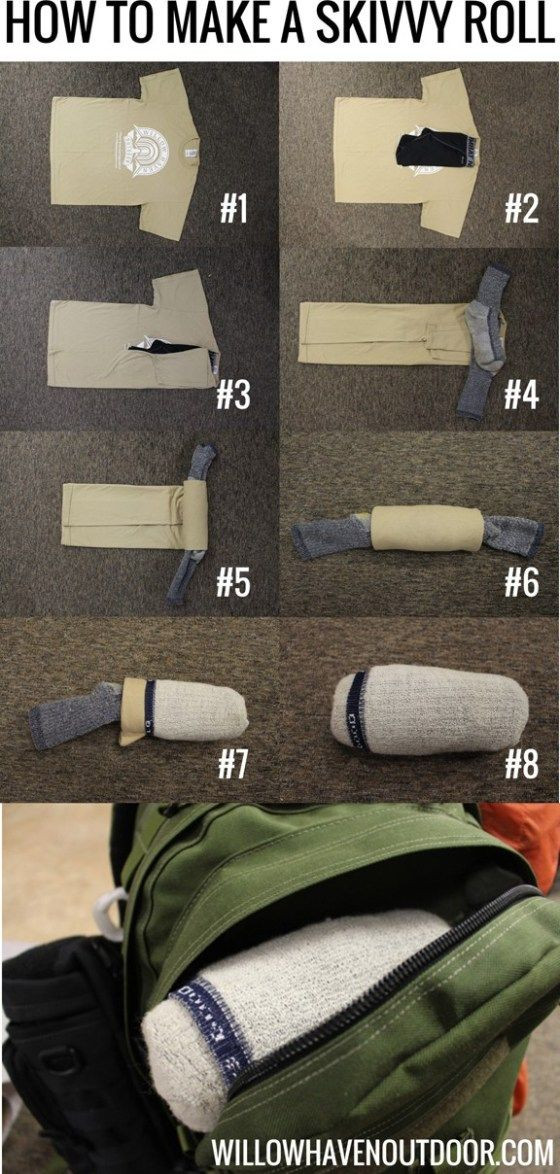
Skivvy Roll

An alternative packing technique is the Skivvy Roll.How to roll a skivvy roll
This may be done for just a teeshirt, socks and underwear, or for more comprehensive outfits. Helps if your socks are on the large side!
Categories
Phillosoph

Rolling and Folding

 
I suspect that many readers have already seen the above video. It may be one of the most useful things on the internet. Using this technique putting away the laundry has become a quick job of a few minutes rather than a tiresome chore.
Yesterday I came across the term “ranger roll” used to name an alternative to a sleeping bag. Not a term I had encountered before. It turned out to be an alternate name for a poncho and liner used as a sleeping system. A websearch on “ranger roll” in fact turned up something quite different:
 

Rolling clothing this way may be old news to many of you. If, like me, you had not encountered it before there are a number of webpages and videos. Once you have seen how it works for towels and tee-shirts you can probably work out how to roll most items. Some users suggest items may be rolled tighter if rolled on a hard surface. Some items may be more compact if folded flat. It will also depend  on the space where you need to stow something, so experiment.
I realized that I had encountered the technique before. My mother used to “marry” socks by rolling them up and turning over the cuff. As an adult I realized that this was a complete waste of time. Dump your washed socks in a drawer and grab the first pair that look similar.
The ranger roll method is worth trying if you have to pack items. Remember that items such as sleeping bags and down jackets should not be stored for long periods tightly rolled.
Many items of outdoor equipment that you buy come in their own stuff sack. Like me, you have probably unpacked the item to examine it and then found you cannot fit it back in the sack as neatly as it came. Using a ranger roll it may be possible to pack the item without using the sack. Either save weight by not carrying the sack or put the sack to a more useful purpose.
Categories
Phillosoph

How to Wrestle Numbers

Many things I was made to learn at school I have never had to use. Over the years, however, I have had occasions to use trigonometry, geometry and arithmetic.
Maths was not one of my best subjects at school, With time I have got more dexterous with numbers but do not regard it as a strong suit. This is relative, of course. To the astonishment of younger generations I have been known to multiply numbers together without using my phone!
Over the last week I have been reading “Mind Performance Hacks” by Ron Hale-Evans. A very interesting book with many varied ideas.
To my surprise, I found the maths section far more engaging than I expected.
This lead me to a book called “Rapid Math Tricks and Tips” by Edward H. Julius. I never thought I would enjoy reading a mathematics book, but I did!
This book is a fast and easy read and is full of techniques that will improve your handling of numbers. The book says “thirty days” but I read most of it in an afternoon and intend to reread it today.
I have come to the revelation that arithmetic is rather like judo. You learn a few basic principles and then you may wrestle the numbers into submission.
Some insights and observations:
z x y = 2z x ½y = 3z x ⅓y = nz x y/n
which is my way of remembering that when multiplying you can change one number if you chance the other by the same quantity. For example, if you halve the multiplicand you must double the multiplier or vice versa. In other words:
66 x 3.5 = 33 x 7, but one may be much easier for you to calculate.
Similarly, with division:
z/y = 2z/2y = 3z/3y = nz/ny
This is easy to remember if recall a division is essentially a fraction, and top and bottom must balance. You must change dividend and divisor by the same proportion. Hence:
34 ÷ 4.5 = 68 ÷ 9
Breaking numbers up is another useful trick:
For example:
47 x 14
can be reorganized as
(50 – 3) x 7 x 2 or (40 + 7) x 7 x 2
Since I find threes and fives easier than my seven-times table I would solve this as:
7(50-3) x 2 = (350 – 21) x 2 = 329 x 2 = 685
When you split a number keep track of if you have to subtract or add the elements.
Solving the above I used another useful trick, which is subtracting by addition. What do I need to add to “21” to make it “350” ? If I add a “9” it becomes “30”. 30 needs “320” to become “350”. Therefore the difference is “9 + 350”. The book suggests doing the “tens” first: 21 needs 320 to make 341, then 9. OR, you can reorganize: 350 – 21 = 350 – 20 – 1.
When I was at school I was taught you divided numbers from the left hand side, but multiplication, addition and subtraction was to be done from the right.
THEY LIED!
This book has lots of examples where addition or multiplication are simpler if you start on the left. One of my favourites is the method where you run down one column, up the next, down the one after that and so forth.
The book has many other useful techniques. Many are quite simple but may not have occurred to you if you are uncomfortable with numbers. For example, rather than multiplying by “8” you may find it easier to double a number, double the result and double again. To divide by 16, quarter the number and quarter the result. Dividing by 3 and then 2 may be easier than attempting to divide by 6. One way to quickly multiply by 9 is to add a zero to the number and then subtract the original number from this. This is treating x9 as x(10 – 1). 
Categories
Phillosoph

Ten Move Flow Drill

Today I am going to look at a flow drill. The video says “knife strikes” but the application of this is broader.
The numbering system used in this video is different to that I used for “angles of attack” in my books. This doesn't really matter, it is the flow of the moves that is important rather than its nomenclature. Some systems only teach five angles: the four diagonals and a thrust.
While the demonstration is made with knives, these moves can be used for a variety of other weapons or unarmed strikes. I will expand a little more on that  later.
The instructor refers to a “box”. This is an imagined rectangle within which you should attempt to keep your blows. No wide swings! Your box should be a little wider than your shoulders. 
 
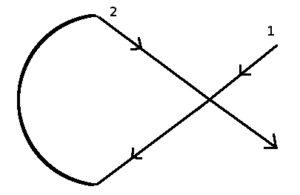
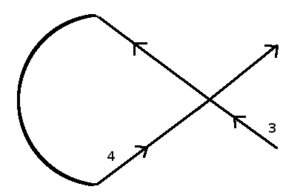
The first cut is an oblique cut from your high right to your low left. This flows upwards to make the second cut, from high left to low right. These combine to create an alpha shape. 
 
Flip your blade over and follow the alpha in the reverse direction, making the cuts from low right to high left and low left to high right. That is four cuts made already!
The fifth move is a thrust, made with the hand pronated (knuckles upmost). Then turn your hand palm upwards and make a horizontal slash, from right to left. Finish this move with another thrust, this time with the palm upwards (“supinated”). Pronate (turn over) your hand and make a horizontal cut from left to right.
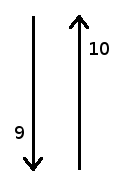
The ninth move is a vertical downwards cut, so you will find you need to learn not to overextend the previous horizontal move. Learn the most economical way to get from the end of 8 to the start of 9. 
The downwards vertical move is followed by an upwards vertical action. That completes the ten motions.
You will learn that the individual motions will need to be modified for particular weapons. With a knife the final move will probably be an upward thrust. With a machete it is more logical to turn your hand over and make this an upwards cut. The seventh move, the supinated thrust, isn't very useful if practicing empty-handed. More logical to pronate your hand and make a thrusting hammer-strike.
Practice this drill with a variety of weapons.
Here is the video:
 
Categories
Phillosoph

Textilage on Rucksacs

Two projects I completed some time ago but had not got around to photographing.
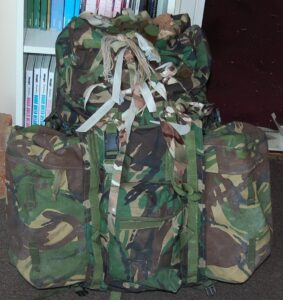
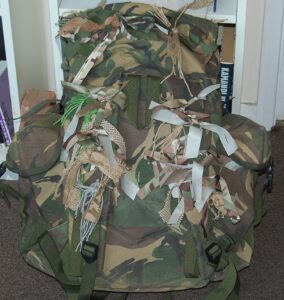
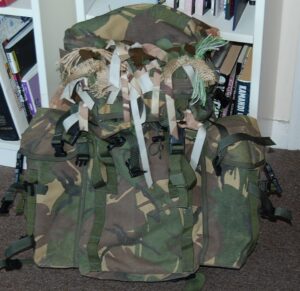
The first project was to experiment with some textilage on rucksacs. For this I used a British army “Northern Ireland” patrol pack and a larger rucksac. I found a company that sells half a kilo of camouflage material strips. Most are PU MTP pattern and unlike most MTP, there is good contrast between the colour elements. Strips of hessian cloth or cord are also used. Note the variation in DPM colours. This is particularly notable between the large pack and its side pouches.
This is the large pack. Note that the side pouches can be removed. More on this later. 
Harness side. The shoulder straps have a strap sewn down them in loops. These allow strips of fabric to be easily applied. 
 
“Public” side of the large pack. Some netting, brown on one side and green on the other, has been added to the lid. This does not show up much against the DPM, but can be used for attaching natural materials. Note that there are are additional “ladder” straps down the outside. More textilage could be attached to these to further break up the shape.
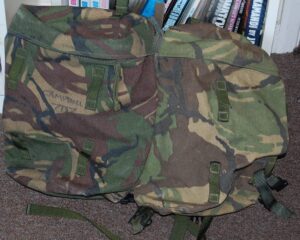
Patrol pack, harness side. The shoulder straps lacked a looped narrower strap. Instead a length of paracord was zig-zagged down the padding and sewn at the curves. As you can see, the paracord is totally hidden by the textilage and the shoulder straps themselves are well concealed.
Public side of the patrol pack. Textilage added to the pack top to break up the shape. The top photo is the standard configuration. The side pockets are well constructed with a waterproof lining and drawcord top, the latter in DPM PU. Unlike the side pockets of the larger pack, these cannot be be detached. This feature may have been added to later versions of the Northern Ireland.
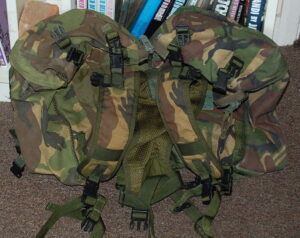
This photo (above) shows my second project. This pack has been modified so that a pair of the detachable side pouches can be attached. This can simply be achieved with some lengths of 20mm webbing and 20mm buckles.
Side pouches rigged for independent use.
Side pouches with their harness. The entire thing can be clipped to the patrol pack without needing to be disassembled.
Categories
Phillosoph

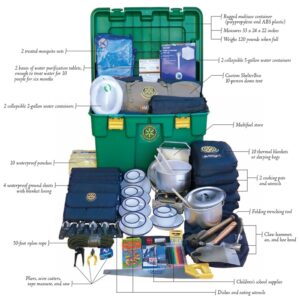
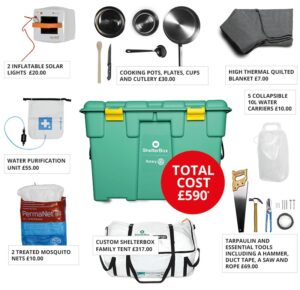
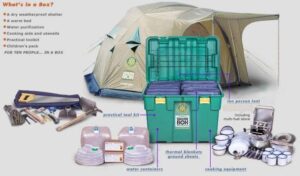
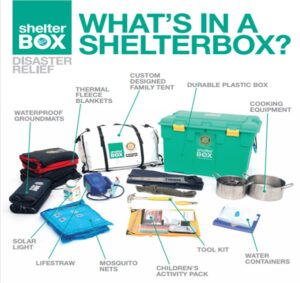
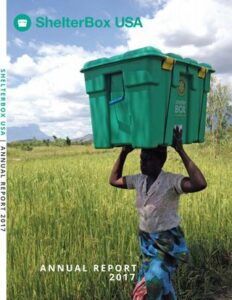
Shelterbox

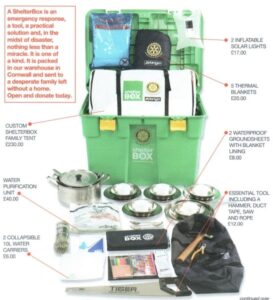
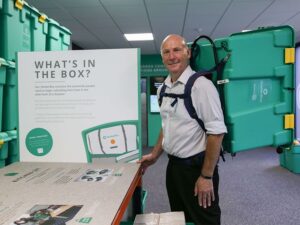
I came across a charity called “Shelterbox” the other day. The contents tie in with my recent article on foundation survival kits.
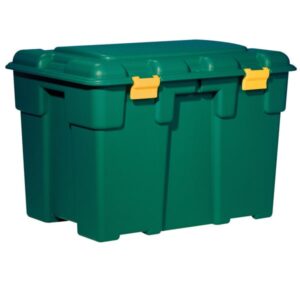
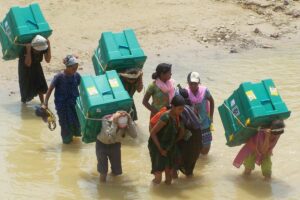
A single shelterbox can hold materials for up to ten people, which is some impressive packing. The exact contents are varied to suit the intended location. I suspect many people might be interested in purchasing similar kits for their families. Such a box could do double duty as a table or footstool until needed. 
A bit of research identifies the box as 185 litre capacity.
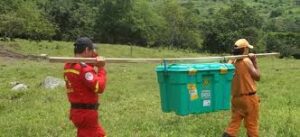
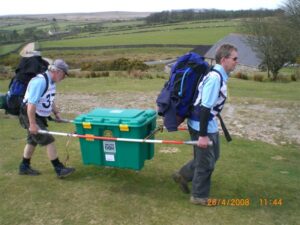
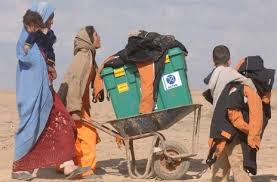
You can carry a shelterbox on your back, but if you are smart, you find other means…
Categories
Phillosoph

Brick and Mortar Camouflage

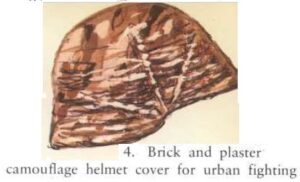
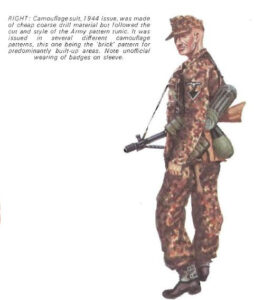
Way back in the 1980s I read an article about camouflage. In that article was a reference to the German army issuing a “brick and mortar” camouflage for urban combat. (Not the April Fool pattern above!) More information could not be found, and it was several years before I came across a single illustration.
Locating this image on line proved even harder!
 
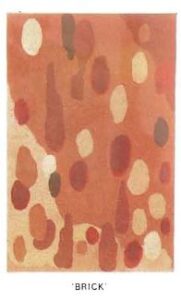
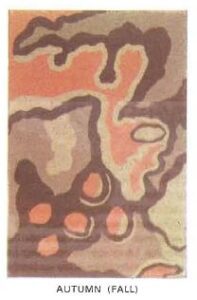
Here is the illustration, taken from Funcken's “Arms and Uniforms. Second World War Part 2”. My recollection was of a red pattern with grey/cream swirls. My recollection is inaccurate, but it can be seen how the creases and wear lines on the illustration would create this impression.
This is actually the same pattern as shown in “Waffen-SS” by D.S. V. Fosten and R. J. Marrion.
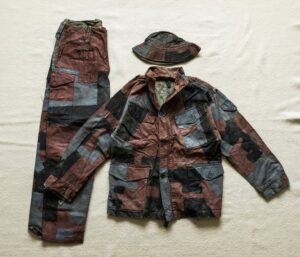
In addition to this pattern the German army and SS issued a number of autumn patterns that used reds and oranges. These were intended for environments such as woodland leaf litter but might have also proved useful in some urban environments. Below is a German garment captured and used by the urban fighters of the Warsaw uprising.
 
Another German pattern that might be useful in brick environments: 
Future conflicts are very likely to take place in urban environments, yet most military gear is still being designed for verdant, rural environments. In some urban environments desert or semi-arid camouflages are useful. Other environments may need more red/orange dominant patterns. Correctly designed these patterns may also serve in some rural environments too. Smocks are the logical way to provide troops with the correct camouflage for the fight.
A friend of mine found this, originally a British army DPM item, it has been painted. 
Categories
Phillosoph

Getting Jigae

Various diversions took my thoughts in the direction of Korea the other day, and I recalled and located this image.
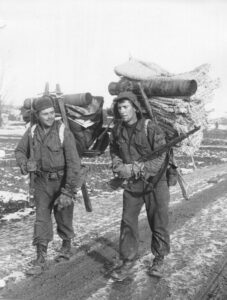
The soldier is Chinese, but the pack design is the Korean “chige” or “jigae”. The text notes that the frame can also be used to serve as section of tent frame. I spend a lot of time on this blog trying to teach people to carry less. Sometimes you have to be able to carry more, and one of the ways to do it is the jigae.

Yes, a floorboard!

I found some images of barrels being carried by jigae but so far no photographic evidence to back up the stories of 210 litre oil drums being moved by jigae
Rooting around the net I came across this company offering an aluminium version. This idea takes the idea further with what resembles a modified chair. Food for thought!
Categories
Phillosoph

More Toggle Ropes

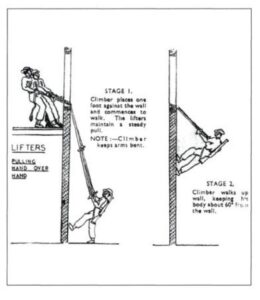
A friend of mine asked me about “the thing with the toggle”, so today I will post a couple of examples of toggle ropes in use.
The first is called “the fly walk”. Two or more ropes are joined and passed behind a soldier. The two men above then take up the slack and the soldier “walks” up the wall. Another book of mine notes that once a high place was reached fishing line was useful for drawing up a toggle rope.
 
The second method uses a pair of ropes as a sort of ladder. Each time the climber bends his knee the man on the rope takes up the slack. The illustration shows a sliding loop for the foot. If you are not wearing rock-hard 1940s army boots I would suggest a fixed loop.