One consequence of becoming interested in the length of documents is that I have given some attention to the related field of reading speed and time.
Over the years I have worked with a number of academics who proceed a workshop with a lengthy introduction. Sometimes this can be very long indeed! It is often claimed that the average human has an attention span of about 40 minutes.My own experience suggests that despite this an introduction should be kept to under 15 to 20 minutes duration. Adding more content serves no purpose if it does not register.
According to a Wikipedia article reading speed varies with language and writing system. Interestingly many people read much quicker than they are able to listen to spoken text. For English, reading speed is somewhere between 200 and 300 words per minute, bearing in mind that many people who will be reading an article in English may not have English as their first language. This means that a concise webpage of under 2,000 words will take about six to ten minutes of a reader’s time. If you have written a page of 8,000 words you should ask yourself will it interest a reader enough for them to spend 30 to 40 minutes of their time reading it?
A fellow writer suggested the use of videos to me. Similar criteria apply, although just as a video is more complex than a written page so too are the factors affecting its acceptability. Personally I find myself reluctant to watch videos of more than ten minutes length unless it promises to cover something I am particularly interested in. If a friend sends me a music clip I find I will give it about 30 to 45 secs before I decide to continue or not. If the intro seems to be one that is particularly drawn out I may jump forward to see if the track improves. With non-musical videos I probably will give it a bit longer to develop, but a lot will depend on the presentation. If a webpage is badly presented and/or poorly structured you can sometimes fish through it for the better parts. With videos this is more difficult so poor structure or presentation will often discourage a viewer.
A significant contribution to the soldier’s load is ammunition. One way to reduce this is to modify how ammunition is expended.
Full-Auto Fever
An assault rifle is not a machine gun. The effective range of an assault rifle with fully automatic fire is considerably less than that of a true machine gun. Full auto from a rifle can be used to sweep a trench or clear a room. It will only be cost-effective at longer ranges if the enemy is in a big dumb bunch. Some manuals state the effective range of a rifle on full-auto as 50 metres. About half of this distance is probably more realistic. If the enemy is more than 50 metres away keep your rifle on semi-automatic.
Let the MGs, Mortars and Snipers Do the Work!
When machine guns, snipers and mortars are available let them do the majority of the work. There is little point blazing away if you know you have little chance of having an effect. Only let the better marksmen make long range shots. Alternately use collective fire and semi-automatic volleys against the same target. Reserve your rifle ammunition for an assault or to repel assaults against the heavier weapons. The less you shoot the harder it is for the enemy to locate you.
Suppressive Fire Doesn’t Have to be Full-Auto
There will be times when rifles must provide suppressive fire. Think about the Westerns you have seen where a character gets pinned down in the rocks. The Winchesters and revolvers used did not need to go full-auto to do this! Suppress an enemy position with aimed, semi-automatic fire.
It’s Fire or Manoeuvre!
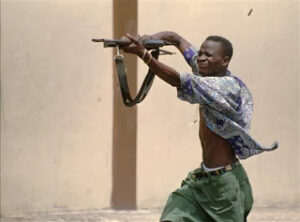
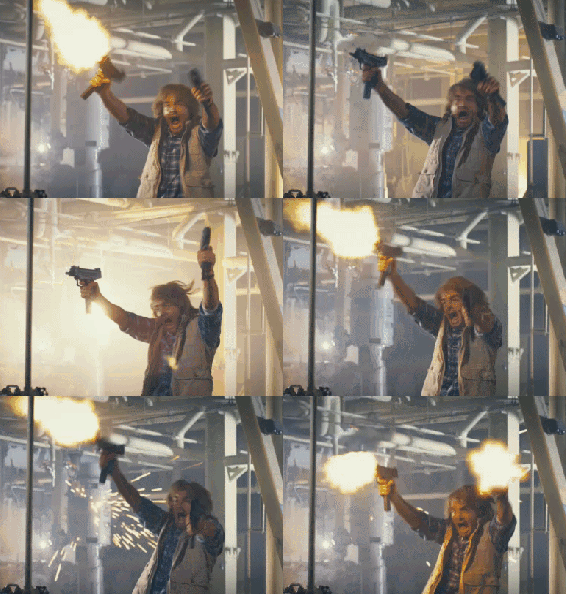
Running across a street guns blazing is pure Hollywood but you will see it done in real life. Firing like this has very little chance of hitting a target. Most of your rounds will not even be close enough to suppress an enemy. What this does do is waste your ammunition and draw attention to you!
If you are moving, concentrate on moving. Tactical movement needs your full attention. You need to be thinking about how you use the cover and concealment available and how you are going to traverse gaps and obstacles. Let other elements provide any suppression. Ideally a moving element should never be visible to an enemy.
Only when an enemy is within a few metres should you be firing and moving.
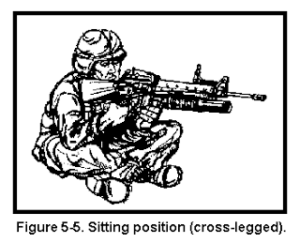
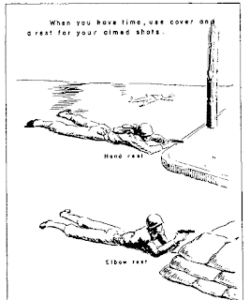
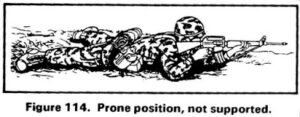
If you are shooting, concentrate on shooting. Use any cover and concealment as effectively as you can. Use the most stable firing posture that your surroundings allow. Standing or moving is the least accurate posture to shoot from. Prone is the most stable. If you are surprised, take cover first, then return fire. If in the open drop prone and then roll for cover.
Many years ago I came across a statement from the SAS when they were reactivated for operations in Malaya:
“At first we carried too much ammo. We learnt to carry less. We learnt to shoot less and hit more often.”
To that we can add a statement from the Home Guard Fieldcraft manual by Maj. JohnLangdon-Davies. He observes that a Home guard solder will never have as much ammo as he might wish for and that twenty rifle rounds at 25 yards will be far more effective that fifty at 250 yards.
Recently, I posted a blog on lightweight shelter from the perspective of the soldier.
This weekend I was reading some suggestions about covert/tactical bivouacking.
Of interest was a passage that said something along the lines of
“The pegs are not to be hammered in. A hole is made with a bayonet and the pegs driven in with the head”(The head of the peg, presumably, not that of the soldier!)
An interesting idea, but some readers will now be recalling that recently I posted on how the bayonet should be one of the first things a soldier should get rid of.
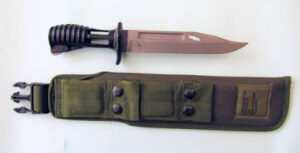
Last night, I put my SA-80 bayonet on the scales.
The bayonet alone was 15 oz, about the same as my favourite 10" bladed kukri.
The bayonet with scabbard was just over 1 lb 7 oz.
This is the later pattern of scabbard without the useful wire cutter and woodsaw fittings.
The blade is a sort of bowie-like shape so not sure how well it will poke peg holes in hard ground.
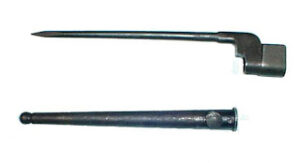
The author of the about passage was probably talking about sword bayonets. The later issue spike bayonet might be even more useful.
Obviously, there is little point carrying a heavy bayonet just to make holes for pegs.
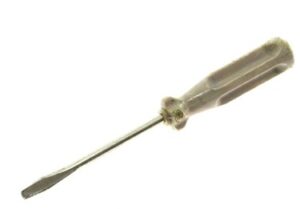
The solution is to find yourself a suitably sized screwdriver.
Sharpen the end if necessary and pack it with your pegs.
The screwdriver can be used to make peg holes.
The shank can be placed under the hook of some peg designs and the screwdriver used to pull up these pegs.
The screwdriver can also be used as a peg, so you are able to carry one peg less.
Since it is Friday I will continue my tradition of a more off-topic topic!
Many readers will be familiar with Osprey. They publish a number of series of books on military history such as the “Men at Arms” and “Elite” ranges. I was recommending one of these books to a friend and made an observation that these books were of a convenient length to get through in a lunch break.
When I write a blog post I usually write it first in a word processor program. I then upload the basic text onto the website and add links and illustrations as required. Recently I have noticed that many of the posts I had made were two pages or less of plain text. This seemed to produce a blog of a relatively convenient size that can deal with a topic but not be overly long.
I had been reading some GURPS sourcebooks recently too. These can often be a useful source of interesting information since some are very well researched. These tend to be more text intensive than the Osprey books. Third edition sourcebooks can be 128+ pages long, which can be a little long (over 100,000 words). Interestingly many of the more recent fourth edition publications are under 60 pages, with some as short as 17 pages. Some may be shorter.
I began to ponder these observations. The Osprey books are very informative and detailed but generally have a page count of between 32 and 64 pages. This includes numerous illustrations, eight full colour plates and quite wide margins down one side of the page. How big is an Osprey book in plain text? I found a blog where an author talks about writing his first book for Osprey and the figure of 15,000 words is mentioned. 15,000 words is approximately 30-40 pages of single spaced text. That sounds very credible for a 48-64 page illustrated book of Osprey format.
Every now and then I come across a webpage where the writer attempts to include absolutely everything on a certain topic. They may also decide to put down everything they know related to the topic. And everything else they may be interested in at the moment they were writing the page. Just to make things even more interesting the page will often lack a logical structure. It is a pity since some such pages often include a lot of interesting information, but this is easy to overlook or miss. If the author is trying to make a particular point this can sometimes be lost in the general tidal wave. If you want to refer the reader to additional information use hyperlinks or, if writing in dead tree format, references!
Now I have written a few overly long and somewhat rambling webpages myself over the years. A few of the more recent ones, however, I have been pleased with the conciseness of. Out of curiosity I pasted a few examples of these into the word processor for a crude word count. Several of these are under 2,000 words, with the longer ones a couple of hundred under 4,000. Hubspot suggests up to 2,00-2,500 words for a blog post. Medium suggests three to seven minutes reading time.
This seems like a very useful set of guidelines. Two pages or less of plain solid text for a blog post. (Font size 12, Georgia, single spaced). 4,000 words or less for a webpage, with less than half of that attractive. For longer works aim for under 15,000 words. If that is not possible aim for sections or chapters of less than this size. The latter strategy may also help towards the better structuring and presentation of the information.
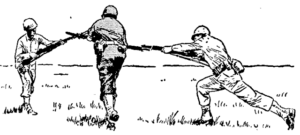
When I was writing “Attack, Avoid, Survive” a friend asked that it include a section on dealing with multiple attackers. “Crash Combat” was written from a slightly different perspective so includes a section on the use of teamwork in close combat. Such might be necessary in operations such as crowd control.
This week I came across some nice illustrations in the 1943 version of FM 23-25. While these show bayonet attacks rather than riot control these nicely supplement the suggestions in Crash Combat.
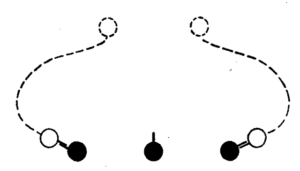
In the first few examples the exact sequence is decided by the enemy under attack. His response determines which of the attackers engages him frontally and which attacks his rear or flank.
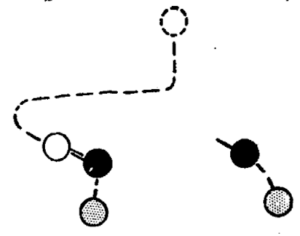
In the second example three men attack two. Once again, the responses of the two defenders determine what actually happens. The right defender could have chosen to engage the central attacker, in which case the rightmost attacker would have made a flank attack.
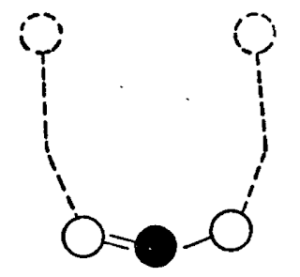
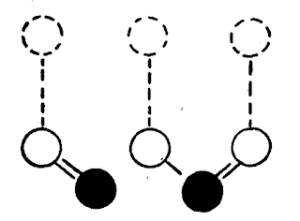
The next two illustrations show the tactics if the attacker is in a minority. In this example the ends of the trio are engaged to prevent the central fighter joining in. In Crash Combat I suggest the alternate approach of concentrating the attackers’ strength at one end of a formation to counter superior numbers.
The other day I saw a post on facebook. I think it was trying to make a point that the chances of being killed by a moslem fundamentalist were really small. As is often the case with such things there was some very selective cherry picking of the data. Number of people who had been killed by buses was given, but not the number killed by road traffic accidents in general. The author had chosen to make the highest number that they posted as deaths from firearms.
Something of interest struck me. The figure given for “deaths by firearms” was 11,000. Or should I say, “only 11,000”. For a country with a population of around 350 million 11,000 is actually a very low percentage. Looking at other sources I am not sure how they got that figure. It may be meant to be murders with firearms.
Deaths from firearms in the US average about 10.5 per 100,000 population. Or 0.0105 per cent! Homicides by firearm are 3.43-5.0 per 100,000, suggesting that most firearm fatalities are accidents, suicide or legitimate self-defence. Deaths from road traffic accidents vary from 10 to 20 per 100,000 population per year. So you are three to four times more likely to be killed by an automobile than murdered with a gun. Chances of a non-fatal injury from an automobile are much higher. As a contrast, an estimated 12,000 people in the US die from falling down steps each year.
Looking at the cause of death figures for 2014 is interesting. The total number of deaths for that year was 2,626,418 which is 823.7 per 100,000. Heart disease and cancer were the main killers. What is interesting is that diabetes killed 76,488, which is 23.98 per 100,000. 55,227 or 17.32 per 100,000 died from “Influenza and Pneumonia”. To place this in perspective, the number of Americans killed in the entire Vietnam war was around 58,315.
Think about that for a second! In a first world country that claims to be a superpower tens of thousands of people are dying from diabetes and chest infections!
Next time you see a politician or someone else claiming that guns are an important issue and something needs to be done about them remember the above and think about what they are really trying to distract you from.
Many modern bayonet designs are not particularly useful. I have an SA-80 bayonet that is inferior to my kukri in every respect. It even weighs and costs more. For soldiers who are attempting to lighten their load the bayonet is often one of the first things to be discarded.
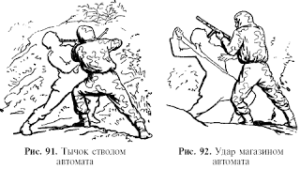
Bayonet fighting, however, is still an important skill to become familiar with. Even if you do not have a bayonet or do not have time to fit it bayonet fighting skills can be utilized. Butt strikes and thrusts work the same with an unbayonetted rifle. With the bayonet a thrust from the muzzle can still have a telling effect. The basic principles also apply to long batons or some improvised weapons. For this reason both Crash Combat and Attack, Avoid, Survive have sections on bayonet fighting without a bayonet.
Training in the bayonet was also considered to be a good way to reduce a recruit’s tendency to hesitate and to increase their commitment to an advance.
The second paragraph of a British WW2 manual makes the wise observation:
“2. It is impossible to drill men into becoming good bayonet fighters as it is undesirable for those of different physique to adopt exactly the same style. Words of command will, therefore, be reduced to a minimum, and men will be encouraged to develop a style suitable to their size and build, provided that the methods laid down are followed.
3. By his own example the instructor must instil a spirit of energy and determination in his squad.”
That is good advice, not just for bayonet instruction.
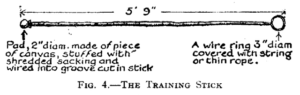
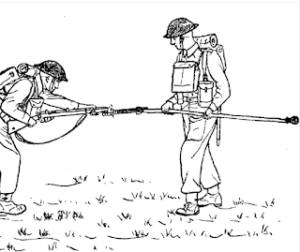
The illustration below is taken from the manual above and shows a useful training aid for bayonet skills. The ring is used as a target to develop accuracy and coordination. The padded end is used for the practice of counters against attacks.
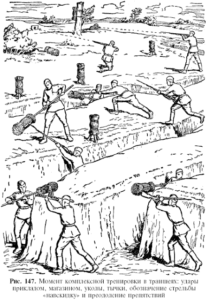
Many armies used similar devices for training. Below is a rather nice Soviet-era illustration of a course to teach soldiers. Rather reminds me of a crazy golf course! In other illustrations parts of the course seem to be used with knives, entrenching tools or unarmed techniques. Elsewhere strikes can be seen being made with the muzzle, drum and stock of the PPSh-41.
Recent posts have mainly been about “the soldier’s load”. This blog is mainly about self-defence and preparedness so generally I try to keep things from getting too military. This has been a useful topic, however, since not only does it reveal solutions for civilian application but it also illustrates the differences between civilian and military applications. Today I will look at lightweight solutions to the need for shelter.
I recently saw an opinion that if a man who was bivouacking was surprised in the night he would take refuge in the dark of the forest. If a man in a tent was surprised, however, he would tend to take refuge behind the false security of his tent walls. Shelter for a soldier must consider tactical factors. Many of the tent designs a civilian might use are not suitable for military use unless required by a particular environment or situation.
A shelter can be thought of as a sort of sandwich. The uppermost layer is responsible for keeping off the rain, wind and sun. The middle layer keeps the sleeper warm. The bottom layer insulates the sleeper from damp ground and ground chill.
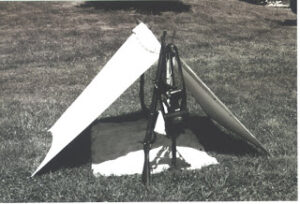
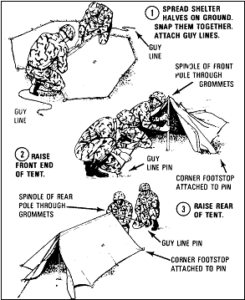
As an illustration of this let us consider how infantry in the American Civil War slept. Men would sleep in pairs, buttoning their shelter halves together to form a “dog tent”. Rifle-muskets might be used to support this structure. A gum-blanket was used as a ground cloth and each man slept wrapped in his woollen blanket. If the shelter cloth had been lost or discarded the top layer of the shelter would be created from the other man’s gum-blanket.
The basic soldier shelter has not changed that much since then. The ground sheet may now be plastic or a foam kipmat. The inner layer may be a sleeping bag or poncho liner rather than a blanket. A basha-sheet or poncho may be used instead of a cloth shelter half.
Unlike many civilian outdoorsmen the soldier is seldom alone. The makings of a shelter can be shared between a pair of men. For example, each man needs to carry only one support pole. As an aside, it is amusing how many kit lists I see that list the poncho as a shelter item yet do not include any support poles for the shelter. Perfectly positioned trees or ideal poles are not always to be found!
Suppose each soldier carries:
Poncho.
Support pole sections and pegs. Enough pegs to also secure a groundsheet. A screwdriver.
Lightweight sleeping bag with liner.
A ground cloth or kipmat.
Probably one man will sleep while the other stands watch. One of the ponchos creates the upper layer of the shelter. The other poncho can be worn by the man on watch if it rains. The other soldier sleeps in the lightweight sleeping bag and liner. If it is particularly cold he can use one sleeping bag within the other. Bulky “three or four season” sleeping bags are not necessary when it is warmer to use two lighter ones together. Giving each soldier his own sleeping bag liner makes sharing a sleeping bag a little more pleasant.
Beneath the sleeping soldier is the kipmat and a groundsheet. He may have placed found materials beneath the groundsheet to serve as a mattress. Kipmats can be trimmed to size to reduce weight and bulk.
A poncho has been chosen for the upper layer since it is the lightest and most versatile option. The poncho can be used as foul weather clothing as well as a shelter. On the downside the poncho is less robust than some of the other options. This is one of the reasons I do not suggest the poncho as a groundsheet.
The actual groundsheet could be an all-weather blanket but can be made from any piece of suitable waterproof material. It only needs to be large enough for one or two soldiers to sleep on so can be smaller than a poncho. In the past I have proposed a groundsheet with a brown side and a high visibility side so it can be also used for ground to air signals.
One man carries the kipmat, the other the groundsheet. A bivi-bag for use with the other items may also be carried by the man with the groundsheet. A pair of sandbags are carried for the eventuality that the sleeping man must keep his boots on. A hammock can be carried in environments where such might prove useful. Poncho liners or blankets may be added where the weather requires them.
The above system is designed with a measure of redundancy. The kipmat and groundsheet can be used on their own if one is lost. With only one poncho the bivi-bag still provides some protection, etc. Many of the proposed items can also be used as foul or cold weather clothing. This is why some of the recent posts have been on subjects such as cloaks.
Some armies define a soldier’s combat equipment as being three levels.This paper gives a concise account of the British Army’s perception:
Assault Order, to provide for operations lasting a few hours. Items needed to “close and defeat an enemy then hold off his immediate counter attack. Weapons, ammunition, water and digging tools”. NBC equipment, communication gear, a flashlight and immediate first aid (field dressings) might also be included here.
Combat Order for operations of 24hrs/overnight. Assault order with some food and “just enough clothing to keep warm and dry”. This level might include some provision for sleeping in reasonable comfort.
Marching Order, containing “all of the man’s issued items that he had in the field.” Some armies have had some very odd ideas what should be in this category! The Wehrmacht infantryman took to the field with his best shoes and sports kit in his pack. At least this pack was carried on the company wagon.
To the above list I would add a fourth level, the Emergency Order. These are the things you have in your pockets that will be available if your webbing is lost. See my post on “sundries” for suggestions in this direction.
Theory and practice often diverge!
For most British soldiers in the last quarter of the 20th century there was no real distinction between Assault order and Combat order. (For clarity, I am using photos of the 58 pattern webbing. More recent systems use the same design.)
Many of the “Combat Order” items were carried in the kidney pouches and poncho roll. These also carried not so vital items such as boot polish!
The weight of the webbing with the kidney pouches and contents necessitates that the yoke be more thickly padded and this can interfere with the wearing of some rucksacs.
The kidney pouches could not be easily removed from the webbing, so the infantryman went into the assault carrying a significant weight of equipment he did not immediately need. During one assault in the Falklands, paratroopers discarded all of their webbing and carried ammunition in their pockets!
The kidney pouches also caused considerable problems with the design of military rucksacs.
A good rucksac puts most of the weight on the top of your pelvis. It may have a hip belt to facilitate this. The main function of the shoulder straps is to keep the load in position. Kidney pouches or similar items hinder this.
While British army designed rucksacs may resemble civilian models, they behave quite differently.
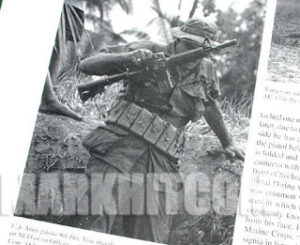
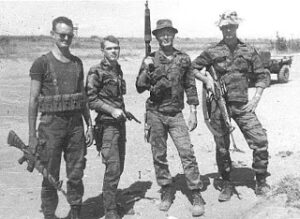
In a recent post we looked at the Vietnam chest rig. This, combined with the grenade carrier and waterbottle on the belt is obviously an Assault order.
Marching order was created by adding a rucksac and it will be noted that there is nothing at the back of the belt to hinder a comfortable fit. Note also that the shoulder straps of the chest rig are relatively unpadded too.
The NVA soldier does not appear to have a formal means of “Combat Order” but obviously such an intermediate level of load is desirable. See my article on Soldier's sundries. Likely contents might include:
Compact wash kit and repair kit
Toilet paper
Spare socks
Canteen cup and brew kit
One or two days rations
Poncho/basha
Sleeping bag/blanket/poncho liner
Poles and pegs
Ground cloth/kip mat/airbed/hammock.
Hat(s), gloves.
Rope
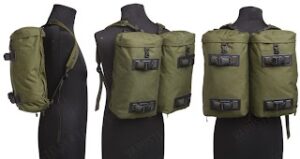
Some of the popular designs of civilian rucksac that have been used by British soldiers have detachable side pockets which can be joined together to create a small pack.
The British Army committees in this paper regarded this as an acceptable way to carry loads of less than full Marching Order.
Sadly they did not follow on to the logical step of eliminating the kidney pouches.
A pack formed from a pair of side pockets has a capacity of about 20-30 litres. It can easily accommodate the contents of a pair of kidney pouches.
The side pockets are long enough to hold shelter pole sections.
Some lightweight sleeping bags pack down to a rugby ball-sized mass so it is quite possible room for such a sleeping bag can be found inside such a pouch.
If a number of accessory patches are fitted to the outside of the pouches, items such as ground-cloths, blankets, ponchos and kipmats can be tied under, around and between the two pouches. A mesh pocket would allow a towel or poncho to dry.
Such an approach eliminates the need for kidney pouches. It allows the use of more efficient rucksacs for marching order and gives the soldier a true, lighter assault order.
Continuing my researches on how to carry equipment.
Last night I read a lengthy paper about the adoption of British PLCE. One of the points that struck me was the mixed reviews of the chest rigs trailed. It is probably safe to say that for most readers mentioning chest rigs will bring to mind the Vietnam war.
During this period Soviets and most countries under their influence used belt pouches for AK magazines. The examples below hold four 30 round magazines, although versions holding just three are also known. The side pouch on one of these examples is for an oil bottle. (The East German example with the splinter pattern shows a nice example of “staple and tag” closure, btw.) The North Vietnamese Army (NVA) did make some use of these pouches but a chest rig seems to be a more common option. Understandably such rigs are often termed as “Vietnam”, “Chicom” or “Viet Cong” chest rig.
Commonwealth forces did use some systems that could be termed chest-rigs. One of the photos below shows additional ammo pouches that could be worn above the belt pouches. Certain variants of the battle jerkin used only a pair of pouches on the chest.
It is more likely that the inspiration for the Vietnam chest rig was from closer to home. There are numerous photos of Chinese soldiers in the 1920s and 30s wearing a sort of “apron” for SMG magazines.
Several types of chest rig were in use by the Viet Cong (VC) and NVA.
The “simplest” was that intended for use with the SKS. This had ten identical pockets. Each pocket could hold two 10 round chargers for the SKS, giving a capacity of up to 200 rounds. In practice, one pocket often held a weapon combination tool and an oiler. The pockets could also accommodate a 20 round M16 magazine so this rig was also used by some GIs or Vietnamese with American weapons. It is probable that some of these pouches were used for other items. They appear to be of a size that can accommodate some designs of grenade.
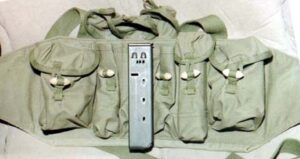
A variety of SMGs were in use in this conflict so there were also chest rigs designed to accommodate SMG magazines. An example is shown below:
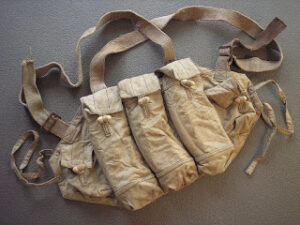
The third type of chest rig was intended for use with the AK-47/AKM/Type 56 and related weapons. Typically it had three central pouches each capable of holding a pair of 30 round magazines. One or two smaller pouches were to either side. These could be used for grenades but might have held other items such as loose ammunition, field dressings, cleaning kits etc. It is worth remembering that these items were often produced at a local level or homemade so show considerable variation in both colour and details. Some items had straps that crossed at the back while others are described as having a loop that passed over the head like an apron.
One of the things to note about these items is that “chest rig” is something of a misnomer. Often you see the pouches worn quite low on the torso. A sort of “combat cumberbund” or “belly rig”! Perhaps this transferred some of the weight to the pelvis? Rigs such as these can be worn either high or low, depending on physique, preference, type of rucksac worn etc. NVA/ VC seem to have kept their actual waist belts relatively uncluttered, often with just a grenade pouch and a canteen. Items not needed in the assault seem to have been carried in the rucksac rather than crammed into belt-mounted butt-packs or kidney pouch equivalents.
The Chicom chest rig has inspired a number of other designs. The Rhodesians often encountered enemies using this equipment and developed their own version with four or five pockets for 20 round FAL magazines.
The South Africans also adopted the chest rig. The 83 pattern shown below has a smoke-grenade pouch on the wearer’s right and two smaller pouches on the left, possible for a frag-grenade and shell-dressing.
There are small fittings that can carry a pen-flare/pen/pencil, knife or small flashlight.
A rather clever feature is that there is a map/document pocket behind the magazine pouches. On the other hand, the sides seem to have some excess material.
Not surprisingly, the Russians also copied the Vietnam chest rigs. The first-pattern Lifchik is very similar to the Vietnam Type 56, but designed for the AK-74 magazines. It also adds provision for carrying a pair of RSP-30 flares. The second-pattern moves the small pouches so they are vertically aligned. The second-pattern also has the option of attaching a belt holding ten 40mm (VOG-25) grenades.
1st Pattern Lifchik Chest Rig
Some commercial imitations have possibly tried to incorporate too many “bells and whistles”. Some have ignored that a chest rig can also be a “belly rig”. Another problem is the chest rig is often seen as additional rather than alternate carrying capacity.
The Chicom chest rig is very much a compact assault order carrying ammo and grenades and little else. When you start adding pouches for waterbottles, mess tins and rain-proofs it become something else. The main improvements I would make over the original designs is provision to carry a couple of field dressings. I’d also add provision to carry a small fixed blade knife on either the left pouch or left suspender, a snaplink/ carbineer for empty magazines and a small pouch for a flashlight.
The chest region is often shadowed so a chest rig should have a light base colour to compensate for this .
As mentioned above, VN examples often resembled a sort of combat- cummerbund or “belly rig”. A moment’s thought will confirm that you do not want the openings of your ammo pouches up at nipple level or higher, if you are carrying them vertically. You don’t have much choice with the long AK magazines, admittedly.
The chest area is a major site of heat loss, so a lower slung chest rig may help avoid overheating.
Many (western) chest rigs simply try to carry too much, hence problems with crawling, which is your primary means of not being seen or shot!.
Don’t use frontal pouches that hold more than a pair of magazines each.
There are a great variety of options out there commercially. Some can be mounted horizontally or slanted on the chest. The under-arm or hip positions proposed in a later blog is another option.
No more than six magazines/180 rounds and up to six (standard sized) grenades, for example, four frags and two smoke. There is probably not enough room on many designs to carry all of these grenades on the chest/belly rig. One smoke and one or two frags seems more likely, with additional grenades carried elsewhere.
You can mount your “pec’ knife;” on a rig (see Survival Weapons or Crash Combat), a shell-dressing or four, a flashlight and a snap link for spent mags.
Some of the shell-dressings may be carried at the back over the kidneys. They are more likely to be accessed by someone treating the wearer, rather than the wearer so the rear position is not a major problem.
If you have a compact weapon-cleaning kit, such as in a discarded flare container, the belly-rig is a logical place to carry that too.
You will not need the latter in a hurry so it can be stowed on the rig somewhere out of the way.
Provision to add other items temporarily can be included.