Disclaimer: “As an Amazon Associate I may earn from qualifying purchases.” Adsense and Infolinks were no help at all.

If you have enjoyed this article or it has been helpful to you please feel free to show your appreciation. Thank you.

Read The Third Wave by Alvin Toffler!
Categories
Phillosoph

Hybrid Societies and Incompatible Cultures

It is comforting for us to think of many things as static and unchanging. Many readers of this blog will have read about various martial arts and encountered the opinion that “this set of move is XXX-jitsu” and “these techniques are YYY-style kung fu” and so on. The truth is that many things are in fact constantly undergoing a state of change. It is now much easier for the practitioners of a certain style to learn about other styles and inevitably new ideas are encountered and some are adopted. This is true of many things that we may wish were unchanging. Our culture, our language, etiquette and many other things are all ever changing. Things change, and this is not necessarily a bad thing. With change comes selection and this is necessary if improvement is likely to occur.
Decades back I was part of various on-line discussion groups. One relatively new member had a habit of frequently introducing his pet topic/hate into discussions. “Isn’t diversity wonderful” he would sarcastically sneer. I think he might have been quite shocked if he had known just how diverse some of the other group members were. At least one was Jewish (!). A couple were even not American (!!). Yet another had some specialised (yet legal) leisure tastes, the details of which do not concern us today. Some of you will no doubt already be relishing the irony of a (presumably) white American complaining about diversity when the very culture he champions is itself a fusion of many others.
“Multi-culturalism” is a term that has been thrown about a lot in the last few decades. What is often ignored is that the multi-cultural societies that work best are in fact hybrid societies. Various communities may maintain their own identities but they are also willing to entertain the ideas and concepts of other cultures. We take what is best or most useful and make it our own. I am writing in an alphabet acquired from the Romans but perform maths with Indo-Arabic symbols. The language I am writing to you in draws on words from a smorgasbord of other languages. Our national dish is now curry and the little Moslem girls next door are just as excited about the fireworks on Bonfire night/Dwalli and Christmas as any other child in the city. The love of my life is a British Brazilian and has introduced me to many wonderful things from that culture. “Girl talk” between her mother and sisters is conducted in Portuguese, and that suits me fine, I am not expected to listen.
The reason I am writing about this today is because it has occurred to me that there is a flipside to this. If we accept the biological analogy of a hybrid society then the logical implication is that there possibly may be cultures that are simply not compatible with some others. Observation of the facts seems to indicate that this premise is more than just theoretical. Many societies (supposedly) practice sexual equality with respect to gender or even sexual preference. Some cultures have a deeply-ingrained patriarchalism and/or misogyny as a fundamental component of their identity. Others not only include homophobia in their beliefs but advocate active persecution and execution of such. There is at least one cultural group that is actively parasitical or even predatory, wishing nothing from other cultures other than a one way flow of wealth and resources.
I’ll refrain from further discussion along these lines since inevitably some fool will cry “racist” rather than trying to actually understand the concept I want the reader to think about.
It is nearly Thanksgiving in the US. A meme that some people have been circulating is that the Pilgrim Fathers were themselves refugees. Part of the folklore of Thanksgiving is that the Pilgrim Fathers were fleeing persecution. It seems in reality this is not strictly true and that many were a separatist minority whose main complaint was everyone else was not following their creed. Refugees are one of the topics of the day and some will have it that anyone who opposes the immigration of refugees is simply a racist. Perhaps things are not so simple. Some of the countries being criticised for reluctance are some of the most densely populated in Europe. Many richer Moslem countries are refusing to take predominately Moslem refugees. My recent meditations cause me to ask if certain new or existing cultural groups will contribute to our hybrid society or are they incompatible? Tolerance needs to work both ways. These are things that need to be recognised and intelligently discussed sensibly without knee jerk accusations of “racist!”

Categories
Phillosoph

Duodecimal Finger Counting: Counting to 60 on One Hand

Currently I am reading “The Last and First Men” by Olaf Stapledon.
I’ve just reached the section on the third species of mankind. The third species have six fingers on each hand and Stapledon notes that they have a duodecimal mathematical system.
By a manifestation of synchronicity. I was watching “QI” that very night and a base- twelve finger counting system they attributed to the Babylonians was featured. Using this system it was possible to count up to or display numbers of up to 60.
Investigating the topic further, I came across a number of websites averring that the Babylonians in fact had a base-60 numerical system. Looking at their numeral system, however, seems to suggest a decimal system. Which of these is true is out of the scope of this blog.
I thought it would be handy (pun intended) for readers of this blog to know about a hand signal system that can represent relatively high numbers. Many measurement systems are based on dozens, 24 or 60, after all.

The system is very simple. There are four fingers on your hand and each has three joints and three bones. The joint or bone of the first finger nearest the wrist is “1”. The join of the little finger nearest its tip is “12”.
By pointing at a joint with the thumb of your other hand you can indicate any number from 1 to 12. If you point with your index finger instead of your thumb the joints are designated 13 to 24. And so the progression goes on up to 60, which would be the tip of your little finger pointing to the last joint of the other little finger.
Counting in dozens makes this technique even easier. For example, a count of “three dozen and two” can be easily converted to 38.  
The illustration above is labelled in “dozenal” notation so the upside down 2 (↊) is “ten” and the inverted 3 (↋) is “eleven” in base-10.
Twelve and 60-based counting has obvious applications to navigation using degrees, minutes and seconds, or calculations of time using hours, minutes and seconds.
That is the system. Perhaps you may find it of use sometime.

Update

You can actually count to 156 on your hands! Use the tip of your thumb of your same hand to touch the finger bones between the joints rather than the joints.
You may find it more logical to start with the little finger for the lower numbers.
For each dozen you count off, you touch the corresponding bone on your other hand with the thumb of that hand. 12 x 12 =144.
You other hand can actually represent any number from 0 to 12, hence this system can count up to 156 (12×12 + 12).
You can also do quick additions using this method. Shifting your thumb from a finger bone to the equivalent fingerbone on the next finger adds three, two fingers adds six and three fingers adds nine. Using the other hand, skipping a finger adds 36/three-dozen. For more on dozenal counting see here.
Using this method you can use your hands as a simple abacus in either base twelve or base ten. For the latter you just ignore the first two sections of your last finger.
Categories
Phillosoph

Facebook Friday Funny

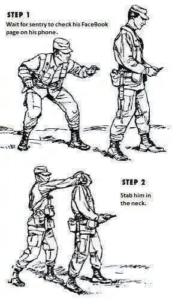
        A "Friday funny" for today's blog. I came across this image by accident yesterday. Regular readers will know I have often cautioned against paying more attention to your phone than your surroundings. I suspect this joke may be closer to the truth than some might wish!
……and then update his status: "Bleeding from carotid. LOL"

Categories
Phillosoph

Yule Be Sorry!

I once read a story in which Buddha was asked if he would ever eat meat. “Yes.” he replied. He then went on to explain that if his hosts at a dinner inadvertently served meat he would go ahead and eat it. It was better to be a poor Buddhist that a bad guest.

That is something that is worth thinking about, and not just if you are vegetarian. The reason that I am reminded of this is that I have just seen yet another story about the acceptability of saying “Merry Christmas”, “Happy Holidays” or whatever. The mass media loves to stir up and fan such stories. Various attention-seeking persons can be relied on to wade in and jump on the bandwagon or try to turn the discussion towards their own pet topic. We see the same rants and rages every year.

    Let me settle this issue once and for all with three points:

Firstly “holiday” derives from “holy day” so is an appropriate salutation and not the anti-Christian meme that many choose to take it to be. Holidays around solstice time probably date back thousands of years before Christianity.

Secondly, one should take a salutation in the spirit in which it is intended. Merry Christmas, Happy Holidays, Happy Yule, Happy Chanukah, Namaste or whatever. If they are given with good intention then they should be treated as such and not as an excuse to take offence, air your pet topic or introduce your personal interpretation of religion. This is, quite simply, just good manners. As a man once said “Be polite, tolerant; wear deodorant”.

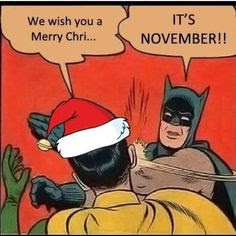
That being said, however, if someone does wish you Merry Christmas/ Happy Holidays in the next twenty days you are quite entitled to reply “IT’S NOVEMBER!” Save Christmas for December.

Categories
Phillosoph

Don't Believe All That You Read

A friend of mine has written a book addressing several aspects of modern and future military operations. It is well worth a read if you have an interest in such topics.
In one chapter he reproduces a pair of articles written by Fred Reed, a former US marine turned journalist. For today’s blog I will repost one of these articles, since it gives a good explanation as to why journalists and their publications are usually such a bad source for reliable information. The article cannot be all inclusive, of course. Reed does not address the common practice of deliberate misrepresentation of facts for sensationalism or political effect, for example. Every firearm is “AN ASSAULT WEAPON!”, every single armoured vehicle “TANKS!”, every transport delay “TRAVEL CHAOS!” and so on. It still baffles me that otherwise intelligent people treat newspaper stories as though they were reliable and waste good money buying them.

“Most cops know that the national media do not pursue the truth, they pursue a story. Their story and the truth are too often a little like fraternal twins. They are related, but cops can’t explain why they don’t look anything alike.”
Reporters Errant
The Origins of Bushwah
Everyone and his pet goat has noticed that the media do a poor job of covering the news. The facts frequently aren't facts, the reporters conspicuously don't understand their subjects, and the spin is annoying. Why?
For lots of reasons. To begin with, newspapers necessarily attract certain types of people. To get the news, reporters have to be aggressive, willing to push their way over others and to ask questions people don't want to answer. They have to work well under the pressure. Because deadlines rule newsrooms, they often have no choice but to write superficial, half-understood stories. A reporter can't tell the editor, "Yeah, somebody did just nuke Capitol Hill, but I think we should wait to write about it until next week, when we have the facts."
Further, reporters have to submerge themselves daily in tedious details of unimportant stories about trivial people: Who wrote the check used to buy the fur coat that was obviously if not provably part of the bribe from the lobbyist of the trash-collectors' union to the mayor's wife? (Who really gives a damn?) Most reporting is neither interesting nor exciting.
It requires the soul of a CPA in a hurry, and reporters indeed amount to high-speed fact-accountants. The job quickly weeds out those who don't want to be, who aren't comfortable with the compromises and pressure.
The nature of people is that some qualities do not often coexist with others. For example, the aggressive and detail-minded are seldom studious or contemplative. Fact-accountants are not theorists. The cast of mind of reporters is concrete, not abstract, their mental horizons short. Reporters aren't stupid–most are quick and some are very bright indeed–but they do not naturally look at the big picture. They do not, for example, approach a new beat by reading books about it. Intellectual they ain't.
To put it a bit too succinctly, the qualities needed to get the news preclude an understanding of it.
Since most of the people in any newsroom fit this pattern, a culture has evolved which supports the reporters in their natural inclinations. It is a staple of reportorial philosophy that one does not particularly have to know a field to cover it. Any reporter, goes the thinking, should, given a week or two to fill the Rolodex, be able to cover anything. Which in fact he can, barely: Within a few days an experienced reporter can knock out copy that usually is not ridiculously wrong. Neither is it very good. But that is good enough.
A concrete example: A reporter assigned to the military beat and told to cover, say, submarines, will pull everything he can find on submarines from Nexis and the morgue. He will learn who in the Pentagon deals in submarines, who builds them, what the armed-services committees on the Hill think about submarines, whose districts profit from the contracts.
He will not read books on the design of submarines, their history and modes of employment. He will probably never quite learn what they are for: plugging the GIUK Gap, for instance. Further, reporters seem to be obligate technological illiterates: Our example will not learn about phased arrays, convergence zones, the relation of the aperture of a towed array to its angular resolution. He won't have the background to understand such things even should he try. So he will go for politics, which he understands.
In short, he will learn everything about the politics and bureaucracy of submarines, and nothing about submarines.
The fundamental ignorance leaves him at the mercy of his sources. Since he will have no independent idea which of competing claims about a new submarine make sense, he will have to decide instead which sources seem to him more trustworthy. Seeming trustworthy is an art much studied in Washington.
Now consider the circumstances under which reporters work. Newspapers with few exceptions are understaffed. A computer magazine can have a writer specializing in CPUs and microcircuitry, another in software, a third in disk drives. By contrast a newspaper will have a reporter who covers Science-and-Technology. The job is a bit like specializing in practically everything. It ain't doable. The field is too grand. It can be approximated by the very rare reporter with a strong technical bent and a lifetime of reading texts in biochemistry, vector analysis, neurology, and so on. These usually go to technical publications.
Back to our example, him of the submarines. His beat will be The Military. He can't cover it. The military is a vast, sprawling canvas of different services, weapons, missions, bases, much of it relying on exotic and highly disparate technologies. Further it is all over the world. The reporter can't go all over the world.
So he will cover the Pentagon, which is convenient, and military politics, which he can believe he understands. They aren't the military. But they're coverable.
And here we come to a governing principle of newspaper journalism: Do what you have time to do. This is why you see stories reporting that some policy shop, say the National Coalition of Concerned Physicists (I think I made that up) says that we are all in danger from radioactive emissions from rutabagas. Maybe we are; maybe we aren't. The reporter doesn't have time or, perhaps, knowledge to find out.
To save labor, journalism has decided that the issuing of a report is in itself a story, not the beginning of one. The reporter therefore doesn't have to know enough to determine whether the report is correct. He merely has to announce its existence. The published account is inherently biased, even if the reporter covers himself by adding a one-sentence rejoinder from the rutabaga farmers. The important thing is that he gets a story easily, which is all he has time to do.
The policy shop understands all of this, and takes advantage of it.

Them's some realities of the news racket. We'll look at other from time to time.

Categories
Phillosoph

Making a Bilum Bag

Decades ago, just off Regent Street, London had the Museum of Mankind. The museum no longer exists on that site. The premises was closed down and the exhibits merged with the British Museum. The collection at the British Museum is vastly greater than the space available for display so I suspect many of the items from the Museum of Mankind have been sitting in boxes, unviewed for years at a time.
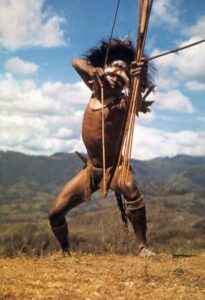
My visits to the Museum of Mankind coincided with an exhibition on Papua New Guinea. There were many interesting things to see. For example, the arrows on display had neither nocks or flights. They were drag-stabilized with a blob of tree gum added just behind the head to adjust the balance. Rather than strings the bows had a broad strap as wide as the base of the arrow. 

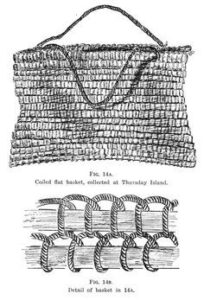
One of the things that fascinated me was the net bags on display. These were constructed using a repeating multiple knot that reminded me of a figure-eight knot. This technique has been called “knotless” but I tend to think of it as multiple interwoven knots or even one vast, complex knot!
The bags made by this technique are called “bilum” on many webpages so we will call this technique of construction “bilum knotting”.
If you have read my book on knots you will know at least two ways to make nets. Bilum knotting creates and expanding bag useful for carrying loads in. Such bags are used to carry everything from phones to babies.
Images of how the knotting is actually done are relatively rare on the internet. Below is the best I could find and I have coloured certain parts in to give a better appreciation of how it works.

Red is the first row, and could have been made going from left to right. I have coloured some of the second row green to illustrate better how it attaches to the previous row. While the second row looks identical it was probably constructed moving from right to left. The lighter green threads show how a row is ended to create a new row. Start the first row with a slip knot.
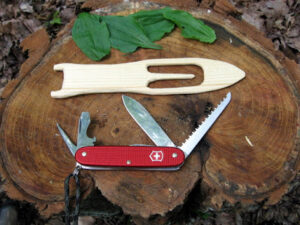
All this looks complicated but is actually relatively simple. Connect with a neighbour first, then the row above. The most tedious part is pulling the yarn through each new knot. I suggest you find a suitable piece of wood or plastic and make yourself a net-mender’s needle.
To keep the knots even the yarn is looped around strips of flat material. Traditionally long leaves were used. More common now is to use strips of plastic strapping. Created using a former such as this the knots/loops look more like a “ ∫ ” than an “8”. Rulers might make handy formers.

 
A mandatory charge has been introduced to encourage us to re-use our shopping bags. A bilum net bag may be a useful alternative. It packs up small in a pocket and can carry a large volume.
Categories
Phillosoph

Stop, Look, Listen, Smell

         Today’s blog is something a friend sent me. Those of you that have purchased my second book will recall that in the tactical chapter I offer similar advice about the value of frequently stopping to listen and scent. 
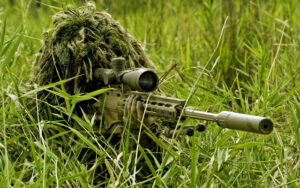
Here are twelve thoughts from a British Army Sniper. Tip 12 is useful in daily life, and is the reason you are getting this. The other hints are fun and likely worth reading if you hunt, play video games, or engage in recreation battles.

12. SLLS ( Stop, Look, Listen, Smell) This is an army method that allows you to regain your focus<http://www.soldiercombatskills.com/chapter-7-movement/> when the stress of the mission or situation gets too much. When you become too stressed and feel your focus slipping, stop what you are doing, look, listen and smell the surrounding environment. Take as long as you need to regain your focus and return to the task at hand.

Original article, eleven more handy tricks and hints.

http://www.theprepperjournal.com/2015/10/26/12-tips-from-a-british-army-sniper/

How to SLLS https://survivormind.wordpress.com/2012/12/05/stay-alert-stay-alive-slls/

Stop – Everyone takes a knee and completely stops moving. Breathing goes shallow. Nothing moves but your head like it’s on a swivel and you move it in a a slow, deliberate motion so that you don’t even hear your neck rub against your collar. Making the smallest noises can literally cancel out the benefits of this entire exercise. You must be absolutely silent. Part of stopping has to do with feeling as well. You will suddenly notice which direction the wind is blowing. You’ll realize you are a little overdressed because the insides of your thighs are sweating. Etc.

Look – You move your head from side to side, up and down, taking in everything around you. You will start to notice things that you didn’t see before, like an odd boot print, a broken twig in front of you when you are the first man in the movement, a distant fighting position on the side of the hill, etc.

Listen – There is absolute silence from those around you. Your hearing will start to key in on faint noises that you couldn’t hear before. You’ll suddenly realize that there is a road somewhere in the distance through the thick copse of trees in front of you. Animals will begin to make noise again. You may hear enemy troops, laughing in the distance.

Smell – Our ability to smell is muted by the comforts of civilization. If you’ve ever been outdoors for more than a few days at a time and been starved, you start to smell things you never would normally. I once conducted SLLS by myself in a patrol base in Ranger School and smelt peanut butter. I was like WTF? It’s not chow time. I began walking around and found the offender on the very opposite side of the patrol base from me, 100 yards away. Yes, I smelt this clown’s peanut butter from 100 yards away. This would never happen in your outdoor cafeteria at your local University. Like I said, our smell is muted. While conducting SLLS out in nature, you’ll notice things that you normally would not. The smell of weapons discharge, fire, food, dead animals or people, and you’ll smell it at a distance you never thought possible.

More on SLSS; https://www.themuse.com/advice/take-back-control-of-your-workday-with-this-one-simple-sniper-trick

Categories
Phillosoph

Positioning Weapons

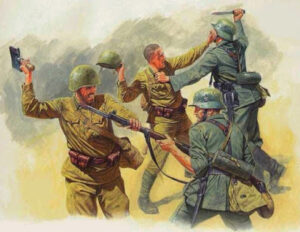
During my recent researches of things Soviet I came across the following rather nice illustration. As is so often the case with these posts, another topic I had been reflecting upon had relevance here. This is not going to be a post on fighting with entrenching tools. There will be treatment of this topic in time, included a little known, possibly exclusive technique that most of you will not have encountered.

Those of you that have read my books will know that I advocate that you should have at least one weapon that can be accessed by your weaker hand. There are a number of scenarios wherein your stronger arm can get trapped, grabbed or wounded. In such a situation you should be able to use your other hand to bring a weapon into action. In the time of the Japanese samurai combats would often end in grappling, the winner being the one who could manoeuvre his opponent to a position from where he could insert a dagger trough a weak point in his opponent’s armour. Such grappling combats were actually fairly common in other cultures that used armour. I use Japan as an example since there are records that some samurai ensured that they wore a dagger on either side of the belt so that they could draw a weapon no matter which arm was entangled with an opponent.
As well as arming both sides, one should also be aware of the danger of having all you weapons on one level. I have been reading about some instances when police officers have been attacked with a tackling action. Since all of a cop’s authorized weapons are generally carried on his belt an attacker hugging him around the waist prevents him from drawing a weapon. The tackler does not need to be a skilled grappler to exploit this position. He can just hang on long enough for his friends to stomp the cop or steal his weapons and turn them against him.

Obviously, having weapons accessible at different levels is prudent. Many soldiers carry a knife on their webbing suspenders. I discuss this further in my second book as the “Pec Knife”. The positioning of such a knife allows it to be accessed with either hand even when one is down on the ground.
During the Second World War many soldiers and SOE agents carried small thumb knives or lapel knives. As the name suggests, these could be concealed behind a suit or uniform lapel. They were also hidden behind trouser braces, cap badges and a wide variety of other places. The lapel knife sheathes were provided with button holes so they could be attached to a button sewn wherever the user desired. At least one agent placed his knife in his inside pocket so he could draw it when asked for his papers.

Many readers will have heard of the “Sap Cap”, a baseball cap with a weight sewn in the back. Some of you will know that this commercial product is predated by “do it yourself” articles that suggest pinning a fishing weight in the back of a hat. The other day I came across a Russian source that advised soldiers to sew a piece of lead 30 x 20 x 1.5mm into the back of their uniform hats. This was a peaked “patrol hat” type item but I suspect that it would work with a beret too. Given that lead is toxic and can be absorbed through the skin I’d not use it in a hat unless it was well insulated. Steel shot, lead-free fishing weights and steel washers have been used instead. The piece of lead suggested above would have weighed less than a third of an ounce so a great weight or mass is probably not needed. As well as the obvious offensive use a sap-cap can be used to strike a hand holding a knife or thrown in the face to create a distraction.
The Soviet soldier using his helmet as a weapon obviously reminded me of the sap-cap idea. A helmet held in the hand also makes a pretty useful buckler against a knife or bayonet. As an aside, in his army days in Malaya my father sharpened the brim of his steel helmet.
If you are armed, you need weapons accessible by either hand. You also need plan for the situation that a weapon may not be accessible due to posture, body position or enemy action. And finally, you need to understand that if attacked there may not be time to draw a weapon. Often attempting to draw rather than initially countering an attack can be a fatal mistake. Your hands, boots and other body parts are the weapons you never have to waste time drawing. Learn how to use them well. 

Categories
Phillosoph

There Were Two in the Bed and the Comrade Said "Roll Over!"

      Three hundredth post today! Buy the books or the posts will continue!      Today’s blog is effectively an adjunct to Friday’s post on the equipment of a Soviet soldier. You will recall that the wartime Soviet soldier was not issued a blanket or sleeping bag. Instead he was expected to sleep under his greatcoat with his rain cape providing shelter.
      I have often come across references to men sleeping under coats or cloaks and been a little bit puzzled. Even a long coat must be shorter than the man that wears it so how do you sleep under it without your feet sticking out?  This weekend I came across an account of how the Soviet soldier achieved this. In true communist fashion it involved some teamwork! Note that the Soviet greatcoat had a half belt at the back that gathered some of the coat’s width in. When used for sleeping this belt was undone on one side so that the coat covered a larger area.
      Here is how the Soviet Infantrymen did it:

      Blankets, which were brown, although issued in garrison environments were not issued for field use. Soldiers were expected to make do with greatcoats. Here is an example: "On cold nights I shared a greatcoat with quite a few of my wartime comrades in the fighting lines. Many of them have since fallen.
       There is no brotherhood that binds people closer than the one that's born in the lines, and a shared greatcoat is one of its symbols. You feel warm and secure with a friend close by. Actually, there are two greatcoats for two. A shared greatcoat is just a figure of speech. So what happens to the second? Duffel bags or lambskin mittens (with two fingers so it's easier to shoot) are used for pillows. The individual tents that double up as cloaks are used as mattresses and the greatcoats are the blankets. The shabbier one covers the feet and legs and the newer one the upper part of the bodies. Both men settle down on the same side. If there is the blessed chance of taking off your boots, the feet are tucked into the sleeves of the greatcoat – a pair of feet to a sleeve. The upper greatcoat is pulled over the shoulder, the shoulder of one fits into the right sleeve, the shoulder of the other into the left. The result is a kind of sleeping bag, warm and cosy. If it gets inordinately cold, the greatcoat is pulled over the heads – one head in one sleeve, the other in the other. When one side goes numb and the other freezes stiff, both men turn over simultaneously and the fitful sleep of the soldier continues."


      I have updated Friday’s blog with a link to this account.

Categories
Phillosoph

Soldier's Load : The Soviet Approach

As is now an established tradition, the Friday post will be a little more diverse than usual (Although yesterday we had a bomb thrower that used biscuits to work!).
I have been reading a little about the Battle of Berlin (the 1945 one). This lead me to look at Soviet infantry equipment.
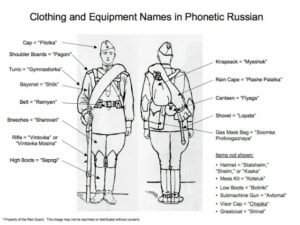
In military circles “simple and effective” is often synonymous with “Russian”. The Soviet solder did not seem to carry very much, but what he did carry was surprisingly well thought out. Reducing the soldier’s load is a long running topic of debate so it is worth having a look at how the Soviets approached this. This is going to be just a quick thumbnail sketch of Soviet equipment so for brevity I will not go into great depth. There are many fine websites that can give you details such as introduction dates, model numbers, variations and so forth. 
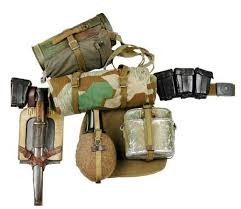
The first thing that becomes apparent is that some of the infantry equipment was very similar to that of the German soldier. Of course, during the war a lot of German equipment was used by the Soviets and the similarities often do not make this obvious in photos. Many readers will be familiar with German belt order items so for convenience I will refer to these for purposes of comparison.
The first thing you notice when comparing the German and the Soviet is what is not there. The German routinely carried his mess tin and breadbag on his belt. Sometimes the mess tin was attached to the yoke or a backpack but carry on the belt was very common. The Soviet seems to have preferred to carry his mess tin in his backpack or tied to the outside. The Soviet mess tin was a kidney section pail of similar design to the German. An older pattern of circular pail was also in use. There was a Soviet version of the breadbag but it does not seem to have been so widely used. Again the Soviet seems to have preferred to carry his rations and personal items in his pack. The breadbag may be placed inside the pack rather than being worn on the belt.
Another “missing” item is the bayonet scabbard. The German usually placed his bayonet over his entrenching tool. The Soviet rifle used a socket bayonet that was kept permanently attached to the rifle. The standard bayonet had a screwdriver tip for adjustment of certain parts of the rifle. It was also a handy implement for clearing a jammed cartridge. Some other Soviet weapons had folding bayonets. No bayonet scabbard was issued in wartime since they were not needed. Bayonet scabbards tend to be all metal and on the heavy side in my experience, so this policy may have saved the Soviet soldier a few ounces of unnecessary weight. While the bayonet was a useful fire poker, screwdriver, pot lifter and candlestick it was not much use as a utility knife. Scouts and some other troops might carry the NR-40 knife. Other blades such as German trench knives or Finnish puukkot might also have been carried.
An iconic equipment item of the German soldier is the metal canister used to carry his gas mask. The Soviet equivalent was a canvas bag carried near the left hip. Once it was accepted that gas warfare was unlikely Soviet soldiers often did not bother to wear this bag. Some removed the gas protection equipment and used the bags for more useful items.
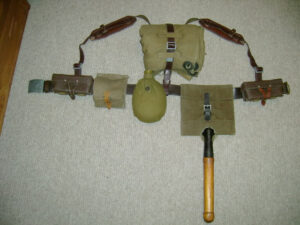
So what did the Soviet soldier carry? There would be an ammunition pouch. At the start of the war a pouch was worn each side in the same fashion as a German soldier. Reenactor websites I have viewed are insistent that it became routine to wear just one ammunition pouch, which was positioned on the right of the belt. A grenade pouch was usually worn on the left side. The belt would also carry a water bottle.

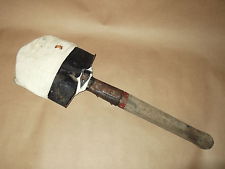
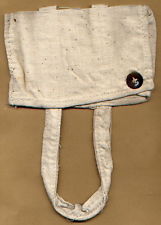
The final belt item was an entrenching tool. The German soldier seems to have favoured carrying this on his left side, sometimes towards the rear. In contrast the Soviet carried his on the right side. A dense item such as an entrenching tool might injure the wearer if it was fallen upon, so the Soviet e-tool was on the flank, with the ammunition pouch preventing it creeping forward. Alternately the tool was tied to the pack. If the tool was expected to be urgently needed for close combat it might be tucked through the front of the belt. Several designs of carrier were used for the e-tool. The simplest and most interesting is the one shown below. The shaft is passed through a loop and a flap used to secure the top. The flap is fastened by a button, toggle or popper. It is both a quick draw and minimum weight solution!

The Soviet’s kit was not limited to what was on his belt. We have mentioned his backpack several times and have discussed the design of this item in >another blog. The classic image of the Soviet soldier has him with a blanket roll across his chest. In actual fact this item is a rolled greatcoat. Russian soldiers were not issued blankets and were expected to use their greatcoat to sleep under. Note that the rolled greatcoat was always worn from the left shoulder to the right hip so that the rifle or SMG could be properly fired from the right shoulder. Alternately the greatcoat horseshoe was tied around the outside of the pack.
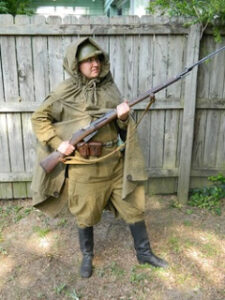
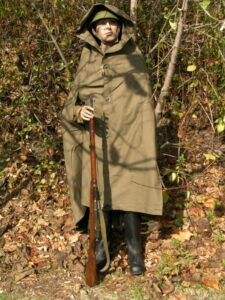
Another important item was the shelter cape or “Plash-palatka”. This was rather ingenious square of cloth that served as basha-sheet, tent component and rain cape. As can be seen, this is a 180cm square of canvas with button holes in each edge and grommets at the corners. One side has toggles next to the button holes (top edge in diagram). There is a single arm slit near this side. One corner (top left) has two drawcords in channels. Not shown in the diagram is that there is a toggle sewn some distance toward the centre from the bottom right corner. When worn as a rain cape the toggle is passed through the bottom right grommet to prevent this corner trailing on the ground.
 
When used as a rain cape the drawcords are pulled in to form that corner into a hood. The opposite corner is folded up and secured as described in the previous paragraph. The right arm is passed through the arm slit to operate the weapon. The left arm comes through the front opening of the cape but maintains a good drape of cloth over the left side to keep off the rain and provide concealment. This really is a well thought out design!

The Plash-palatka on its own could be used as a shelter or combined with others to form a variety of structures. Some of these are illustrated in the Russian manual. The preferred method of joining them appears to be lacing them together through the button holes. This may be because only one side had toggles and this side would have to be placed lowest to prevent rain entering through the fly of the arm slit.
For turning the Plash-palatka into a shelter the soldier also carried two sections of tent pole, a wooden peg, a metal peg and four foot of guy rope. This could be compactly stowed in a small back and the resulting package was the right length to fit widthwise in the backpack! It could also be tied to the outside of the pack if interior space was limited.
The Plash-palatka might be carried folded up inside the backpack. If the rolled greatcoat was carried it might be rolled around the greatcoat to keep it dry. When the greatcoat was not carried the Plash-palatka might be rolled up and carried from the left shoulder to the right hip in the same fashion that the greatcoat was. The folded item might also be carried attached directly to the yoke straps as is shown in an earlier photo.

My researches also brought me to the combat load of a cold-war era Soviet Motor Rifleman. Very little has changed! The design of ammunition pouch is different to suit the AKM and a bayonet in a scabbard is now worn. The gas mask case is back and a rolled NBC suit is attached to the yoke, just above a shelter cape.