Many people consider a “Tactical Folder” an important component of their Everyday Carry (EDC).
The price of such a knife may reach triple figures.
Price is not the same as value, however.
How useful is such a knife to you?
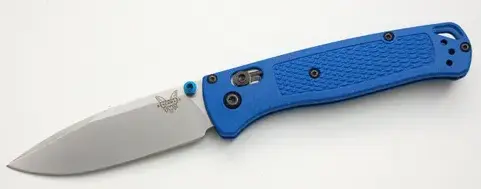
Ask someone why they carry a tactical folder and you will get a variety of answers. One of the answers you may get is “utility”.
Utility
Having a cutting edge or two on you is useful. You will get no argument from me.
There are cords to cut, threads to trim and packages to open.
I am seldom far from my Swiss Army Knives and Leatherman Squirt P4.
Most of these jobs, however, do not need a long blade. Many are actually easier and safer with a short blade.
While most tactical folders claim to be “great for EDC”, what you are not being told is that you will still need a penknife or multi‑tool too.
When opening packaging, you do not want to cut‑up the contents. The tools I most often use to open packages are the reamer, scissors or can-opener of a Swiss Army Knife. You can use the scissor blade as a tiny knife, as well as its more conventional application. Often I will use the P51 on my keyring rather than unfolding a penknife tool.
The knife blades of my Swiss Army Knives seldom see use in everyday life.
The tools that see the most use are typically the scissors and screwdrivers. The latter are often used for unconventional applications such as cleaning under fingernails, prising off keyboard keys, and opening stubborn pistachio nuts.
You can do some of these tasks with a tactical folder, but the bigger knives are often a clumsy compromise and that is seldom a good idea when sharp edges are involved.
The point I am making is that even if you have a state of the art tactical folder, it is prudent to also carry a Swiss Army Knife or other multi‑tool for its scissors, screwdrivers and other useful and more often used implements.
What we term as a multi‑tool is in actuality a small tool kit. A small tool kit more than capable of handling most everyday cutting tasks.
It is prudent to invest in a Swiss Army Knife for your EDC before you take out a mortgage for a tactical folder.
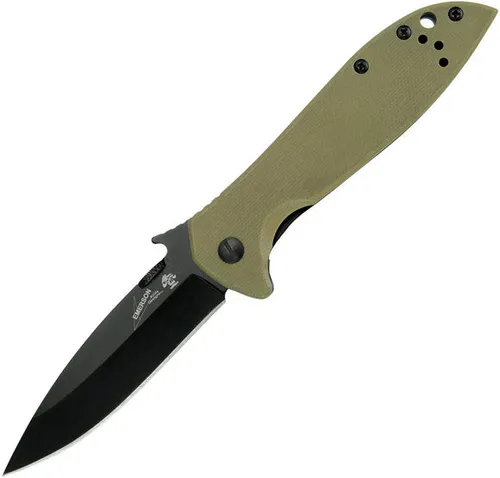
Preppers are subject to enough prejudice and get a very bad press as it is. In social situations, you are better reaching for a penknife than brandishing a “fighting knife”.
What about out in the wilds? A bigger blade will be useful here, will it not?
It will. While you can baton a Swiss Army Knife through a log, a larger tactical folder blade is likely to be more robust.
As an aside, there are alternatives. You can cut a notch in a log end with a Swiss Army Knife saw‑blade and carve a hardwood wedge to drive into it, for example.
But if you are knowingly entering such an environment or situation where a knife might see heavy use, you should be packing at least one fixed blade knife.
Something like a Mora Companion is far better suited to messy tasks or hard use than any tactical folder, and probably will cost a fraction of the price.
A larger fixed blade such as a kukri, billhook or hatchet can easily master tasks a tactical folder cannot.
Have no illusions that a tactical folder is a compromise. It is more convenient to carry in civilised areas, but not as capable or inherently durable as a fixed blade.
A knife, multi‑tool and flashlight are the “trinity of EDC” according to at least one website (that sells knives and multi‑tools!)
Flashlights are useful, but I rate them as several tiers lower in priority than a space blanket, lighter and some cordage.
There is little point in having multi‑tool(s) and a knife unless the knife is bringing something to the table that the multi‑tools do not.
One-Hand Opening
Most tactical folders have some means by which they may be opened with just one hand. This can be very useful in many situations.
If your arm is injured, you may have to open your knife with your non-dominant side hand. Ambidextrous opening is desirable.
One-handed opening is of an obvious value if you have certain disabilities, or if your other hand is occupied.
Good designs allow easy one-handed release of the blade too. Safely putting a knife away may be a more important, sometimes.
Some single-bladed folding knives can be opened by grasping the back of the blade and giving the handle a good flick. This requires a change of grip to use, so may not be ideal halfway up a cliff-face.
There are some multi-tools that offer one-hand opening of a blade. These tend to be large models that you cannot comfortably carry in trouser pocket.
When I was moving into my current place, I often found myself with a box in one hand, and needing a means to open that box or cut tape to seal it within reach of the other hand.
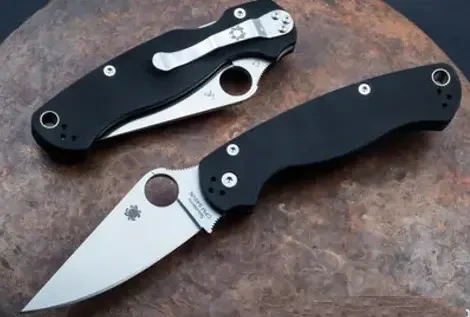
I spent most of that day using my Spyderco Police, grateful that I could open or close it with one hand, and stow it using its pocket clip.
There were alternative solutions, however. If I did it again, I might use my Stanley knife or a box-cutter instead.
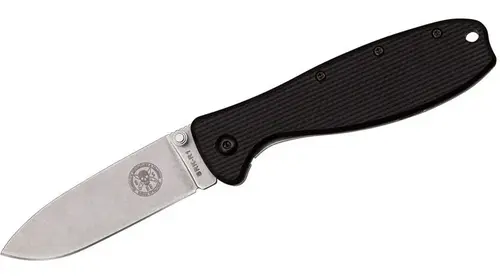
One-handed opening may also be of value in an emergency.
One emergency use for a tactical folder that I have seen proposed is to cut a seat-belt when trapped in a vehicle.
This sounds reasonable in theory, but may prove different in practice.
Many people carry their tactical folder in a front trouser pocket or a belt pouch. It may be prudent to experiment with just how easily you can reach your knife when strapped into a car seat.
Imagine one arm is injured and you have to reach for your knife with the other.
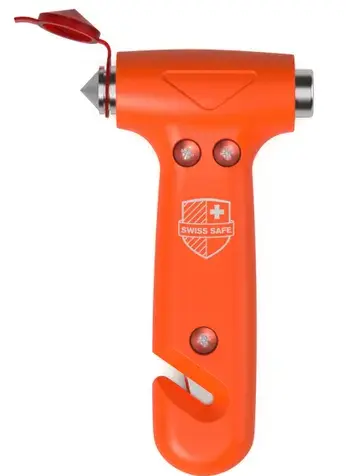
For your own vehicle(s), ensure you have some purpose‑designed strap cutters within reach. Many such devices are very reasonably priced. Some designs include devices to break glass and facilitate rapid exit when your vehicle is on fire or sinking into the lake.
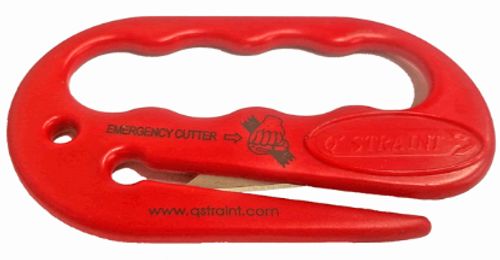
If you are a law-enforcement officer or first responder that has a higher likelihood of encountering people trapped in vehicles, a strap-cutter or purpose-designed fixed blade rescue knife is a superior option to a tactical folder.
Such cutters are also useful for rapidly cutting clothing away from wounds.
Defence
“Tactical Folder” implies that a major purpose of such a knife is defensive.
Despite my considerable interest in bladed weapons, my personal feeling is that knives are not the ideal defensive weapon. Knives are generally good for offensive and poor in defence,
Knives cannot parry like a sword or stick. A knife is, at best, a counter-offensive weapon. This means that to defend yourself with a knife you must use it aggressively.
If used, a knife can do a lot of serious damage which may not be considered warranted by the situation, placing you in a difficult legal position.
Tactics of Mistake
I have often covered this topic, but it is worth repeating.
Do not try to attack when it is time to defend.
Many a morgue table has been occupied by someone who tried to shoot, punch or stab when they should have been dodging or defending.
Many were cops who had shot and even fatally wounded a charging attacker, only to be knocked down and killed themselves, often with their own weapon.
This is as likely for a civilian with a tactical folder as it is for a cop with a gun.
Drawing and opening a knife takes a finite amount of time. You may be fast, smooth and slick in the dojo or in front of your bedroom mirror.
Against a real threat, drawing when you should be dodging will get you killed.
You cannot beat a foe to the punch when their punch is already on its way.
This is why you must have a realistic grounding in empty‑hand techniques, not matter what weapon you carry.
A tactical folder (or other weapon) is only useful if utilised alongside situational awareness, empty‑hand techniques and escape‑orientated tactics.
Overt and Covert Attacks
Most violent criminal attacks can be divided into covert and overt attacks.
The covert attacker may not make their aggression known until the actual attack. They might “come out of nowhere” and in the event of a knife attack, you may be feeling the blade before you see it.
Some covert attacks might be preceded by an “assessment phase” that may include questions to establish if you are a suitable victim. This may take place at a different location and some time before the attack.
Your main defence against covert attack is your awareness.
If an attack does come, you will not have time to draw any form of weapon and must rely on your empty‑hand close combat skills for the vital first few seconds.
Reread that sentence about awareness. There are many people who have spent three figures for a tactical folder but never look up from their phones when walking.
Overt attacks are often ego inspired and may be proceeded by aggressive behaviour and posturing, some of which may serve to work the aggressor up into an attack. Often the aggressor will be part of a group, and you will be outnumbered.
Your best defence is to diffuse the situation or remove yourself.
If violence is inevitable, your best option may be to pre‑empt his attack.
This may make you the aggressor in the eyes of certain courts, but this may be preferable to the alternative.
Do not waste your time drawing a weapon. You need to achieve surprise and gain the initiative if possible.
Launch a fast and telling opening attack, then follow through and keep raining the blows until he goes down or there is an opening to escape. (And it probably will be a “he”, so stow the woke posturing!)
You won't have time to draw a knife until he is down, and if he was on his own you don't need the knife once he is down. It may be prudent to stomp his leg to hinder him pursuing you. It is time for you to leave.
If he was with a group, do not try to stay and fight if you have a choice. This is not a Hollywood action movie.
If an ego based attacker has a weapon, he may choose to brandish it a little to intimidate you.
Use the extra time and distance to grab something such as an ashtray, beer glass or pool ball and throw it at him. Dig your toe into the dirt and kick grit at his face.
These distractions may buy time to draw your knife and close in. Seize the initiative.
You may be better forgetting trying to draw your knife and going straight to knocking the foe off balance, as suggested below. If there is a better weapon such as a pool cue or bar-stool, forget trying to draw the knife and use that instead.
Your best option is always to escape, even if yourself armed.
Rather than turn your back, it is often better to run at and past the attacker if possible, passing him on his non-knife side if he is so armed.
Give him a shove to knock him off balance and you will probably be some distance away before he can turn and pursue.
Head for help or any populated area and yell your head off to attract attention.
If you cannot escape, use anything you can throw or a chair etc and close distance.
If cut, flick blood towards his eyes.
Try to stay at his sides or behind. Low kick to his legs and hit him with everything you have got, anywhere you can land a blow, and keep hitting.
Once again, escape if you can.
Strategy for Folders
There may be situations when you suspect an attack is possible and you do have time to ready a weapon.
You may think you are being followed, for example, Hollywood’s now classic “footsteps in the parking garage” scenes.
You may be wary of a group hanging around in the street ahead or at the bar.
The knife can be very useful here since it can easily be held in the hand ready but out of sight and it has considerable intimidation value if produced at the right moment.
A tactical folder is most useful if you can ready it before the fighting starts, hence it is more strategic than tactical.
Combat Application and Blade Shape
If you are in a situation where you have a knife in hand and have to use it to protect yourself, what is the best way to do so?
This is a topic I will only deal with briefly here.
Please consult my books for much more information and options.
Your primary objective is to create an opportunity to escape.
A lot of combat manuals show a knife being used to slash. Some tactical folders have been allegedly designed with slashing as their primary mode.
The Filipino martial arts have been influential on modern knife fighting theory and tactical folder design.
In many regions, however, heavier and multiple layers of clothing make slashing attacks with light knives impractical unless directed against bare flesh.
If attacking a clothed area, you should favour the point.
The attacker’s hands or their contents are the main threat.
Be aware of his hands but don’t fixate on them or you will leave yourself open to other attacks.
Intercept the foe's hands and forearms with your knife edge or point. Manoeuvre to their outside gate and stab anything within reach. Push them over or knock them down if you can.
If grabbed, immediately attack their arm with your blade.
Attacking or threatening the face will make an assailant back off, but to achieve this may bring you within range of their arms.
Tip Press and Snap Cut
A folding blade is most likely to fail when used to stab or thrust.
Tactical folders have a means to keep the blade locked open, but like any mechanism with multiple parts there is a greater potential for failure than with a unitary construction.
In some areas, knives with locking blades have become illegal to carry or are highly restricted.
When using a folding blade, a stabbing or thrusting action should be modified to reduce the chance of a blade closing.
With a folding blade, rather than stabbing, apply a push cut with the point and the region of the edge just behind the point so that the pressure helps keep the blade open.
This may be made with a thrusting action, and is a version of the “snap cut” mentioned in my first book. The tip of the blade makes a flick or dipping action on contact.
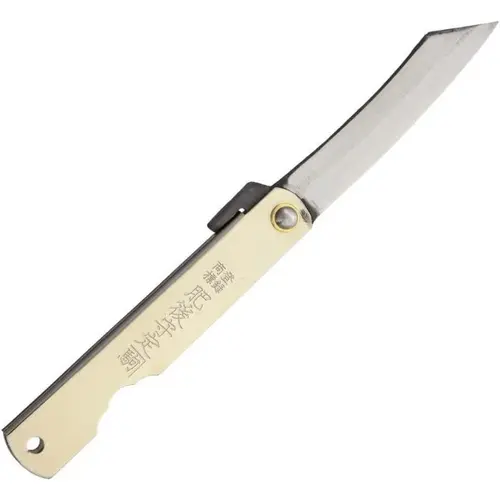
I suspect that this method of using a blade favours some tip shapes over others.
Reverse tanto and Wharncliffe point configurations (above) re probably well suited to applying a tip press.
I have yet to find time to conduct any experiments on making tip presses with different point configurations.
Design Features
As I noted earlier, a tactical folder is a compromise. It cannot be so large, bulky or heavy that you cannot carry it where you may easily get at it when wanted.
A long blade may be attractive for combat applications, but may make the knife less useful for the many everyday tasks it may usually be put to.
One-handed opening is desirable, but forget any fantasies that you are going to outdraw an attacker.
The tactical folder's defensive applications are mainly counter-offensive and require there was time and opportunity to draw and ready the knife. If possible, use this time to escape, evade or find safety.
Do not let having a knife distract you from other and possibly better options for armament. A friend of mine used to maintain the main defensive use for a knife was to sharpen a point on a broomstick, If you pardon the pun, he had a point.
From a combat perspective, a serrated or part-serrated edge is more likely to tear through cloth or “bite” during a slashing attack. Serrations are useful for cutting some other materials, such as rope.
Those who think of their tactical folder as an emergency survival knife may find a plain edge more suited to tasks such as batoning.
Pocket clips are a common feature on tactical folders. Consider if you can remove or reposition them if you wish to.
Legal Considerations
Check if there are any particular legal restrictions that apply in the region that you are in or will be travelling through.
Balisong knives are illegal in some American states, legal in others.
In some parts of the world you cannot carry a concealed knife with a blade of greater than a certain length.
Blades with locking mechanisms may be restricted.
In some states or countries automatic knives or switchblades are perfectly legal, while in others they are not. In some areas, automatic knives are legal if you are a member of the police or emergency services. Knives with “assisted opening” may or may not be considered switchblades.