Last night I was once again discussing something that is somewhat an oddity in the history of clothing.
For thousands of years soldiers, outdoorsmen and many other prudent humans have used and valued cloaks as useful items of clothing. A cloak traps lots of air to keep you warm and yet is easily vented to keep you dry. A cloak can shed the rain and snow, protect from the wind and is large enough to act as a useful blanket should you need to sleep out. Then, sometime during the 19th or early 20th century cloaks became rarer and I have never encountered as sufficiently convincing explanation as to why this was.
A cloak still has much to recommend it to a survivalist or outdoorsman. Currently in Afghanistan insurgents are shielding themselves from expensive high-tech thermal imagers and infrared systems using woollen blankets.

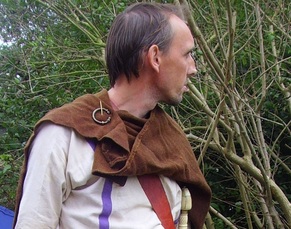

One of the simplest of practical cloaks is what the Roman legionary called a sagum. The sagum was a suitably folded square or rectangular piece of material fastened to itself at the shoulder with a brooch or pin. Easily constructed (if you had a fastener) and a useful blanket too. Many cloaks are just blankets with a bit of tailoring. The Scottish word “plaid” is derived from the term for blanket and the great plaid was big enough to sleep out in. I will discuss the plaid in more depth some other time.


A step up from the sagum was the hooded cloak that the roman soldier called a paenula. This page has a rather nice, simple method for making a semi-circular one. Take a bit of wool, 60 x 120" (1.5 x 3m) and cut out a semicircle using a length of string as a compass. Cut an 8" slit widthwise from the middle of the straight edge and sew the two rectangular hood halves to this. Hem and finish as necessary. If we are considering our cloak as a practical field garment then 60" may be on the long side. Ideally you want the bottom at about calf height. Two quarter circles can be cut from a smaller piece of cloth and sewn together.

The same page shows how to make a circular paenula. Essentially you make a semi-circular paenula then sew a second semicircle to the front edge. The illustration shows a poncho style but one could extend the neck slit down to the edge to make a circular cloak that opens up the front. The circular paenula has more folds of cloth to trap more air. On the other hand it uses about twice as much cloth and may be difficult to roll into a handy bundle.

A compromise is the oval paenula. Take a cloth of about 60"width and of a length twice the length that you want the final thing to be. I am a little above average height and the distance from my shoulder to below the knee is about 50". A piece of cloth between eight and nine feet will probably be about right. Interestingly making an oval cloak and a semi-circular needs about the same amount of working material. There will be less wastage with the oval cloak and it will of course be a little heavier. You may need an extra piece of material to make the hood.
Lining the hood part of the cloak can be a good idea. Loops and toggles or other fastenings were often fitted to keep the cloak closed without the need for a brooch. If your cloak is going to be “modern” then a few press-stud poppers might be worth considering.
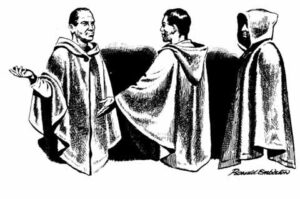
A cloak of a dull, neutral shade with a few bits of scrim or frayed cloth added for camouflage might be a very handy thing for a hunter that needs to spend some time stationary, waiting for his shot.
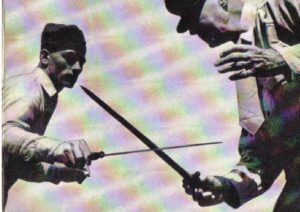





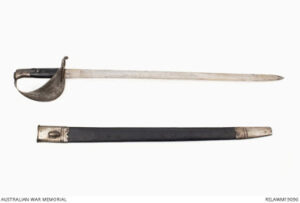

 derived from a civilian tool favoured by outdoorsmen. Hangers, “short hunting swords” or “couteau de chasse” were useful for chopping firewood, clearing brush and butchering game. They were carried by noble and commoner alike. There are exciting accounts of them being used to hunt game and they were a useful defence against both beast and man. Decorated versions might be worn out court to display one’s affection for hunting. They might also be worn in town as a handy defence against robbers, in many cases being more effective and convenient than rapiers or small swords. Understandably the common foot soldier found the hanger to be a useful implement. In addition to the sword bayonet the hanger is probably the ancestor of both the naval cutlass and the machete, and is why you occasionally come across machetes referred to as cutlasses. Sword bayonets were created to produce a bayonet that also served as an infantryman’s hanger. The yataghan configuration blade provided better clearance for the hand when reloading a muzzle-loading weapon. The blade shape is not without other merits so a number of breech loaders also used sabre bayonets.


 you can see them wearing a tube-like item that resembles a thin blanket roll. This would be made of silk, cotton or even from a bicycle inner tube and carried the fighter’s rice ration.